
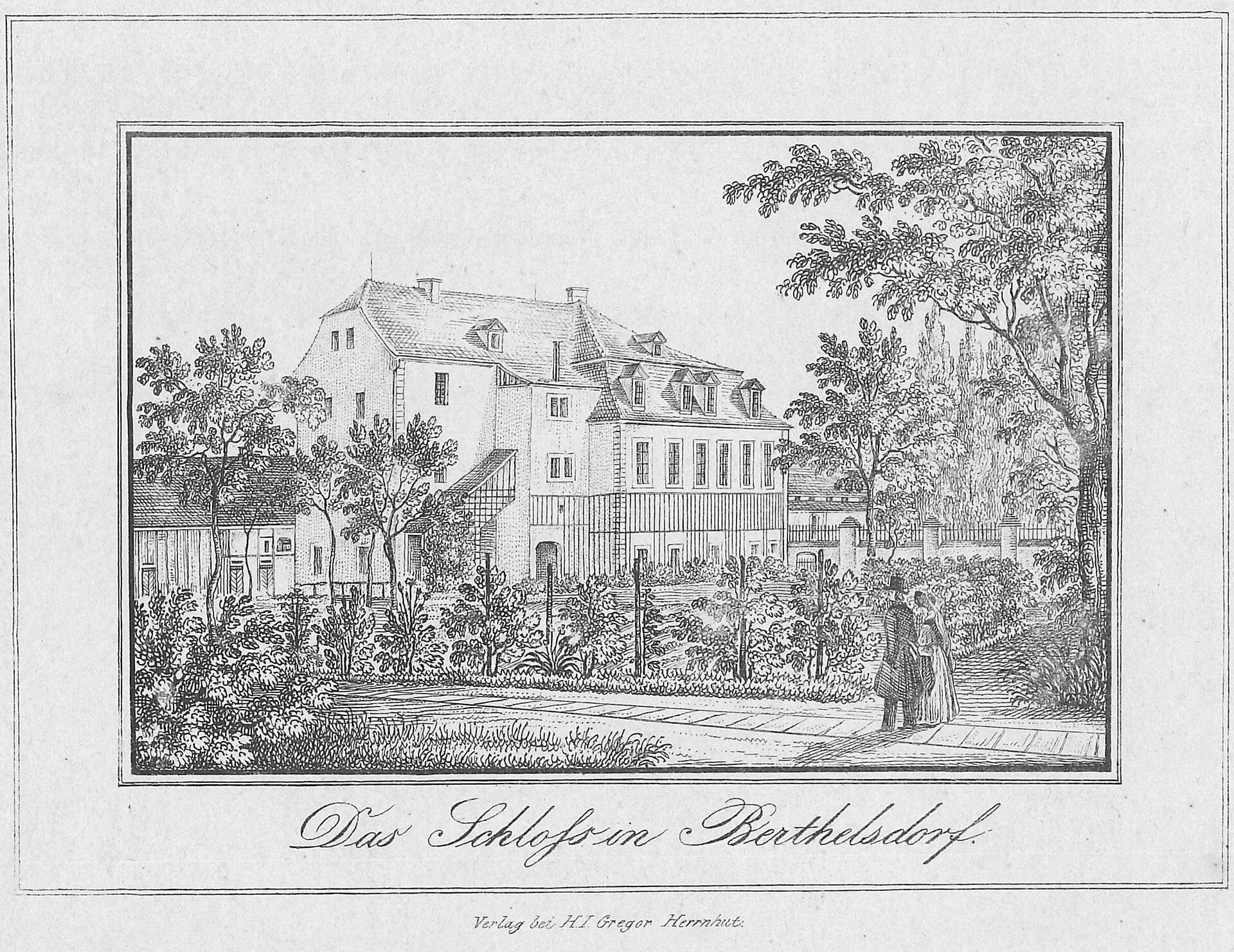
Verlag H. I. Gregor, Das Schloss in Berthelsdorf, about 1850. Public domain.
1415 to 1738 · Subject · Featured Study
From Hus to Herrnhut
The Unity of the Brethren that came from Hus, the Hidden Seed Comenius prayed for, and the refugees who built Herrnhut from 1722.
- Books
- Ephesians, Lamentations, Psalms, Revelation
- Hold in memory
- Lamentations 5:21, Psalm 84:3
In 1732 the church at Herrnhut told the government of Upper Lusatia that anyone who had read the history of John Huss knew the religion of its ancestors.
Restore us to Yourself, O LORD, so we may return; renew our days as of old,
Summary
Refugees from Moravia settled on Count Zinzendorf's land in Saxony. They said they came from the Unity of the Brethren, the church of Jan Hus's followers. Its last bishop, Comenius, went into exile. A remnant kept the faith in secret at home, and his family kept the line of bishops.
- Hus was burned at the Council of Constance.
- His followers formed their first society in the valley of Kunwald.
- The line runs on from the Moravians to the Wesleys and, later, to Bonhoeffer.
- John Wesley printed Herrnhut's claim to Hus in his Journal after his visit.
The Verses Along the Line
Four men of the story each stood on a verse at a turn in it.
The four verses below are given in the order the story reaches them, from Constance to the first house at Herrnhut.
The Brethren before the exile
And God put everything under His feet and made Him head over everything for the church,
Hus argued from this verse that Christ alone is head of the universal church.
The refugees in Saxony
Even the sparrow has found a home, and the swallow a nest for herself, where she places her young near Your altars, O LORD of Hosts, my King and my God.
The carpenter who led the first refugees spoke these words as he struck his axe into the first tree at Herrnhut.
Psalm 84:3BSB
And I heard a loud voice from the throne saying: “Behold, the dwelling place of God is with man, and He will dwell with them. They will be His people, and God Himself will be with them as their God.
Zinzendorf used this picture for Herrnhut in the summer of its renewal.
Psalm 84:3, Revelation 21:3
From Constance to Herrnhut
Seven dated links run from Hus's death to Wesley's visit.
The line from the burning of Hus to Wesley's visit to Herrnhut runs 323 years in seven dated links.
- Hus is burned at Constance6 July 1415Hutton, Book One, chapter II
- The Brethren settle at Kunwald1457 or 1458Hutton, Book One, chapter V
- The exile from Bohemia1628Hutton, Book One, chapter XVI
- The first refugees reach Berthelsdorf8 June 1722Hutton, Book Two, chapter II
- Zinzendorf reads Comenius at ZittauJuly 1727Hutton, Book Two, chapter III
- Jablonsky consecrates David Nitschmann13 March 1735Hutton, Book Two, chapter V
- John Wesley reaches Herrnhut1 August 1738Wesley, Journal, page 82
A timeline of seven links, each row naming the record that fixes its date.
The line runs on from Herrnhut into the twentieth century, through Bonhoeffer's family and his reading of the daily texts.
Two Readings of the Line
Herrnhut claimed the old church as its mother, and its own historian weighed how much of it came through.
Herrnhut's own letter and Hutton's history answer three questions differently.
| The question | Herrnhut's letter | Hutton's history |
|---|---|---|
| Who were the settlers' ancestors? | The church of Hus, known to any reader of his history | Some were sons of the Brethren, and not all can be shown to be |
| Where did their rules come from? | They kept their ancient discipline | They framed their rules before they had heard of the old discipline |
| Did the old bishops' orders pass to them? | Through Jablonsky, Comenius's grandson | Through Comenius, Peter Jablonsky and Daniel Ernest Jablonsky |
The Refugees at Herrnhut
A carpenter led the first families out of Moravia, and Zinzendorf read Comenius five years after they came.
Christian David, a carpenter born in Moravia, met the first band of emigrants at Jacob Neisser's house in Sehlen at ten o'clock one night in May. They crossed the mountains by unknown paths and reached Berthelsdorf on 8 June.
Sixteen years later he told Wesley what the Count had said to him before they came. Zinzendorf's words, as Wesley wrote them down, were “I will give them land to build on, and Christ will give them the rest.”
Zinzendorf's steward led them to a swampy slope on the high road from Löbau to Zittau, called the Hutberg. On 17 June the carpenter felled the first tree there.
Five young men from Zauchtenthal came after them, among them David Nitschmann, later the first bishop of the Renewed Church. Hutton calls them genuine sons of the Brethren who used the catechism of Comenius and sang the Brethren's hymns.
In the summer of the renewal Zinzendorf found Comenius's Latin account of the Brethren's discipline in the library at Zittau. Hutton reports that it was the first true account of the old church he had read.
In 1735 Daniel Ernest Jablonsky, court preacher at Berlin, consecrated Nitschmann a bishop.
When Wesley reached Herrnhut, he found about a hundred houses on rising ground. On 10 August he spent some hours with Christian David and wrote down his account.
In Their Own Words
Jan Hus (1372 to 1415)
The Church, chapter 4
Hus held that Christ alone is head of the church.
“Christ alone is the head of the universal church, which church is not a part of anything else.”
Pre-Reformation reformer
About this saying1 paragraph
Early in the fifteenth century, Hus set out his teaching on the head of the church in his treatise The Church.
Jan Amos Comenius (1592 to 1670)
His commendation of the Brethren to the Church of England, as J. E. Hutton gives it in A History of the Moravian Church, Book One, chapter XVI
Comenius committed the dying church to the English.
“Even in her death, which seems approaching, you ought to love her, because in her life she has gone before you for more than two centuries with examples of faith and patience.”
Unity of the Brethren
About this saying1 paragraph
In exile in the seventeenth century, Comenius commended the Brethren to the Church of England, believing his own church was near its end.
Nicolaus Ludwig von Zinzendorf (1700 to 1760)
A discourse of 12 May 1748, in The Memorial-Days of the Renewed Church of the Brethren, page 90
Zinzendorf remembered Herrnhut's summer of renewal.
“The whole place represented truly, a visible tabernacle of God among men, and till the 13th of August, there was nothing to be seen and heard but joy and gladness: then, this uncommon joy subsided, and a calmer sabbatic period succeeded.”
Moravian
About this saying1 paragraph
Twenty-one years later, Zinzendorf told the congregation what Herrnhut had been in the weeks before 13 August 1727.
Where the Claim Is Weighed
The Renewed Church's own documents and its own historian differ on how much of the old church came to Herrnhut.
Hutton writes of the first band that “we cannot be sure that they were all descendants of the old Church of the Brethren.”
He also holds that the settlers framed their own rules. In his view the movement at Herrnhut was Zinzendorf's attempt to apply the ideals of Spener.
The same letter dates the withdrawal of Hus's followers to 1453, some four years before Hutton's date for Kunwald.
Hutton still names Comenius the strongest link, because he handed on the bishops' orders, the discipline and the faith of those who stayed behind.
Books to Read Next
A History of the Moravian Church
J. E. Hutton · 1909
Hutton tells the story from Hus to his own day as a Moravian minister and weighs his church's claims.
Free at Project GutenbergThe Works of the Rev. John Wesley, volume III, his Journal
John Wesley · 1831
Wesley prints Herrnhut's letter and the carpenter's account, which he wrote down during his visit.
Free scan of volume IIIWhat the Line Carried
The old Brethren left a remnant, a catechism and a line of bishops, and the settlers at Herrnhut took up all three. Within fourteen years of the first tree, their church had met John Wesley.
Sources
Scripture is the Berean Standard Bible.
- The Holy Bible, Berean Standard Bible (read 2026)
- J. E. Hutton, A History of the Moravian Church, second edition, revised and enlarged (London: Moravian Publication Office, 1909), Book One, chapters II, V and XVI, and Book Two, chapters II to V.
- John Wesley, Journal, in The Works of the Rev. John Wesley (New York: J. Emory and B. Waugh, 1831), volume III, pages 82, 86, 87 and 89.
- Jan Hus, The Church, translated by David S. Schaff (1915), chapter 4.
- Jan Amos Comenius, his commendation of the Brethren to the Church of England, as Hutton (1909) gives it in Book One, chapter XVI.
- Nicolaus Ludwig von Zinzendorf, a discourse of 12 May 1748, in The Memorial-Days of the Renewed Church of the Brethren, page 90.
Keep Studying
Studies1
People and groups3
Doctrines1
Go further1