
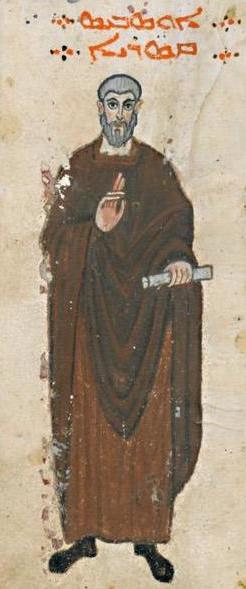
Eusebius, Rabbula Gospels, 6th century. Public domain.
303 to 311 · Subject · Featured Study
Eusebius and the Martyrs of Palestine
Eusebius of Caesarea saw the Great Persecution in Palestine and wrote down its martyrs year by year, by name, day and place.
Of most of the martyrs of Palestine, the translator of 1890 writes, we know only what Eusebius tells us.
Finally, brothers, whatever is true, whatever is honorable, whatever is right, whatever is pure, whatever is lovely, whatever is admirable—if anything is excellent or praiseworthy—think on these things.
Finally, brothers, whatever is true, whatever is honorable, whatever is right, whatever is pure, whatever is lovely, whatever is admirable—if anything is excellent or praiseworthy—think on these things.
- Books
- Philippians, 2 Corinthians, Lamentations
- Hold in memory
- Philippians 4:8
Summary
Eusebius lived through the edicts against the churches in Palestine, which his translator dates from 303. He wrote down who died there, when and how, in a short book called The Martyrs of Palestine. He gives each death its day in two calendars and names the governor, the city and the last words where he knew them.
- He names Procopius as the first martyr of Palestine, beheaded at Caesarea.
- His friend Pamphilus died with eleven others on one day.
- He counts the persecution in Palestine as eight complete years.
- He says himself that he left out those who gave way.
The Verses Eusebius Read the Persecution By
Eusebius set Lamentations over its cause, 2 Corinthians over a blind confessor, and Philippians over what he chose to record.
Eusebius quotes few verses in these chapters, and each one carries a judgment of his own. Each one serves his account of events, and the label over each card names the book and chapter of his that holds it. Read in this order, they show his cause, a witness he heard and his rule for the record.
His reading of the cause, book VIII, chapter 1
How the Lord has covered the Daughter of Zion with the cloud of His anger! He has cast the glory of Israel from heaven to earth. He has abandoned His footstool in the day of His anger.
Eusebius applies these words to a church grown lax and quarrelsome before the edicts came.
A confessor he heard, The Martyrs of Palestine 13
It is clear that you are a letter from Christ, the result of our ministry, written not with ink but with the Spirit of the living God, not on tablets of stone but on tablets of human hearts.
Eusebius says the blind confessor John had whole books of Scripture written on the tablets of his heart.
2 Corinthians 3:3
Eight Years in Palestine
Eusebius dates each death by the Macedonian month, the Roman day and the year of the persecution.
The record runs from the first edict to the thirty-nine beheaded in one day in the eighth year.
- The first edict reaches PalestineThe nineteenth year of Diocletian, the month XanthicusPreface
- Procopius is beheaded at CaesareaThe seventh of Desius, the seventh before the ides of June1
- Alphaeus and Zacchaeus are beheadedThe seventeenth of Dius, the fifteenth before the Kalends of December1
- Apphianus dies at Caesarea after the order that all must sacrificeThe third year, the second of Xanthicus4
- Ninety-seven confessors from the Porphyry quarry are maimedThe sixth year8
- Pamphilus and eleven others die on one dayThe nineteenth of Peritius, the fourteenth before the Kalends of March11
- Thirty-nine are beheaded on one day by order of MaximinusThe eighth year13
A timeline of the deaths Eusebius dates, each row with his own date and the chapter of The Martyrs of Palestine that gives it.
The story of the edicts across the empire, and of the witnesses outside Palestine, stands on its own page.
The Record and the Verdict
Eusebius keeps names, days and places, and he tells the reader what he chose to leave out.
What Eusebius records as a witness and what he adds as a judge.
| The kind of statement | An example in his words or close to them | Where |
|---|---|---|
| A date and a place | Procopius died at Caesarea on the seventh of Desius | The Martyrs of Palestine 1 |
| A confession | Alphaeus and Zacchaeus confessed one God and Christ Jesus as king | The Martyrs of Palestine 1 |
| A cause he assigns | The church had fallen into laxity and strife, and judgment followed | Book VIII, chapter 1 |
| A silence he declares | He will not mention those who were shaken by the persecution | Book VIII, chapter 2 |
In The Martyrs of Palestine he passes over bishops set to keep camels, disorderly ordinations and schisms among the confessors. He says he judges it better to record what is sober and praiseworthy.
McGiffert, the translator of 1890, thought the shorter form of the book was attached to his longer History by a copyist and not by Eusebius.
What Eusebius Saw for Himself
Eusebius writes as one who was present, and he names the times he was.
In book VIII of his Church History, Eusebius writes that he saw the houses of prayer thrown down and the Scriptures burned in the market places.
In the Thebaid of Egypt he writes that he was on the spot himself and saw many die in one day, some beheaded and some burned.
Among the confessors in the last year was a blind man named John. Eusebius writes that when he first heard John repeat Scripture to a congregation, he thought John was reading until he came near.
Pamphilus, a presbyter of Caesarea, was his friend. Eusebius calls him a man thrice dear to him and the leader of the twelve who died with him.
Among the twelve was Vales, a deacon from Aelia, who knew the Scriptures so well that he needed no book to repeat a passage.
In Their Own Words
Eusebius of Caesarea (died 339)
Church History, book VIII, chapter 2, section 3, page 324
Eusebius said what he would put in the record.
“Hence we shall not mention those who were shaken by the persecution, nor those who in everything pertaining to salvation were shipwrecked, and by their own will were sunk in the depths of the flood. But we shall introduce into this history in general only those events which may be usefull first to ourselves and afterwards to posterity.”
Patristic
About this saying1 paragraph
Eusebius wrote this in the 4th century, at the start of book VIII, before he named a single martyr.
Eusebius of Caesarea
The Martyrs of Palestine, chapter 1, section 5, pages 342 to 343
Two martyrs confessed one God and one king.
“having confessed one only God and Christ Jesus as king, as if they had uttered some blasphemy, they were beheaded like the former martyr.”
Patristic
About this saying1 paragraph
Eusebius records the confession of Alphaeus and Zacchaeus, made in the first year of the persecution in the 4th century.
Eusebius of Caesarea
The Martyrs of Palestine, chapter 12, page 354
Eusebius said what he would tell of the martyrs.
“I consider it most proper to tell and to record, and to present to believing hearers in the history of the admirable martyrs.”
Patristic
About this saying1 paragraph
Near the end of The Martyrs of Palestine, written in the 4th century, he set this beside Philippians 4:8.
How Far to Trust the Record
Scholars have read his facts as evidence, and Eusebius states his verdicts as his own.
McGiffert judged the book excellently arranged, taking the persecution year by year in order, though over a limited ground.
McGiffert also read the confession of Alphaeus and Zacchaeus against Eusebius's framing. The Greek word for king was the title of the emperor, so he held that they were beheaded as men judged guilty of treason.
Eusebius himself states his silences, so a reader knows the record honours the faithful and is not a full count of all who were tried.
Books to Read Next
Nicene and Post-Nicene Fathers, second series, volume 1
Eusebius of Caesarea, translated by Arthur Cushman McGiffert · 1890
It holds book VIII of the Church History and The Martyrs of Palestine, with the translator's notes on both.
Free at the Christian Classics Ethereal LibraryWhat the Record Keeps
Eusebius kept the names of the dead of one province, with their days and their last words. He also told his readers plainly whom he had left out.
Sources
Scripture is the Berean Standard Bible.
- The Holy Bible, Berean Standard Bible (read 2026)
- Eusebius, Church History, book VIII, in Nicene and Post-Nicene Fathers, second series, vol. 1, ed. Philip Schaff and Henry Wace, trans. Arthur Cushman McGiffert (New York: Christian Literature Company, 1890), pages 323 to 340.
- Eusebius, The Martyrs of Palestine, the shorter recension, in Nicene and Post-Nicene Fathers, second series, vol. 1, ed. Philip Schaff and Henry Wace, trans. Arthur Cushman McGiffert (New York: Christian Literature Company, 1890), pages 342 to 356.
- Arthur Cushman McGiffert, introductory note to The Martyrs of Palestine, in Nicene and Post-Nicene Fathers, second series, vol. 1, ed. Philip Schaff and Henry Wace, trans. Arthur Cushman McGiffert (New York: Christian Literature Company, 1890), page 342.
Keep Studying
People and groups2
Church history7
Trials of life1