
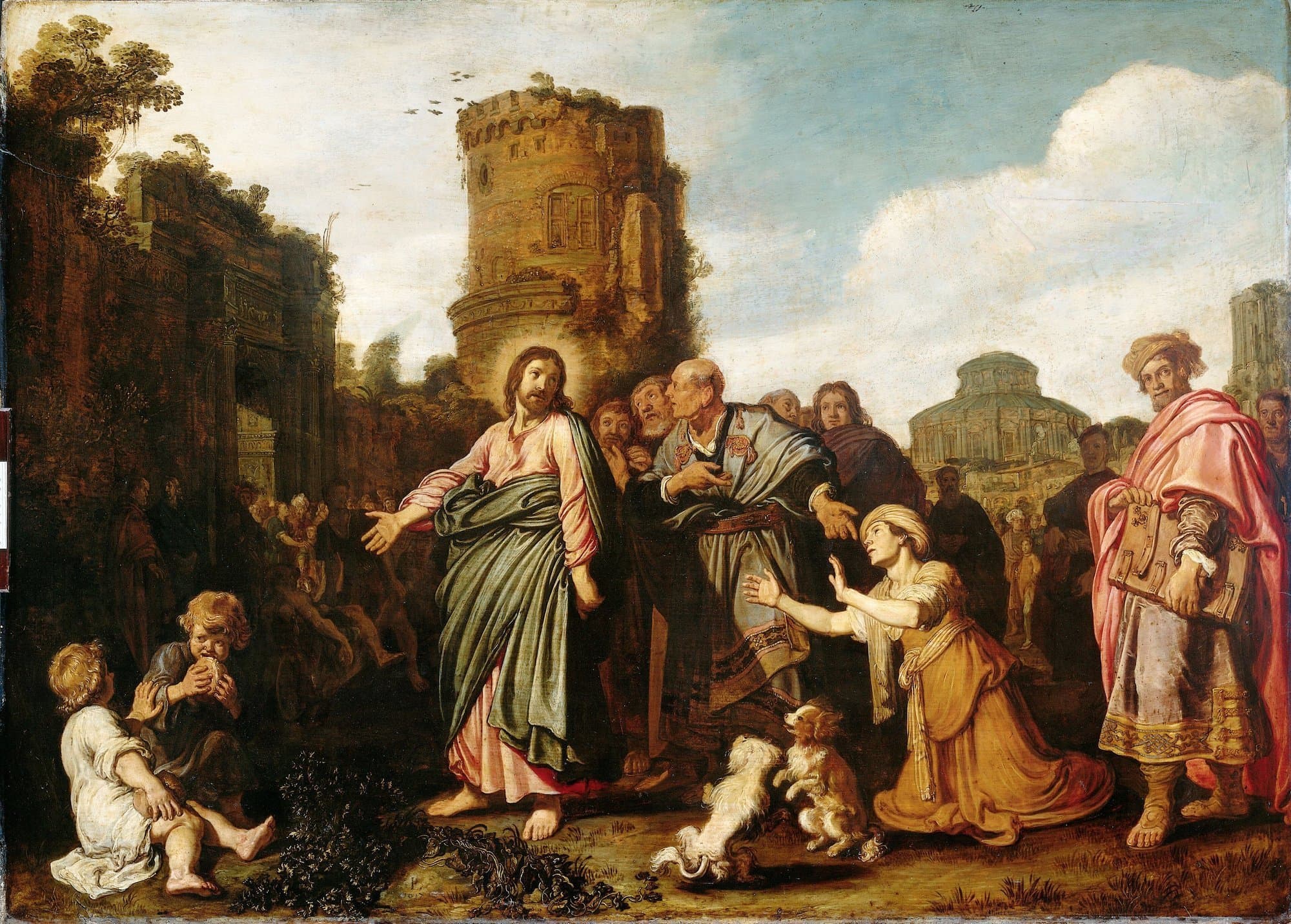
Mark 7:24 to 30 · Story · Parenting and Its Trials
The Mother Who Would Not Go Away
Mark tells of a Greek woman of Syrophoenician origin who came to Jesus for her daughter's sake.
The Gospel records her nation and her answer, and never her name.
“Yes, Lord,” she replied, “even the dogs under the table eat the children’s crumbs.”
- Where
- Tyre
- When
- The ministry of Jesus, in the region of Tyre (Mark 7:24)
Summary
A mother whose little daughter had an unclean spirit fell at Jesus' feet and would not stop asking for her. Jesus first answered with a saying about the children's meal and the dogs, and she turned His saying into a plea for what falls from the table. Because of that answer He told her the demon had left her daughter, and she went home and found it so.
- Matthew calls the same mother a Canaanite woman (Matthew 15:22).
- The word “First” in Jesus' answer stands in Mark's telling and is absent from Matthew's (Mark 7:27 and Matthew 15:26).
- Readers differ on what the word “first” meant on Jesus' lips.
A House in the Region of Tyre
The scene opens in a house far from Galilee.
The Mother Who Would Not Go Away is a story of the trial of parenting from Mark 7:24 to 30. It asks what a mother did for a daughter she could not help herself, and how Jesus answered a Gentile who pleaded with Him.
The study reads the scene in Mark's own words. It explains the Greek words Mark uses for the daughter, the asking and the dogs, and it weighs two readings of the word “first” with the holders of each and the objection to each.
Jesus left that place and went to the region of Tyre. Not wanting anyone to know He was there, He entered a house, but was unable to escape their notice.The verse sets the scene in Gentile country, so a Gentile mother meets Jesus on her own ground.
Instead, a woman whose little daughter had an unclean spirit soon heard about Jesus, and she came and fell at His feet. Now she was a Greek woman of Syrophoenician origin, and she kept asking Jesus to drive the demon out of her daughter.Mark names the daughter's need in the same breath as the mother's coming, so the reader knows at once that she pleads for her child.
The verb of her asking in Mark 7:26 is erotao in the imperfect tense, “was asking”, the form Greek uses for an action that goes on.
First the Children
Jesus answered the mother with a saying about a household meal.
“First let the children have their fill,” He said. “For it is not right to take the children’s bread and toss it to the dogs.”This is the saying the mother answers, and its first word sets the order her reply accepts.
I am not ashamed of the gospel, because it is the power of God for salvation to everyone who believes, first to the Jew, then to the Greek.Paul gives the gospel the same order, the Jew first and then the Greek, the very name Mark gives this mother.
The Little Dogs
The word for dogs in Mark 7:27 to 28 is a small form.
The word in both sayings is kunarion, which the STEP Bible's lexicon, built on G. Abbott-Smith's Manual Greek Lexicon of the New Testament (1922), renders “little dog”.
It stands four times in the New Testament, in Mark 7:27 to 28 and in Matthew's telling of the scene (Matthew 15:26 to 27).
Whether the small form softens the word is weighed with its holders on the study Little Faith and Great Faith, which reads Matthew's telling.
Before and After the Scene
Mark sets the scene between a teaching on food and a road through Sidon.
Nothing that enters a man from the outside can defile him; but the things that come out of a man, these are what defile him.”The teaching on what defiles a man comes just before the scene, so the next house Jesus enters is a Gentile one.
Then Jesus left the region of Tyre and went through Sidon to the Sea of Galilee and into the region of the Decapolis.The road out of the region runs through Sidon, so the whole route keeps to Gentile land until it reaches the Sea of Galilee.
Asking for a Daughter
Everything the mother asked in Mark 7 she asked for her child.
Mark calls the girl thygatrion, “little daughter”, a word that stands twice in the New Testament (Mark 7:25).
Jamieson, Fausset and Brown, in their Commentary Critical and Explanatory (1871), remarked on how quickly she heard of Him: “One wonders how; but distress is quick of hearing”.
What “First” Meant
Two readings weigh why Jesus answered her as He did.
Israel first, with mercy held in reserveMatthew Henry
Matthew Henry's Commentary on the Whole Bible (1710) reads the saying as a promise to the Gentiles.
He wrote that “his saying, Let the children first be filled, intimates that there was mercy in reserve for the Gentiles, and not far off”.
Against this reading, the daughter was set free that same day, so the order did not keep the mercy from this Gentile (Mark 7:29 to 30).
A delay that tried and showed her faithTheophylact of Ohrid, in the Catena Aurea
Theophylact of Ohrid is gathered by Thomas Aquinas in the Catena Aurea on Mark 7.
He wrote, “The reason, therefore, why the Lord does not immediately hear, but delays His grace, is, that He may also show that the faith of the woman was firm”.
Against this reading, Mark never names her faith, and Jesus gives the reason for the healing as “this answer” (Mark 7:29).
She Went Home
The proof of the healing waited for the mother at home.
Then Jesus told her, “Because of this answer, you may go. The demon has left your daughter.”Jesus gives His reason and His word together, and the word speaks of the healing as already done.
And she went home and found her child lying on the bed, and the demon was gone.The mother's finding at home proves the word, with no sign given beforehand.
The mother kept asking until she was answered, and her daughter was healed though Jesus never entered her house.
Sources
Scripture is the Berean Standard Bible.
- STEP Bible, Translators Amalgamated Greek New Testament and its lexicon based on G. Abbott-Smith, A Manual Greek Lexicon of the New Testament (1922), Tyndale House, Cambridge, CC BY 4.0.
- Matthew Henry, Commentary on the Whole Bible (1710), on Mark 7:27.
- Theophylact of Ohrid, in Thomas Aquinas, Catena Aurea, volume 2 (London: J. G. F. and J. Rivington, 1842), on Mark 7:27.
- Robert Jamieson, A. R. Fausset and David Brown, Commentary Critical and Explanatory on the Whole Bible (1871), on Mark 7:25.
Keep Studying
Studies1
In this trial7
People and groups3