
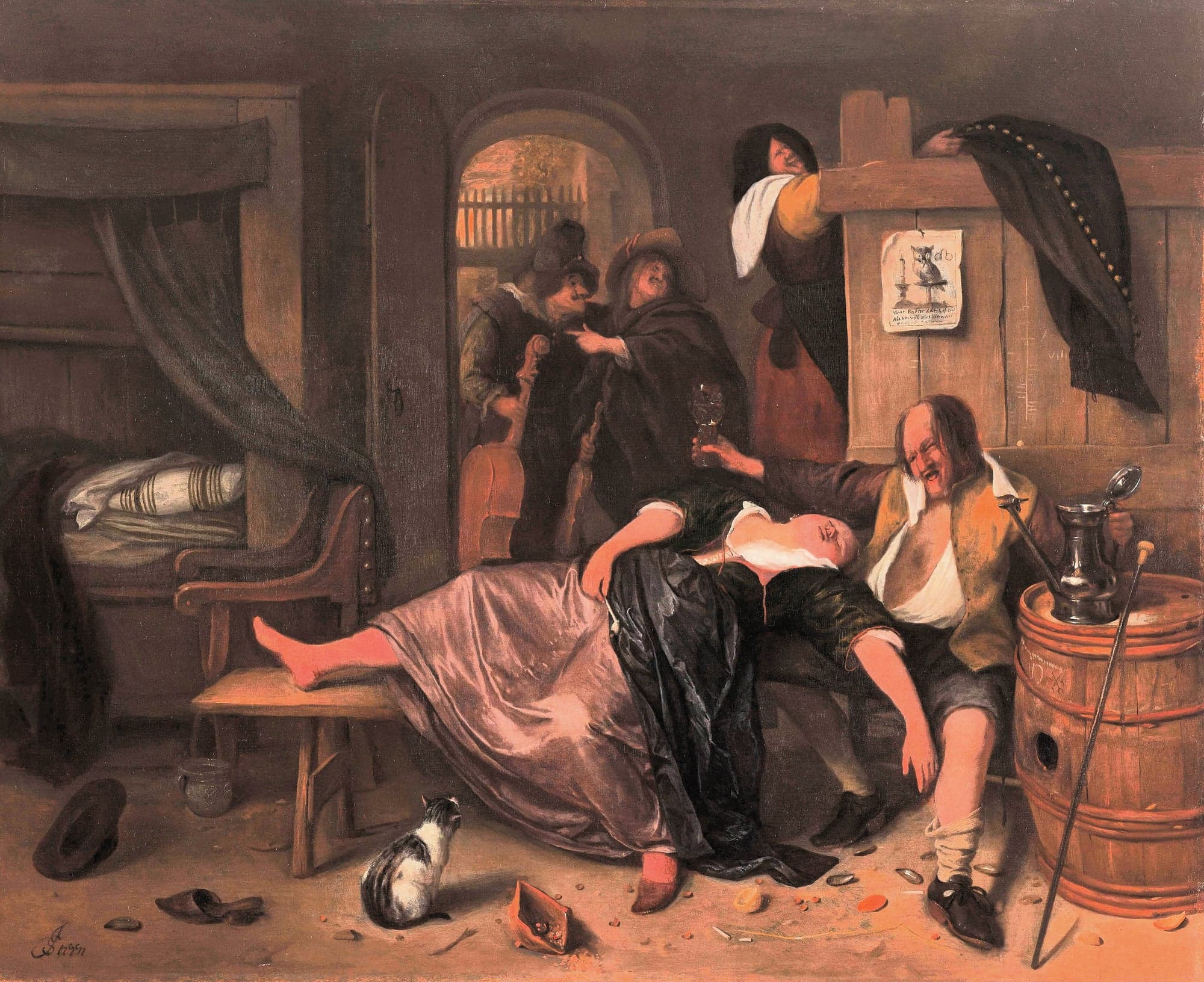
Ephesians 5:18 · Subject · Watchfulness
Wine and Drunkenness in Scripture
Scripture's texts on wine run from Noah's vineyard in Genesis 9 to Paul's command in Ephesians 5:18 to be filled with the Spirit.
Jeremiah was sent to set pitchers full of wine before the Rechabites in a chamber of the house of the LORD and to tell them to drink.
Do not get drunk on wine, which leads to reckless indiscretion. Instead, be filled with the Spirit.
- Book
- Ephesians
- Hold in memory
- 1 Thessalonians 5:8
Summary
Scripture receives wine with thanks as a gift of God and never permits drunkenness. The Law allowed wine at the feasts before the LORD, and Jesus gave the cup at His last supper. The same Scriptures warn that wine mocks the one who is led astray by it and count drunkenness among the sins of those who will not inherit the kingdom of God. In the New Testament drunkenness stands beside sleep, and sobriety beside watching.
- Priests on duty in the Tent of Meeting and Nazirites under their vow drank no wine at all (Leviticus 10:9 and Numbers 6:3).
- An overseer of the church must not be dependent on wine, and Paul still told Timothy to use a little wine for his stomach (1 Timothy 3:3 and 1 Timothy 5:23).
- Christians have held that Scripture asks total abstinence of all, abstinence of those set apart to God, or moderate use with drunkenness forbidden.
What Scripture Says of Wine
The Bible speaks of wine as food, as joy and as danger, and the same books command and warn.
Wine and Drunkenness in Scripture gathers what the Bible says of wine and of being drunk, as part of watchfulness, the value of staying awake and clear-minded for the Lord's return. Paul joins the two subjects in 1 Thessalonians 5, where he calls believers to be awake and sober.
The question this study answers is whether Scripture forbids wine or only its abuse, and why drunkenness stands against watching. Its matter is the texts that receive wine and those that judge drunkenness, the stories of Noah and Lot, and those who drank no wine. It also covers the rule for the church's officers, the Hebrew and Greek words, and three positions Christians have held with their holders.
The Texts in Three Groups
The ten texts come from the Law, the Psalms, Proverbs, Isaiah, the Gospels and Paul's letters.
Four texts receive wine as a gift, three warn of what it does, and three judge drunkenness as sin.
| What the text treats | The Berean words |
|---|---|
| Wine as a gift | |
| The fruits God brings from the earth | "wine that gladdens the heart of man, oil that makes his face to shine, and bread that sustains his heart" |
| The tithe spent on a feast | "Then you may spend the money on anything you desire: cattle, sheep, wine, strong drink, or anything you wish." |
| The wine Jesus made at Cana | "Everyone serves the fine wine first, and then the cheap wine after the guests are drunk. But you have saved the fine wine until now!" |
| The cup of the Supper | "I will not drink of this fruit of the vine from now on until that day when I drink it anew with you in My Father’s kingdom." |
| Wine as a danger | |
| What wine does to the one led astray | "Wine is a mocker, strong drink is a brawler, and whoever is led astray by them is not wise." |
| The end of lingering over wine | "In the end it bites like a snake and stings like a viper." |
| Drinking from morning into evening | "Woe to those who rise early in the morning in pursuit of strong drink, who linger into the evening, to be inflamed by wine." |
| Drunkenness judged | |
| The acts of the flesh | "drunkenness, orgies, and the like. I warn you, as I did before, that those who practice such things will not inherit the kingdom of God." |
| Those who will not inherit the kingdom | "nor thieves, nor the greedy, nor drunkards, nor verbal abusers, nor swindlers, will inherit the kingdom of God." |
| The conduct of the day | "Let us behave decently, as in the daytime, not in carousing and drunkenness, not in sexual immorality and debauchery, not in dissension and jealousy." |
What wine does to the one led astray, The end of lingering over wine, Drinking from morning into evening, Drunkenness judged, The acts of the flesh, Those who will not inherit the kingdom, The conduct of the day
Wine at Cana and at the Supper
Two meals in the Gospels show Jesus giving wine, once at a wedding and once at the table with the Twelve.
When the wine ran out at a wedding in Cana, Jesus turned water into wine, and John counts it the first of His signs (John 2:3 to 11).
At His last meal with the disciples Jesus gave thanks over the cup and gave it to them (Matthew 26:27). He said, "This is My blood of the covenant, which is poured out for many for the forgiveness of sins" (Matthew 26:28).
The Drunkenness of Noah and of Lot
Genesis 9 and Genesis 19 tell how wine overcame two men whom Scripture calls righteous.
Now Noah, a man of the soil, proceeded to plant a vineyard. But when he drank some of its wine, he became drunk and uncovered himself inside his tent.Noah's drunkenness is the first in Scripture, and it led to Ham's sight of his father's nakedness and the curse on Canaan (Genesis 9:22 to 25).
Come, let us get our father drunk with wine so we can sleep with him and preserve his line.” So that night they got their father drunk with wine, and the firstborn went in and slept with her father; he was not aware when she lay down or when she got up.The verse shows wine taking from a man the knowledge of his own acts, the loss that sobriety guards against.
Those Who Drank No Wine
Scripture names four groups who kept from wine and gives a reason for each.
“You and your sons are not to drink wine or strong drink when you enter the Tent of Meeting, or else you will die; this is a permanent statute for the generations to come.The next verses give the reason, that the priests must distinguish between the holy and the common and teach Israel the statutes (Leviticus 10:10 to 11).
The Nazirite was to abstain from wine and strong drink while the vow lasted (Numbers 6:3). Kings were warned that drink would make them forget what is decreed and deprive the oppressed of justice (Proverbs 31:4 to 5).
“We do not drink wine,” they replied, “for our forefather Jonadab son of Rechab commanded us, ‘Neither you nor your descendants are ever to drink wine.God later holds up the Rechabites' obedience to their forefather as a rebuke to the men of Judah, who had not obeyed Him (Jeremiah 35:13 to 16).
For John the Baptist came neither eating bread nor drinking wine, and you say, ‘He has a demon!’ The Son of Man came eating and drinking, and you say, ‘Look at this glutton and drunkard, a friend of tax collectors and sinners!’Jesus contrasts John, who drank no wine, with Himself, whom His critics called a drunkard for eating and drinking with sinners.
The Rule for the Church's Officers
Paul sets a rule on wine for overseers and deacons and gives Timothy a word of his own.
An overseer, then, must be above reproach, the husband of but one wife, temperate, self-controlled, respectable, hospitable, able to teach, not dependent on wine, not violent but gentle, peaceable, and free of the love of money.Paul lists freedom from dependence on wine among the marks of an overseer, beside temperance and self-control.
Deacons likewise must be dignified, not double-tongued or given to much wine or greedy for money.Paul lays a like rule on deacons, the second office he names in the chapter.
Stop drinking only water and use a little wine instead, because of your stomach and your frequent ailments.The verse shows that Paul's rule for overseers did not forbid wine to a minister in need of it.
The Words for Wine and Drunkenness
Two Hebrew words name the drinks, and four Greek words name wine, drunkenness, the man given to wine and the act of getting drunk.
Yayin, wine
141 uses in the canon
The common Hebrew word for wine, glossed as wine that has fermented.
Shekar, strong drink
23 uses in the canon
The Hebrew word for an intoxicating drink, set beside wine in the vow of the Nazirite and in Isaiah's woe.
Oinos, wine
34 uses in the canon
The Greek word for wine, used of the wine that ran out at Cana and of the wine Paul forbids getting drunk on.
Methe, drunkenness
3 uses in the canon
The Greek noun Paul uses in his list of the deeds of the flesh and in his call to behave decently.
Paroinos, given to wine
2 uses in the canon
The Greek word for one given to wine, the mark that rules a man out as an overseer in Titus 1:7.
Methysko, to get drunk
4 uses in the canon
The Greek verb used of the servant who gets drunk while his master delays, and in Paul's command of Ephesians 5:18.
Drunkenness and Sleep Against Watching
The New Testament sets drunkenness beside sleep as two ways of being unready for the day of the Lord.
For those who sleep, sleep at night; and those who get drunk, get drunk at night. But since we belong to the day, let us be sober, putting on the breastplate of faith and love, and the helmet of our hope of salvation.The verses join drunkenness to sleep as marks of the night, so that Paul's call to sobriety is a call to watch.
Jesus warned that hearts can be "weighed down by dissipation, drunkenness, and the worries of life", so that the day springs on them suddenly like a snare (Luke 21:34).
John Chrysostom, in his ninth homily on 1 Thessalonians, wrote that "sobriety is the intensity of watchfulness". He added that "The drunkenness he here speaks of is not that from wine only, but that also which comes of all vices".
John Wesley, on the call of 1 Peter 4:7, wrote that "Temperance helps watchfulness, and both of them help prayer". Jamieson, Fausset and Brown wrote on the same verse that "Drink makes drowsy, and drowsiness prevents prayer".
Ambrose, in On the Sacraments, read Ephesians 5:18 as a contrast of two kinds of fullness. He wrote that "those who are drunk with wine stagger and stumble, but those who are intoxicated in the Spirit are rooted in Christ".
The discipline of the body that keeps a person from excess is taught in the self-control family of studies.
Does Scripture Forbid Wine or Its Abuse?
Each answer has its holders, its work and the texts it must answer.
Total abstinence for every ChristianLyman Beecher, Six Sermons on Intemperance; the American Temperance Society
Lyman Beecher made the case in his Six Sermons on the Nature, Occasions, Signs, Evils, and Remedy of Intemperance. He asked the ministers, "the watchmen upon Zion's walls", whether they were not "called upon to set examples of entire abstinence". He answered the plea of a little wine for the stomach with the words "This is the way in which men become drunkards". He closed by urging every reader to "Resolve upon reformation by entire abstinence, before you close the book".
The Catholic Encyclopedia article Temperance Movements (1912) records that the American Temperance Society "was established at Boston" on 13 February 1826. It adds that "The new society advocated total abstinence", though it did not enforce it. The same article names Beecher among the early prominent advocates of temperance reform.
Against it stand the wine Jesus made at Cana and the cup He gave at the Supper (John 2:9 to 10 and Matthew 26:27 to 29).
Abstinence for those set apart to GodJerome, Against Jovinianus
Wine allowed, drunkenness forbiddenClement of Alexandria; Matthew Henry
Clement of Alexandria, in The Instructor, wrote that "if He made water wine at the marriage, He did not give permission to get drunk". He allowed wine to the old, writing that "Those who are already advanced in life may partake more cheerfully of the draught", and kept it from the young.
Matthew Henry wrote on Cana that "if divine providence gives us abundance of the delights of sense, and divine grace enables us to use them moderately, this is self-denial that is praiseworthy".
Against it stands the warning not to gaze at wine while it is red (Proverbs 23:31).
It is better not to eat meat or drink wine or to do anything to cause your brother to stumble.Paul's rule for the strong binds every one of the three positions, since a brother's conscience can limit a freedom Scripture allows.
Filled With the Spirit
Paul follows his command against drunkenness with what the fullness of the Spirit brings to the church.
After the command of Ephesians 5:18, Paul tells the church to "Speak to one another with psalms, hymns, and spiritual songs". He adds singing to the Lord in the heart and "always giving thanks to God the Father for everything in the name of our Lord Jesus Christ" (Ephesians 5:19 to 20).
These men are not drunk, as you suppose. It is only the third hour of the day!At Pentecost Peter answered the crowd that took the Spirit-filled disciples for drunk men.
Sources
Scripture is the Berean Standard Bible.
- STEP Bible TBESH and TBESG, Tyndale House, CC BY 4.0, the Brief lexicons.
- Clement of Alexandria, The Instructor, book 2, chapter 2, On Drinking, translated by William Wilson, Ante-Nicene Fathers volume 2.
- Lyman Beecher, Six Sermons on the Nature, Occasions, Signs, Evils, and Remedy of Intemperance, tenth edition (New York: American Tract Society, 1833)
- W. Liese, J. Keating and W. Shanley, Temperance Movements, The Catholic Encyclopedia, volume 14 (1912)
- Matthew Henry, Commentary on the Whole Bible (1710), on John 2:9 to 10.
- Jerome, Against Jovinianus, book 2, chapter 15.
- John Chrysostom, Homilies on 1 Thessalonians, Homily 9.
- John Wesley, Explanatory Notes upon the New Testament (1755), on 1 Peter 4:7.
- Jamieson, Fausset and Brown, Commentary Critical and Explanatory on the Whole Bible (1871), on 1 Peter 4:7.
- Ambrose of Milan, On the Sacraments 5.3.17, in an English translation whose translator is not named.
Keep Studying
Read it1
Studies2
People and groups11