

Patriarch
Noah
Preacher of Righteousness · Antediluvian · c. 2900-1950 BC
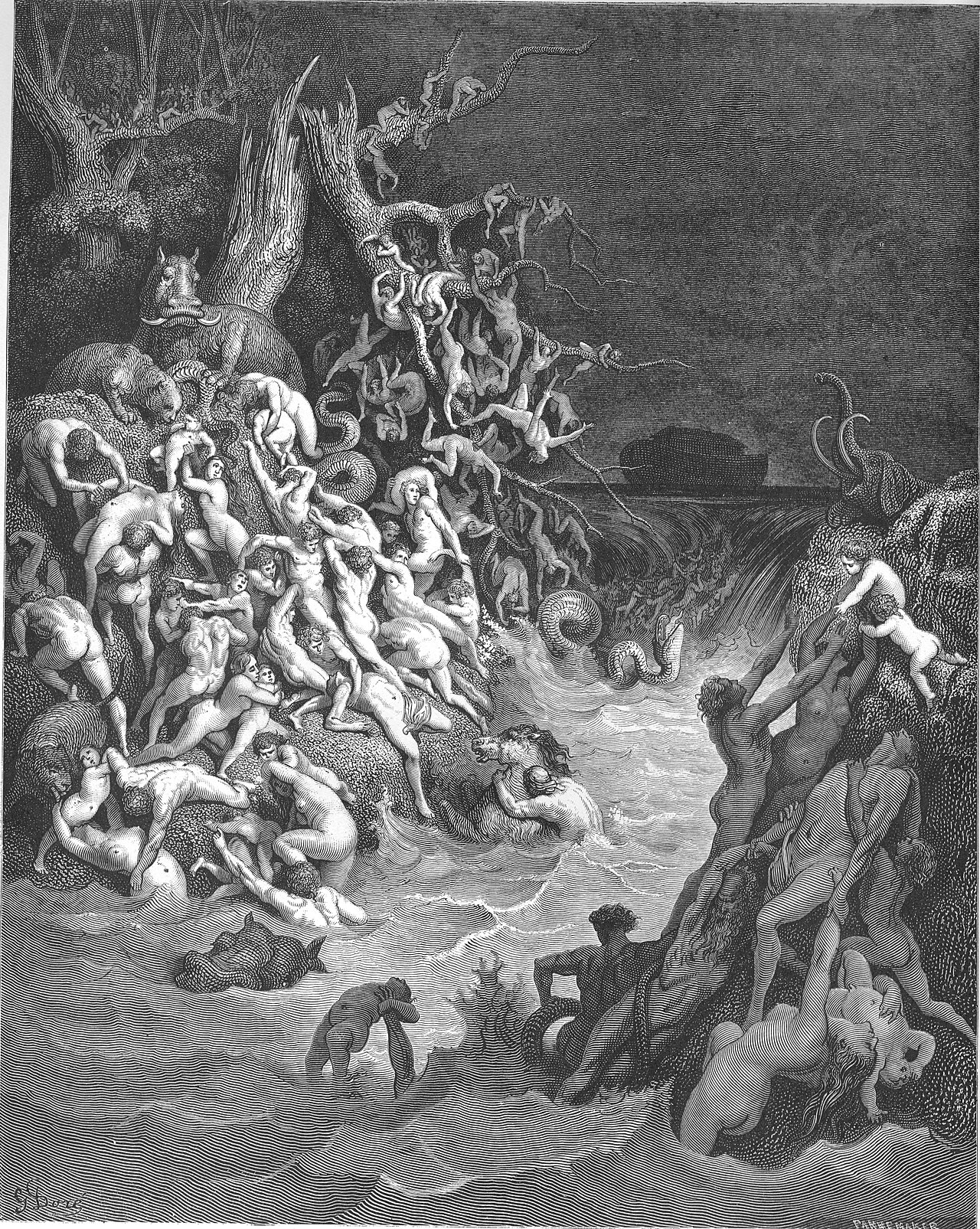
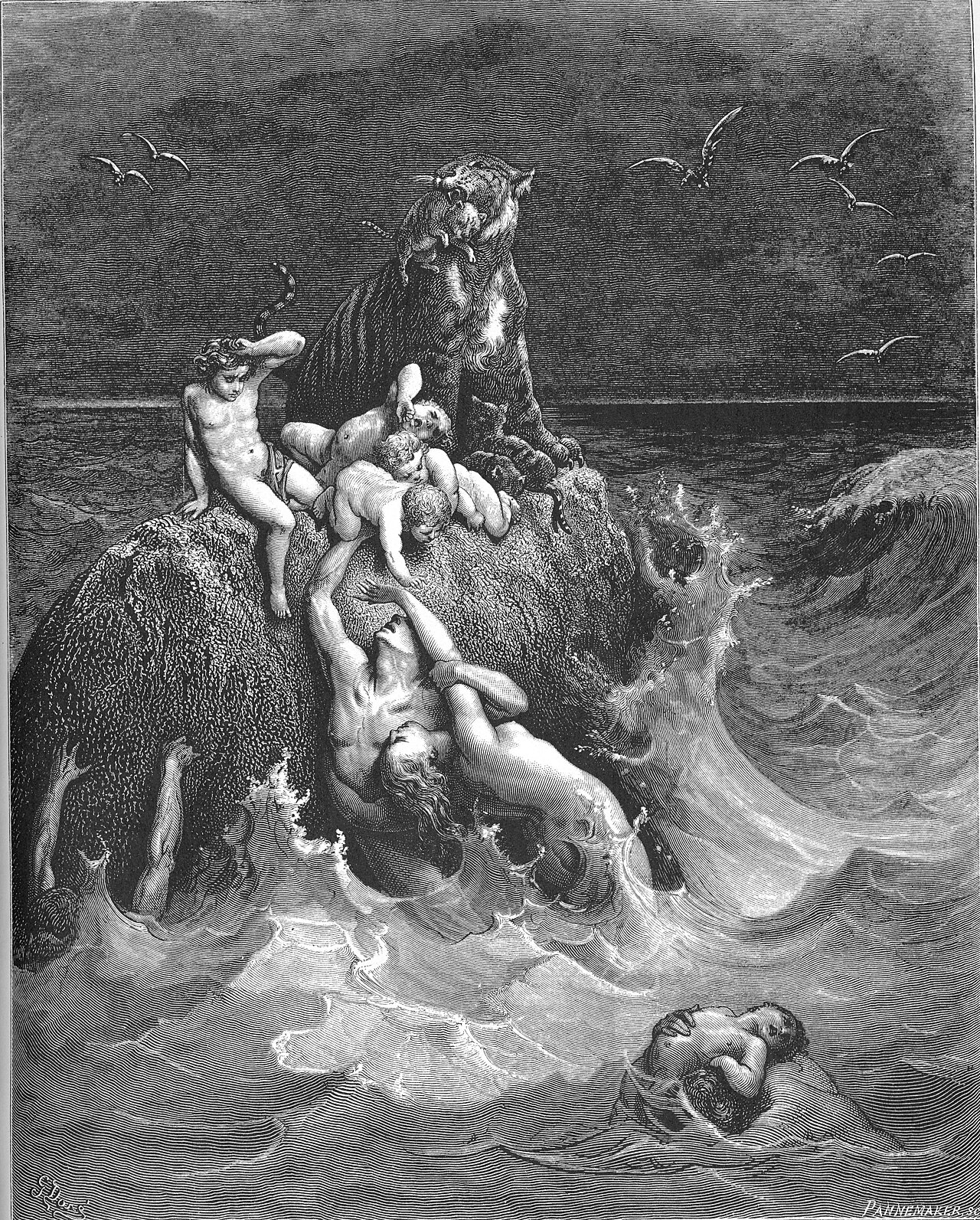
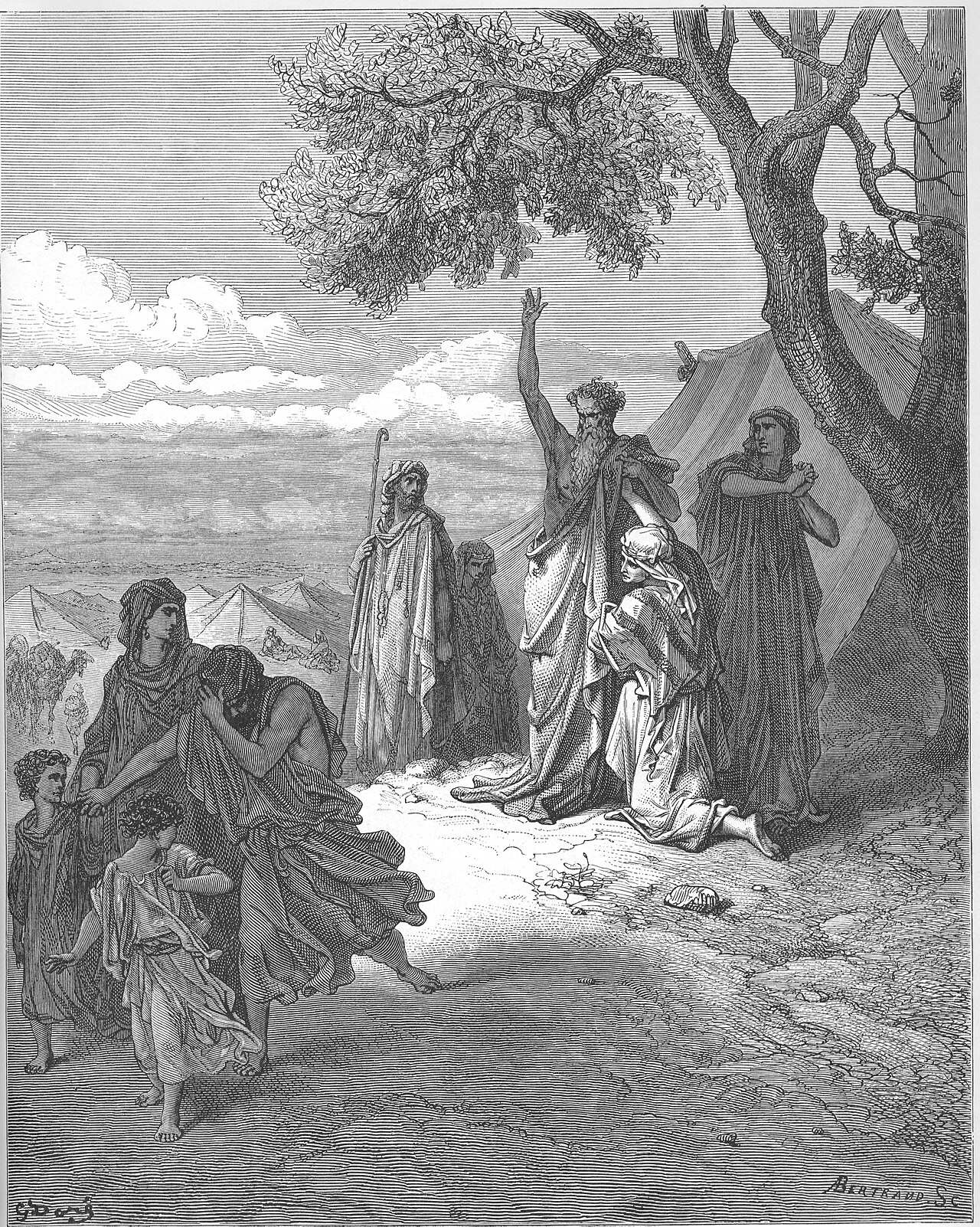
Gustave Doré, La Sainte Bible (Tours: Alfred Mame et fils, 1866). Public domain.
Summary
Noah was a righteous man who found favor with God in a corrupt generation. He built the ark at God's command, preserved humanity and animal life through the flood, and received God's covenant with the rainbow as its sign.
- Noah is the tenth man in the line from Adam through Seth, and Genesis 6:8 says he found favor in the eyes of the LORD before Genesis 6:9 says he was righteous.
- God told him the world would end in water and gave him the measurements of a wooden box. Genesis 6:22 says he did everything precisely as God had commanded him.
- He was inside the ark a year and ten days. The rain fell forty days, the waters prevailed 150 days, and the door was shut by God rather than by Noah.
- The covenant of Genesis 9 is made with every living creature that came out of the ark, and the sign is given to God: "I will see it and remember."
- His last recorded scene is a vineyard, a drunkenness and a curse spoken over his grandson Canaan, and Genesis softens none of it.
On this page
Start here
This is the account of Noah. Noah was a righteous man, blameless in his generation; Noah walked with God.
Genesis 6:9→- 6 key events in order
- 55 verses name Noah, across 11 books
In Scripture
- Verses
- 55
- Books
- 11
Noah
- Role
- Preacher of Righteousness
- Era
- Antediluvian
- Dates
- c. 2900-1950 BC
- Tribe
- Seth's line
- Father
- Lamech
- Mother
- Unknown
- Spouse
- Unknown
- Children
- Shem, Ham, Japheth
The life in order
in the order the canon tells it
- Lamech names him for a relief that had not come yetGenesis 5:29And he named him Noah, saying, “May this one comfort us in the labor and toil of our hands caused by the ground that the LORD has cursed.”
- Three sons, born after he was 500Genesis 5:32After Noah was 500 years old, he became the father of Shem, Ham, and Japheth.
- He found favor, and the text says it before it says he was righteousGenesis 6:8Noah, however, found favor in the eyes of the LORD.
- Righteous, blameless, walking with GodGenesis 6:9This is the account of Noah. Noah was a righteous man, blameless in his generation; Noah walked with God.
- The first covenant named in Scripture, spoken before the floodGenesis 6:18But I will establish My covenant with you, and you will enter the ark—you and your sons and your wife and your sons’ wives with you.
- He builds it, preciselyGenesis 6:22So Noah did everything precisely as God had commanded him.
- Seven pairs of the clean animals, the ones the altar will useGenesis 7:2You are to take with you seven pairs of every kind of clean animal, a male and its mate; a pair of every kind of unclean animal, a male and its mate;
- The flood begins in his six hundredth yearGenesis 7:11In the six hundredth year of Noah’s life, on the seventeenth day of the second month, all the fountains of the great deep burst forth, and the floodgates of the heavens were opened.
- The LORD shuts him inGenesis 7:16And they entered, the male and female of every living thing, as God had commanded Noah. Then the LORD shut him in.
- The waters hold for 150 daysGenesis 7:24And the waters prevailed upon the earth for 150 days.
- God remembers him, and the water starts downGenesis 8:1But God remembered Noah and all the animals and livestock that were with him in the ark. And God sent a wind over the earth, and the waters began to subside.
- The ark grounds on the mountains of Ararat, a region and not a peakGenesis 8:4On the seventeenth day of the seventh month, the ark came to rest on the mountains of Ararat.
- The dove comes back with an olive leafGenesis 8:11And behold, the dove returned to him in the evening with a freshly plucked olive leaf in her beak. So Noah knew that the waters had receded from the earth.
- The ground is dry, a year and ten days after he went inGenesis 8:14By the twenty-seventh day of the second month, the earth was fully dry.
- The first altar named in ScriptureGenesis 8:20Then Noah built an altar to the LORD. And taking from every kind of clean animal and clean bird, he offered burnt offerings on the altar.
- The sign is given to God, not to usGenesis 9:16And whenever the rainbow appears in the clouds, I will see it and remember the everlasting covenant between God and every living creature of every kind that is on the earth.”
- He plants a vineyardGenesis 9:20Now Noah, a man of the soil, proceeded to plant a vineyard.
- The curse falls on Canaan, his grandsonGenesis 9:25he said, “Cursed be Canaan! A servant of servants shall he be to his brothers.”
- He dies at 950Genesis 9:29So Noah lived a total of 950 years, and then he died.
- The nations of the earth spread out from his three sonsGenesis 10:32All these are the clans of Noah’s sons, according to their generations and nations. From these the nations of the earth spread out after the flood.
Why Noah matters
Noah is the tenth man in the line from Adam through Seth. He was the son of Lamech and the great-grandson of Enoch, the man who walked with God and was taken. Genesis describes the world he was born into twice over as ruined, corrupt in God's sight and full of violence, and it says God resolved to end it in water. The order of the sentences in Genesis 6 carries the whole point. Verse 5 says every inclination of man's heart was evil. Verse 7 says God resolved to blot man out. Verse 8 says Noah found favor in the eyes of the LORD. Only at verse 9 does the text call him righteous and blameless. The favor is stated before the righteousness, and Genesis 6:8 is the first appearance of the word in the Bible. What he was told to build was a box, not a ship. The Hebrew word is used of one other object in the whole Old Testament, the basket that carried the infant Moses. It had no rudder, no sail and no bow, one door in the side, and three decks. At an eighteen inch cubit Adam Clarke reckoned it 450 feet long, 75 wide and 45 high. Genesis never records a drop of rain before chapter 7, so every board of it was cut on a word alone. Four times the text says he did what he was told. Genesis 6:22, then 7:5, then 7:9, then 7:16. There is no recorded argument, no bargaining and no delay. Hebrews 11:7 makes that the point in the New Testament's own words: he was warned about things not yet seen. He was inside a year and ten days, from the seventeenth day of the second month of his six hundredth year to the twenty-seventh day of the second month of his six hundred and first. The turns of the story are not his. God shut the door behind him. God remembered him, and the water began to go down. He could see dry ground and still waited until God told him to come out. Then the story ends badly. He planted a vineyard, drank its wine, became drunk, and the last words out of his mouth in Scripture are a curse spoken over a grandson. Genesis does not excuse it and does not explain it away. Matthew Henry's line is the honest one: the fairest copy that ever mere man wrote since the fall had its blots. Scripture keeps coming back to him anyway. Ezekiel 14:14 sets him beside Daniel and Job as one of three men whose righteousness was proverbial. Hebrews 11:7 makes him a founding example of faith. 2 Peter 2:5 calls him a preacher of righteousness. Peter reads the eight saved through water as the pattern of baptism, and Jesus names his generation as the picture of the last one.
Biography
Noah lived in an age of unprecedented wickedness, when humanity's thoughts were only evil continually and the earth was filled with violence. Yet in this corrupt generation, Noah found favor in God's eyes, described as a righteous man, blameless in his generation, who walked with God. God revealed to Noah His plan to destroy the earth with a flood, commanding him to build an ark of massive proportions—450 feet long, 75 feet wide, and 45 feet high. For perhaps 120 years, Noah labored on this enormous vessel while preaching righteousness to an unbelieving world. He is called "a herald of righteousness" in 2 Peter 2:5, faithfully warning of coming judgment even as his neighbors mocked. When the ark was complete, Noah brought his family—his wife, three sons, and their wives—along with representatives of every animal kind into the ark. God Himself shut them in, and the fountains of the great deep burst forth while the windows of heaven opened. For forty days the rain fell, and for 150 days the waters prevailed on the earth. After the flood, Noah built an altar and offered sacrifices to God—the first recorded altar in Scripture. God made a covenant with Noah and all living creatures, promising never again to destroy the earth with a flood, setting the rainbow as the sign of this everlasting covenant. Through Noah, humanity began again, and all people alive today descend from his three sons: Shem, Ham, and Japheth.
This is the account of Noah. Noah was a righteous man, blameless in his generation; Noah walked with God.
Noah was righteous and walked with God
The ark and the flood
Genesis 6:9 to 8:22, in the order the text tells it
- The account of Noah opens with three descriptionsGenesis 6:9This is the account of Noah. Noah was a righteous man, blameless in his generation; Noah walked with God.
- God tells him the world is endingGenesis 6:13Then God said to Noah, “The end of all living creatures has come before Me, because through them the earth is full of violence. Now behold, I will destroy both them and the earth.
- The measurements, and one door in the sideGenesis 6:16You are to make a roof for the ark, finish its walls a cubit from the top, place a door in the side of the ark, and build lower, middle, and upper decks.
- The covenant is promised before the water comesGenesis 6:18But I will establish My covenant with you, and you will enter the ark—you and your sons and your wife and your sons’ wives with you.
- He builds it exactly as he was toldGenesis 6:22So Noah did everything precisely as God had commanded him.
- The deep opens from below before the sky opens aboveGenesis 7:11In the six hundredth year of Noah’s life, on the seventeenth day of the second month, all the fountains of the great deep burst forth, and the floodgates of the heavens were opened.
- The door is shut, and not by NoahGenesis 7:16And they entered, the male and female of every living thing, as God had commanded Noah. Then the LORD shut him in.
- Everything outside the ark diesGenesis 7:23And every living thing on the face of the earth was destroyed—man and livestock, crawling creatures and birds of the air; they were blotted out from the earth, and only Noah and those with him in the ark remained.
- The hinge of the whole accountGenesis 8:1But God remembered Noah and all the animals and livestock that were with him in the ark. And God sent a wind over the earth, and the waters began to subside.
- The altar, and a promise made on the same fact that condemned the worldGenesis 8:21When the LORD smelled the pleasing aroma, He said in His heart, “Never again will I curse the ground because of man, even though every inclination of his heart is evil from his youth. And never again will I destroy all living creatures as I have done.
Two instructions about the animals stand in the text and both are kept here. Genesis 6:19-20 gives two of every living creature; Genesis 7:2-3 gives seven pairs of every clean animal and every bird, which is what the altar at 8:20 uses. The rain fell forty days, the waters prevailed 150 days, and the whole stay ran a year and ten days.
The Flood: the full studyKey events
- 1Found favor with GodGenesis 6:8-9→
Noah was righteous and walked with God in a corrupt generation
Read the verse here
Genesis 6:8-9Noah, however, found favor in the eyes of the LORD.
- 2Commanded to build arkGenesis 6:13-22→
God instructed Noah to build the ark with exact specifications
Read the verse here
Genesis 6:13-22Then God said to Noah, “The end of all living creatures has come before Me, because through them the earth is full of violence. Now behold, I will destroy both them and the earth.
- 3Entered the arkGenesis 7:1-9→
Noah and his family entered with animals as God commanded
Read the verse here
Genesis 7:1-9Then the LORD said to Noah, “Go into the ark, you and all your family, because I have found you righteous in this generation.
- 4The great floodGenesis 7:17-24→
Waters covered the earth for 150 days
Read the verse here
Genesis 7:17-24For forty days the flood kept coming on the earth, and the waters rose and lifted the ark high above the earth.
- 5Offered sacrificeGenesis 8:20-22→
After leaving the ark, Noah built an altar and sacrificed
Read the verse here
Genesis 8:20-22Then Noah built an altar to the LORD. And taking from every kind of clean animal and clean bird, he offered burnt offerings on the altar.
- 6Received covenantGenesis 9:8-17→
God established the rainbow covenant with Noah
Read the verse here
Genesis 9:8-17Then God said to Noah and his sons with him,
More key verses
Text: Berean Standard Bible.
“By faith Noah, when warned about things not yet seen, in godly fear built an ark to save his family. By faith he condemned the world and became heir of the righteousness that comes by faith.”
“if He did not spare the ancient world when He brought the flood on its ungodly people, but preserved Noah, a preacher of righteousness, among the eight;”
What they got right, and what they got wrong
Strengths
Righteousness in a corrupt generation, faith to obey despite ridicule, patience in long-term obedience, worshipped God immediately after deliverance
Weaknesses
Became drunk after the flood, his drunkenness led to family dysfunction
Lessons
Righteousness can flourish even in corrupt surroundings. Faith acts on God's word despite ridicule. God preserves the faithful through judgment. Worship should follow deliverance.
Spiritual significance
Noah exemplifies salvation through faith and obedience. His preservation through the flood illustrates God's judgment on sin and salvation for the faithful. The ark prefigures Christ as the only means of salvation.
How Noah points to Jesus
The New Testament makes the first connection itself. 1 Peter 3:20-21 says a few people, only eight souls, were saved through water, "And this water symbolizes the baptism that now saves you also." Peter then guards the sentence in the same breath: the saving is "not the removal of dirt from the body, but the pledge of a clear conscience toward God, through the resurrection of Jesus Christ." The water washes nobody. The resurrection does. Charles Spurgeon, preaching on Genesis 8:21 in 1865, gave the shape of it plainly: Noah was not saved by the world being gradually reformed, but by a sentence of condemnation, then death, burial and resurrection, going into the ark and coming out into a new world. Genesis 6:16 puts one door in the side of the ark. Everything that lived went through it, and God closed it. Augustine, writing City of God in the early fifth century, read the ark as the church and the door as the wound in the side of the Crucified, "the door by which those who come to him enter in." That is Augustine reading the passage, not what Genesis says, and it is offered here as his reading. The plainer line needs no Father at all. Jesus says at John 10:9, "I am the door." Matthew Henry heard the same call in God's word to Noah at Genesis 7:1: "Christ is an ark already prepared, in whom alone we can be safe when death and judgment come." Lamech named the boy for relief from ground the LORD had cursed, and the relief did not arrive. Genesis 8:21 has God lift the curse from the ground, and Genesis 9:20 has Noah go straight back to farming it and fall. Origen said the obvious thing in the third century: the words of Lamech are not appropriate to the ancient Noah, and "Jesus only has given rest to humanity and has freed the earth from the curse." Matthew 11:28 is where the name lands. This is a Christian reading of Genesis 5:29 held since the third century, and it is not a claim about what Lamech knew. Jesus uses this man as the picture of His own coming. "As it was in the days of Noah, so will it be at the coming of the Son of Man" (Matthew 24:37). What He picks out is not the wickedness. It is that nobody noticed. They were eating and drinking, marrying and giving in marriage, ordinary life, right up to the day. Eusebius of Caesarea drew the structural point in the fourth century: the flood did not come before Noah entered the ark, and fire did not fall on Sodom before Lot left, so the righteous are separated before the judgment falls. J. C. Ryle added a caution worth keeping, that the passage is about the second coming and not about death, and that using these verses on a tombstone misreads them. 2 Peter 2:5 calls Noah a preacher of righteousness, and the Greek word is keryx, a herald. A herald announces a decision that has already been made rather than offering terms. It is the same root as the verb at 1 Peter 3:19. On that verse this site's posture receives first the reading that takes the spirits as the angels who sinned before the flood, held in chains as 2 Peter 2:4 and Jude 6 say, and the preaching as the risen Lord's proclamation of victory. Augustine read it instead as the preincarnate Christ preaching through Noah to men whose spirits are now in prison, and a third reading places the preaching in Hades between the death and the resurrection. Each stands with its holders, and on every main reading no second chance after death is taught. Genesis 8:22 and 9:11 are the reason there is still a world for the gospel to be preached in. Seedtime and harvest do not cease and the flood does not come again. The promise retires the flood and not the judgment: 2 Peter 3:7 says the present heavens and earth are reserved for fire, kept for the day of judgment. Isaiah 54:9-10 is the Old Testament using the covenant the same way, and the logic is that God kept the first promise. Theodoret of Cyrus put it in one line in the fifth century: having the first covenant as a pledge, believe that you will always enjoy my love. Isaiah 54 is spoken to Israel, and where a teacher applies its comfort to all who believe, that is the teacher's application and not a transfer of the promise away from Israel.
Peter connects the ark's salvation through water to baptism and salvation in Christ (1 Peter 3:20-21). Noah's faith in building the ark despite no visible evidence models faith that saves (Hebrews 11:7).
The voices
each quoted from the work named
And this is the fashion--According to the description, the ark was not a ship, but an immense house in form and structure like the houses in the East, designed not to sail, but only to float.
The text goes on, "The Lord God shut the ark from the outside." Notice in this place too the considerateness in the expression "God shut the ark from the outside," to teach us that he had ensured the good man's complete safety. The reason for adding "from the outside" to "he shut" was that the good man might not be in the position of seeing the disaster occur and suffering even greater distress.
He sent forth a raven, which went forth to and fro - It is generally supposed that the raven flew off, and was seen no more, but this meaning the Hebrew text will not bear; ויצא יצוא ושוב vaiyetse yatso vashob, and it went forth, going forth and returning. From which it is evident that she did return, but was not taken into the ark.
4 more teachers on these versesEphrem the Syrian · Charles Spurgeon · Matthew Henry · Augustine of Hippo
"The Lord smelled" not the smell of the flesh or the smoke of wood, but rather he looked out and saw the simplicity of heart with which Noah offered the sacrifice from all and on behalf of all.
PETER tells us that Noah's ark and Baptism are figures of salvation. He puts the two together as pictures of the way by which we are saved. Noah was not saved by the world's being gradually reformed and restored to its primitive innocence, but a sentence of condemnation was pronounced and death, burial and resurrection ensued. Noah must go into the ark and become dead to the world.
That the fairest copy that ever mere man wrote since the fall had its blots and false strokes. It was said of Noah that he was perfect in his generations ( ch. vi. 9 ), but this shows that it is meant of sincerity, not a sinless perfection.
He did not intend that His rational creature, who was made in His image, should have dominion over anything but the irrational creation,-not man over man, but man over the beasts. And hence the righteous men in primitive times were made shepherds of cattle rather than kings of men, God intending thus to teach us what the relative position of the creatures is, and what the desert of sin; for it is with justice, we believe, that the condition of slavery is the result of sin. And this is why we do not find the word "slave" in any part of Scripture until righteous Noah branded the sin of his son with this name. It is a name, therefore, introduced by sin and not by nature.
Noah in Scripture
Open a book to read its mentions here. Text: Berean Standard Bible. Names repeat in Scripture, so some of these verses may speak of another person called Noah. The two marks are drawn from the chapters this page's own references stand in.
Old TestamentNew Testamentsegment width = share of mentions
Old Testament6 books · 47 mentions
Genesis39 mentions
- Genesis 5:29And he named him Noah, saying, “May this one comfort us in the labor and toil of our hands caused by the ground that the LORD has cursed.”
- Genesis 5:30And after he had become the father of Noah, Lamech lived 595 years and had other sons and daughters.
- Genesis 5:32After Noah was 500 years old, he became the father of Shem, Ham, and Japheth.
- Genesis 6:8Noah, however, found favor in the eyes of the LORD.
- Genesis 6:9This is the account of Noah. Noah was a righteous man, blameless in his generation; Noah walked with God.
34 further mentions in Genesis, read them in the book.
Numbers3 mentions
- Numbers 26:33Now Zelophehad son of Hepher had no sons but only daughters. The names of his daughters were Mahlah, Noah, Hoglah, Milcah, and Tirzah.
- Numbers 27:1Now the daughters of Zelophehad son of Hepher, the son of Gilead, the son of Machir, the son of Manasseh, belonged to the clans of Manasseh son of Joseph. These were the names of his daughters: Mahlah, Noah, Hoglah, Milcah, and Tirzah. They approached
- Numbers 36:11Mahlah, Tirzah, Hoglah, Milcah, and Noah, the daughters of Zelophehad, were married to cousins on their father’s side.
Joshua1 mention
1 Chronicles1 mention
Isaiah1 mention
Ezekiel2 mentions
- Ezekiel 14:14then even if these three men—Noah, Daniel, and Job—were in it, their righteousness could deliver only themselves, declares the Lord GOD.
- Ezekiel 14:20then as surely as I live, declares the Lord GOD, even if Noah, Daniel, and Job were in it, they could not deliver their own sons or daughters. Their righteousness could deliver only themselves.
New Testament5 books · 8 mentions
Matthew2 mentions
Luke3 mentions
- Luke 3:36the son of Cainan, the son of Arphaxad, the son of Shem, the son of Noah, the son of Lamech,
- Luke 17:26Just as it was in the days of Noah, so also will it be in the days of the Son of Man:
- Luke 17:27People were eating and drinking, marrying and being given in marriage, up to the day Noah entered the ark. Then the flood came and destroyed them all.
Hebrews1 mention
1 Peter1 mention
Common questions
Were the sons of God in Genesis 6 angels, or the line of Seth?
Readers differ; the positions are named
The reading that they were angelic beings is the older one, and it is what 1 Enoch, Jubilees, Jude 6 and 2 Peter 2:4 assume. Josephus wrote in the first century that "many angels of God accompanied with women, and begat sons that proved unjust." Philo, Justin Martyr, Irenaeus, Julius Africanus, Eusebius, Ambrose and Jerome all hold it. This site's tradition follows that reading and teaches it at full strength.
The reading that they were the godly line of Seth marrying into the line of Cain is held by Augustine in City of God 15.23, by John Cassian, by Cyril of Alexandria, by Chrysostom, and later by Calvin, and it became the majority Western reading. It is presented here in the words of the men who held it, with respect.
Chuck Missler put the angelic reading this way in "The Gospel in Genesis" (1996): "Some authorities suggest that this might be an allusion to the Sons of God who came down to corrupt the daughters of men, resulting in the Nephilim (Fallen Ones) of Genesis 6." Michael S. Heiser argued the same case from the ancient Near Eastern setting in "The Ancient Near Eastern Context for Genesis 6:1-4" (drmsh.com, 2015): "This article deals a death blow to any non-supernatural (or non-mythic as some prefer) interpretation in the sense that, if you care about interpreting the Bible in context, no human interpretation of the sons of God can work."
Both sides agree that Genesis 6 describes a corruption grave enough to bring the flood, and Genesis names two causes in the same passage: the transgression of 6:1-4 and the violence and corruption of 6:5-13. The full study takes the argument at length.
What does 1 Enoch say about Noah, and is it Scripture?
1 Enoch is a Jewish work whose parts date from the third century BC to the first century AD. Aramaic fragments of most of it were found at Qumran, Jude 14-15 quotes its opening chapter, and it is canonical in the Ethiopian Orthodox Tewahedo Church. On this site it is a labeled Second Temple study resource and never Scripture.
It adds no facts to Genesis. It adds a frame. In its tenth chapter the warning to Noah and the sentence on the Watchers are spoken in one breath: “Then said the Most High, the Holy and Great One spake, and sent Uriel to the son of Lamech, and said to him: ’Go to Noah and tell him in my name “Hide thyself!” and reveal to him the end that is approaching” (1 Enoch 10:1-2, R. H. Charles's translation). Later God tells him, “And now the angels are making a wooden (building), and when they have completed that task I will place My hand upon it and preserve it, and there shall come forth from it the seed of life” (1 Enoch 67:2).
Its last chapters go back to his birth. Lamech tells his father that he has “begotten a strange son, diverse from and unlike man, and resembling the sons of the God of heaven” (1 Enoch 106:5) and has to be told the boy is his own. Enoch names him and gives the reason: “for he will comfort the earth after all the destruction” (1 Enoch 107:3). That frame was in circulation before the New Testament was written, and it is the frame 2 Peter 2:4-5 and Jude 6 write inside.
Was the flood worldwide?
Readers differ; the positions are named
Genesis says the waters covered "all the high mountains under all the heavens" and stood fifteen cubits above them, and that every living thing on the face of the earth was destroyed. 2 Peter 3:6 says the world of that time perished in the flood. A flood over the whole globe is the reading held through most of church history and it is the widely held belief today. Jamieson, Fausset and Brown put the traditional case plainly: the language is not consistent with the theory of a partial deluge.
Some readers, including believing scholars, take the universal language as covering the whole world known to Noah. Albert Barnes said so in the nineteenth century, writing that the land means the portion of the earth's surface known to man and that this is all Scripture warrants us to assert. Theophylact of Ohrid read 2 Peter 3:6 the same way in the eleventh century. Bernard Ramm, Davis Young and Hugh Ross hold versions of it today. An evidence-based reading belongs on the page, and it may never be used to erase the traditional one.
The age of the earth and a chronology counted from the genealogies are handled the same way here, as widely held beliefs rather than as this site's assertion. Genesis was written by Moses for Israel in the exodus to teach them who the LORD is, and it was not written to answer every question a modern reader brings to it.
How long was Noah in the ark, and how long did the rain last?
The rain fell forty days and forty nights (Genesis 7:12). The waters then prevailed for 150 days (7:24) before they began to go down. He entered on the seventeenth day of the second month of his six hundredth year (7:11) and the ground was fully dry on the twenty-seventh day of the second month of his six hundred and first (8:14).
That is a year and ten days, which Adam Clarke worked out as a complete solar year. He did not leave when he saw dry ground. He waited for God to tell him to come out.
Which month "the second month" of 7:11 actually names is itself disputed in rabbinic tradition. The Babylonian Talmud, at Rosh Hashanah 11b-12a, records a dispute between the tannaim Rabbi Eliezer and Rabbi Yehoshua: Rabbi Eliezer holds the world was created in Tishrei and reads the flood's start as the seventeenth of Marcheshvan, while Rabbi Yehoshua holds it was created in Nisan and reads the same date as the seventeenth of Iyar. Both readings agree on the count of days; they differ only on which season those days fall in.
Who was cursed at Genesis 9:25, and does the curse apply to any race of people today?
The text names Canaan, Noah's grandson through Ham, not Ham himself and not any race of people. The words speak of one man's line and its place among his uncles, Shem and Japheth. Reading this curse as marking a whole race of people has no basis in the text itself.
Why the grandson and not the son is an old question and the church has always asked it. Justin Martyr in the second century answered that the Spirit of prophecy would not curse a son whom God had blessed. Chrysostom answered that Ham did not suffer less by watching his son bear it. Ephrem asked what sin Canaan could possibly have committed. Adam Clarke supplied the textual note that settles the reading: the Arabic version has "Ham the father of Canaan" at verses 25, 26 and 27, a reading found in no other version and plainly a gloss.
The same chapter carries the answer the church's own greatest reader of the passage gave. Augustine, in City of God 19.15, wrote that God gave His rational creature dominion "not man over man, but man over the beasts," and that the word slave appears nowhere in Scripture until this scene.
Why did God tell Noah to take two of every animal and then seven pairs of some?
Both instructions are in the text. Genesis 6:19-20 gives two of every living creature. Genesis 7:2-3 then gives seven pairs of every clean animal and seven pairs of every bird, and the second instruction is the more detailed one, given as he was about to go in.
Jamieson, Fausset and Brown give the reason from the story itself: the extra clean animals were reserved for sacrifice. Noah offers burnt offerings from every kind of clean animal and clean bird at Genesis 8:20, and without the seven pairs that altar would have ended a species. Read forward, Genesis 7:2 is a man carrying his worship supplies through a year of judgment.
What is the rainbow actually for?
God says the bow is the sign of a covenant He is making with Noah, with his descendants, and with every living creature that came out of the ark. The animals are named four times in seven verses. The remarkable line is Genesis 9:16: "I will see it and remember." The sign is given to God, not to us.
The Hebrew word is qeshet, the ordinary word for a war bow, and it is a weapon in nearly all of its seventy-six occurrences. What God hangs in the sky is a bow set down. Matthew Henry added that a rainbow is only sunlight, so the sign has no glory of its own, and pointed to the rainbow around the throne at Revelation 4:3.
The promise is also specific. It retires the flood and not the judgment. 2 Peter 3:7 says the present heavens and earth are reserved for fire, being kept for the day of judgment.
Why does Jesus talk about the days of Noah?
Because He is asked what His coming will look like, and He answers with this story. The thing He picks out is not the wickedness. It is that nobody noticed: "And they were oblivious, until the flood came and swept them all away."
Luke records the same saying and sets Lot beside Noah. Eusebius of Caesarea drew out the pattern in the fourth century: the flood did not come before Noah entered the ark, and fire did not fall before Lot left Sodom. J. C. Ryle added a caution worth keeping, that the passage is about the second coming and not about death.
Other ancient peoples told a flood story. What is the relationship to Genesis?
Readers differ; the positions are named
The parallel is real and worth stating plainly. Atrahasis has the gods send a flood because the noise of humanity disturbs Enlil's sleep, and Enki warns the hero through a reed wall. The eleventh tablet of the Epic of Gilgamesh has Utnapishtim build a boat, survive, release birds and make an offering. The church knew of the parallel long before Assyriology existed: the site's own quote pool holds Cosmas Indicopleustes, writing in the sixth century, reporting the Babylonian historian Berossus at second hand, with ten kings before the flood and a hero he calls Xisuthrus. Berossus, a priest of Bel in Babylon, wrote his Babyloniaca in Greek about 281 BC, dedicated to the Seleucid king Antiochus I. The tablet parallel became public on 3 December 1872, when George Smith read his translation of the eleventh tablet of the Epic of Gilgamesh to the Society of Biblical Archaeology in London.
The differences are as sharp as the likenesses. Genesis gives a moral cause, violence and corruption, and a righteous man. Atrahasis gives noise and a god's irritation. The Mesopotamian gods quarrel, panic at the flood they started, and swarm the sacrifice afterward. Genesis ends with a covenant for every living creature; Gilgamesh ends with immortality for one man and his wife.
Three positions are held on the relationship. Genesis draws on an older Mesopotamian tradition, which has been the standard reading in the university field since the generation after the tablets were read. All the accounts remember one real event, and Genesis preserves it accurately while the others carry it in polytheistic dress, which is held across conservative and evangelical scholarship and is the reading this site's tradition takes. Or both descend from a tradition older than either, with neither borrowing from the other. This page names the positions and rules between none of them.
Notable art
3 verified pieces depicting Noah
Sources cited
- The Berean Standard BibleEvery verse quoted on this page, byte for byte from the site's own verse store. Public domain since 2023.
- R. H. Charles, translator, The Book of Enoch (SPCK, 1917)The translation behind this site's 1 Enoch text, quoted byte for byte from apocrypha_verses, book 16. A labeled Second Temple study resource, never canon.
- Adam Clarke, Commentary on the Bible (1832)The raven at Genesis 8:7, the ark's dimensions at an eighteen inch cubit, the complete solar year, and the Arabic gloss at Genesis 9:25. Public domain.
- Robert Jamieson, A. R. Fausset and David Brown, Commentary Critical and Explanatory on the Whole Bible (1871)The ark as a house built to float, the seventh clean animal reserved for sacrifice, and the traditional case on the extent of the flood. Public domain.
- Matthew Henry, Commentary on the Whole Bible (1710)The blots on the fairest copy, Christ as an ark already prepared, and the bow read toward Revelation 4:3. Public domain.
- Charles H. Spurgeon, The Metropolitan Tabernacle Pulpit, Sermon No. 615: “Human Depravity And Divine Mercy” (1865)The ark read as condemnation, burial and resurrection. Public domain.
- Albert Barnes, Notes, Explanatory and Practical, on the Old and New Testaments (1832 to 1869)The regional reading of the flood language at Genesis 7:17, cited for the position it argues. Public domain.
- John Chrysostom, Homilies on Genesis, fourth centuryThe door shut from the outside, the forty days as forbearance, and why the curse fell on Canaan. Public domain.
- Ephrem the Syrian, Commentary on Genesis, fourth centuryWhat was accepted at Noah's altar, and the question of what Canaan could have done. Public domain.
- Augustine of Hippo, City of God 15.23, 15.26 and 19.15The Sethite reading, the door in the side as his reading, and dominion given over the beasts and not over men. Public domain.
- Justin Martyr, Dialogue with Trypho 139, second centuryWhy the curse begins with the son's son. Public domain.
- Origen of Alexandria, Homilies on Genesis 2.3, third centuryThe name of Noah read as rest, and the reading that only Jesus has given it. Public domain.
- Eusebius of Caesarea, in the Catena Aurea of Thomas Aquinas, fourth centuryThe righteous separated before the judgment falls, at Luke 17:30. Public domain.
- Theodoret of Cyrus, Commentary on Isaiah, fifth centuryThe first covenant held as the pledge of the second, at Isaiah 54:9. Public domain.
- J. C. Ryle, Expository Thoughts on the Gospels: Matthew (1856)The caution that these verses are about the second coming and not about death. Public domain.
- Cosmas Indicopleustes, The Christian Topography, Book 12, sixth centuryA Christian writer preserving Berossus at second hand, with ten kings and Xisuthrus. Public domain.
- Chuck Missler, “The Gospel in Genesis” (1996)Cited at 32 words with the work named, under the site's cite-only rule for authors in copyright.
- Michael S. Heiser, “The Ancient Near Eastern Context for Genesis 6:1-4” (drmsh.com, 2015)Cited at 38 words with the work named, under the same cite-only rule.
- Gustave Doré, La Sainte Bible (Tours: Alfred Mame et fils, 1866)The four engravings on this page. They are the only art the site holds for this story: there is no painting of Noah, the ark or the flood in the featured-art collection, and no map reaches his world. Public domain.
- The site's own tables, queried 2026-09-02biblical_characters, verses at translation_id 3, apocrypha_books and apocrypha_verses for 1 Enoch, pull_quotes, scholars and lexicon_entries.
- Berossus, Babyloniaca, about 281 BCThe date of Berossus's Greek history, dedicated to Antiochus I, confirmed by search in the 2026-09-02 session 7 re-verification. Berossus's own work survives only in later quotation, including Cosmas.
- George Smith's Chaldean Account of the Deluge, read 3 December 1872The date George Smith presented his translation of the Gilgamesh flood tablet to the Society of Biblical Archaeology in London, confirmed by search in the 2026-09-02 session 7 re-verification.
- Sefaria, Babylonian Talmud, Rosh Hashanah 11b-12aThe dispute between Rabbi Eliezer and Rabbi Yehoshua over which calendar the flood's dates in Genesis 7:11 follow, confirmed by search in the 2026-09-02 session 7 re-verification.
Keep studying
On this page
Studies15
On this person
Trails2
Every page that names them1
Books11
Doorway1
Keep this page