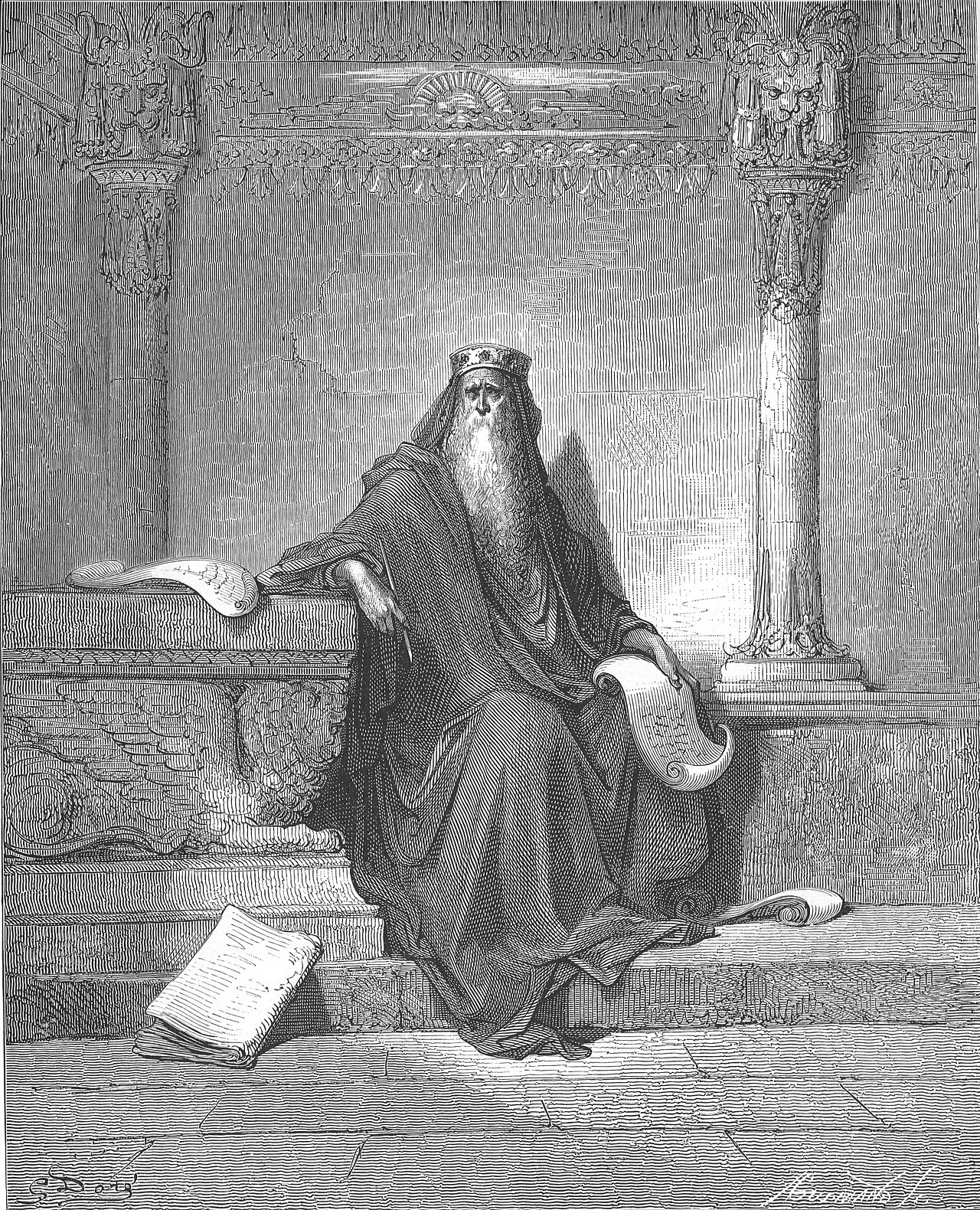
Wisdom · Ecclesiastes
Every Avenue, Run Through the Sieve
Ecclesiastes is not a counsel of despair. It is a diagnostic — the most searching test the Bible ever runs on wisdom, pleasure, great works, wealth, and toil, each tried by a king with the means to try them all, and each found to be hevel: real, but ungraspable, unable to secure lasting gain under the sun. What does not filter through is the whole point — the gift received with joy, and the fear of God who will judge every hidden thing.

The Sieve
— six avenues, one filter, two things that do not filter throughQoheleth had the means to try everything a human life can chase, and he tried it — as an experiment, methodically, with wisdom guiding the trial. Each avenue below is genuinely good, tested honestly, and run through the same filter: death, the leveler, “under the sun.” What comes out the other side is hevel — not worthless, but ungraspable as a breath. Below the sieve stand the only two things the book finds that were never being tested by that method in the first place.
Surveyed “all that is done under heaven” with unmatched wisdom — and found that in much wisdom is much grief, and that one מִקְרֶה (fate) waits for the wise man and the fool alike.
Pleasure & LaughterEcclesiastes 2:1–3Tested mirth and wine, still guiding himself with wisdom, to see “what it was good for the sons of men that they should do under heaven” — the verdict came back hevel.
Great WorksEcclesiastes 2:4–6Houses, vineyards, gardens, orchards, pools of water — a building program that outbuilt every king before him in Jerusalem (cf. 1 Kings 7; 9–10).
Wealth & PossessionsEcclesiastes 2:7–9; 6:1–9Silver, gold, herds, singers, “whatsoever mine eyes desired” — and, elsewhere, riches kept by their owner “to his hurt,” or given by God to a stranger to enjoy instead.
Toil's FruitEcclesiastes 2:18–23A lifetime's labor left to an heir who did not labor for it — and no one can say in advance whether that heir will be wise or a fool.
Youth & the Prime of LifeEcclesiastes 11:9–10Even the vigor of a young life — rightly enjoyed, the book insists — is itself hevel: it does not last long enough for a hand to close around it.
shemesh (sun) + tachath (under) — the phrase bounding Qoheleth's search to what can be tested this side of the grave. One מִקְרֶה, one fate, waits for the wise man and the fool, man and beast alike (2:14–16; 3:19–20; 9:2–3). Nothing tested inside this boundary keeps its shape.
What does not filter through
Food, drink, and good in one's labor, taken not as a consolation prize scraped from a failed search but as a gift out of God's own hand — the one pleasure “under the sun” the diagnosis never asks Qoheleth to renounce, because it was never secured by force in the first place. The refrain returns again and again across the book, escalating each time.
The frame narrator's resolving imperative, reaching in from outside the bounded experiment: God will bring every work into judgment, with every hidden thing. It does not filter through the sieve because it was never “under the sun” to begin with — it is the one claim in the book about what lies beyond that horizon.
“There is a judgment to come, in which every man's eternal state will be finally determined. God himself will be the Judge, God-man will, not only because he has a right to judge, but because he is perfectly fit for it, infinitely wise and just.”
Matthew Henry, Commentary on the Whole Bible (1710), on Ecclesiastes 12:14 · public domain
The Argument
— the whole book in three sentences- Attribution
- Qoheleth, “son of David, king in Jerusalem” (1:1) — traditionally Solomon
- Date
- MannaFest's flag: traditional-Solomonic, c. 940s–931 BC
- Genre
- Wisdom — first-person royal-testament reflection, framed by a third-person epilogue
- Shape
- 12 chapters · 2 voices · 1 inclusio (1:2 ↔ 12:8)
- 1
Qoheleth runs every avenue of meaning available to a man with unlimited means — wisdom, pleasure, great works, wealth, posterity — through the sieve of death, and finds each one hevel: real, but ungraspable, unable to secure lasting gain “under the sun.”
- 2
The relentless clearing-of-the-ground is not nihilism but a diagnostic: it empties every rival source of ultimate meaning so that the one thing that survives the sieve stands unchallenged as the only foundation.
- 3
What survives is not a better strategy for winning under the sun, but a relocation outside it entirely — the fear of God, gifts received and enjoyed as gifts, and a final accounting still to come (12:13–14).
The Two Voices
— a third-person frame introduces and completes a first-person testimonyIntroduces Qoheleth (1:1), states the motto on his behalf (1:2), then returns at the end to commend his “words of truth” as “given from one shepherd” (12:11) and supply the resolving imperative his own bounded search could not generate on its own terms (12:13–14).
The royal experimenter's own “I” — testing wisdom, pleasure, toil, and wealth from inside the deliberately bounded horizon of “under the sun,” without appeal to resurrection or the world to come. This is the body the frame both honors and completes.
The inclusio — the same sentence, opening and closing
“Vanity of vanities, saith the Preacher; vanity of vanities, all is vanity.”
Ecclesiastes 12:8“Vanity of vanities, saith the Preacher; all is vanity.”
A reading associated in modern scholarship with commentators such as Michael V. Fox calls this the “frame-narrator” structure — directly relevant to whether the book's apparent pessimism is the canon's endorsed conclusion or its most thorough diagnosis (see Contested Points).
Christ in Ecclesiastes
— no direct prophecy — but the diagnosis is exactly the wound the gospel answersQoheleth bounds his search to what can be seen “under the sun”; the New Testament's counter-move is to locate hope in what comes from above that horizon — “he that cometh from heaven is above all” (John 3:31); “set your mind on the things that are above, not on the things that are upon the earth” (Col 3:2). Where Qoheleth's search dead-ends at death, the gospel opens the ceiling he could not see past.
Where Solomon's own wisdom-experiment, run to its limit, could not secure lasting yithron — “profit” — the New Testament names Christ “the wisdom of God,” the one “made unto us wisdom from God, and righteousness and sanctification, and redemption.” The gain Qoheleth searched for and could not find under the sun is supplied by union with Christ, not by better searching.
Open the study →Paul names creation itself “subjected to vanity” — the same semantic field as hevel — “not of its own will, but by reason of him who subjected it, in hope.” Qoheleth's honest diagnosis of a groaning, frustrated creation is real; Paul supplies the piece Qoheleth's method could not reach: hope, and a coming deliverance “into the liberty of the glory of the children of God.”
“God will bring every work into judgment, with every hidden thing” is the Old Testament wisdom corpus's clearest statement of a coming universal accounting — the same horizon named at the great white throne, where “the dead were judged … according to their works.”
Themes
— six load-bearing lines through the bookHevel — the diagnostic keyword
Not “worthless” but fleeting, ungraspable, insubstantial as a breath — the image of trying to hold vapor, applied in turn to wisdom, pleasure, toil, wealth, youth, and finally to “all.”
Under the sun — the bounded search
Qoheleth's deliberately bounded vantage point: everything he examines and calls hevel is evaluated strictly within the horizon of observable life on earth. The bounding is the interpretive key to the whole book.
A time for everything, eternity in the heart
God has fitted human life into an ordered cycle of appointed times, yet has also placed an ineradicable sense of eternity in every heart, while withholding the capacity to grasp his total work — eternity-hunger without eternity-sight.
The limits of wisdom, pleasure, toil and wealth
Each pursuit is tested and found genuinely good as a created gift, yet incapable of delivering the lasting “profit” the human heart seeks from it when pursued as an end in itself, cut off from God.
Death, the great leveler
One event befalls the wise and the fool, man and beast — the fact against which every “under the sun” achievement is measured and found hevel.
Fear God and keep his commandments
Not a late add-on but the resolving keynote already threading the body — the epilogue's climax is the capstone of a line already running throughout.
Original Language
— Ecclesiastes' vocabulary is small and load-bearing — a handful of words carry the whole diagnosisWatch also for re'ut ruach, “striving after wind” — Qoheleth's recurring verdict-phrase paired with hevel (1:14; 2:11, 17, 26). The wordplay sharpens because ruach itself means both “wind” and “spirit/breath,” echoing hevel's own breath-imagery — a deliberate double meaning worth catching on a slow read.
The Approved Voices on Ecclesiastes
— the roster applied — the specific work named, so you can go to itLearn the Bible in 24 Hours
Marcus Brown's formative teacher. His integrated-design hermeneutic treats 3:11's “eternity in their heart” as apologetically load-bearing — an innate, divinely placed sense of eternity standing against a purely naturalistic account of human longing.
The Holiness of God (1985)
“If we lose our awe of God, we lose our dependence upon Him” — the Reformed-register ground for why Ecclesiastes' resolution is the fear of God, not a better “under the sun” strategy.
The Pursuit of God (1948)
“The blessed possessor” — things held loosely under God rather than grasped as ends — Tozer's own devotional-register translation of Qoheleth's verdict on wealth and possessions (2:4–11; 5:10–17; 6:1–9).
The Metropolitan Tabernacle Pulpit corpus
Preached repeatedly from Ecclesiastes texts across his 63-volume sermon corpus, with 12:1's “Remember also thy Creator in the days of thy youth” a standard evangelistic entry point in 19th-c. preaching generally.
Commentary on the Whole Bible
Henry completed his own Old Testament commentary before his 1714 death, so the Ecclesiastes volume is Henry's own writing — read pastorally, as a corrective to worldliness rather than a counsel of despair.
Commentary, Critical and Explanatory
A. R. Fausset authored the JFB Old Testament sections from Job through the Minor Prophets — Ecclesiastes falls within Fausset's own portion of the whole-Bible commentary.
Commentary on the Song of Songs and Ecclesiastes (1875, ET)
The standard 19th-century conservative-critical commentary on the book — and, notably, the very commentary in which Delitzsch pressed the linguistic argument behind the authorship debate below.
One honest absence, worth naming so nobody goes looking: Calvin's Old Testament corpus runs Pentateuch, Joshua, Psalms, Isaiah, Jeremiah, Lamentations, Ezekiel 1–20, Daniel, and the twelve Minor Prophets — Job, Proverbs, Ecclesiastes, and Song of Songs fall outside his commentary corpus. Marcus Brown's own commentary leads above all; within a tier, all voices are equal.
Contested Points
— presented at full strength, then MannaFest's flagSolomonic authorship vs. a later Qoheleth persona
The critical / linguistic case
The book's Hebrew shows features aligning more closely with Late Biblical Hebrew than with demonstrably 10th-c.-BC Hebrew, a cluster of Aramaisms, and at least two apparent Persian loanwords (pardes, “park/orchard,” 2:5; pitgam, “decree,” 8:11) — vocabulary that, if genuine, places the extant text no earlier than the Persian period. The conservative 19th-c. scholar Franz Delitzsch himself pressed this on purely linguistic grounds. On this reading, Qoheleth is a royal persona — Solomon's voice adopted by a later sage as the fitting mask for a book about the wisest man's disillusioned, ultimately-tested wisdom.
The traditional-Solomonic case
The superscription's own claim (“son of David, king in Jerusalem,” 1:1) and the extensive first-person biographical detail — unmatched wisdom, great works, vineyards, gardens, pools, silver and gold, singers (1:16; 2:4–10) — are precise enough that a purely fictive persona would be an unusually elaborate device for a wisdom book to sustain without ever breaking character. The linguistic argument is contested on its own terms: Late-Biblical-Hebrew-style features can also be explained by later scribal updating of an earlier core text, and the proposed Persian loanwords are individually debated.
MannaFest flag — MannaFest holds traditional Solomonic authorship, with the debate noted rather than flattened — consistent with the book's own self-presentation.
The book's apparent pessimism — how does it function canonically?
Read flatly, near-despair
Large stretches of Qoheleth's testimony sound close to despair — “I hated life” (2:17), a leveling of righteous and wicked, wise and fool, man and beast alike under one fate (2:14–16; 3:19–20; 9:2–3), a God whose total work “man cannot find out” (3:11; 8:17). Some readers take this as the book's largely unresolved content, only lightly domesticated by a later epilogue.
The frame-narrator answer
The book's two-voice architecture is precisely the mechanism by which Ecclesiastes functions as honest diagnosis, not endorsed despair. Qoheleth's first-person search is bounded, deliberately, to “under the sun” — a bounded epistemic experiment, not the canon's final word. The frame voice both commends this testimony as inspired, hard-won “words of truth” (12:10) and supplies, from outside the experiment, the resolving imperative it could not generate on its own terms (12:13–14).
MannaFest flag — MannaFest reads the book as the canon's most thorough demonstration of what life yields when examined without reference to God's coming judgment and eternal purposes — the “under the sun” foil the gospel later answers directly.
The epilogue's relation to the body (12:9–14) — integral or added?
The later-addition case
Some critical scholars read the third-person epilogue as a subsequent editorial layer, added by a more conventionally orthodox hand to frame and “tame” a book whose main body reads as more radically skeptical than mainstream wisdom theology — the shift from first-person testimony to third-person commentary being the literary seam where the addition shows.
The integral-unity case
The epilogue's key move — commending the fear of God as final — is not an alien graft but the capstone of a thread already present throughout the body: “it shall be well with them that fear God” (8:12); “he that feareth God shall come forth from them all” (7:18); “fear thou God” as the corrective to rash vows (5:7). The frame-narrator device is a recognized biblical literary convention, not evidence of a later hand.
MannaFest flag — MannaFest reads the epilogue as the book's own intended, integral resolution — the “so what” toward which the entire testimony has been building.
The Cast
— a persona, a frame, a son — and one named placePlace