
Luke 22:24
in Luke 22A dispute also arose among the disciples as to which of them would be considered the greatest.
BSB
The same verse in ASV and KJV ▾
ASV
And there arose also a contention among them, which of them was accounted to be greatest.
KJV
And there was also a strife among them, which of them should be accounted the greatest.
⋯
This verse in Luke 22
Commentary
18 notes on this verseAnd there was also a strife among them,.... The Persic version reads, "at a certain time there was a contention among the apostles"; and some think, that this refers to the time when the mother of Zebedee's two sons asked the favour of Christ, to set one of them at his right hand, and the other at his left, in his kingdom; which greatly incensed the other disciples, and occasioned a dispute about precedence; when our Lord interposed, and used much the same arguments as here; and which, it is thought, Luke here inserts out of the proper place.
This site's exposition
A dispute also arose
on Luke 22:24-27
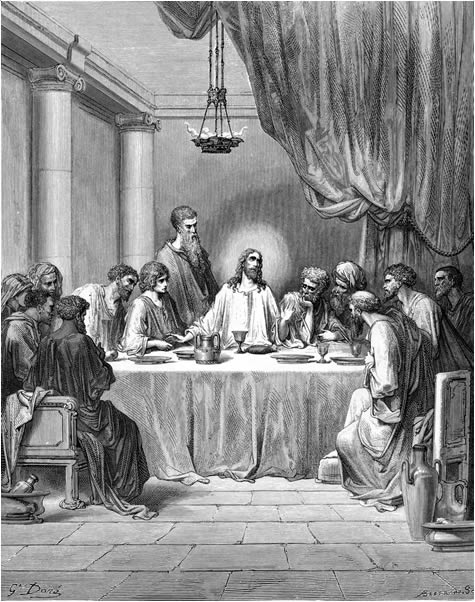
A dispute also arose among the disciples as to which of them would be considered the greatest, just after He spoke of His body given for them. He sets Gentile kings, who lord it over them, against His own example: I am among you as one who serves.
The record, by era
The Church Fathers4 voices
And they who gave in their branches green and cracked were always faithful and good, though emulous of each other about the foremost places, and about fame: now all these are foolish, in indulging in such a rivalry.
"Awake and watch" is one of the holy apostles' summons to us. The net of sin is spread everywhere, and Satan makes us his prey in different ways. He grabs hold of us by many passions and leads us on to a condemned mind.… The disciples had given in to human weakness and were arguing with one another about who was the leader and superior of the rest. Perhaps those who held the second rank among them were not willing to give way to those who held the first. This happened, and it was recorded for our benefit. What happened to the holy apostles may prove an incentive for humility in us. Christ immediately rebukes the sickness. Like a vigorous physician, he uses an earnest and deep-reaching commandment to cut away the passion that sprang up among them.
(in Reg. Brev. ad int. 301.) For as in bodily diseases there are many of which the affected are not sensible, but they rather put faith in the opinion of their physicians, than trust their own insensibility; so also in the diseases of the soul, though a man is not conscious of sin in himself, yet ought he to trust to those who are able to have more knowledge of their own sins.
If the disciples did contend, it is not alleged as any excuse, but held out as a warning. Let us then beware lest any contentions among us for precedence be our ruin.
The Medieval Church1 voice
There arose also a contention etc. After he described the machination of the betrayal and the institution of the Sacrament of the altar, here thirdly he describes the provident instruction of the disciples. And since a person is prepared for ruin in two ways: either …
11 more voices on this verse
The Medieval Church5 voices
(Apollinarius in loc.) Or the strife seems to have arisen from this, that when our Lord was departing from the world, it was thought that some one must become their head, as taking our Lord's place.
But a contention also arose among them, regarding who seemed to be the greatest among them. Just as it is customary for good morals in the Scriptures to always look to the examples of the preceding Fathers, by which they might progress to better things, …
As good men seek in the Scriptures the examples of their fathers, that they may thereby gain profit and be humbled, so the bad, if by chance they have discovered any thing blameable in the elect, most gladly seize upon it, to shelter their own iniquities thereby. Many therefore most eagerly read, that a strife arose among the disciples of Christ.
They are now troubled not only by the suspicion of betrayal among themselves, but from this confusion they pass to a dispute, arguing about which of them is the greatest. They arrived at this dispute in a natural progression. Probably one of them was saying …
While they were enquiring among themselves who should betray the Lord, they would naturally go on to say to one another, "Thou art the traitor," and so become impelled to say, "I am the best, I am the greatest." Hence it is said, And there was also a strife among them which should be accounted the greatest.
The Puritans and the Awakening1 voice
There was also a contention among them - It is highly probable, this was the same dispute which is mentioned by St. Matthew and St. Mark: and consequently, though it is related here, it happened some time before.
The Nineteenth Century5 voices
There was also a strife among them - There are two different instances of this sort of contention or strife mentioned by the evangelists, each of which was accompanied with very different circumstances; one by Matthew, in Mat 18:1, etc., by Mark, Mar 9:33, etc.; and by Luke, in Luk 9:46, etc. That contention cannot have been the same with this which is mentioned here.
A commentator
Jamieson, Fausset & Brown1802–1910
Commentary Critical and Explanatory on the Whole Bible (1871)
proposed
there was--or "had been," referring probably to some symptoms of the former strife which had reappeared, perhaps on seeing the whole paschal arrangements committed to two of the Twelve.
quarantine:debris (2026-07-29) — starts-lowercase
A commentator
J.C. Ryle1816–1900
Expository Thoughts on the Gospels: Luke (lightly modernized text, Grace Gems edition) (1858)
proposed
Let us observe, in this passage — how firmly pride and love of preeminence can stick to the hearts of Christian men. We are told that "There was a dispute among the disciples, as to which of them should be considered the greatest." The strife was one which had been rebuked by our Lord on a former occasion. The ordinance which the disciples had just been receiving, and the circumstances under which they were assembled — made the strife particularly inappropriate.
A commentator
J.C. Ryle1816–1900
Expository Thoughts on the Gospels: Luke (lightly modernized text, Grace Gems edition) (1858)
proposed
Let us observe, in this passage — how firmly pride and love of preeminence can stick to the hearts of Christian men. We are told that "There was a dispute among the disciples, as to which of them should be considered the greatest." The strife was one which had been rebuked by our Lord on a former occasion. The ordinance which the disciples had just been receiving, and the circumstances under which they were assembled — made the strife particularly inappropriate. And yet at this very season, the last quiet time they could spend with their Master before His death — this little flock begins a dispute, as to who should be the greatest! Such is the heart of man — ever weak, ever deceitful, ever ready, even at its best times, to turn aside to what is evil! The sin before us is a very old one. Ambition, self-esteem, and self-conceit — lie deep at the bottom of all men's hearts, and often in the hearts where they are least suspected! Thousands imagine that they are humble — who cannot bear to see an equal more honored and favored than themselves. Few indeed can be found who rejoice heartily in a neighbor's promotion over their own heads. The quantity of envy and jealousy in the world, is a glaring proof of the prevalence of pride. Men would not envy a brother's advancement — if they had not a secret thought that their own merit was greater than his. Let us live on our guard against this great evil — if we make any profession of serving Christ. The harm that it has done to the Church of Christ, is far beyond calculation. Let us learn to take pleasure in the prosperity of others — and to be content with the lowest place for ourselves. The rule given to the Philippians should be often before our eyes, "In lowliness of mind let each esteem others better than themselves."
A commentator
Albert Barnes1798–1870
Notes, Explanatory and Practical, on the Old and New Testaments (1832-1869)
proposed
A strife - A contention or debate. Which of them should be the greatest - The apostles, in common with the Jews generally, had supposed that the Messiah would come as a temporal prince, and in the manner of other princes of the earth - of course, that he would have officers of his government, ministers of state, etc. Their contention was founded on this expectation, and they were disputing which of them should be raised to the highest office. They had before had a similar contention. See Mat 18:1; Mat 20:20-28. Nothing can be more humiliating than that the disciples should have had “such” contentions, and in such a time and place. That just as Jesus was contemplating his own death, and laboring to prepare them for it, they should strive and contend about office and rank, shows how deeply seated is the love of power; how ambition will find its way into the most secret and sacred places; and how even the disciples of the meek and lowly Jesus are sometimes actuated by this most base and wicked feeling.
The words behind it
12 Greek wordsEvery Greek word of this verse in the order it stands, with what it means and the door to its own study. The last column counts the times a word stands in the whole Bible: the rarer the word, the more the places it appears belong together.
| Greek | Sound | Meaning | Word study | In the Bible |
|---|---|---|---|---|
| Ἐγένετο | egeneto | There was | G1096 → | 667 times |
| δὲ | de | then | G1161 → | 2765 times |
| καὶ | kai | also | G2532 → | 9120 times |
| φιλονεικία | philoneikia | a dispute | G5379 → | |
| ἐν | en | among | G1722 → | 2738 times |
| αὐτοῖς, | autois | them, | G846 → | 5565 times |
| τὸ | to | <the> | G3588 → | 19766 times |
| τίς | tis | which | G5101 → | 563 times |
| αὐτῶν | auton | of them | G846 → | 5565 times |
| δοκεῖ | dokei | is thought | G1380 → | 62 times |
| εἶναι | einai | to be | G1511 → | 123 times |
| μείζων. | meizon | [the] greatest. | G3173 → | 243 times |
ἘγένετοThere was
egenetoG1096 →667 times
δὲthen
deG1161 →2765 times
καὶalso
kaiG2532 →9120 times
φιλονεικίαa dispute
philoneikiaG5379 →
ἐνamong
enG1722 →2738 times
αὐτοῖς,them,
autoisG846 →5565 times
τὸ<the>
toG3588 →19766 times
τίςwhich
tisG5101 →563 times
αὐτῶνof them
autonG846 →5565 times
δοκεῖis thought
dokeiG1380 →62 times
εἶναιto be
einaiG1511 →123 times
μείζων.[the] greatest.
meizonG3173 →243 times
A shaded row is a word that stands 400 times or fewer in the Bible.
The walk
8 stopsEach card is a verse this one points to, and under it the verses that one points to in turn. Where several paths arrive at the same place, that place is listed first: the text keeps returning to it.
Through
Luke 9:46Then an argument started among the disciples as to which of them would be the greatest.
it leads to
- 3 John 1:9
I have written to the church about this, but Diotrephes, who loves to be first, will not accept our instruction.
Reached by 2 separate paths from here.
- Matthew 18:1–5
At that time the disciples came to Jesus and asked, “Who then is the greatest in the kingdom of heaven?”
- Mark 9:33–37
Then they came to Capernaum. While Jesus was in the house, He asked them, “What were you discussing on the way?”
- Matthew 20:20–22
Then the mother of Zebedee’s sons came to Jesus with her sons and knelt down to make a request of Him.
- Philippians 2:3
Do nothing out of selfish ambition or empty pride, but in humility consider others more important than yourselves.
- 3 John 1:9
Through
Mark 9:34But they were silent, for on the way they had been arguing about which of them was the greatest.
it leads to
- Mark 9:50
Salt is good, but if the salt loses its saltiness, with what will you season it? Have salt among yourselves, and be at peace with one another.”
- Philippians 2:3–7
Do nothing out of selfish ambition or empty pride, but in humility consider others more important than yourselves.
- 1 Peter 5:3
not lording it over those entrusted to you, but being examples to the flock.
- Mark 9:50
Where this verse is studied
On this page
Studies12
About Luke
This page draws on 18 works. Open the list of works
This page draws on Adam Clarke, Commentary on the Bible; Albert Barnes, Notes, Explanatory and Practical, on the Gospels; Albert Barnes, Notes, Explanatory and Practical, on the Old and New Testaments (1832-1869); Ambrose of Milan, Catena Aurea by Aquinas; Ancient Greek Expositor, Catena Aurea by Aquinas; Basil of Caesarea, Catena Aurea by Aquinas; Bede, On the Gospel of Luke; Bede, Catena Aurea by Aquinas; Bonaventure, Commentary on Luke, Chapter 22; Cyril of Alexandria, COMMENTARY ON LUKE, HOMILY 143; J.C. Ryle, Expository Thoughts on the Gospels: Luke (lightly modernized text, Grace Gems edition); Jamieson, Fausset & Brown, Commentary Critical and Explanatory on the Whole Bible; John Gill, Exposition of the New Testament (1746-1748); John Gill, Exposition of the New Testament; John Wesley, Explanatory Notes upon the New Testament; Shepherd of Hermas, Shepherd of Hermas, Similitude 8; Theophylact of Ohrid, Commentary on Luke and Theophylact of Ohrid, Catena Aurea by Aquinas.