
Luke 2:17
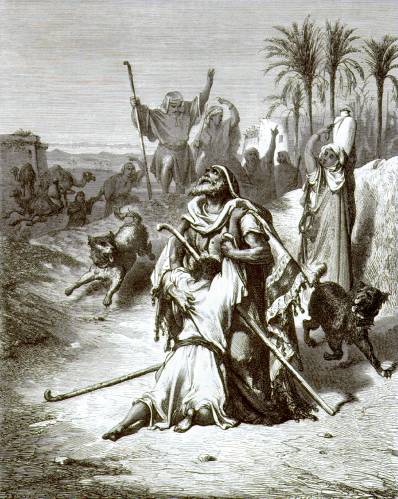
in Luke 2After they had seen the Child, they spread the message they had received about Him.
BSB
The same verse in ASV and KJV ▾
ASV
And when they saw it, they made known concerning the saying which was spoken to them about this child.
KJV
And when they had seen it, they made known abroad the saying which was told them concerning this child.
⋯
This verse in Luke 2
Commentary
18 notes on this verseAnd the angel of the Lord, he says, appeared to the shepherds, proclaiming joy to them: "For [Luke 2:11, etc.] there is born in the house of David, a Saviour, which is Christ the Lord. Then [appeared] a multitude of the heavenly host, praising God, and saying, Glory in the highest to God, and on earth peace, to men of good will." The falsely-called Gnostics say that these angels came from the Ogdoad, and made manifest the descent of the superior Christ.
This site's exposition
the shepherds said to one another
on Luke 2:15-17
When the angels had left them, the shepherds said to one another, Let us go to Bethlehem and see this thing that has happened, testing the word at once. So they hurried off and found Mary and Joseph and the Baby, who was lying in the manger, with the haste Mary showed at 1:39, the sign confirmed by sight. They spread the message they had received about Him, and shepherds become the Gospel’s first preachers before any apostle is called.
This site's exposition
they spread the message they had received about Him
Once the shepherds had seen the Child, they had evidence to give others, as Barnes explains. Clarke calls them the first preachers of the good news. Bede applies the verse to every shepherd in the church.
The record, by era
The Medieval Church5 voices
(Photius) Beholding with hidden faith indeed the happy events which had been told them, and not content with marvelling at the reality of those things which at the very first they saw and embraced when the Angel told them, they began to relate them not only to Mary and Joseph, but to the others also, (and what is more they impressed them on their minds,) as it follows, And all who heard it marvelled. For how could it be otherwise, at the sight of one of the heavenly host upon earth, and earth in peace reconciled to heaven; and that ineffable Child binding together in one, by His divinity, heavenly things, by His humanity, earthly things, and by this conjunction of Himself effecting a wonderful union!
The shepherds did not keep silent about the hidden mysteries that they had come to know by divine influence. They told whomever they could. Spiritual shepherds in the church are appointed especially for this, that they may proclaim the mysteries of the Word of God …
It seems to succeed in due order, that after having rightly celebrated the incarnation of the Word, we should at length come to behold the actual glory of that Word. Hence it follows: But when they saw it, they made known the word which had been spoken to them.
The shepherds did not hide in silence what they knew, because to this end have the Shepherds of the Church been ordained, that what they have learned in the Scriptures they might explain to their hearers.
And because this sign was given by the Angel, therefore it is added: But seeing, they recognized concerning the word that had been spoken to them about this child, namely, that it was true. Whence they could now say that word of the Samaritans to …
10 more voices on this verse
The Medieval Church1 voice
And when they see this bread, it is their obligation to proclaim it to others as well, just as the shepherds, having seen the Infant, told others about Him.
The Puritans and the Awakening2 voices
9 , This being a day of good tidings, we dare not hold our peace ), so they made known abroad the whole story of what was told them, both by the angels, and by Joseph and Mary, concerning this child, that he was the Saviour, even Christ the Lord, that in him there is peace on earth, and that he was conceived by the power of the Holy Ghost, and born of a virgin.
quarantine:debris (2026-07-29) — unbalanced-parens
And when they had seen it,....
The Nineteenth Century6 voices
A commentator
Albert Barnes1798–1870
Notes, Explanatory and Practical, on the Old and New Testaments (1832-1869)
When they had see it - When they had satisfied themselves of the truth of the coming of the Messiah, and had ascertained that they could not have been mistaken in the appearance of the angels. There was evidence enough to satisfy “them” that what the angels said was true, or they would not have gone to Bethlehem. Having seen the child themselves, they had now evidence that would satisfy others; and accordingly they became the first preachers of the “gospel,” and went and proclaimed to others that the Messiah had come.
A commentator
J.C. Ryle1816–1900
Expository Thoughts on the Gospels: Luke (lightly modernized text, Grace Gems edition) (1858)
proposed
We read, in these verses — how the birth of the Lord Jesus was first announced to mankind. The birth of a king's son is generally made an occasion of public reveling and rejoicing. But the announcement of the birth of the Prince of Peace was made privately, at midnight, and without anything of worldly pomp and ostentation. Let us mark WHO they were, to whom the tidings first came that Christ was born . They were shepherds abiding in the field near Bethlehem, keeping watch over their flocks by night.
A commentator
J.C. Ryle1816–1900
Expository Thoughts on the Gospels: Luke (lightly modernized text, Grace Gems edition) (1858)
proposed
We read, in these verses — how the birth of the Lord Jesus was first announced to mankind. The birth of a king's son is generally made an occasion of public reveling and rejoicing. But the announcement of the birth of the Prince of Peace was made privately, at midnight, and without anything of worldly pomp and ostentation. Let us mark WHO they were, to whom the tidings first came that Christ was born . They were shepherds abiding in the field near Bethlehem, keeping watch over their flocks by night. To shepherds — not to priests and rulers; to shepherds — not to Scribes and Pharisees, an angel appeared, proclaiming, "unto you is born this day a Savior, who is Christ the Lord." The saying of James should come into our mind, as we read these words, "Has not God chosen the poor of this world, to be rich in faith and heirs of the kingdom, which he has promised to those who love him." (James 2:5.) The lack of money debars no one from spiritual privileges. The things of God's kingdom are often hidden from the great and noble, and revealed to the poor. The busy labor of the hands need not prevent a man being favored with special communion with God. Moses was keeping sheep, Gideon was threshing wheat, Elisha was ploughing, when they were each honored by direct calls and revelations from God. Let us resist the suggestion of Satan, that religion is not for the working man. The weak of the world, are often called before the mighty. The last are often first — and the first last. Let us mark, secondly — the LANGUAGE used by the angel in announcing Christ's birth to the shepherds. He said, "I bring unto you good tidings of great joy, which shall be to all people." We need not wonder at these words. The spiritual darkness which had covered the earth for four thousand years, was about to be rolled away.
EVERY season has its own proper fruit—apples for autumn, holly berries for Christmas. The earth brings forth according to the period of the year and with man there is a time for every purpose under Heaven. At this season the world is engaged in congratulating itself and in expressing its complimentary wishes for the good of its citizens. Let me suggest extra and more solid work for Christians.
EVERY season has its own proper fruit—apples for autumn, holly berries for Christmas. The earth brings forth according to the period of the year and with man there is a time for every purpose under Heaven. At this season the world is engaged in congratulating itself and in expressing its complimentary wishes for the good of its citizens. Let me suggest extra and more solid work for Christians. As we think, today, of the birth of the Savior, let us aspire after a fresh birth of the Savior in our hearts—that as He is already "formed in us the hope of glory," we may be "renewed in the spirit of our minds"—that we may go again to the Bethlehem of our spiritual nativity and do our first works, enjoy our first loves and feast with Jesus as we did in the holy, happy, heavenly days of our espousals. Let us go to Jesus with something of that youthful freshness and excessive delight which was so manifest in us when we looked to Him at first. Let Him be crowned anew by us, for He is still adorned with the dew of His youth and remains "the same yesterday, today and forever." The citizens of Durham, though they dwell not far from the Scotch border, and consequently in the olden times were frequently liable to be attacked, were exempted from the toils of war because there was a cathedral within their walls and they were set aside to the bishop's service, being called in the olden times by the name of "holy work-folk." Now, we citizens of the New Jerusalem, having the Lord Jesus in our midst, may well excuse ourselves from the ordinary ways of celebrating this season. And considering ourselves to be "holy work-folk," we may keep it, after a different sort from other men, in holy contemplation and in blessed service of that gracious God whose unspeakable gift the new-born King is to us.
They made known abroad the saying - These shepherds were the first preachers of the Gospel of Christ: and what was their text? Why, Glory to God in the highest heavens, and on earth peace and good will among men. This is the elegant and energetic saying which comprises the sum and substance of the Gospel of God. This, and this only, is the message which all Christ’s true pastors or shepherds bring to men. He who, while he professes the religion of Christ, disturbs society by his preachings or writings, who excludes from the salvation of God all who hold not his religious or political creed, never knew the nature of the Gospel, and never felt its power or influence. How can religious contentions, civil broils, or open wars, look that Gospel in the face which publishes nothing but glory to God, and peace and good will among men? Crusades for the recovery of a holy land so called, (by the way, latterly, the most unholy in the map of the world), and wars for the support of religion, are an insult to the Gospel, and blasphemy against God!
Modern Voices1 voice
A commentator
G.K. Chesterton1874–1936
The Everlasting Man, Part II Ch. 1 "The God in the Cave" (1925)
The shepherds had found their Shepherd.
The words behind it
13 Greek wordsEvery Greek word of this verse in the order it stands, with what it means and the door to its own study. The last column counts the times a word stands in the whole Bible: the rarer the word, the more the places it appears belong together.
| Greek | Sound | Meaning | Word study | In the Bible |
|---|---|---|---|---|
| ἰδόντες | idontes | Having seen | G1492 → | 374 times |
| δὲ | de | now | G1161 → | 2765 times |
| ἐγνώρισαν | egnorisan | they made known | G1107 → | |
| περὶ | peri | concerning | G4012 → | 332 times |
| τοῦ | tou | the | G3588 → | 19766 times |
| ῥήματος | rhematos | declaration | G4487 → | 68 times |
| τοῦ | tou | which | G3588 → | 19766 times |
| λαληθέντος | lalethentos | having been told | G2980 → | 294 times |
| αὐτοῖς | autois | to them | G846 → | 5565 times |
| περὶ | peri | concerning | G4012 → | 332 times |
| τοῦ | tou | <the> | G3588 → | 19766 times |
| παιδίου | paidiou | Child | G3813 → | 51 times |
| τούτου. | toutou | this. | G3778 → | 1381 times |
ἰδόντεςHaving seen
idontesG1492 →374 times
δὲnow
deG1161 →2765 times
ἐγνώρισανthey made known
egnorisanG1107 →
περὶconcerning
periG4012 →332 times
τοῦthe
touG3588 →19766 times
ῥήματοςdeclaration
rhematosG4487 →68 times
τοῦwhich
touG3588 →19766 times
λαληθέντοςhaving been told
lalethentosG2980 →294 times
αὐτοῖςto them
autoisG846 →5565 times
περὶconcerning
periG4012 →332 times
τοῦ<the>
touG3588 →19766 times
παιδίουChild
paidiouG3813 →51 times
τούτου.this.
toutouG3778 →1381 times
A shaded row is a word that stands 400 times or fewer in the Bible.
The walk
8 stopsEach card is a verse this one points to, and under it the verses that one points to in turn. Where several paths arrive at the same place, that place is listed first: the text keeps returning to it.
Through
Psalms 66:16Come and listen, all you who fear God, and I will declare what He has done for me.
it leads to
- Psalms 71:15
My mouth will declare Your righteousness and Your salvation all day long, though I cannot know their full measure.
- Psalms 34:11
Come, children, listen to me; I will teach you the fear of the LORD.
- Psalms 71:18
Even when I am old and gray, do not forsake me, O God, until I proclaim Your power to the next generation, Your might to all who are to come.
- Malachi 3:16
At that time those who feared the LORD spoke with one another, and the LORD listened and heard them. So a scroll of remembrance was written before Him regarding those who feared the LORD…
- 1 John 1:3
We proclaim to you what we have seen and heard, so that you also may have fellowship with us. And this fellowship of ours is with the Father and with His Son, Jesus Christ.
- Psalms 71:15
Through
Luke 8:39“Return home and describe how much God has done for you.” So the man went away and proclaimed all over the town how much Jesus had done for him.
it leads to
- 1 Timothy 5:8
If anyone does not provide for his own, and especially his own household, he has denied the faith and is worse than an unbeliever.
- John 4:29
“Come, see a man who told me everything I ever did. Could this be the Christ?”
- 1 Timothy 5:8
Through
Luke 2:38Coming forward at that moment, she gave thanks to God and spoke about the Child to all who were waiting for the redemption of Jerusalem.
it leads to
- Luke 2:25
Now there was a man in Jerusalem named Simeon, who was righteous and devout. He was waiting for the consolation of Israel, and the Holy Spirit was upon him.
- Luke 2:25
Where this verse is studied
On this page
Studies12
On this verse
About Luke
This page draws on 14 works. Open the list of works
This page draws on Adam Clarke, Commentary on the Bible; Albert Barnes, Notes, Explanatory and Practical, on the Old and New Testaments (1832-1869); Ancient Greek Expositor, Catena Aurea by Aquinas; Bede, Homilies on the Gospels 1.7; Bede, Catena Aurea by Aquinas; Bonaventure, Commentary on Luke, Chapter 2; Charles Spurgeon, The Metropolitan Tabernacle Pulpit, Sermon No. 666: “Holy Work For Christmas” (lightly modernized text, CCEL edition); G.K. Chesterton, The Everlasting Man, Part II Ch. 1 "The God in the Cave"; Irenaeus, Against Heresies (Book III, Chapter 10); J.C. Ryle, Expository Thoughts on the Gospels: Luke (lightly modernized text, Grace Gems edition); Jamieson, Fausset & Brown, Commentary Critical and Explanatory on the Whole Bible; John Gill, Exposition of the New Testament (1746-1748); Matthew Henry, Commentary on the Whole Bible and Theophylact of Ohrid, Commentary on Luke.