
Luke 2 · Story · Waiting
Anna in the Temple
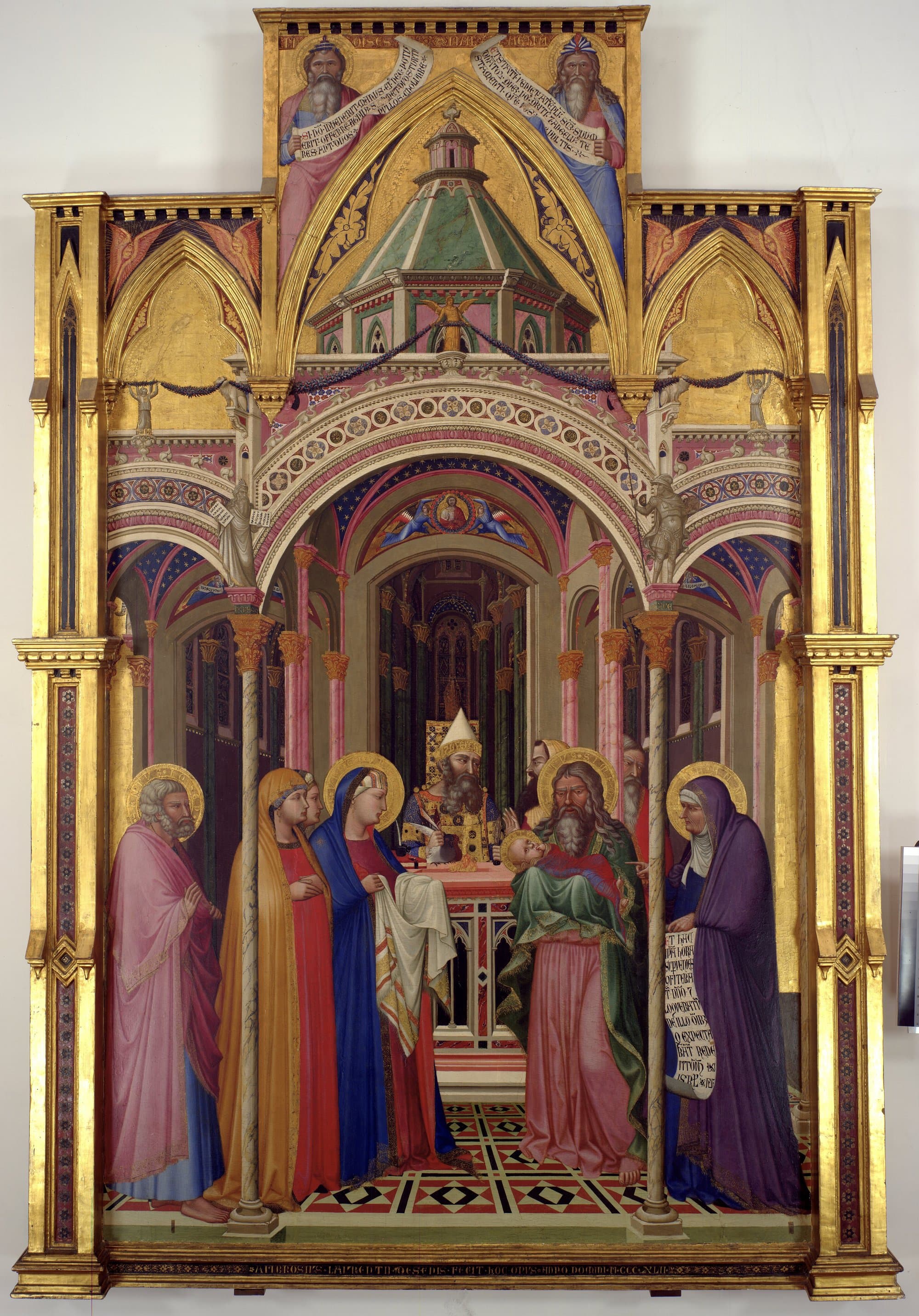
Anna, a prophetess of the tribe of Asher, gave thanks to God when Mary and Joseph brought the infant Jesus to the temple in Jerusalem.
One hour in the temple courts brought an end to Anna's long waiting.
Coming forward at that moment, she gave thanks to God and spoke about the Child to all who were waiting for the redemption of Jerusalem.
- Where
- Jerusalem, The Temple
- Who
- Anna, Jesus of Nazareth, Mary, Mother of Jesus, Joseph of Nazareth
Summary
Luke sets two worshipers in the temple when Jesus is presented to the Lord, Simeon and Anna. Anna had spent a long widowhood in worship, fasting and prayer, and she recognized the Child as the One for whom she and others had waited. She answered with thanks to God and with speech about Him to others who looked for Jerusalem's redemption. Her story shows a waiting kept up for decades in worship.
- Anna was a prophetess of Asher, one of the northern tribes, and she was widowed after seven years of marriage (Luke 2:36 to 37).
- Luke describes Simeon and the people Anna spoke to with one Greek verb, prosdechomai (Luke 2:25 and Luke 2:38).
- Anna came forward in the same hour as Simeon's blessing, so two aged worshipers greeted the Child together (Luke 2:38).
A Widow Who Waited in the Temple
Luke's account of the presentation of Jesus closes with Anna.
Waiting is the trial this study belongs to. Anna's waiting was measured in decades, and Luke tells it in three verses. She was an old woman who worshiped in the temple at Jerusalem until the day Mary and Joseph brought their firstborn there.
The question this study answers is how Anna waited and what she did when her waiting ended. It sets her life and the day of the presentation on a timeline, tells the scene beside Simeon, and explains her family and her title. It weighs two readings of her years and of her service in the temple, and it reads the Greek verb Luke uses for the people who were waiting with her.
From Her Marriage to the Day of the Presentation
Luke dates none of these events by a year.
Five events lead from Anna's marriage to the hour she came forward in the temple.
- Anna is married"She had been married for seven years"Luke 2:36
- Her husband dies and she remains a widow"and then was a widow"Luke 2:37
- She worships in the temple through the years"She never left the temple"Luke 2:37
- Mary and Joseph bring Jesus to Jerusalem"to present Him to the Lord"Luke 2:22
- Simeon takes the Child and blesses God"Simeon took Him in his arms"Luke 2:28
A timeline of five events, each row carrying words of its verse from the Berean text.
The Hour of the Presentation
Anna came forward while Simeon was still with the family.
Mary and Joseph came to the temple when the time of purification under the Law of Moses was complete. They came to present their firstborn to the Lord and to offer "A pair of turtledoves or two young pigeons" (Luke 2:22 to 24).
Simeon, a righteous and devout man on whom the Holy Spirit rested, had been promised that he would see the Lord's Christ before he died. The Spirit led him into the temple courts that day (Luke 2:25 to 28). His song is the Nunc Dimittis, one of the canticles of Luke's first two chapters.
Luke says Anna came forward at that moment, and the Greek reads, word for word, at that hour.
Two Readings of Luke 2:37
Commentators have read Anna's years and her service in the temple in more than one way.
Eighty-four years: her age or her widowhoodLuke 2:37
The Greek of Luke 2:37 reads chēra heōs etōn ogdoēkonta tessarōn, word for word a widow until years eighty-four. The Berean text renders it as her age, "to the age of eighty-four."
Albert Barnes read it the same way: "That is, she was about 84 years of age. It does not mean that she had been a widow for that long time". John Gill read the number as the length of "her widowhood state, as distinct from her marriage state, and the time of her virginity".
She never left the templeLuke 2:37
Jamieson, Fausset and Brown read "She never left the temple" to mean that Anna "was found there at all stated hours of the day, and even during the night services of the temple watchmen". Adam Clarke wrote that she attended "at the hours of prayer, which were nine in the morning and three in the afternoon". Barnes took "night and day" to mean "at the usual times of public worship and in private."
Come, bless the LORD, all you servants of the LORD who serve by night in the house of the LORD!The psalm is the text these commentators give for worship at night in the temple.
Phanuel, Asher and the Title Prophetess
Luke names Anna's father, her tribe and her calling in one verse.
Anna and her father Phanuel are each named in one verse of the New Testament, Luke 2:36.
Jamieson, Fausset and Brown note that Asher was "one of the ten tribes, of whom many were not carried captive, and not a few reunited themselves to Judah after the return from Babylon". At Hezekiah's Passover, "some from Asher, Manasseh, and Zebulun humbled themselves and came to Jerusalem" (2 Chronicles 30:11).
The Greek word for prophetess, prophētis, stands in two verses of the New Testament. One is Luke 2:36, and the other is Revelation 2:20, where the church at Thyatira tolerates "that woman Jezebel, who calls herself a prophetess."
Albert Barnes wrote in his Notes, "Why Anna was called a prophetess is not known". He named three possibilities: she had been the wife of a prophet, she was employed in celebrating the praises of God, or she had foretold future events.
Waiting for the Redemption of Jerusalem
The verb looks back to the prophets' promise of a redeemed Jerusalem.
In Luke 2:25 Simeon is prosdechomenos, waiting for the consolation of Israel. In Luke 2:38 the people Anna spoke to are prosdechomenois, waiting for the redemption of Jerusalem. Both are forms of the verb prosdechomai, which can also mean to welcome.
The study of the words qavah and prosdechomai follows the verb through the rest of the New Testament.
Break forth in joy, sing together, O ruins of Jerusalem, for the LORD has comforted His people; He has redeemed Jerusalem.Isaiah's song is the promise behind both hopes Luke names in this scene.
The same hope was still alive after the crucifixion. On the road to Emmaus two disciples said, "But we were hoping He was the One who would redeem Israel" (Luke 24:21).
How Anna Has Been Taught
Anna's fasting and her old age each gave a later writer a lesson.
died 220 · Tertullian
Tertullian held up Anna's widowhood and her fasting as a pattern for those who serve the church.
“We produce, too, our remaining (evidences). For we now hasten to modern proofs. On the threshold of the Gospel, Anna the prophetess, daughter of Phanuel, ‘who both recognised the infant Lord, and preached many things about Him to such as were expecting the redemption of Israel,’ after the pre-eminent distinction of long-continued and single-husbanded widowhood, is additionally graced with the testimony of ‘fastings’ also; pointing out, as she does, what the duties are which should characterize attendants of the Church, and (pointing out, too, the fact) that Christ is understood by none more than by the once married and often fasting.”
Tertullian · On Fasting · on Luke 2:36Patristic
1703 to 1791 · John Wesley
An eighteenth-century reading set Anna beside Simeon as an example for believers in old age.
“And the revival of the spirit of prophecy, together with the memorable occurrences relating to the birth of John the Baptist, and of Jesus, could not but encourage and quicken the expectation of pious persons at this time. Let the example of these aged saints animate those, whose hoary heads, like theirs, are a crown of glory, being found in the way of righteousness.”
John Wesley · Explanatory Notes upon the New Testament · on Luke 2:38Evangelical
Thanks at the End of a Long Wait
Paul later set Anna's way of waiting before the widows of the church.
The prayer and fasting of her widowhood were the form her waiting took, and when the Child came they turned to thanks and to witness.
The widow who is truly in need and left all alone puts her hope in God and continues night and day in her petitions and prayers.Paul's rule for the church's widows sets out the pattern Anna kept, which is why the verse closes her story.
Sources
Scripture is the Berean Standard Bible.
- STEP Bible, the Translators Amalgamated Greek New Testament (TAGNT), Tyndale House, Cambridge, CC BY 4.0.
- STEP Bible, the Brief lexicon of Extended Strongs for Greek (TBESG), Tyndale House, Cambridge, CC BY 4.0, based on Abbott-Smith (1922)
- Albert Barnes, Notes, Explanatory and Practical, on Luke 2:36 and 2:37.
- John Gill, Exposition of the New Testament (1746 to 1748), on Luke 2:37.
- Jamieson, Fausset and Brown, Commentary Critical and Explanatory on the Whole Bible (1871), on Luke 2:36 and 2:37.
- Adam Clarke, Commentary on the Bible (1832), on Luke 2:37.
- Tertullian, On Fasting, on Luke 2:36 to 37.
- John Wesley, Explanatory Notes upon the New Testament (1755), on Luke 2:38.
Keep Studying
Read it1