
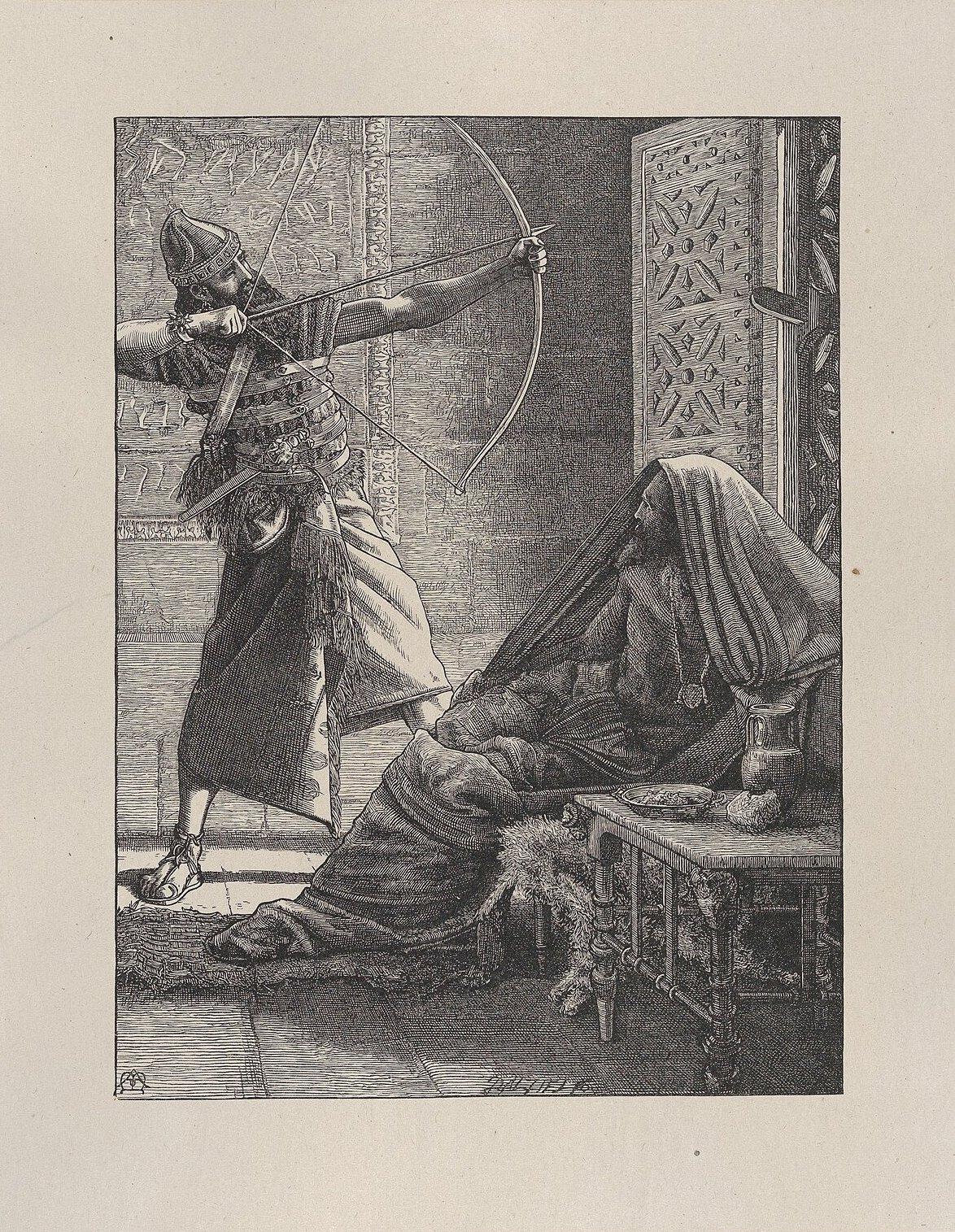
Arthur Murch, The Arrow of Deliverance, 1865 to 1881. Public domain.
Joshua 13:13 · Place · Featured Study
Syria
Syria is the Greek name for the land of Aram, and the name of a Roman province in the Gospels and Acts.
Hazael asked how a mere dog could do such a monstrous thing, and Elisha answered that the LORD had shown him Hazael would be king over Aram.
but the Israelites did not drive out the Geshurites or the Maacathites. So Geshur and Maacath dwell among the Israelites to this day.
but the Israelites did not drive out the Geshurites or the Maacathites. So Geshur and Maacath dwell among the Israelites to this day.
- Region
- North-east of Israel; under Rome, a province that took in Judea
- First named
- Matthew 4:24 “…about Him spread all over Syria, and people…”
- Last named
- Galatians 1:21 “…went to the regions of Syria and Cilicia.”
Summary
Aram fought Israel and Judah from the days of Asa to the days of Ahaz.
- A seer rebuked Asa for leaning on the king of Aram (2 Chronicles 16:7).
- Isaiah called Rezin and Pekah two stubs of firewood (Isaiah 7:1 to 4).
- The king of Aram took many captives to Damascus (2 Chronicles 28:5).
Syria and the Book of Joshua
The name Syria came to the land of Aram through the Greek.
This study asks how Aram came to be called Syria and what its kingdom and province meant for Israel and the church. It sets the wars on an atlas plate and weighs three readings of the census in Luke 2:2.
Joshua 1:4 sets the land's reach from the wilderness and Lebanon to the great River Euphrates. Adam Clarke, the Methodist commentator, writes on that verse that Israel did not hold the full grant until the days of David.
Clarke also writes, on Genesis 10:22, that the Arameans were afterwards called Syrians. The American Standard Version of 1901 prints Syria in 68 verses, 60 of them in the Old Testament, where the Hebrew has Aram. The Berean text prints Syria in eight verses, all in the New Testament.
The study of Aram sets Geshur and Zobah among the states of the Arameans and teaches their name and their tongue.
The Wars on Smith's Plate
The plate of the times of Elijah and Elisha prints Damascus and the cities of Israel the armies of Aram reached.
Damascus, the seat of Aram's kings, stands north-east of the three places in Israel where their armies fought.
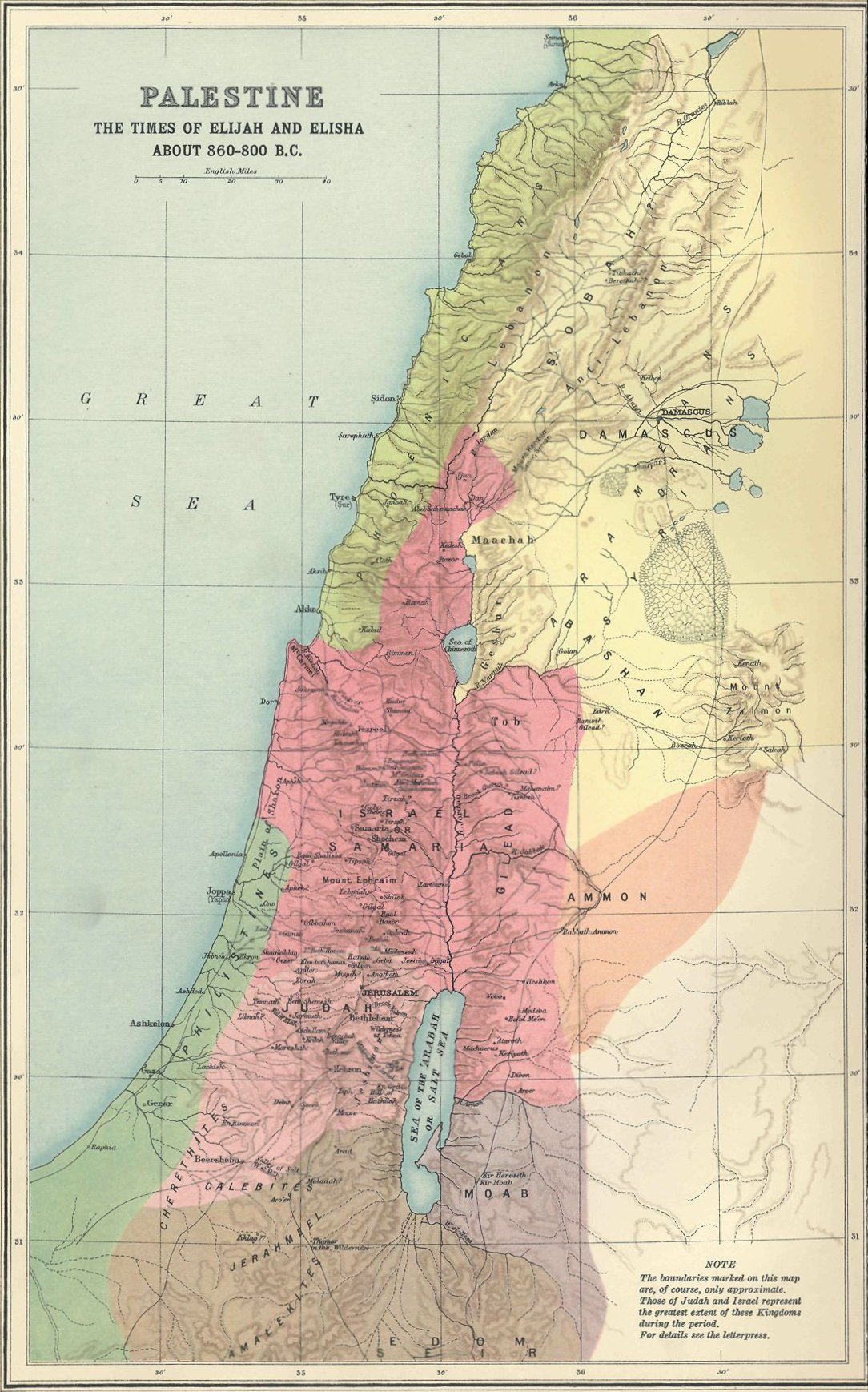
- DamascusElisha came to Damascus while Ben-hadad king of Aram lay sick. The plate prints the city with no query, the north-easternmost point, and its place is known.2 Kings 8:7
- DanBen-hadad's commanders conquered Ijon, Dan and Abel-beth-maacah. The plate prints Dan with no query, at the foot of Mount Hermon, and its place is known.1 Kings 15:20
- Ramoth-gileadJoram and Ahaziah fought Hazael at Ramoth-gilead, and the Arameans wounded Joram. The plate prints the town with a query, east of the Jordan, so its place is proposed.2 Kings 8:28
- SamariaBen-hadad assembled his entire army and marched up to besiege Samaria. The plate prints Samaria with no query, the south-westernmost point, and its place is known.2 Kings 6:24
George Adam Smith, Palestine in the Times of Elijah and Elisha, about 860 to 800 B.C., in his Atlas of the Historical Geography of the Holy Land, 1915. Public domain; File:Palestine in the times of Elijah and Elisha (Smith, 1915).jpg.
Four numbered points, each where George Adam Smith's plate prints the place, with north at the top. The plate's note says its boundaries are only approximate, and it prints a scale in English miles.
Aram and Israel at War, in Order
Kings records sieges, raids and a battle on the plain.
Two of the eight moments end with an Aramean army sent home or put to flight without a battle.
- The reign of AsaAsa sends silver and gold to Ben-hadad to break his treaty with Baasha1 Kings 15:18 to 19
- The first siege of SamariaBen-hadad and thirty-two kings besiege Samaria1 Kings 20:1
- The battle at AphekIsrael's small army defeats the Arameans, and the city wall falls on the rest1 Kings 20:27 to 30
- Ahab's last battleAn arrow drawn without aim strikes the king of Israel, and he dies that evening1 Kings 22:34 to 35
- Elisha at DothanThe LORD strikes the Aramean army with blindness, and the king of Israel feeds them and sends them home2 Kings 6:18 to 23
- The siege liftedThe Lord makes the Arameans hear a great army, and they flee and leave their camp2 Kings 7:6 to 7
- Elisha's last wordJehoash strikes the ground three times, and Elisha promises him three victories over Aram2 Kings 13:18 to 19
- The reign of AhazRezin of Aram and Pekah of Israel besiege Ahaz in Jerusalem and cannot overcome him2 Kings 16:5
Eight moments from 1 Kings to 2 Kings in the order of the canon, each with its verse.
Elisha's last word, The reign of Ahaz
The study of Elisha at Dothan tells the blinded army whole, and the study of Gath tells how Hazael of Aram took that city.
Syria in the Days of the Apostles
Matthew, Luke, Acts and Galatians name Syria among the lands of the Roman world.
Josephus, in his Antiquities of the Jews, writes that Judea was added to the province of Syria. In William Whiston's translation the man Caesar sent is Cyrenius, one that had been consul, sent to take account of the people's substance.
News about Him spread all over Syria, and people brought to Him all who were ill with various diseases, those suffering acute pain, the demon-possessed, those having seizures, and the paralyzed—and He healed them.Matthew uses the province's name to show how far the report of Jesus reached.
John Wesley, on that verse, takes Syria as the whole province, of which the Jewish country was only a small part.
and sent them with this letter: The apostles and the elders, your brothers, To the brothers among the Gentiles in Antioch, Syria, and Cilicia: Greetings.The council at Jerusalem sent its letter to the believers of this province and its neighbour.
Albert Barnes, the American commentator, notes on that verse that Antioch was the capital of Syria. Paul went to the regions of Syria and Cilicia after his first visit to Jerusalem (Galatians 1:18 to 21), and later strengthened the churches there (Acts 15:41).
What the Text Leaves Unsaid
Kings gives no place for the battles that won back Israel's cities.
2 Kings 13:25 says that Jehoash defeated Ben-hadad son of Hazael three times and recovered the cities of Israel, and it names no battlefield.
God of the Hills and the Valleys
The LORD answers the Aramean claim that He rules only the hills.
Meanwhile, the servants of the king of Aram said to him, “Their gods are gods of the hills. That is why they prevailed over us. Instead, we should fight them on the plains; surely then we will prevail.Their plan rests on the belief that each god ruled one kind of ground.
Then the man of God approached the king of Israel and said, “This is what the LORD says: ‘Because the Arameans think the LORD is a god of the hills and not of the valleys, I will deliver all this great army into your hand. Then you will know that I am the LORD.’”The LORD makes the battle a lesson in who He is.
Voices on Syria
Jamieson, Fausset and Brown wrote on Elisha's last sign against Aram.
Jamieson, Fausset & Brown (1802 to 1910)
“His laying his hands upon the king's hands was to represent the power imparted to the bow shot as coming from the Lord through the medium of the prophet. His shooting the first arrow eastward--to that part of his kingdom which the Syrians had taken and which was east of Samaria--was a declaration of war against them for the invasion.”
Jamieson, Fausset & Brown · Commentary Critical and Explanatory on the Whole Bible · on 2 Kings 13:15 to 18Reformed
The Census of Luke 2:2
Readers differ on how Luke's census under Quirinius fits the days of King Herod.
Now in those days a decree went out from Caesar Augustus that a census should be taken of the whole empire. This was the first census to take place while Quirinius was governor of Syria.Luke ties the birth of Jesus to the rule of Rome.
The first of two enrolmentsJohn Gill, Exposition of the New Testament
John Gill, the Baptist commentator, reads the verse as the first enrolment in the Jewish nation. He sets a second one later, in the days when Judas the Galilean arose (Acts 5:37).
The objection: Josephus sets the census of Quirinius after Archelaus was banished, and Luke names Quirinius as governor at the first census.
The first to take in the whole worldBede, in Thomas Aquinas's Catena Aurea
Bede, the English monk, reads first in one of two ways. It may mean the first census of the whole world, since many lands had been taxed before, or the census that began when Quirinius was sent into Syria.
The objection: Luke 2:2 still names Quirinius as governor while the census took place.
A governor ten years laterAdam Clarke, Commentary on the Bible
Clarke holds that Quirinius was not governor of Syria until ten or twelve years after the birth of Christ, and that under Herod the governor was Quintilius Varus. He cites Josephus for it.
The objection: Gill and Bede each read first so that the census need not fall in Quirinius's later governorship.
Only Naaman the Syrian
Grace reached a commander of Aram while many in Israel went without it. Luke 4 asks the reader to welcome God's mercy when it reaches outsiders.
And there were many lepers in Israel in the time of Elisha the prophet. Yet not one of them was cleansed—only Naaman the Syrian.”Jesus answers the people of Nazareth with a foreigner's healing.
Sources
Scripture is the Berean Standard Bible.
- American Standard Version (1901)
- M. G. Easton, Illustrated Bible Dictionary (1897), entries Aram and Syria.
- Adam Clarke, Commentary on the Bible (1832), on Joshua 1:4.
- Adam Clarke, Commentary on the Bible (1832), on Genesis 10:22.
- Flavius Josephus, Antiquities of the Jews, trans. William Whiston, Book 17, chapter 13, section 5, and Book 18, chapter 1, section 1.
- John Wesley, Explanatory Notes upon the New Testament (1755), on Matthew 4:24.
- Albert Barnes, Notes, Explanatory and Practical, on the Old and New Testaments (1832 to 1869), on Acts 15:23.
- Jamieson, Fausset and Brown, Commentary Critical and Explanatory on the Whole Bible (1871), on 2 Kings 13:15 to 18.
- John Gill, Exposition of the New Testament (1746 to 1748), on Luke 2:2.
- Bede, on Luke 2:2, in Thomas Aquinas, Catena Aurea.
- Adam Clarke, Commentary on the Bible (1832), on Luke 2:2.
Keep Studying
Read it4
Places7
Church history1