
Matthewchapter 14
36 verses · Matthew, by tradition · AD 50 to 65 · The Gospels
Key verse
But Jesus said unto them, They need not depart; give ye them to eat.
It stands in Five Loaves, Two Fish, Five Thousand Fed, verses 13 to 21.
The chapter
Chapter summary
John the Baptist beheaded at Herod's birthday feast. Jesus withdraws; five thousand fed from five loaves and two fish, twelve baskets remain. Jesus walks on the sea to the disciples in the storm; Peter walks and sinks: 'O thou of little faith, wherefore didst thou doubt?' Gennesaret's sick touch the hem of his garment.
Context
Gospel · Matthew · Matthew overview
The world of this chapter
The Galilean ministry under Herod Antipas · c. AD 29 · Antipas's court, a remote place on the lakeshore, and the water in the last hours before dawn · Jewish readers who knew that speaking truth to a Herod could cost a head
Historical context
The marriage John denounced was a genuine scandal with political consequences. Antipas dismissed his first wife, a daughter of King Aretas of Nabatea, in order to marry Herodias, who was the wife of his own half-brother. Josephus reports that the insult led to war with Aretas, and that many Jews regarded Antipas's later military defeat as God's judgement for what he did to John.
The birthday banquet is a Greco-Roman scene, not a Jewish one. A ruler feasting his officers, entertainment during the drinking, and a grand public oath sworn before guests he could not lose face in front of, the trap Herod walks into is a trap made of honour.
The feeding takes place in open country in spring, which is why there is grass to sit on. Five loaves would have been small flat barley cakes, the cheap bread of the poor. Counting only the men, as Matthew does, follows the ordinary practice of the day and means the actual crowd was considerably larger.
The fourth watch is Roman timekeeping: the night was split into four watches, so this is roughly three to six in the morning. The disciples had been fighting a headwind for most of the night on a lake where the wind funnels down the valleys after dark.
Significance
Placing John's execution beside the feeding of the crowd sets two banquets side by side, one where a king kills a prophet to save face, and one where the King feeds thousands of strangers on a hillside.
For readers facing rulers of their own, the sequence said something plain: the prophets die, and the kingdom is not stopped. And Peter on the water gave them the picture of themselves, walking, sinking, and caught by a hand that was already close enough to reach.
Where the chapter sits
Matthew 14 falls in Parables of the Kingdom (chapters 13). Discourse 3: hidden then revealed.
Before it: Mission of the Twelve, chapters 10. After it: Community in the Kingdom, chapters 18.
The whole shape of Matthew→The structure of this chapter
The heads below are this chapter's scenes. The numbered points under each are its verses.
A. Herod's Birthday and the Head of John
1. (vv. 1-2)
heard of the fame of Jesus: Herod the tetrarch heard of the fame of Jesus is Herod Antipas, son of Herod the Great and ruler of Galilee and Perea, the same man who had John beheaded and whom Jesus later calls that fox in Luke 13:32. This is risen from the dead betrays a guilty conscience rather than a settled theology of resurrection, a superstitious dread that the prophet he silenced has returned with greater power than before; the bench reads Herod's fear as the same pattern verse 5 will describe him living under all along, a ruler who knew righteousness and feared it more than he desired it.
Matthew 14:1
“At that time Herod the tetrarch--Herod Antipas, one of the three sons of Herod the Great, and own brother of Archelaus (Mt 2:22), who ruled as ethnarch over Galilee and Perea. heard of the fame of Jesus--"for His name was spread abroad" (Mr 6:14).”
Jamieson, Fausset & Brown· Commentary Critical and Explanatory on the Whole Bible (1871)reformed
2 more voices on this verseWhat preachers and commentators have said about this verse, in their own words.
Matthew 14:1
“One of the Ecclesiastical interpreters asks what caused Herod to think that John was risen from the dead; as though we had to account for the errors of an alien, or as though the heresy of metempsychosis was at all supported by this place—a heresy which teaches that souls pass through various bodies after a long period of years—for the Lord was thirty years old when John was beheaded.”
Jerome· written before 420· Catena Aurea by Aquinaspatristic
Matthew 14:1
“Herod the tetrarch - See also Mar 6:14-16; Luk 9:7-9. This was a son of Herod the Great. Herod the Great died probably in the first year after the birth of Christ, and left his kingdom to his three sons, of whom this “Herod Antipas” was one. He ruled over Galilee and Perea. See the notes at Mat 2:15. The title “tetrarch” literally denotes one who rules over a “fourth” part of any country. It came, however, to signify the governor or ruler of any province subject to the Roman emperor - Robinson, Lexicon.”
Matthew 14:2
“And said unto his servants--his counsellors or court-ministers. This is John the Baptist: he is risen from the dead, &c.--The murdered prophet haunted his guilty breast like a specter and seemed to him alive again and clothed with unearthly powers in the person of Jesus.”
Jamieson, Fausset & Brown· Commentary Critical and Explanatory on the Whole Bible (1871)reformed
4 more voices on this verse
Matthew 14:2
“The Jews had different opinions about the resurrection. Some of them were false. The Sadducees did not believe in the resurrection of the dead or in the existence of angels. They believed those things that were written about them were only to be interpreted figuratively but had no reality in point of fact.Other Jewish views of the resurrection were true, such as were taught by the Pharisees about the resurrection of the dead—that they rise.We must now therefore inquire about the opinion regarding the soul, which was mistakenly held by Herod and some from among the people.”
Origen of Alexandria· written before 253· COMMENTARY ON MATTHEW 10.20patristic
Matthew 14:2
“He is risen from the dead - Herod was a Sadducee: and the Sadducees denied the resurrection of the dead. But Sadduceeism staggers when conscience awakes.”
John Wesley· Explanatory Notes upon the New Testament (1755)evangelical
Matthew 14:2
“This is John the Baptist - Ον εγω απεκεφαλισα, Whom I beheaded. These words are added here by the Codex Bezae and several others, by the Saxon, and five copies of the Itala. - See the power of conscience! He is miserable because he is guilty; being continually under the dominion of self-accusation, reproach, and remorse. No need for the Baptist now: conscience performs the office of ten thousand accusers! But, to complete the misery, a guilty conscience offers no relief from God - points out no salvation from sin.”
Adam Clarke· Commentary on the Bible (1810-1826)evangelical
Matthew 14:2
“Herodias laid the plot; her implacable revenge thirsted after John's blood, and would be satisfied with nothing less. Cross the carnal appetites, and they turn into the most barbarous passions; it was a woman, a whore, and the mother of harlots, that was drunk with the blood of the saints, Rev. xvii.”
Matthew Henry· Commentary on the Whole Bible (1707-1721)puritan
2. (vv. 3-5)
for Herodias’ sake: Herod had laid hold on John for Herodias' sake, his brother Philip's wife, and Matthew names the marriage that John had publicly condemned as unlawful under Leviticus 18:16 and 20:21, since Philip was still living. The bench notes a genuine identification question here, since Josephus names Herodias's first husband Herod, not Philip, likely a half-brother distinct from Philip the tetrarch of 16:13; the family carried multiple sons named similarly, and the confusion belongs to the historical record rather than to any error in the Gospel's own account of the marriage's unlawfulness. He feared the multitude, because they counted him as a prophet explains why Herod held John rather than killing him outright despite wanting to.
Matthew 14:3
“For Herod had laid hold on John,.... By his servants, whom he sent to apprehend him: and bound him; laid him in chains, as if he was a malefactor; and put him in prison, in the castle of Machaerus (d), for Herodias's sake; who was angry with him, had a bitter quarrel against him, and by whose instigation all this was done; who was his brother Philip's wife.”
2 more voices on this verse
Matthew 14:3
“For Herod had laid hold on John ... - See Mar 6:17-20; Luk 3:19-20. This Herodias was a granddaughter of Herod the Great. She was first married to Herod Philip, by whom she had a daughter, Salome, probably the one that danced and pleased Herod. Josephus says that this marriage of Herod Antipas with Herodias took place while he was on a journey to Rome.”
Matthew 14:3
“For this sin John reproved him; not by tacit and oblique allusions, but in plain terms, It is not lawful for thee to have her. He charges it upon him as a sin; not, It is not honourable, or, It is not safe, but, It is not lawful; the sinfulness of sin, as it is the transgression of the law, is the worst thing in it.”
Matthew Henry· Commentary on the Whole Bible (1707-1721)puritan
Matthew 14:4
“It is not lawful for thee to have her - It was not lawful indeed for either of them to have her. For her father Aristobulus was their own brother. John's words were rough, like his raiment.”
John Wesley· Explanatory Notes upon the New Testament (1755)evangelical
Matthew 14:5
“He would have put him to death - ln his fit of passion; but he was then restrained by fear of the multitude; and afterward by the reverence he bore him.”
John Wesley· Explanatory Notes upon the New Testament (1755)evangelical
1 more voice on this verse
Matthew 14:5
“Note, The way of sin, especially the sin of persecution, is down-hill; and when once a respect to Christ's ministers is cast off and broken through in one instance, that is at length done, which the man would sooner have thought himself a dog than to have been guilty of, 2 Kings viii.”
Matthew Henry· Commentary on the Whole Bible (1707-1721)puritan
3. (vv. 6-8)
danced before them: The daughter of Herodias danced before them at Herod's birthday feast, a performance the bench reads as beneath the dignity a princess would ordinarily keep, more fitting a paid entertainer than the daughter of the house, and it pleased Herod enough to draw a rash oath before his whole court. Being before instructed of her mother names Herodias, not the girl, as the scheme's real author, waiting for exactly this opening to finish what Herod's own fear of the people had so far prevented, and her demand comes back with grim precision, John Baptist's head in a charger.
Matthew 14:6
“But when Herod's birthday was kept,.... The birthdays of princes, both of their coming into the world, and accession to the throne of government, were kept by the Gentiles; as by the Egyptians, Gen 40:20 and by the (n) Persians, and Romans (o), and other nations, but not by the Jews; who reckon these among the feasts of idolaters.”
1 more voice on this verse
Matthew 14:6
“Herod’s birth-day - Either the day in which he was born, or the day on which he began to reign; for both were termed birth-days. See 1Sa 13:1, and Hos 7:5. The kings of Persia were accustomed to reject no petition that was preferred to them during the entertainment. See Herodotus in Calliope, and Est 5:3. The daughter - danced - This was Salome, mentioned before.”
Adam Clarke· Commentary on the Bible (1810-1826)evangelical
Matthew 14:8
“Give me here John Baptist’s head in a charger - The word charger formerly signified a large dish, bowl, or drinking cup: the Saxon has a dish, Tindal, a platter; any thing is better than charger, which never conveyed much meaning, and now conveys none. The evangelist says she was instructed before, by her mother, to ask the Baptist’s head! What a most infernal mother, to give such instructions to her child! and what a promising daughter to receive them!”
Adam Clarke· Commentary on the Bible (1810-1826)evangelical
1 more voice on this verse
Matthew 14:8
“She was before instructed of her mother. Note, The case of those children is very sad, whose parents are their counsellors to do wickedly, as Ahaziah's ( 2 Chron. xxii. 3 ); who instruct them and encourage them in sin, and set them bad examples; for the corrupt nature will sooner be quickened by bad instructions than restrained and mortified by good ones.”
Matthew Henry· Commentary on the Whole Bible (1707-1721)puritan
4. (vv. 9-11)
the king was sorry: , and the bench reads the sorrow as real but shallow, a conscience troubled yet not strong enough to overrule the shame of breaking an oath in front of guests whose good opinion mattered more to him than a prophet's life. Nevertheless for the oath's sake shows a scruple about vows outlasting every scruple about murder, an oath rashly sworn treated as more binding than the law that forbade the killing it was used to justify. His head was brought in a charger closes the scene with the starkest image the Gospels give of court cruelty, a girl carrying a martyr's head to her mother as a trophy.
Matthew 14:9
“The king was sorry - He knew John to be a righteous man, and at first did many things gladly which John told him it was his duty to perform: Mar 6:20. Nevertheless, for the oath’s sake - The Oaths, ορκους - he had probably sworn again and again - one sin begets many. And them which sat with him at meat - Who were probably such as himself, and would have considered it a breach of honor if he had not fulfilled his sworn promise: he therefore commanded it to be given!”
Adam Clarke· Commentary on the Bible (1810-1826)evangelical
3 more voices on this verse
Matthew 14:9
“Otherwise; It is the manner of Scripture to speak of events as they were commonly viewed at the time by all. So Joseph is called by Mary herself the father of Jesus; so here Herod is said to be sorry, because the guests believed that he was so. This dissembler of his own inclinations, this contriver of a murder displayed sorrow in his face, when he had joy in his mind. For his oath's sake, and them which sat with him at meat, he commanded it to be given.”
Jerome· written before 420· Catena Aurea by Aquinaspatristic
Matthew 14:9
“The king was sorry, at least took on him to be so, but, for the oath's sake, he commanded it to be given her. Here is, [1.] A pretended concern for John. Note, Many a man sins with regret, that never has any true regret for his sin; is sorry to sin, yet is utterly a stranger to godly sorrow; sins with reluctancy, and yet goes on to sin.”
Matthew Henry· Commentary on the Whole Bible (1707-1721)puritan
Matthew 14:9
“And the king was sorry - Knowing that John was a good man. Yet for the oath's sake - So he murdered an innocent man from mere tenderness of conscience.”
John Wesley· Explanatory Notes upon the New Testament (1755)evangelical
Matthew 14:10
“And he sent and beheaded John in the prison, and his head was given to the damsel - How mysterious is the providence, which left the life of so holy a man in such infamous hands! which permitted it to be sacrificed to the malice of an abandoned harlot, the petulancy of a vain girl, and the rashness of a foolish, perhaps drunken prince, who made a prophet's head the reward of a dance!”
John Wesley· Explanatory Notes upon the New Testament (1755)evangelical
1 more voice on this verse
Matthew 14:10
“It was done in the night, for it was at supper-time, after supper, it is likely. It was done in the prison, not at the usual place of execution, for fear of an uproar. A great deal of innocent blood, of martyr's blood, has thus been huddled up in corners, which, when God comes to make inquisition for blood, the earth shall disclose, and shall no more cover, Isa. xxvi.”
Matthew Henry· Commentary on the Whole Bible (1707-1721)puritan
Matthew 14:11
“His head was given to the damsel: and she brought it to her mother - There is no person so revengeful as a lascivious woman when reproved and blamed. A preacher of the Gospel has most to fear from this quarter: - the first of this profession lost his life for the sake of truth and chastity; and others, especially those who have any thing to do with men in power who are profligates, may learn what they are to expect in return for a faithful discharge of their duty.”
Adam Clarke· Commentary on the Bible (1810-1826)evangelical
5. (v. 12)
took up the body: His disciples came, and took up the body, and buried it, the last honor John's own followers could pay their teacher, and went and told Jesus closes the account by turning it toward the one it always pointed to. The bench reads this small notice as significant: John's disciples, some of whom had already transferred allegiance to Jesus at John 1:35-37, bring the news of his death directly to the one whose way he had come to prepare, the forerunner's ministry ending where it had always aimed.
Matthew 14:12
“And his disciples came,.... To the prison where his body was left, and to which they had liberty of recourse before; see Mat 11:2 and very probably, upon hearing what was done, might apply to Herod, as Joseph of Arimathea did to Pilate, for the body of Jesus; who might, as he did, give them leave to take it: and took up the body and buried it. Theophylact says, his body was buried in Baste Caesarea, and that his head was first reposited in Emesesa.”
2 more voices on this verse
Matthew 14:12
“And his disciples came and took his body and buried it. Josephus reports in a certain town of Arabia that John was beheaded. And what follows: His disciples came and took the body, both of him (John) and of the Savior, we can understand.”
Jerome· written before 420· Commentary on Matthewpatristic
Matthew 14:12
“His disciples came, and took up the Body - The Head was in the possession of Herodias, who, ’tis probable, took a diabolic pleasure in viewing that speechless mouth which had often been the cause of planting thorns in her criminal bed; and in offering indignities to that tongue from which she could no longer dread a reproof. Her character justifies every bad conjecture that can well be formed on this head: and St. Jerome positively says that, when she got it, she drew out the tongue, and thrust it through with her bodkin.”
Adam Clarke· Commentary on the Bible (1810-1826)evangelical
B. Five Loaves, Two Fish, Five Thousand Fed
1. (v. 13)
by ship into a desert place: Jesus departed thence by ship into a desert place apart on hearing of John's death, and the bench reads the withdrawal both as ordinary human grief for a kinsman and forerunner and as prudent caution, since the same ruler who killed John now sets his curious eye on Jesus in verse 1. The multitude will not let him keep the solitude, following him on foot around the shore faster than the boat could carry him, and the desert place that was meant for retreat becomes instead the setting for the next miracle.
Matthew 14:13
“A full narrative of the feeding the five thousand is given in each of the other evangelists: in Mar 6:32-44; in Luk 9:10-17; in Joh 6:1-14. Mat 14:13 And when Jesus heard of it, he departed - He went to a place of safety. He never threw himself unnecessarily into danger. It was proper that he should secure his life until the appointed time had come for him to die. By a ship into a desert place - That is, he crossed the Sea of Galilee. He went to the country east of the sea, into a place little inhabited.”
2 more voices on this verse
Matthew 14:13
“He did not retire into the desert through fear of death, as some suppose, but in mercy to His enemies, that they might not add murder to murder; putting off His death till the day of His passion; on which day the lamb is to be slain as the sacrament, and the posts of them that believe to be sprinkled with the blood. Or, He retired to leave us an example to shun that rashness which leads men to surrender themselves voluntarily, because not all persevere with like constancy under torture with the which they offered themselves to it.”
Jerome· written before 420· Catena Aurea by Aquinaspatristic
Matthew 14:13
“It should seem, there was more crowding to Christ after John's martyrdom than before. Sometimes the suffering of the saints are made to further the gospel ( Phil. i. 12 ), and "the blood of the martyrs is the seed of the church." Now John's testimony was finished, it was recollected, and more improved than ever.”
Matthew Henry· Commentary on the Whole Bible (1707-1721)puritan
2. (v. 14)
moved with compassion: He was moved with compassion toward them despite the grief and the interrupted rest he had sought, and the bench reads this as one of the clearest windows in the Gospel into the Lord's own heart, splanchnizomai, a compassion felt in the body rather than a distant pity, the same word used of the father running to the prodigal in Luke 15:20. He healed their sick before he fed them, meeting the need in front of him first and the larger need the evening would bring only after.
Matthew 14:14
“Jesus - was moved with compassion - Εσπλαγχνισθε, he was moved with tender compassion, so I think the word should in general be translated: see the note on Mat 9:36. As a verb, it does not appear to have been used by any but ecclesiastical writers. It always intimates that motion of the bowels, accompanied with extreme tenderness and concern, which is felt at the sight of the miseries of another.”
Adam Clarke· Commentary on the Bible (1810-1826)evangelical
1 more voice on this verse
Matthew 14:14
“Note, In all the favours Christ shows to us, he is moved with compassion, Isa. lxiii. The motion which the disciples made for the dismissing of the congregation, and Christ's setting aside the motion. The evening drawing on, the disciples moved it to Christ to send the multitude away; they thought there was a good day's work done, and it was time to disperse.”
Matthew Henry· Commentary on the Whole Bible (1707-1721)puritan
3. (vv. 15-18)
buy themselves victuals: The disciples' proposal that the people go into the villages and buy themselves victuals is the ordinary, reasonable solution, and Jesus refuses it outright, they need not depart, give ye them to eat. The bench reads the disciples' answer, we have here but five loaves, and two fishes, as an honest accounting meant to prove the impossibility of his command, and his reply, bring them hither to me, as the whole point of the miracle about to follow: not that the need was small, but that whatever is placed in his hands becomes sufficient.
Matthew 14:15
“And when it was evening,.... Mark says, "when the day was now far spent"; and Luke, "when the day began to wear away"; it was upon the decline of the day.”
Matthew 14:16
“They need not depart - He that seeks first the kingdom of heaven is sure to have every temporal requisite. When a man ensures the first, God always takes care to throw the other into the bargain. He who has an interest in Jesus has in him an inexhaustible treasure of spiritual and temporal good. Though the means by which man may help his fellows have failed, we are not to suppose that the bounty of God is exhausted.”
Adam Clarke· Commentary on the Bible (1810-1826)evangelical
1 more voice on this verse
Matthew 14:16
“OF course the Master was right, but He appeared to speak unreasonably. It seemed self-evident that the people very much needed to depart. They had been all day long hearing the Preacher. The most of them had not broken their fast and they were ready to faint for hunger. The only chance of their being fed was to let them break up into small parties and forage for themselves among the surrounding villages. But our Lord declared that there was no necessity for them to go away from Him, even though they were hungry, famished and in a desert place.”
Charles Spurgeon· written before 1892· The Metropolitan Tabernacle Pulpit, Sermon No. 3046: “One of the Master's Choice Sayings” (lightly modernized text, CCEL edition)Particular Baptist
Matthew 14:17
“We have here but five loaves and two fishes - When we are deeply conscious of our own necessities, we shall be led to depend on Jesus with a firmer faith. God often permits his servants to be brought low, that they may have repeated opportunities of proving the kindness and mercy of their gracious Lord and Master.”
Adam Clarke· Commentary on the Bible (1810-1826)evangelical
4 more voices on this verse
Matthew 14:17
“When the disciples advised that the crowds be sent away into the neighboring villages to buy food, he answered, "They do not need to go away." This signaled that these people whom he healed with the food of teaching, teaching that was not for sale, had no need to go back to Judea and buy food. He ordered the apostles to give them something to eat.But was Jesus unaware there was nothing to give? Did he not know the disciples possessed a limited amount of food? He could read their minds, so he knew.”
Hilary of Poitiers· written before 367· Commentary on Matthew 14.10patristic
Matthew 14:17
“Or, by the two fishes we may understand the Prophets, and the Psalms, for the whole of the Old Testament was comprehended in these three, the Law, the Prophets, and the Psalms.”
Rabanus Maurus· written before 856· Catena Aurea by Aquinaspatristic
Matthew 14:17
As was Christ, my Brethren, when in this world, so are we also. Such, indeed, is our calling of God. As Jesus was "the true light which lights every man that comes into the world," so He says to His disciples, "You are the light of the world." How memorable are those words of our Lord—"As You, Father, have sent Me into the world, even so have I also sent them into the world!" And how weighty are those expressions of the Apostle—"We pray you in Christ's place." "We then, as workers together with Him!"
Matthew 14:17
“Wherein He calls the Apostles to breaking of bread, that the greatness of the miracle might be more evident by their testimony that they had none.”
Jerome· written before 420· Catena Aurea by Aquinaspatristic
Matthew 14:18
“He said, bring them hither to me. The loaves and the fishes, signifying that they were sufficient; or that he would make them so: this he said, to try their faith in him, their obedience to him, and their liberality to others: and indeed, the best way to have an increase of temporal supplies, is to bring what we have, and put it into Christ's hands; whereby not only good is done to others, but that with an overplus is returned to the giver.”
2 more voices on this verse
Matthew 14:18
“Bring them hither to me - No creature of God should be considered as good or safe without the blessing of God in it. If thou have but even a handful of meal and a few herbs, bring them to Christ by prayer and faith, and he will make them a sufficiency for thy body, and a sacrament to thy soul.”
Adam Clarke· Commentary on the Bible (1810-1826)evangelical
Matthew 14:18
“Note, The way to have our creature-like comforts, comforts indeed to us, is to bring them to Christ; for every thing is sanctified by his word, and by prayer to him: that is likely to prosper and do well with us, which we put into the hands of our Lord Jesus, that he may dispose of it as he pleases, and that we may take it back from his hand, and then it will be doubly sweet to us.”
Matthew Henry· Commentary on the Whole Bible (1707-1721)puritan
4. (vv. 19-21)
looking up to heaven: , he blessed, and brake, and gave the loaves to his disciples describes a Jewish table blessing, thanks given before the meal rather than a blessing of the bread itself, and the bench notes the increase happened in his hands and passed through the disciples' own, so that every one of the twelve became a distributor of a miracle he could not have performed himself. Twelve baskets full of fragments remained, one for each disciple, and the count of five thousand men beside women and children likely pushed the true number well past ten thousand fed from five loaves and two fishes.
Matthew 14:19
“And took the five loaves, etc. - This was the act of the father of a family among the Jews - his business it was to take the bread into his hands, and render thanks to God, before any of the family was permitted to taste of it. Looking up to heaven - To teach us to acknowledge God as the Supreme Good, and fountain of all excellence.”
Adam Clarke· Commentary on the Bible (1810-1826)evangelical
1 more voice on this verse
Matthew 14:19
“While the Lord breaks there is a sowing of food; for had the loaves been whole and not broken into fragments, and thus divided into a manifold harvest, they could not have fed so great a multitude. The multitude receives the food from the Lord through the Apostles; as it follows, And he gave the loaves to his disciples, and the disciples to the multitude.”
Jerome· written before 420· Catena Aurea by Aquinaspatristic
Matthew 14:20
“And they did all eat,.... Christ and his twelve disciples, and the five thousand men, with the women and children, of the five loaves and two fishes; everyone had their portion, and were filled; they were satisfied, they had a full meal, they had enough, and to spare; see 2Ch 31:10 which the Targumist paraphrases thus.”
1 more voice on this verse
Matthew 14:20
“They did all eat, and were filled - Little or much is the same in the hands of Jesus Christ. Here was an incontestable miracle - five thousand men, besides women and children, fed with five cakes and two fishes! Here must have been a manifest creation of substance - the parts of the bread were not dilated to make them appear large, nor was there any delusion in the eating - for they all ate, and were all filled. Here then is one miracle of our Lord attested by at least five thousand persons!”
Adam Clarke· Commentary on the Bible (1810-1826)evangelical
Matthew 14:21
“To the number of loaves, five, the number of the men that ate is apportioned, five thousand; And the number of them that had eaten was about five thousand men, besides women and children. There partook five thousand who had reached maturity; for women and children, the weaker sex, and the tender age, were unworthy of number; thus in the book of Numbers, slaves, women, children, and an undistinguished crowd, are passed over unnumbered.”
Jerome· written before 420· Catena Aurea by Aquinaspatristic
1 more voice on this verse
Matthew 14:21
“And they that had eaten were about five thousand men,.... The word "about", is omitted in the Vulgate Latin, in Munster's Hebrew Gospel, and in the Syriac, Arabic, and Persic versions, which expressly say there were so many.”
C. Walking on the Water; Peter Begins to Sink
1. (vv. 22-23)
constrained his disciples: Jesus straightway constrained his disciples to get into a ship, and John 6:15 explains the urgency Matthew leaves unstated here, the crowd meant to come and take him by force to make him a king, a popular acclaim built on bread rather than on who he was that he had to break up immediately. He went up into a mountain apart to pray, alone at last after a day that began in grief and ended in a miracle, the bench reading his need for solitary prayer as no mere example for disciples but as his own regular practice under the weight of public demand.
Matthew 14:22
“Jesus constrained his disciples to get into a ship - Either they were afraid to return into the jurisdiction of Herod, or they were unwilling to embark without their Lord and Protector, and would not enter their boat till Christ had commanded them to embark. From this verse it appears that Christ gave some advices to the multitudes after the departure of his disciples, which he did not wish them to hear. Unto the other side - Towards Capernaum, Mat 14:34. Joh 6:16, Joh 6:17, or Bethsaida, see on Mar 6:45 (note).”
Adam Clarke· Commentary on the Bible (1810-1826)evangelical
1 more voice on this verse
Matthew 14:22
“The history contained in these verses is one of singular interest. The miracle here recorded brings out in strong light the character both of Christ and his people. The power and mercy of the Lord Jesus, and the mixture of faith and unbelief in his best disciples, are beautifully illustrated. We learn in the first place, from this miracle what absolute dominion our Saviour has over all created things. We see him “walking on the sea,” as if it was dry land.”
J.C. Ryle· Expository Thoughts on the Gospels: Matthew (1856)Reformed Evangelical
Matthew 14:23
“He went up into a mountain apart, to pray - He whom God has employed in a work of mercy had need to return, by prayer, as speedily, to his Maker, as he can, lest he should be tempted to value himself on account of that in which he has no merit - for the good that is done upon earth, the Lord doth it alone. Some make this part of our Lord’s conduct emblematic of the spirit and practice of prayer, and observe that the proper dispositions and circumstances for praying well are: 1. Retirement from the world.”
Adam Clarke· Commentary on the Bible (1810-1826)evangelical
2 more voices on this verse
Matthew 14:23
“That He withdraws to pray alone, you should refer not to Him who fed five thousand on five loaves, but to Him who on hearing of the death of John withdrew into the desert; not that we would separate the Lord's person into two parts, but that His actions are divided between the God and the man. Also He ascends into the mountain alone because the multitude cannot follow Him aloft, until He has instructed it by the shore of the sea.”
Jerome· written before 420· Catena Aurea by Aquinaspatristic
Matthew 14:23
“That he was alone at prayer; that was his business in this solitude, to pray. Though Christ, as God, was Lord of all, and was prayed to, yet Christ, as Man, had the form of a servant, of a beggar, and prayed. Christ has herein set before us an example of secret prayer, and the performance of it secretly, according to the rule he gave, ch. vi.”
Matthew Henry· Commentary on the Whole Bible (1707-1721)puritan
2. (vv. 24-27)
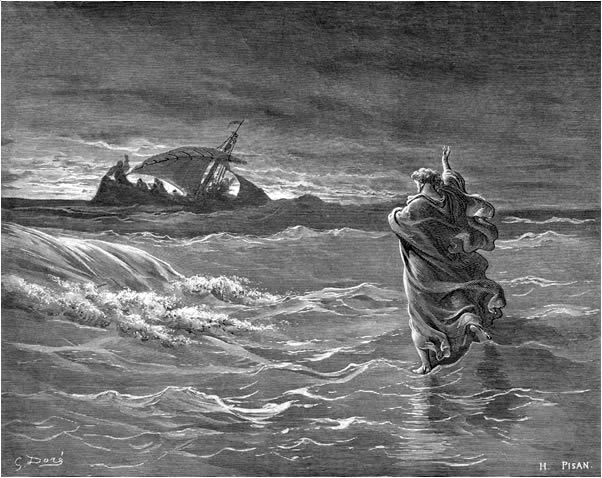
tossed with waves: The ship was tossed with waves, the wind contrary, for hours through the night before Jesus came to them in the fourth watch, between three and six in the morning, walking on the sea. The disciples' cry, it is a spirit, betrays real terror rather than mere surprise, and his answer carries the weight of the divine name itself, be of good cheer; it is I; be not afraid, ego eimi echoing the LORD's own self-naming to Moses, spoken here over water that will not hold up any ordinary man's feet.
Matthew 14:24
“Rightly had the Apostles departed from the Lord as unwilling, and slow to leave Him, lest they should suffer shipwreck whilst He was not with them. For it follows, Now when it was evening he was there alone; that is, in the mountain; but the boat was in the middle of the sea tossed with the waves; for the wind was contrary. While the Lord tarries in the top of the mountain, straightway a wind arises contrary to them, and stirs up the sea, and the disciples are in imminent peril of shipwreck, which continues till Jesus comes.”
Jerome· written before 420· Catena Aurea by Aquinaspatristic
3 more voices on this verse
Matthew 14:24
“Tossed with waves - Grievously agitated. This is the proper meaning of the word βασανιζομενον: but one MS. reads βαπτιζομενον, plunged under the waves, frequently covered with them; the waves often breaking over the vessel.”
Adam Clarke· Commentary on the Bible (1810-1826)evangelical
Matthew 14:24
“Note, It is no new thing for Christ's disciples to meet with storms in the way of their duty, and to be sent to sea then when their Master foresees a storm; but let them not take it unkindly; what he does they know not now, but they shall know hereafter, that Christ designs hereby to manifest himself with the more wonderful grace to them and for them.”
Matthew Henry· Commentary on the Whole Bible (1707-1721)puritan
Matthew 14:24
“In the evening - Learned men say the Jews reckoned two evenings; the first beginning at three in the afternoon, the second, at sunset. If so, the latter is meant here.”
John Wesley· Explanatory Notes upon the New Testament (1755)evangelical
Matthew 14:25
“And in the fourth watch of the night - The Jews anciently divided the night into three parts of four hours each, usually called watches. The first of these watches is mentioned in Lam 2:19, the middle watch in Jdg 7:19, and the morning watch in Exo 14:24. In the time of our Saviour they divided the night into four watches, the fourth having been introduced by the Romans.”
Matthew 14:26
“SOME of the richest comforts are lost to us for want of clear perception. What consolation could be greater to the tempest-tossed disciples than to know their Master was present, and to see Him manifestly revealed as Lord of sea as well as land? Yet because they did not discern Him clearly, they missed the incomparable consolation. What is worse, at times the dimness of our perception will even turn the rarest consolation into the source of fear.”
1 more voice on this verse
Matthew 14:26
“It is a spirit - That the spirits of the dead might and did appear, was a doctrine held by the greatest and holiest of men that ever existed; and a doctrine which the caviliers, free-thinkers and bound-thinkers, of different ages, have never been able to disprove.”
Adam Clarke· Commentary on the Bible (1810-1826)evangelical
Matthew 14:27
“Whereas He says, It is I, without saying who, either they might be able to understand Him speaking through the darkness of night; or they might know that it was He who had spoken to Moses, Say unto the children of Israel, He that is has sent me unto you. (Exod. 3:14.)”
Jerome· written before 420· Catena Aurea by Aquinaspatristic
3. (vv. 28-31)
bid me come unto thee on the water: Peter's request, bid me come unto thee on the water, is unique to Matthew among the Gospels, and the bench reads it as characteristic of the man, bold faith reaching past what the other eleven attempted. He walked on the water so long as his eyes stayed on the word that called him, and began to sink the moment he saw the wind boisterous, the fourth sounding of the little-faith refrain, O thou of little faith, wherefore didst thou doubt, spoken to a disciple in the very act of doing what no disciple had done before, faith enough to step out and too little to finish the walk.
Matthew 14:28
“Bid me come unto thee on the water - A weak faith is always wishing for signs and miracles. To take Christ at his word, argues not only the perfection of faith, but also the highest exercise of sound reason. He is to be credited on his own word, because he is the Truth, and therefore can neither lie nor deceive.”
Adam Clarke· Commentary on the Bible (1810-1826)evangelical
2 more voices on this verse
Matthew 14:28
“If it be thou - It is the same as, Since it is thou. The particle if frequently bears this meaning, both in ours and in all languages. So it means, John xiii, 14, 17.”
John Wesley· Explanatory Notes upon the New Testament (1755)evangelical
Matthew 14:28
“A FEW reflections will be sure to cross the mind of any thoughtful reader of this narrative. I. THE MIXED CHARACTER OF THE BELIEVER'S EXPERIENCE is here very palpably suggested to us. Peter was undoubtedly a bold believer in Jesus Christ. He addresses his Master devoutly, calling Him, "Lord"—a name of reverence, the use of which evidences the change that had been worked in his character, and the obedient spirit it had produced. But the misgivings implied in that, "if—"if it is You"—savors rather of unbelief!”
Charles Spurgeon· written before 1892· The Metropolitan Tabernacle Pulpit, Sermon No. 3562: “Peter Walking on the Sea” (lightly modernized text, CCEL edition)Particular Baptist
Matthew 14:29
“Let those who think that the Lord's body was not real, because He walked upon the yielding waters as a light æthereal substance, answer here how Peter walked, whom they by no means deny to be man.”
Jerome· written before 420· Catena Aurea by Aquinaspatristic
1 more voice on this verse
Matthew 14:29
“Peter - walked on the water - However impossible the thing commanded by Christ may appear, it is certain he will give power to accomplish it to those who receive his word by faith; but we must take care never to put Christ’s power to the proof for the gratification of a vain curiosity; or even for the strengthening of our faith, when the ordinary means for doing that are within our reach.”
Adam Clarke· Commentary on the Bible (1810-1826)evangelical
Matthew 14:30
“When he saw the wind boisterous, he was afraid - It was by faith in the power of Christ he was upheld; when that faith failed, by which the laws of gravitation were suspended, no wonder that those laws returned to their wonted action, and that he began to sink. It was not the violence of the winds, nor the raging of the waves, which endangered his life, but his littleness of faith.”
Adam Clarke· Commentary on the Bible (1810-1826)evangelical
3 more voices on this verse
Matthew 14:30
“Moreover he is left to temptation for a short season, that his faith may be increased, and that he may understand that he is saved not by his ability to ask, but by the power of the Lord. For faith burned at his heart, but human frailty drew him into the deep.”
Jerome· written before 420· Catena Aurea by Aquinaspatristic
Matthew 14:30
“He was afraid - Though he had been used to the sea, and was a skilful swimmer. When grace begins to act, the natural courage and strength are withdrawn.”
John Wesley· Explanatory Notes upon the New Testament (1755)evangelical
Matthew 14:30
I am going to talk about the characteristics of this prayer in the hope that there may be many who have never yet prayed aright, who may make this their own prayer, tonight, so that from many a person here present this cry may silently go up, "Lord, save me." Where did Peter pray this prayer? It was not in a place set apart for public worship, or in his usual place for private prayer. He prayed this prayer just as he was sinking in the water! He was in great peril, so he cried out, "Lord, save me."
Charles Spurgeon· written before 1892· The Metropolitan Tabernacle Pulpit, Sermon No. 3186: “Peter's Shortest Prayer” (lightly modernized text, CCEL edition)Particular Baptist
Matthew 14:31
“OUR Lord did not begin His dealings with Peter in this emergency by asking him that question. He first stretched out His hand and saved him from his peril and then He said to him, "O you of little faith, why did you doubt?" When a man is in trouble, help him out, first, and then blame him for having got into it, if you feel it necessary to do so! It is cruel to bring your censure to bear upon sinking Peter. First give him your help, lest he perish in the sea.”
Charles Spurgeon· written before 1892· The Metropolitan Tabernacle Pulpit, Sermon No. 2925: “Reasons For Doubting Christ” (lightly modernized text, CCEL edition)Particular Baptist
4. (vv. 32-33)
the wind ceased: When they were come into the ship, the wind ceased at once, the same immediate calm that answered the rebuke at 8:26, and this time no rebuke of the storm is even recorded, the sea simply obeying his presence in the boat. They that were in the ship worshipped him, saying, of a truth thou art the Son of God gives the clearest confession the disciples have yet made in this Gospel, stronger than the son-of-David acclaim of the crowds, and the bench reads it as the fitting answer to a night that opened with terror at a figure on the water and closed with worship of the one now safely among them.
Matthew 14:32
“And when they were come into the ship the wind ceased - Here was a new proof of the power of Jesus. He that has power over winds and waves has all power. John adds Joh 6:21 that the ship was immediately at the land whither they went; another proof, amid this collection of wonders, that the Son of God was with them. They came, therefore, and worshipped him, acknowledging him to be the Son of God. That is, they gave him homage, or honored him as the Son of God.”
Matthew 14:33
“Thou art the Son of God - It is probable that these words were spoken either by the sailors or passengers, and not by the disciples. Critics have remarked that, when this phrase is used to denominate the Messiah, both the articles are used, ἑ υιος του Θεου, and that the words without the articles mean, in the common Jewish phrase, a Divine person.”
Adam Clarke· Commentary on the Bible (1810-1826)evangelical
D. Healed at Gennesaret by Touching the Hemvv. 34-36
into the land of Gennesaret: They came into the land of Gennesaret, a fertile plain on the lake's western shore, and the men of that place recognized him at once, sending word through the whole country round about. They besought him that they might only touch the hem of his garment, the fringe or tassel commanded in Numbers 15:38-39, and the bench reads the crowd's confidence as evidence of how widely his healing power was already known by this point in the ministry, need requiring nothing more than the barest contact to be met in full.
Matthew 14:34
“The land of Gennesaret - It was from this country that the sea or lake of Gennesaret had its name. In this district, on the western side of the lake, were the cities of Capernaum and Tiberias.”
Adam Clarke· Commentary on the Bible (1810-1826)evangelical
Matthew 14:35
“The men of that place had knowledge of him - i.e. They knew him again. They had already seen his miracles; and now they collect all the diseased people they can find, that he may have the same opportunity of showing forth his marvellous power, and they of being the instruments of relieving their friends and neighbors. They brought unto him all that were diseased - And Jesus received and healed every man and woman of them.”
Adam Clarke· Commentary on the Bible (1810-1826)evangelical
Matthew 14:36
“And besought him that they might touch the hem of his garment,.... As the woman with the bloody issue did; Mat 9:20. This they desired, partly to show the strength of their faith in him, that they doubted not of a cure, could they be admitted so near his person; and partly, to signify the sense of their unworthiness, to be in another way taken notice of by him, either by speaking to them, or putting his hands on them: and as many as touched, were made perfectly whole.”
1 more voice on this verse
Matthew 14:36
“That they might only touch the hem of his garment - What mighty influence must the grace and Spirit of Christ have in the soul, when even the border or hem of his garment produced such wonders in the bodies of those who touched it! Here is a man who has turned from sin to God through Christ, and the healing hand of Jesus is laid upon him. Then, no wonder that he knows and feels his sins forgiven, his soul purified, and his heart filled with the fullness of his Maker.”
Adam Clarke· Commentary on the Bible (1810-1826)evangelical
Keep studying
On this page
Studies5
Sources for this chapter
The summary
Jamieson, Fausset & Brown, Commentary Critical and Explanatory; John Calvin, Commentaries; John Wesley, Explanatory Notes Upon the New Testament and Matthew Henry, Complete Commentary.
The exposition
Adam Clarke, Commentary on the Bible; Albert Barnes, Notes, Explanatory and Practical, on the Gospels; Flavius Josephus, Antiquities of the Jews, Book XVIII; Jamieson, Fausset & Brown, Commentary Critical and Explanatory on the Whole Bible; John Calvin, Commentary on a Harmony of the Evangelists; John Chrysostom, Homilies on the Gospel of Matthew; John Gill, Exposition of the New Testament and Matthew Henry, Commentary on the Whole Bible.
The painting
Jesus Walking on the Sea, Gustave Doré (engraving), public domain