
Matthew 14:26
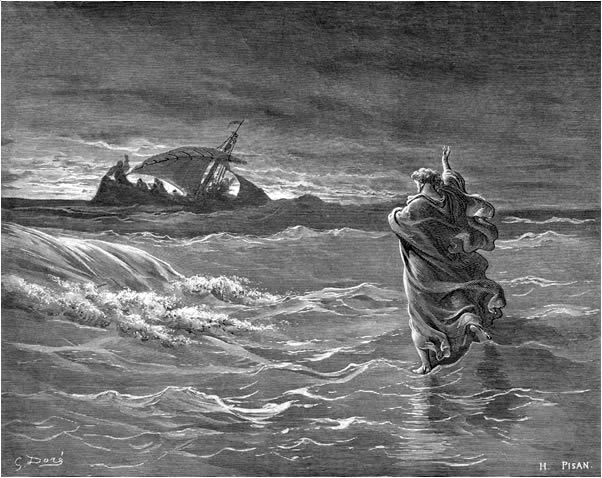
in Matthew 14When the disciples saw Him walking on the sea, they were terrified. “It’s a ghost!” they said, and cried out in fear.
BSB
The same verse in ASV and KJV ▾
ASV
And when the disciples saw him walking on the sea, they were troubled, saying, It is a ghost; and they cried out for fear.
KJV
And when the disciples saw him walking on the sea, they were troubled, saying, It is a spirit; and they cried out for fear.
⋯
This verse in Matthew 14
Commentary
16 notes on this verse(Verse 26.) And when the disciples saw him walking on the sea, they were troubled, saying: It is a ghost. If, according to Marcion and Manichaeus, our Lord was not born of a Virgin, but appeared in a vision: how is it that now the apostles fear seeing a vision? And they cried out due to fear. The confused shout and uncertain voice is a sign of great fear.
This site's exposition
tossed with waves
on Matthew 14:24-27
The ship was tossed with waves, the wind contrary, for hours through the night before Jesus came to them in the fourth watch, between three and six in the morning, walking on the sea. The disciples' cry, it is a spirit, betrays real terror rather than mere surprise, and his answer carries the weight of the divine name itself, be of good cheer; it is I; be not afraid, ego eimi echoing the LORD's own self-naming to Moses, spoken here over water that will not hold up any ordinary man's feet.
The record, by era
The Church Fathers5 voices
But in the fourth watch of the night, which is the end of the night—for one watch consists of three hours—the Lord comes to aid at the end of the age, and He is seen walking on the waters. Although this ship is troubled by the storms of temptation, it nevertheless sees God glorified walking over all the swells of the sea; that is, over all the principalities of this world. For it had previously been said through His passion that when He, according to the flesh, showed the example of humility, the waves of the sea raged against Him, to which He yielded willingly for us, so that the prophecy might be fulfilled: "I have come into deep waters, and the storm overwhelmed me." For He did not repel false witnesses nor the raging clamor of those shouting, "Crucify Him." He did not suppress the rabid hearts and mouths of the furious by force, but endured with patience. They did to Him all they wished; for He became obedient unto death, even the death of the cross. But after He rose from the dead, so that He might alone pray for the disciples established in the Church as in a ship, and carried by the faith of His cross as by wood, and endangered by the temptations of this world as by the waves of the sea, His name began to be honored in this world, in which He was despised, accused, and killed. So that He who had come in the flesh into the deep waters according to His passion, and had been overwhelmed by the storm, might now trample on the necks of the proud as the foam of the waves by the honor of His name. Just as now we see the Lord as though walking on the sea, under whose feet we see all the fury of this world subjected.
(Quæst. Ev. i. 15.) Or; That the disciples here say, It is a phantasm, figures those who yielding to the Devil shall doubt of the coming of Christ.
But Christ coming in the end shall find His Church wearied, and tossed by the spirit of Anti-Christ, and by the troubles of the world. And because by their long experience of Anti-Christ they will be troubled at every novelty of trial, they shall have fear even at the approach of the Lord, suspecting deceitful appearances. But the good Lord banishes their fear, saying, It is I; and by proof of His presence takes away their dread of impending shipwreck.
A confused noise and uncertain sound is the mark of great fear. But if, according to Marcion and Manichæus, our Lord was not born of a virgin, but was seen in a phantasm, how is it that the Apostles now fear that they have seen a phantasm (or vision)?
A commentator
John ChrysostomHomily on the Gospel of Matthew 50 · Written in the 5th century.
proposed
"When the disciples," it is said, "saw Him walking on the sea, they were troubled, saying, It is a spirit: and they cried out for fear." Yea, and He constantly doth so; when He is on the point of removing our terrors, He brings upon us other worse things, and more alarming: which we see took place then also. For together with the storm, the sight too troubled them, no less than the storm. Therefore neither did He remove the darkness, nor straightway make Himself manifest, training them, as I said, by the continuance of these fears, and instructing them to be ready to endure. This He did in the case of Job also; for when He was on the point of removing the terror and the temptation, then He suffered the end to grow more grievous; I mean not for his children's death, or the words of his wife, but because of the reproaches, both of his servants and of his friends. And when He was about to rescue Jacob from his affliction in the strange land, He allowed his trouble to be awakened and aggravated: in that his father-in-law first overtook him and threatened death, and then his brother coming immediately after, suspended over him the extremest danger. For since one cannot be tempted both for a long time and severely; when the righteous are on the point of coming to an end of their conflicts, He, willing them to gain the more, enhances their struggles. Which He did in the case of Abraham too, appointing for his last conflict that about his child. For thus even things intolerable will be tolerable, when they are so brought upon us, as to have their removal near, at the very doors.
9 more voices on this verse
The Medieval Church2 voices
And seeing him. Here the effect of Christ's presence is presented, namely the disturbance of the disciples; hence the disturbance is presented, the cause is presented, and the sign. And he says and seeing him, they were troubled etc. You should know that when divine …
But they thought it was a phantom, so extraordinary and strange was the sight. For they did not recognize Him by figure, because it was night and because of fear.
The Puritans and the Awakening1 voice
And when the disciples saw him walking on the sea,....
The Nineteenth Century6 voices
It is a spirit - That the spirits of the dead might and did appear, was a doctrine held by the greatest and holiest of men that ever existed; and a doctrine which the caviliers, free-thinkers and bound-thinkers, of different ages, have never been able to disprove.
The history contained in these verses is one of singular interest. The miracle here recorded brings out in strong light the character both of Christ and his people. The power and mercy of the Lord Jesus, and the mixture of faith and unbelief in his best disciples, are beautifully illustrated. We learn in the first place, from this miracle what absolute dominion our Saviour has over all created things. We see him “walking on the sea,” as if it was dry land.
SOME of the richest comforts are lost to us for want of clear perception. What consolation could be greater to the tempest-tossed disciples than to know their Master was present, and to see Him manifestly revealed as Lord of sea as well as land? Yet because they did not discern Him clearly, they missed the incomparable consolation. What is worse, at times the dimness of our perception will even turn the rarest consolation into the source of fear.
The history contained in these verses is one of singular interest. The miracle here recorded brings out in strong light the character both of Christ and his people. The power and mercy of the Lord Jesus, and the mixture of faith and unbelief in his best disciples, are beautifully illustrated. We learn in the first place, from this miracle what absolute dominion our Saviour has over all created things. We see him “walking on the sea,” as if it was dry land. Those angry waves, which tossed the ship of his disciples to and fro, obey the Son of God and become a solid floor under his feet. That liquid surface, which was agitated by the least breath of wind, bears up the feet of our Redeemer like a rock. To our poor, weak minds, the whole event is utterly incomprehensible. The picture of two feet walking on the sea is said by Doddridge to have been the Egyptian emblem of an impossible thing; the man of science will tell us that for material flesh and blood to walk on water is a physical impossibility. Even for us to know that it was done. Enough for us toremember that to him who created the seas at the beginning, it must have been perfectly easy to walk over their waves when he pleased. There is encouragement here for all true Christians. Let them know that there is nothing created which is not under Christ’s control: all things serve him. He may allow his people to be tried for a season, and to be tossed to and fro by storms of trouble; he may be later than they wish in coming to their aid, and not draw near till the “fourth watch of the night:” but never let them forget that winds, and waves and storms are all Christ’s servants. They cannot move without Christ’s permission. “The lord on high is mightier tha the voice of many waters, yea than the mighty waves of the sea.” ( Psalm 93:4 ).
SOME of the richest comforts are lost to us for want of clear perception. What consolation could be greater to the tempest-tossed disciples than to know their Master was present, and to see Him manifestly revealed as Lord of sea as well as land? Yet because they did not discern Him clearly, they missed the incomparable consolation. What is worse, at times the dimness of our perception will even turn the rarest consolation into the source of fear. Jesus is come, and in His coming the Sun of their joy has risen, but they do not perceive it to be Jesus. And thinking it to be a phantom, they are filled with alarm and cry out in dread. He who was their best Friend, they were as much afraid of as though He had been the arch enemy. Christ walking on the waves should have put all fear to rest, but instead they mistake Him for a ghost appearing amidst the storm, foreboding darker ill. They were filled with dismay by that which ought to have lifted them up with exultation. Oh, the benefit of the heavenly eye salve by which the eyes are cleared! May the Holy Spirit anoint our eyes therewith. Oh, the excellence of faith which, like the telescope, brings Christ near to us, and lets us see Him as He is! Oh, the sweetness of walking near to Christ, and knowing Him with an assured, confident, clear knowledge—for this would give us comforts which now we miss—and at once remove from us distresses which today unnecessarily afflict us. The subject upon which I wish to speak will be indicated to you if I, first of all, supply you with the outline of it. The first head will be this—it is too common an error to make a phantom of Christ. And, secondly, we are most apt to do this when Jesus is most evidently revealed. And therefore, thirdly, from this come our greatest sorrows.
A commentator
Albert Barnes1798–1870
Notes, Explanatory and Practical, on the Old and New Testaments (1832-1869)
proposed
They were troubled - They were afraid. The sight was remarkable. It was sufficient to awe them. In the dark night, amid the tumultuous billows appeared the form of a man. They thought it was a spirit an apparition. It was a common belief among the ancients that the spirits of people after death frequently appeared to the living.
The words behind it
19 Greek wordsEvery Greek word of this verse in the order it stands, with what it means and the door to its own study. The last column counts the times a word stands in the whole Bible: the rarer the word, the more the places it appears belong together.
| Greek | Sound | Meaning | Word study | In the Bible |
|---|---|---|---|---|
| Οἱ | hoi | <the> | G3588 → | 19766 times |
| δὲ | de | and | G1161 → | 2765 times |
| μαθηταὶ | mathetai | the disciples | G3101 → | 260 times |
| ἰδόντες | idontes | having seen | G1492 → | 374 times |
| αὐτὸν | auton | Him | G846 → | 5565 times |
| ἐπὶ | epi | on | G1909 → | 883 times |
| τῆς | tes | the | G3588 → | 19766 times |
| θαλάσσης | thalasses | sea | G2281 → | 90 times |
| περιπατοῦντα | peripatounta | walking | G4043 → | 94 times |
| ἐταράχθησαν | etarachthesan | they were troubled | G5015 → | |
| λέγοντες | legontes | saying | G3004 → | 1325 times |
| ὅτι | hoti | that | G3754 → | 1292 times |
| φάντασμά | phantasma | A ghost | G5326 → | |
| ἐστιν, | estin | it is! | G1510 → | 2333 times |
| καὶ | kai | And | G2532 → | 9120 times |
| ἀπὸ | apo | in | G575 → | 640 times |
| τοῦ | tou | <the> | G3588 → | 19766 times |
| φόβου | phobou | fear | G5401 → | 46 times |
| ἔκραξαν. | ekraxan | they cried out. | G2896 → | 55 times |
Οἱ<the>
hoiG3588 →19766 times
δὲand
deG1161 →2765 times
μαθηταὶthe disciples
mathetaiG3101 →260 times
ἰδόντεςhaving seen
idontesG1492 →374 times
αὐτὸνHim
autonG846 →5565 times
ἐπὶon
epiG1909 →883 times
τῆςthe
tesG3588 →19766 times
θαλάσσηςsea
thalassesG2281 →90 times
περιπατοῦνταwalking
peripatountaG4043 →94 times
ἐταράχθησανthey were troubled
etarachthesanG5015 →
λέγοντεςsaying
legontesG3004 →1325 times
ὅτιthat
hotiG3754 →1292 times
φάντασμάA ghost
phantasmaG5326 →
ἐστιν,it is!
estinG1510 →2333 times
καὶAnd
kaiG2532 →9120 times
ἀπὸin
apoG575 →640 times
τοῦ<the>
touG3588 →19766 times
φόβουfear
phobouG5401 →46 times
ἔκραξαν.they cried out.
ekraxanG2896 →55 times
A shaded row is a word that stands 400 times or fewer in the Bible.
The walk
8 stopsEach card is a verse this one points to, and under it the verses that one points to in turn. Where several paths arrive at the same place, that place is listed first: the text keeps returning to it.
Through
Luke 24:45Then He opened their minds to understand the Scriptures.
it leads to
- Acts 16:14
Among those listening was a woman named Lydia, a dealer in purple cloth from the city of Thyatira, who was a worshiper of God. The Lord opened her heart to respond to Paul’s message.
- 1 John 5:20
And we know that the Son of God has come and has given us understanding, so that we may know Him who is true; and we are in Him who is true—in His Son…
- Psalms 119:18
Open my eyes that I may see wondrous things from Your law.
- 2 Corinthians 3:14–18
But their minds were closed. For to this day the same veil remains at the reading of the old covenant. It has not been lifted, because only in Christ can it be removed.
- Acts 26:18
to open their eyes, so that they may turn from darkness to light and from the power of Satan to God, that they may receive forgiveness of sins and an inheritance among those sanctified…
- Acts 16:14
Through
Revelation 1:17When I saw Him, I fell at His feet like a dead man. But He placed His right hand on me and said, “Do not be afraid. I am the First and the Last,
it leads to
- Isaiah 44:6
Thus says the LORD, the King and Redeemer of Israel, the LORD of Hosts: “I am the first and I am the last, and there is no God but Me.
- Revelation 22:13
I am the Alpha and the Omega, the First and the Last, the Beginning and the End.”
- Daniel 10:8–10
So I was left alone, gazing at this great vision. No strength remained in me; my face grew deathly pale, and I was powerless.
- Isaiah 44:6
Where this verse is studied
On this page
Studies4
About Matthew
This page draws on 15 works. Open the list of works
This page draws on Adam Clarke, Commentary on the Bible; Albert Barnes, Notes, Explanatory and Practical, on the Old and New Testaments (1832-1869); Augustine of Hippo, Sermon 75; Augustine of Hippo, Catena Aurea by Aquinas; Charles Spurgeon, The Metropolitan Tabernacle Pulpit, Sermon No. 957: “Jesus No Phantom” (lightly modernized text, CCEL edition); Hilary of Poitiers, Catena Aurea by Aquinas; J.C. Ryle, Expository Thoughts on the Gospels: Matthew; Jamieson, Fausset & Brown, Commentary Critical and Explanatory on the Whole Bible; Jerome, Commentary on Matthew; Jerome, Catena Aurea by Aquinas; John Chrysostom, Homily on the Gospel of Matthew 50; John Gill, Exposition of the New Testament; John Gill, Exposition of the New Testament (1746-1748); Theophylact of Ohrid, Commentary on Matthew and Thomas Aquinas, Commentary on Matthew.