
Matthew 14:25
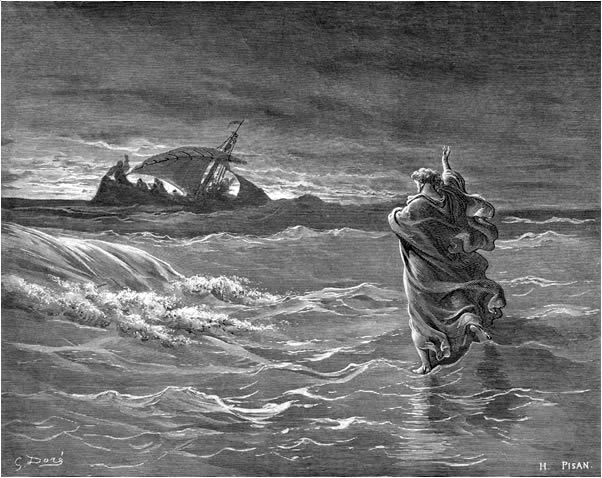
in Matthew 14During the fourth watch of the night, Jesus went out to them, walking on the sea.
BSB
The same verse in ASV and KJV ▾
ASV
And in the fourth watch of the night he came unto them, walking upon the sea.
KJV
And in the fourth watch of the night Jesus went unto them, walking on the sea.
⋯
This verse in Matthew 14
Commentary
23 notes on this verse(Verse 25.) However, during the fourth watch of the night, he came to them, walking on the sea. Military stations and night watches are divided into three-hour intervals. Therefore, when he says that the Lord came to them during the fourth watch of the night, it indicates that they were in danger throughout the entire night, and in the last part of the night, and at the end of the world, he will provide them with help.
This site's exposition
tossed with waves
on Matthew 14:24-27
The ship was tossed with waves, the wind contrary, for hours through the night before Jesus came to them in the fourth watch, between three and six in the morning, walking on the sea. The disciples' cry, it is a spirit, betrays real terror rather than mere surprise, and his answer carries the weight of the divine name itself, be of good cheer; it is I; be not afraid, ego eimi echoing the LORD's own self-naming to Moses, spoken here over water that will not hold up any ordinary man's feet.
The record, by era
The Church Fathers5 voices
(ubi sup.) The Lord came to visit His disciples who are tossed on the sea in the fourth watch of the night—that is, at its close; for each watch consisting of three hours, the night has thus four watches.
(ubi sup.) Therefore in the fourth watch of the night, that is when the night is nearly ended, He shall come, in the end of the world, when the night of iniquity is past, to judge the quick and the dead. But His coming was with a wonder. The waves swelled, but they were trodden upon. Thus howsoever the powers of this world shall swell themselves, our Head shall crush their head.
In the meantime, however, the disciples are harassed by wind and by sea. Amid all the disturbances of the world, in conflict with the unclean spirit, they are tossed about. But the Lord comes in the fourth watch. For the fourth time, then, he will return to a roving and shipwrecked church. In the fourth watch of the night, the measure of his concern is found to be just as great. The first watch was that of the law, the second of the prophets, the third of the Lord's coming in the flesh and the fourth of his return in splendor. But he will find the church in distress and beleaguered by the spirit of the antichrist and by disturbances throughout the world. He will come to those who are restless and deeply troubled. And since, as we may expect from the antichrist, they will be exposed to temptations of every kind, even at the Lord's coming they will be terrified by the false appearances of things and crawling phantasms with eyes. But the good Lord will then speak out and dispel their fear, saying, "It is I." He will dispel the fear of impending shipwreck through their faith in his coming.
The first watch was therefore of the Law, the second of the Prophets, the third His coming in the flesh, the fourth His return in glory.
But Christ coming in the end shall find His Church wearied, and tossed by the spirit of Anti-Christ, and by the troubles of the world. And because by their long experience of Anti-Christ they will be troubled at every novelty of trial, they shall have fear even at the approach of the Lord, suspecting deceitful appearances. But the good Lord banishes their fear, saying, It is I; and by proof of His presence takes away their dread of impending shipwreck.
16 more voices on this verse
The Church Fathers6 voices
Who was able to walk on the sea if not the Creator of the universe? He, indeed, about whom the Holy Spirit had spoken long ago through blessed Job: "Who alone stretched out the heavens and walked on the sea as well as the earth." …
Let us focus on the meaning of this fourth watch in which the Lord comes to his disciples who were caught in the storm. The first watch of the night—that is, of the present world—is understood to be from Adam to Noah, the second watch …
And the Lord will be with thee to help thee, when lulling to rest the perils of thy trials, He restores the confidence of His protection, and this towards the break of day; for when human frailty beset with difficulties considers the weakness of its own powers, it looks upon itself as in darkness; when it raises its view to the protection of heaven, it straightway beholds the rise of the morning star, which gives its light through the whole of the morning watch.
Never is Christ without water: if, that is, He is Himself baptized in water; inaugurates in water the first rudimentary displays of His power, when invited to the nuptials; invites the thirsty, when He makes a discourse, to His own sempiternal water; approves, when teaching concerning love, among works of charity, the cup of water offered to a poor (child); recruits His strength at a well; walks over the water; willingly crosses the sea; ministers water to His disciples. Onward even to the passion does the witness of baptism last: while He is being surrendered to the cross, water intervenes; witness Pilate's hands: when He is wounded, forth from His side bursts water; witness the soldier's lance!
The military guards and watches are divided into portions of three hours each. When then he says that the Lord came to them in the fourth watch, this shows that they had been in danger the whole night.
A commentator
John ChrysostomHomily on the Gospel of Matthew 50 · Written in the 5th century.
proposed
Accordingly, neither did He present Himself to them at once. For, "in the fourth watch," so it is said, "of the night, He went unto them, walking upon the sea;" instructing them not hastily to seek for deliverance from their pressing dangers, but to bear all occurrences manfully. At all events, when they looked to be delivered, then was their fear again heightened.
The Medieval Church4 voices
It can also be asked why, when the disciples were laboring on the sea, the Lord stood on the shore after His resurrection, though before His resurrection He had walked on the waves of the sea before His disciples. The reason for this matter is quickly understood if the cause that was then present is considered. For what does the sea signify except the present age, which dashes itself against the tumults of affairs and the waves of corruptible life? What is figured by the solidity of the shore except that perpetuity of eternal rest? Because the disciples were still amid the waves of mortal life, they were laboring on the sea. But because our Redeemer had already passed beyond the corruption of the flesh, after His resurrection He was standing on the shore.
Lastly, Theodorus wrote that the Lord had not bodily weight in respect of His flesh, but without weight walked on the sea. But the catholic faith preaches the contrary; for Dionysius says that He walked on the wave, without the feet, being immersed, having bodily weight, and the burden of matter.
And in the fourth watch of the night he came to them, walking upon the sea. After the danger is presented, the deliverance from danger is presented; and concerning this he does two things. First, the assistance is presented; second, the effect. The second begins …
He did not appear immediately to them to calm the storm, but at the fourth watch, [that is, as the night was coming to its end], teaching us not to ask for a swift solution to our misfortunes but to endure them bravely. The night …
The Puritans and the Awakening2 voices
He that keepeth Israel neither slumbers nor sleeps, but, when there is occasion, walks in darkness for their succour; helps, and that right early. Of his power, that he went unto them, walking on the sea. This is a great instance of Christ's sovereign dominion over all the creatures; they are all under his feet, an
And in the fourth watch of the night,....
The Nineteenth Century4 voices
A commentator
Albert Barnes1798–1870
Notes, Explanatory and Practical, on the Old and New Testaments (1832-1869)
And in the fourth watch of the night - The Jews anciently divided the night into three parts of four hours each, usually called watches. The first of these watches is mentioned in Lam 2:19, the middle watch in Jdg 7:19, and the morning watch in Exo 14:24. In the time of our Saviour they divided the night into four watches, the fourth having been introduced by the Romans.
The history contained in these verses is one of singular interest. The miracle here recorded brings out in strong light the character both of Christ and his people. The power and mercy of the Lord Jesus, and the mixture of faith and unbelief in his best disciples, are beautifully illustrated. We learn in the first place, from this miracle what absolute dominion our Saviour has over all created things. We see him “walking on the sea,” as if it was dry land.
The history contained in these verses is one of singular interest. The miracle here recorded brings out in strong light the character both of Christ and his people. The power and mercy of the Lord Jesus, and the mixture of faith and unbelief in his best disciples, are beautifully illustrated. We learn in the first place, from this miracle what absolute dominion our Saviour has over all created things. We see him “walking on the sea,” as if it was dry land. Those angry waves, which tossed the ship of his disciples to and fro, obey the Son of God and become a solid floor under his feet. That liquid surface, which was agitated by the least breath of wind, bears up the feet of our Redeemer like a rock. To our poor, weak minds, the whole event is utterly incomprehensible. The picture of two feet walking on the sea is said by Doddridge to have been the Egyptian emblem of an impossible thing; the man of science will tell us that for material flesh and blood to walk on water is a physical impossibility. Even for us to know that it was done. Enough for us toremember that to him who created the seas at the beginning, it must have been perfectly easy to walk over their waves when he pleased. There is encouragement here for all true Christians. Let them know that there is nothing created which is not under Christ’s control: all things serve him. He may allow his people to be tried for a season, and to be tossed to and fro by storms of trouble; he may be later than they wish in coming to their aid, and not draw near till the “fourth watch of the night:” but never let them forget that winds, and waves and storms are all Christ’s servants. They cannot move without Christ’s permission. “The lord on high is mightier tha the voice of many waters, yea than the mighty waves of the sea.” ( Psalm 93:4 ).
The fourth watch - Anciently the Jews divided the night into three watches, consisting of four hours each. The first watch is mentioned, Lam 2:19: the second, Jdg 7:19; and the third, Exo 14:24; but a fourth watch is not mentioned in any part of the Old Testament. This division the Romans had introduced in Judea, as also the custom of dividing the day into twelve hours: see Joh 11:9. The first watch began at six o’clock in the evening, and continued till nine; the second began at nine, and continued till twelve; the third began at twelve, and continued till three next morning; and the fourth began at three, and continued till six. It was therefore between the hours of three and six in the morning that Jesus made his appearance to his disciples. Walking on the sea - Thus suspending the laws of gravitation was a proper manifestation of unlimited power. Jesus did this by his own power; therefore Jesus showed forth his Godhead. In this one miracle we may discover three: - 1. Though at a distance from his disciples, he knew their distress. 2. He found them out on the lake, and probably in the midst of darkness. 3. He walked upon the water. Job, speaking of those things whereby the omnipotence of God was demonstrated, says particularly, Job 9:8, He walketh upon the waves of the sea: intimating that this was impossible to any thing but Omnipotence.
The words behind it
12 Greek wordsEvery Greek word of this verse in the order it stands, with what it means and the door to its own study. The last column counts the times a word stands in the whole Bible: the rarer the word, the more the places it appears belong together.
| Greek | Sound | Meaning | Word study | In the Bible |
|---|---|---|---|---|
| τετάρτῃ | tetarte | In [the] fourth | G5067 → | |
| δὲ | de | now | G1161 → | 2765 times |
| φυλακῇ | phulakea | watch | G5438 → | 47 times |
| τῆς | tes | of the | G3588 → | 19766 times |
| νυκτὸς | nuktos | night | G3571 → | 61 times |
| ἦλθεν | elthen | he came | G2064 → | 628 times |
| πρὸς | pros | to | G4314 → | 700 times |
| αὐτοὺς | autous | them | G846 → | 5565 times |
| περιπατῶν | peripaton | walking | G4043 → | 94 times |
| ἐπὶ | epi | on | G1909 → | 883 times |
| τὴν | ten | the | G3588 → | 19766 times |
| θάλασσαν.¶ | thalassan | sea. | G2281 → | 90 times |
τετάρτῃIn [the] fourth
tetarteG5067 →
δὲnow
deG1161 →2765 times
φυλακῇwatch
phulakeaG5438 →47 times
τῆςof the
tesG3588 →19766 times
νυκτὸςnight
nuktosG3571 →61 times
ἦλθενhe came
elthenG2064 →628 times
πρὸςto
prosG4314 →700 times
αὐτοὺςthem
autousG846 →5565 times
περιπατῶνwalking
peripatonG4043 →94 times
ἐπὶon
epiG1909 →883 times
τὴνthe
tenG3588 →19766 times
θάλασσαν.¶sea.
thalassanG2281 →90 times
A shaded row is a word that stands 400 times or fewer in the Bible.
The walk
8 stopsEach card is a verse this one points to, and under it the verses that one points to in turn. Where several paths arrive at the same place, that place is listed first: the text keeps returning to it.
Through
John 6:19When they had rowed about three or four miles, they saw Jesus approaching the boat, walking on the sea—and they were terrified.
it leads to
- Psalms 93:4
Above the roar of many waters— the mighty breakers of the sea— the LORD on high is majestic.
Reached by 2 separate paths from here.
- Mark 6:47–49
When evening came, the boat was in the middle of the sea, and Jesus was alone on land.
- Job 9:8
He alone stretches out the heavens and treads on the waves of the sea.
Reached by 2 separate paths from here.
- Matthew 14:25–26
During the fourth watch of the night, Jesus went out to them, walking on the sea.
- John 14:18
I will not leave you as orphans; I will come to you.
- Psalms 93:4
Through
Matthew 24:43But understand this: If the homeowner had known in which watch of the night the thief was coming, he would have kept watch and would not have let his house be broken into.
it leads to
- Luke 12:39
But understand this: If the homeowner had known at what hour the thief was coming, he would not have let his house be broken into.
- Luke 12:39
Through
Job 9:8He alone stretches out the heavens and treads on the waves of the sea.
it leads to
- Isaiah 44:24
Thus says the LORD, your Redeemer who formed you from the womb: “I am the LORD, who has made all things, who alone stretched out the heavens, who by Myself spread out the earth,
- Isaiah 40:22
He sits enthroned above the circle of the earth; its dwellers are like grasshoppers. He stretches out the heavens like a curtain, and spreads them out like a tent to dwell in.
- Isaiah 44:24
Where this verse is studied
On this page
Studies4
About Matthew
This page draws on 21 works. Open the list of works
This page draws on Adam Clarke, Commentary on the Bible; Albert Barnes, Notes, Explanatory and Practical, on the Old and New Testaments (1832-1869); Augustine of Hippo, Catena Aurea by Aquinas; Chromatius of Aquileia, TRACTATE ON MATTHEW 52.2; Chromatius of Aquileia, TRACTATE ON MATTHEW 52.5; Gregory the Dialogist, Forty Gospel Homilies, Homily 24; Hilary of Poitiers, Commentary on Matthew 14.14; Hilary of Poitiers, Catena Aurea by Aquinas; J.C. Ryle, Expository Thoughts on the Gospels: Matthew; Jamieson, Fausset & Brown, Commentary Critical and Explanatory on the Whole Bible; Jerome, Commentary on Matthew; Jerome, Catena Aurea by Aquinas; John Chrysostom, Homily on the Gospel of Matthew 50; John Gill, Exposition of the New Testament; John Gill, Exposition of the New Testament (1746-1748); Matthew Henry, Commentary on the Whole Bible; Rabanus Maurus, Catena Aurea by Aquinas; Remigius of Rheims, Catena Aurea by Aquinas; Tertullian, On Baptism; Theophylact of Ohrid, Commentary on Matthew and Thomas Aquinas, Commentary on Matthew.