
Matthew 14:24
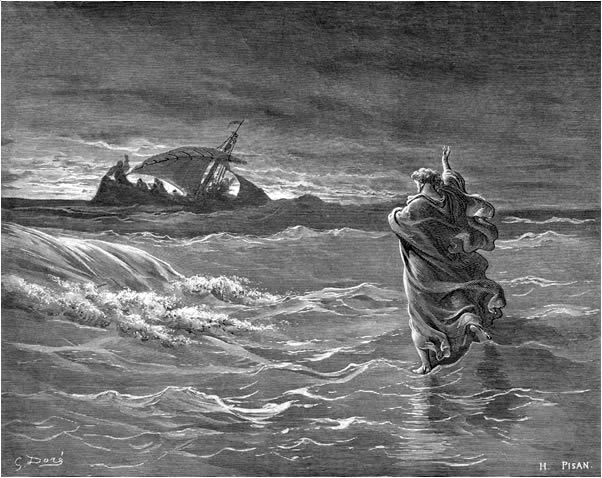
in Matthew 14but the boat was already far from land, buffeted by the waves because the wind was against it.
BSB
The same verse in ASV and KJV ▾
ASV
But the boat was now in the midst of the sea, distressed by the waves; for the wind was contrary.
KJV
But the ship was now in the midst of the sea, tossed with waves: for the wind was contrary.
⋯
This verse in Matthew 14
Commentary
18 notes on this verseRightly had the Apostles departed from the Lord as unwilling, and slow to leave Him, lest they should suffer shipwreck whilst He was not with them. For it follows, Now when it was evening he was there alone; that is, in the mountain; but the boat was in the middle of the sea tossed with the waves; for the wind was contrary. While the Lord tarries in the top of the mountain, straightway a wind arises contrary to them, and stirs up the sea, and the disciples are in imminent peril of shipwreck, which continues till Jesus comes.
This site's exposition
tossed with waves
on Matthew 14:24-27
The ship was tossed with waves, the wind contrary, for hours through the night before Jesus came to them in the fourth watch, between three and six in the morning, walking on the sea. The disciples' cry, it is a spirit, betrays real terror rather than mere surprise, and his answer carries the weight of the divine name itself, be of good cheer; it is I; be not afraid, ego eimi echoing the LORD's own self-naming to Moses, spoken here over water that will not hold up any ordinary man's feet.
The record, by era
The Church Fathers5 voices
Meanwhile the boat carrying the disciples—that is, the church—is rocking and shaking amid the storms of temptation, while the adverse wind rages on. That is to say, its enemy the devil strives to keep the wind from calming down. But greater is he who is persistent on our behalf, for amid the vicissitudes of our life he gives us confidence. He comes to us and strengthens us, so we are not jostled in the boat and tossed overboard. For although the boat is thrown into disorder, it is still a boat. It alone carries the disciples and receives Christ. It is in danger indeed on the water, but there would be certain death without it. Therefore stay inside the boat and call upon God. When all good advice fails and the rudder is useless and the spread of the sails presents more of a danger than an advantage, when all human help and strength have been abandoned, the only recourse left for the sailors is to cry out to God. Therefore will he who helps those who are sailing to reach port safely, abandon his church and prevent it from arriving in peace and tranquility?
(ubi sup.) For when any of a wicked will and of great power, proclaims a persecution of the Church, then it is that a mighty wave rises against the boat of Christ.
That He commands His disciples to enter the ship and to go across the sea, while He sends the multitudes away, and after that He goes up into the mountain to pray; He therein bids us to be within the Church, and to be in peril until such time as returning in His splendour He shall give salvation to all the people that shall be remaining of Israel, and shall for give their sins; and having dismissed them into His Father's kingdom, returning thanks to His Father, He shall sit down in His glory and majesty. Meanwhile the disciples are tossed by the wind and the waves; struggling against all the storms of this world, raised by the opposition of the unclean spirit.
(Verse 24): However, the little boat was being tossed by the waves in the middle of the sea; for the wind was contrary. Rightly, as if unwillingly, and the apostles, drawing back, had departed from the Lord, lest they should suffer shipwrecks in His absence. Finally, while the Lord was staying on the mountain peak, immediately a contrary wind arises, and it stirs up the sea, and the apostles are in peril, and the impending shipwreck persists as long as Jesus does not come.
A commentator
John ChrysostomHomily on the Gospel of Matthew 50 · Written in the 5th century.
proposed
For what purpose doth He go up into the mountain? To teach us, that loneliness and retirement is good, when we are to pray to God. With this view, you see, He is continually withdrawing into the wilderness, and there often spends the whole night in prayer, teaching us earnestly to seek such quietness in our prayers, as the time and place may confer. For the wilderness is the mother of quiet; it is a calm and a harbor, delivering us from all turmoils. He Himself then went up thither with this object, but the disciples are tossed with the waves again, and undergo a storm, equal even to the former. But whereas before they had Him in the ship when this befell them, now they were alone by themselves. Thus gently and by degrees He excites and urges them on for the better, even to the bearing all nobly. Accordingly we see, that when they were first near that danger, He was present, though asleep, so as readily to give them relief; but now leading them to a greater degree of endurance, He doth not even this, but departs, and in mid sea permits the storm to arise, so that they might not so much as look for a hope of preservation from any quarter; and He lets them be tempest-tost all the night, thoroughly to awaken, as I suppose, their hardened heart. For such is the nature of the fear, which the time concurs with the rough weather in producing. And together with the compunction, He cast them also into a greater longing for Himself, and a continual remembrance of Him.
11 more voices on this verse
The Church Fathers1 voice
A commentator
John ChrysostomHomily on the Gospel of Matthew 49 · Written in the 5th century.
proposed
And His pretext indeed for dismissing them was the multitude, but He was Himself minded to go up into the mountain; and He did this, instructing us neither to be always in intercourse with multitudes, nor always to fly from the crowd, but each of the two as may be expedient, and giving each duly his turn.
The Medieval Church3 voices
But the boat in the midst of the sea was tossed with the waves. By the boat is signified the Church; by the sea, the world: Ps. 103:25: this great sea which stretches wide its arms. And this Church, with Christ ascending, remained in the …
Whence it is well said here, that the ship was in the middle of the sea, and He alone on the land, because the Church is sometimes oppressed with such persecution that her Lord may seem to have forsaken her for a season.
He went up on the mountain to show that we should pray in an undistracted manner; everything He did was for our sake as He Himself had no need of prayer. He prayed on into the evening, teaching us not to cease praying after a …
The Puritans and the Awakening3 voices
In the evening - Learned men say the Jews reckoned two evenings; the first beginning at three in the afternoon, the second, at sunset. If so, the latter is meant here.
Note, It is no new thing for Christ's disciples to meet with storms in the way of their duty, and to be sent to sea then when their Master foresees a storm; but let them not take it unkindly; what he does they know not now, but they shall know hereafter, that Christ designs hereby to manifest himself with the more wonderful grace to them and for them.
But the ship was now in the midst of the sea,....
The Nineteenth Century4 voices
Tossed with waves - Grievously agitated. This is the proper meaning of the word βασανιζομενον: but one MS. reads βαπτιζομενον, plunged under the waves, frequently covered with them; the waves often breaking over the vessel.
The history contained in these verses is one of singular interest. The miracle here recorded brings out in strong light the character both of Christ and his people. The power and mercy of the Lord Jesus, and the mixture of faith and unbelief in his best disciples, are beautifully illustrated. We learn in the first place, from this miracle what absolute dominion our Saviour has over all created things. We see him “walking on the sea,” as if it was dry land.
The history contained in these verses is one of singular interest. The miracle here recorded brings out in strong light the character both of Christ and his people. The power and mercy of the Lord Jesus, and the mixture of faith and unbelief in his best disciples, are beautifully illustrated. We learn in the first place, from this miracle what absolute dominion our Saviour has over all created things. We see him “walking on the sea,” as if it was dry land. Those angry waves, which tossed the ship of his disciples to and fro, obey the Son of God and become a solid floor under his feet. That liquid surface, which was agitated by the least breath of wind, bears up the feet of our Redeemer like a rock. To our poor, weak minds, the whole event is utterly incomprehensible. The picture of two feet walking on the sea is said by Doddridge to have been the Egyptian emblem of an impossible thing; the man of science will tell us that for material flesh and blood to walk on water is a physical impossibility. Even for us to know that it was done. Enough for us toremember that to him who created the seas at the beginning, it must have been perfectly easy to walk over their waves when he pleased. There is encouragement here for all true Christians. Let them know that there is nothing created which is not under Christ’s control: all things serve him. He may allow his people to be tried for a season, and to be tossed to and fro by storms of trouble; he may be later than they wish in coming to their aid, and not draw near till the “fourth watch of the night:” but never let them forget that winds, and waves and storms are all Christ’s servants. They cannot move without Christ’s permission. “The lord on high is mightier tha the voice of many waters, yea than the mighty waves of the sea.” ( Psalm 93:4 ).
A commentator
Albert Barnes1798–1870
Notes, Explanatory and Practical, on the Old and New Testaments (1832-1869)
proposed
But the ship was now in the midst of the sea - John says they had sailed about 25 or 30 furlongs. About 7 1/2 Jewish furlongs made a mile; so that the distance they had salted was not more than about 4 miles. At no place is the Sea of Tiberias much more than 10 miles in breadth, so that they were literally in the midst of the sea.
The words behind it
19 Greek wordsEvery Greek word of this verse in the order it stands, with what it means and the door to its own study. The last column counts the times a word stands in the whole Bible: the rarer the word, the more the places it appears belong together.
| Greek | Sound | Meaning | Word study | In the Bible |
|---|---|---|---|---|
| τὸ | to | <the> | G3588 → | 19766 times |
| δὲ | de | And | G1161 → | 2765 times |
| πλοῖον | ploion | the boat | G4143 → | 67 times |
| ἤδη | ede | now | G2235 → | 61 times |
| σταδίους | stadious | stadia | G4712 → | |
| πολλοὺς | pollous | many | G4183 → | 367 times |
| ἀπὸ | apo | from | G575 → | 640 times |
| τῆς | tes | of the | G3588 → | 19766 times |
| γῆς | ges | land | G1093 → | 248 times |
| ἀπεῖχεν | apeichen | was fully | G568 → | 19 times |
| βασανιζόμενον | basanizomenon | being tossed | G928 → | 12 times |
| ὑπὸ | hupo | by | G5259 → | 219 times |
| τῶν | ton | the | G3588 → | 19766 times |
| κυμάτων· | kumaton | waves; | G2949 → | |
| ἦν | en | was | G1510 → | 2333 times |
| γὰρ | gar | for | G1063 → | 1039 times |
| ἐναντίος | enantios | contrary [was] | G1727 → | |
| ὁ | ho | the | G3588 → | 19766 times |
| ἄνεμος. | anemos | wind. | G417 → | 31 times |
τὸ<the>
toG3588 →19766 times
δὲAnd
deG1161 →2765 times
πλοῖονthe boat
ploionG4143 →67 times
ἤδηnow
edeG2235 →61 times
σταδίουςstadia
stadiousG4712 →
πολλοὺςmany
pollousG4183 →367 times
ἀπὸfrom
apoG575 →640 times
τῆςof the
tesG3588 →19766 times
γῆςland
gesG1093 →248 times
ἀπεῖχενwas fully
apeichenG568 →19 times
βασανιζόμενονbeing tossed
basanizomenonG928 →12 times
ὑπὸby
hupoG5259 →219 times
τῶνthe
tonG3588 →19766 times
κυμάτων·waves;
kumatonG2949 →
ἦνwas
enG1510 →2333 times
γὰρfor
garG1063 →1039 times
ἐναντίοςcontrary [was]
enantiosG1727 →
ὁthe
hoG3588 →19766 times
ἄνεμος.wind.
anemosG417 →31 times
A shaded row is a word that stands 400 times or fewer in the Bible.
The walk
8 stopsEach card is a verse this one points to, and under it the verses that one points to in turn. Where several paths arrive at the same place, that place is listed first: the text keeps returning to it.
Through
Isaiah 54:11“O afflicted city, lashed by storms, without solace, surely I will set your stones in antimony and lay your foundations with sapphires.
it leads to
- 1 Peter 2:4–6
As you come to Him, the living stone, rejected by men but chosen and precious in God’s sight,
- Jeremiah 30:17
But I will restore your health and heal your wounds, declares the LORD, because they call you an outcast, Zion, for whom no one cares.”
- Acts 14:22
strengthening the souls of the disciples and encouraging them to continue in the faith. “We must endure many hardships to enter the kingdom of God,” they said.
- Isaiah 54:6
For the LORD has called you back, like a wife deserted and wounded in spirit, like the rejected wife of one’s youth,” says your God.
- 1 Peter 2:4–6
Through
Matthew 8:24Suddenly a violent storm came up on the sea, so that the boat was engulfed by the waves; but Jesus was sleeping.
it leads to
- Luke 8:23
As they sailed, He fell asleep, and a windstorm came down on the lake, so that the boat was being swamped, and they were in great danger.
- Psalms 107:23–27
Others went out to sea in ships, conducting trade on the mighty waters.
- Jonah 1:4–5
Then the LORD hurled a great wind upon the sea, and such a violent storm arose that the ship was in danger of breaking apart.
- Luke 8:23
Through
John 6:18A strong wind was blowing, and the sea grew agitated.
it leads to
- Psalms 135:7
He causes the clouds to rise from the ends of the earth. He generates the lightning with the rain and brings forth the wind from His storehouses.
- Psalms 135:7
Where this verse is studied
On this page
Studies4
About Matthew
This page draws on 18 works. Open the list of works
This page draws on Adam Clarke, Commentary on the Bible; Albert Barnes, Notes, Explanatory and Practical, on the Old and New Testaments (1832-1869); Augustine of Hippo, SERMON 75.4; Augustine of Hippo, Catena Aurea by Aquinas; Hilary of Poitiers, Catena Aurea by Aquinas; J.C. Ryle, Expository Thoughts on the Gospels: Matthew; Jamieson, Fausset & Brown, Commentary Critical and Explanatory on the Whole Bible; Jerome, Catena Aurea by Aquinas; Jerome, Commentary on Matthew; John Chrysostom, Homily on the Gospel of Matthew 50; John Chrysostom, Homily on the Gospel of Matthew 49; John Gill, Exposition of the New Testament; John Gill, Exposition of the New Testament (1746-1748); John Wesley, Explanatory Notes upon the New Testament; Matthew Henry, Commentary on the Whole Bible; Rabanus Maurus, Catena Aurea by Aquinas; Theophylact of Ohrid, Commentary on Matthew and Thomas Aquinas, Commentary on Matthew.