
Matthew 14:31
in Matthew 14Immediately Jesus reached out His hand and took hold of Peter. “You of little faith,” He said, “why did you doubt?”
BSB
The same verse in ASV and KJV ▾
ASV
And immediately Jesus stretched forth his hand, and took hold of him, and saith unto him, O thou of little faith, wherefore didst thou doubt?
KJV
And immediately Jesus stretched forth his hand, and caught him, and said unto him, O thou of little faith, wherefore didst thou doubt?
⋯
This verse in Matthew 14
Commentary
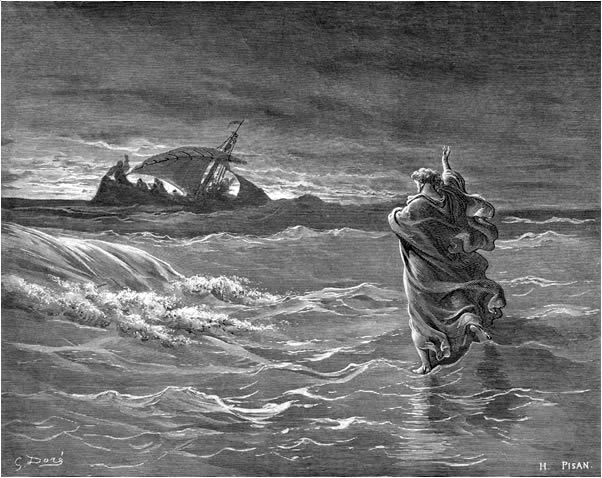
27 notes on this verseThe history contained in these verses is one of singular interest. The miracle here recorded brings out in strong light the character both of Christ and his people. The power and mercy of the Lord Jesus, and the mixture of faith and unbelief in his best disciples, are beautifully illustrated. We learn in the first place, from this miracle what absolute dominion our Saviour has over all created things. We see him “walking on the sea,” as if it was dry land.
This site's exposition
bid me come unto thee on the water
on Matthew 14:28-31
Peter's request, bid me come unto thee on the water, is unique to Matthew among the Gospels, and the bench reads it as characteristic of the man, bold faith reaching past what the other eleven attempted. He walked on the water so long as his eyes stayed on the word that called him, and began to sink the moment he saw the wind boisterous, the fourth sounding of the little-faith refrain, O thou of little faith, wherefore didst thou doubt, spoken to a disciple in the very act of doing what no disciple had done before, faith enough to step out and too little to finish the walk.
The record, by era
The Church Fathers5 voices
While human praise does not tempt the Lord, people are often ruffled and nearly entranced by human praise and honors in the church. Peter was afraid on the sea, terrified by the great force of the storm. Indeed, who does not fear that voice: "Those who say you are happy place you in error and disturb the path of your feet"? And since the soul struggles against the desire for human praise, it is good for it to turn to prayer and petition amid such danger, lest one who is charmed by praise be overcome by criticism and reproach. Let Peter, about to sink in the waves, cry out and say, "Lord, save me!" The Lord reached out his hand. He chided Peter, saying, "O man of little faith, why did you doubt?"—that is, why did you not, gazing straight at the Lord as you approached, pride yourself only in him? Nevertheless he snatched Peter from the waves and did not allow him who was declaring his weakness and asking the Lord for help to perish.
(Serm. 76. 8.) Peter then presumed on the Lord, he tottered as man, but returned to the Lord, as it follows, And when he began to sink, he cried out, saying, Lord, save me. Does the Lord then desert him in his peril of failure whom he had hearkened to when he first called on Him? Immediately Jesus stretched forth his hand, and caught him.
(Quæst. Ev. i. 15.) That Peter cries to the Lord for help that he should not be drowned, signifies that He shall purge His Church with certain trials even after the last persecution; as Paul also notes, saying, He shall be saved, yet so as by fire. (1 Cor. 3:15.)
That when Peter was seized with fear, the Lord gave him not power of coming to Him, but held him by the hand and sustained him, this is the signification thereof; that He who alone was to suffer for all alone forgave the sins of all; and no partner is admitted into that which was bestowed upon mankind by one.
(Verse 31, 32.) And immediately Jesus, stretching out His hand, took hold of him and said to him, 'You of little faith, why did you doubt?' And when they got into the boat, the wind stopped. If it is said to the Apostle Peter, of whose faith and ardor of mind we have spoken above, who confidently asked the Savior, saying, 'Lord, if it is You, command me to come to You on the water,' because he was a little afraid, 'You of little faith, why did you doubt?'
20 more voices on this verse
The Church Fathers1 voice
A commentator
John ChrysostomHomily on the Gospel of Matthew 50 · Written in the 5th century.
proposed
"And he said, Come. And when Peter was come down out of the ship, he walked on the water, and came to Jesus. But when he saw the wind boisterous, he was afraid; and beginning to sink, he cried, saying, Lord, save me. And immediately Jesus stretched forth His hand and caught him, and saith unto him, O thou of little faith, wherefore didst thou doubt?" This is more wonderful than the former. Therefore this is done after that. For when He had shown that He rules the sea, then He carries on the sign to what is yet more marvellous. Then He rebuked the winds only; but now He both walks Himself, and permits another to do so; which thing if He had required to be done at the beginning, Peter would not have so well received it, because he had not yet acquired so great faith. Wherefore then did Christ permit him? Why, if He had said, "thou canst not," Peter being ardent would have contradicted Him again. Wherefore by the facts He convinces him, that for the future he may be sobered. But not even so doth he endure. Therefore having come down, he becomes dizzy; for he was afraid. And this the surf caused, but his fear was wrought by the wind. Peter then having come down from the ship went unto Him, not rejoicing so much in walking on the water, as in coming unto Him. And when he had prevailed over the greater, he was on the point of suffering evil from the less, from the violence of the wind, I mean, not of the sea. For such a thing is human nature; not seldom effecting great things, it exposes itself in the less; as Elias felt toward Jezebel, as Moses toward the Egyptian, as David toward Bathsheba. Even so then this man also; while their fear was yet at the height, he took courage to walk upon the water, but against the assault of the wind he was no longer able to stand; and this, being near Christ. […]
The Medieval Church3 voices
Showing that the cause of his sinking was not the wind but faintheartedness, Christ does not rebuke the wind, but the fainthearted Peter. This is why He raised him up and set him on the water, but allowed the wind to blow. Peter did not …
The Lord looked back upon him, and brought him to repentance; He stretched forth His hand, and forgave him, and thus the disciple found salvation, which is not of him that willeth or of him that runneth, but of God that showeth mercy. (Rom. 9:16.)
And immediately Jesus stretching forth his hand took hold of him. Christ does two things: he both gives help and rebukes his lack of faith. He gives help by extending his hand; Ps. 143:7: put forth your hand from on high, deliver me and rescue …
The Puritans and the Awakening1 voice
And immediately Jesus stretched forth his hand,....
The Nineteenth Century15 voices
THERE is only one word in the original for the phrase, "O you of little faith." The Lord Jesus virtually addresses Peter by the name of "Little-Faith" in one word. I do not suppose that Peter had ever before dreamed of that name as applicable to himself. Possibly he had thought in his heart that his faith was strong even to assurance. When so lately he had seen his Master feed the multitudes with a few loaves and fishes and had helped to gather up 12 baskets of fragments, he felt that his faith was equal to anything.
BETWEEN the very lowest degree of faith and a state of unbelief there is a great gulf. An immeasurable abyss yawns between the man who has even the smallest faith in Christ and the man who has none. One is a living man, though feeble, the other is "dead in trespasses and sins"—the one is a justified man, the other is "condemned already—because he has not believed in the name of the only begotten Son of God." The weakest Believer is on the road to Heaven.
A commentator
Charles Spurgeon1834–1892
The Metropolitan Tabernacle Pulpit, Sermon No. 2925: “Reasons For Doubting Christ” (lightly modernized text, CCEL edition) · Written before 1892.
OUR Lord did not begin His dealings with Peter in this emergency by asking him that question. He first stretched out His hand and saved him from his peril and then He said to him, "O you of little faith, why did you doubt?" When a man is in trouble, help him out, first, and then blame him for having got into it, if you feel it necessary to do so! It is cruel to bring your censure to bear upon sinking Peter. First give him your help, lest he perish in the sea.
A commentator
Charles Spurgeon1834–1892
The Metropolitan Tabernacle Pulpit, Sermon No. 3247: “Unreasonable Reasons” (lightly modernized text, CCEL edition) · Written before 1892.
OUR Savior did not ask Peter that question for His own information. He could have told Peter much more about his unbelieving heart than Peter knew! The Savior was well acquainted with those springs from which the unbelief of Peter arose. He asked it, therefore, rather that Peter might make the enquiry of himself—that he might look into the matter and see how groundless his unbelief was—so that on the next occasion he might not fall into the same error.
A commentator
Charles Spurgeon1834–1892
The Metropolitan Tabernacle Pulpit, Sermon No. 3562: “Peter Walking on the Sea” (lightly modernized text, CCEL edition) · Written before 1892.
A FEW reflections will be sure to cross the mind of any thoughtful reader of this narrative. I. THE MIXED CHARACTER OF THE BELIEVER'S EXPERIENCE is here very palpably suggested to us. Peter was undoubtedly a bold believer in Jesus Christ. He addresses his Master devoutly, calling Him, "Lord"—a name of reverence, the use of which evidences the change that had been worked in his character, and the obedient spirit it had produced. But the misgivings implied in that, "if—"if it is You"—savors rather of unbelief!
A commentator
Jamieson, Fausset & Brown1802–1910
Commentary Critical and Explanatory on the Whole Bible (1871)
proposed
And immediately Jesus stretched forth his hand, and caught him, and said to him, O thou of little faith, why didst thou doubt?--(Also see on Mr 6:50.)
quarantine:scripture (2026-07-29) — scripture-overlap:85%@v29-31
TT SEEMS AS if doubt were doomed to be the perpetual companion of faith. As dust attends the chariotwheels so do doubts naturally becloud faith. Some men of little faith are perpetually enshrouded with fears; their faith seems only strong enough to enable them to doubt. If they had no faith at all, then they would not doubt, but having that little, and but so little, they are perpetually involved in distressing surmises, suspicions, and fears. Others, who have attained to great strength and stability of faith, are nevertheless, at times, subjects of doubt.
The history contained in these verses is one of singular interest. The miracle here recorded brings out in strong light the character both of Christ and his people. The power and mercy of the Lord Jesus, and the mixture of faith and unbelief in his best disciples, are beautifully illustrated. We learn in the first place, from this miracle what absolute dominion our Saviour has over all created things. We see him “walking on the sea,” as if it was dry land. Those angry waves, which tossed the ship of his disciples to and fro, obey the Son of God and become a solid floor under his feet. That liquid surface, which was agitated by the least breath of wind, bears up the feet of our Redeemer like a rock. To our poor, weak minds, the whole event is utterly incomprehensible. The picture of two feet walking on the sea is said by Doddridge to have been the Egyptian emblem of an impossible thing; the man of science will tell us that for material flesh and blood to walk on water is a physical impossibility. Even for us to know that it was done. Enough for us toremember that to him who created the seas at the beginning, it must have been perfectly easy to walk over their waves when he pleased. There is encouragement here for all true Christians. Let them know that there is nothing created which is not under Christ’s control: all things serve him. He may allow his people to be tried for a season, and to be tossed to and fro by storms of trouble; he may be later than they wish in coming to their aid, and not draw near till the “fourth watch of the night:” but never let them forget that winds, and waves and storms are all Christ’s servants. They cannot move without Christ’s permission. “The lord on high is mightier tha the voice of many waters, yea than the mighty waves of the sea.” ( Psalm 93:4 ).
TT SEEMS AS if doubt were doomed to be the perpetual companion of faith. As dust attends the chariotwheels so do doubts naturally becloud faith. Some men of little faith are perpetually enshrouded with fears; their faith seems only strong enough to enable them to doubt. If they had no faith at all, then they would not doubt, but having that little, and but so little, they are perpetually involved in distressing surmises, suspicions, and fears. Others, who have attained to great strength and stability of faith, are nevertheless, at times, subjects of doubt. He who has a colossal faith will sometimes find that the clouds of fear float over the brow of his confidence. It is not possible, I suppose, so long as man is in this world, that he should be perfect in anything; and surely it seems to be quite impossible that he should be perfect in faith. Sometimes, indeed, the Lord purposely leaves his children, withdraws the divine inflowings of his grace, and permits them to begin to sink, in order that they may understand that faith is not their own work, but is at first the gift of God, and must always be maintained and kept alive in the heart by the fresh influence of the Holy Spirit. I take it that Peter was a man of great faith. When others doubted, Peter believed. He boldly avowed that Jesus was the Christ, the Son of the living God, for which faith he received the Master’s commendation, “Blessed art thou, Simon Bar-jona: for flesh and blood hath not revealed it unto thee, but my Father which is in heaven.” He was of faith so strong, that at Christ’s command he could tread the billow and find it like glass beneath his feet, yet even he was permitted in this thing to fall.
THERE is only one word in the original for the phrase, "O you of little faith." The Lord Jesus virtually addresses Peter by the name of "Little-Faith" in one word. I do not suppose that Peter had ever before dreamed of that name as applicable to himself. Possibly he had thought in his heart that his faith was strong even to assurance. When so lately he had seen his Master feed the multitudes with a few loaves and fishes and had helped to gather up 12 baskets of fragments, he felt that his faith was equal to anything. He who could feed so many with so little, could do any kind of wonder! And how could Peter—brave, honest Peter—ever think of doubting his Lord? O Brothers and Sisters, we do not know ourselves! We fancy that we are rich and increased in goods and, lo, in the time of trial we discover that we are naked, poor and miserable! Those who are strong in faith to their own thinking, may soon be brought into circumstances where their confidence will be grievously shaken. All is not gold that glitters, neither is all faith that speaks bravely. Peter is strong in faith on board the ship, strong in faith even as he walks the waters—but that unexpected gust of wind which came howling down from the mountains took him aback, staggered him—and caused his faith to reel. Then the waters yielded under his feet and, as he began to sink, he discovered his own weakness and had his discovery confirmed by the verdict of his Lord who surnamed him, Little-Faith. Let no man think of himself beyond his own experience. Experience is the true gauge and he who boasts of an untried faith is puffed up with vainglory. Stretch not your arm beyond your sleeve lest it be frostbitten! He who glories in himself, deceives himself. It is not an easy thing to endure the humiliation which must follow upon the collapse of untried confidence.
BETWEEN the very lowest degree of faith and a state of unbelief there is a great gulf. An immeasurable abyss yawns between the man who has even the smallest faith in Christ and the man who has none. One is a living man, though feeble, the other is "dead in trespasses and sins"—the one is a justified man, the other is "condemned already—because he has not believed in the name of the only begotten Son of God." The weakest Believer is on the road to Heaven. The other, having no faith, is going the downward road and he will find his portion at last among the unbelievers—a terrible portion, indeed! Although we thus speak of Believers as all of one company, yet there is a great distance between weak faith and strong faith. Thank God it is a distance upon the one safe road—the King's highway. No gulf divides Little Faith from Great Faith—on the contrary, Little Faith has only to travel along the royal road and he shall overtake his stronger Brother and himself become "strong in the Lord, and in the power of His might." I want to quicken some of the more tardy travelers along the sacred way. I would have doubts slain and faith revived. I want Mr. Feeble-Mind, and Mistress Much-Afraid, and Miss Despondency and the whole tribe of the little ones to take heart of hope this morning and observe that they have not yet enjoyed all that the Lord has prepared for them! Although a little faith saves, there is more faith to be had—faith which strengthens, gladdens, honors and makes useful is a most desirable Grace of God. It is written, "He gives more Grace," and therefore God has more in readiness for us. Little faith may increase exceedingly until it ripens into full assurance with all its mellowness and sweetness. There are three things I am going to attend to.
A commentator
Charles Spurgeon1834–1892
The Metropolitan Tabernacle Pulpit, Sermon No. 2925: “Reasons For Doubting Christ” (lightly modernized text, CCEL edition) · Written before 1892.
proposed
OUR Lord did not begin His dealings with Peter in this emergency by asking him that question. He first stretched out His hand and saved him from his peril and then He said to him, "O you of little faith, why did you doubt?" When a man is in trouble, help him out, first, and then blame him for having got into it, if you feel it necessary to do so! It is cruel to bring your censure to bear upon sinking Peter. First give him your help, lest he perish in the sea. And when you have done that, you may chide him afterwards for any fault that you perceive in him. This is always the way with our Master. He gives liberally and upbraids not, except when there shall come to be a special reason for our spiritual profit, when a little upbraiding may do us good. Now I am going, first, to use our text and then I am going to alter it. I shall first speak to God's people, and say, "Why did you doubt, O Christian?" And then put it into another tense altogether, and address it to the unconverted, and say, "Why doyou doubt, O you who know the Gospel, but have not yet believed it?" I. LET US USE THE TEXT AND QUESTION GOD'S PEOPLE—"Why did you doubt?" I am probably addressing some Brothers and Sisters—perhaps a great many who have been through a season of profound gloom and in the midst of that gloom there has been the element of spiritual evil. To be gloomy and depressed is not sinful at all, but there may have been in the midst of that, the sin of unbelief. There may have been a doubting of God—a distrust of His Providence—a questioning of His love. Now I come at this time to such a Brother or Sister and say, "O you of little faith, why did you doubt?" Can you answer that question? Shall I help you? First, I will suppose some reasons which, if they do exist, will justify you in having doubted. And then I will take the reasons you, yourselves assign, one by one.
A commentator
Charles Spurgeon1834–1892
The Metropolitan Tabernacle Pulpit, Sermon No. 3247: “Unreasonable Reasons” (lightly modernized text, CCEL edition) · Written before 1892.
proposed
OUR Savior did not ask Peter that question for His own information. He could have told Peter much more about his unbelieving heart than Peter knew! The Savior was well acquainted with those springs from which the unbelief of Peter arose. He asked it, therefore, rather that Peter might make the enquiry of himself—that he might look into the matter and see how groundless his unbelief was—so that on the next occasion he might not fall into the same error. I believe it is sometimes a very great cure for unbelief to look it in the face even while we are under it—and after we have escaped from it, it is still a preventive for the future if we look back upon it and reason concerning it. Remember how David, in the 42nd Psalm, twice asked himself, "Why are you cast down, O my Soul? And why are you disquieted within me?" He was persuaded that the questioning of his unbelief would convict him of its folly. It only needs to be looked at closely to lose all its terror, to be robbed of its seeming foundation and to be overcome! I am afraid that most of us have, some time or other in our lives, been like sinking Peter and have cried, "Lord, save me," not in tones of faith, but in the language of unbelief. And if so, it will be as good a thing for us as for Peter to hear the Master say to us, tonight, "Why did you doubt? Why did you doubt? Was there any good reason for it? Was there any excuse for it? Did any good come of it? Why did you doubt?"And I hope, too, that after I have spoken to Believers in that way, I may have a word for sinners—only for them I shall have to take liberties with the text and alter it into the present tense, saying to anyone who is desirous of peace in Christ, but who trembles and is afraid, "Why do you doubt? Why do you doubt? Why do you continue in this state of hesitancy and unbelief?" I.
A commentator
Charles Spurgeon1834–1892
The Metropolitan Tabernacle Pulpit, Sermon No. 3562: “Peter Walking on the Sea” (lightly modernized text, CCEL edition) · Written before 1892.
proposed
A FEW reflections will be sure to cross the mind of any thoughtful reader of this narrative. I. THE MIXED CHARACTER OF THE BELIEVER'S EXPERIENCE is here very palpably suggested to us. Peter was undoubtedly a bold believer in Jesus Christ. He addresses his Master devoutly, calling Him, "Lord"—a name of reverence, the use of which evidences the change that had been worked in his character, and the obedient spirit it had produced. But the misgivings implied in that, "if—"if it is You"—savors rather of unbelief! And yet we find this hesitancy immediately followed by an expression of such strong confidence that we marvel at the request he uttered, "Bidme come to You on the water."Then cheered by the Lord's prompt answer, "Come," we find him showing his courage by descending from the vessel, setting foot on the sea and actually walking on the water! Thus did he participate in the wonder which Christ worked and share in the miracle of subduing the elements. His valor, however, soon evaporates. For, "when he saw that the wind was boisterous, he was afraid." The faith that buoyed him up gave place to a fear that bowed him down. He who was walking on the liquid wave, one instant, is sinking beneath the surge the next! The gallant cry, "Bid me come to You on the water," is quickly exchanged for the grievous wail, "Lord, save me!" So great his pluck, so dire his panic! And is this a common experience? Are all God's people thus subject to changes—alternating between calm trust and cowardly fear? Can they be neither one thing or the other—neither altogether believing or totally unbelieving? We think it is even so. We will not say how much frailty of the creature is mixed up with fealty to Christ in the best of men, nor how far the Grace of God may protect us from the guilt of double-dealing in the conduct of our lives.
Jesus stretched forth his hand - Every moment we stand in need of Christ: while we stand - we are upheld by his power only; and when we are falling, or have fallen, we can be saved only by his mercy. Let us always take care that we do not consider so much the danger to which we are exposed, as the power of Christ by which we are to be upheld; and then our mountain is likely to stand strong.
The words behind it
16 Greek wordsEvery Greek word of this verse in the order it stands, with what it means and the door to its own study. The last column counts the times a word stands in the whole Bible: the rarer the word, the more the places it appears belong together.
| Greek | Sound | Meaning | Word study | In the Bible |
|---|---|---|---|---|
| Εὐθέως | eutheos | Immediately | G2112 → | 87 times |
| δὲ | de | now | G1161 → | 2765 times |
| ὁ | ho | <the> | G3588 → | 19766 times |
| Ἰησοῦς | iesous | Jesus | G2424 → | 908 times |
| ἐκτείνας | ekteinas | having stretched out | G1614 → | 16 times |
| τὴν | ten | the | G3588 → | 19766 times |
| χεῖρα | cheira | hand | G5495 → | 175 times |
| ἐπελάβετο | epelabeto | took hold | G1949 → | |
| αὐτοῦ | autou | of him | G846 → | 5565 times |
| καὶ | kai | and | G2532 → | 9120 times |
| λέγει | legei | He says | G3004 → | 1325 times |
| αὐτῷ· | auto | to him; | G846 → | 5565 times |
| ὀλιγόπιστε, | oligopiste | [You] of little faith, | G3640 → | 5 times |
| εἰς | eis | of | G1519 → | 1755 times |
| τί | ti | why | G5101 → | 563 times |
| ἐδίστασας; | edistasas | did you doubt? | G1365 → |
ΕὐθέωςImmediately
eutheosG2112 →87 times
δὲnow
deG1161 →2765 times
ὁ<the>
hoG3588 →19766 times
ἸησοῦςJesus
iesousG2424 →908 times
ἐκτείναςhaving stretched out
ekteinasG1614 →16 times
τὴνthe
tenG3588 →19766 times
χεῖραhand
cheiraG5495 →175 times
ἐπελάβετοtook hold
epelabetoG1949 →
αὐτοῦof him
autouG846 →5565 times
καὶand
kaiG2532 →9120 times
λέγειHe says
legeiG3004 →1325 times
αὐτῷ·to him;
autoG846 →5565 times
ὀλιγόπιστε,[You] of little faith,
oligopisteG3640 →5 times
εἰςof
eisG1519 →1755 times
τίwhy
tiG5101 →563 times
ἐδίστασας;did you doubt?
edistasasG1365 →
A shaded row is a word that stands 400 times or fewer in the Bible.
The walk
8 stopsEach card is a verse this one points to, and under it the verses that one points to in turn. Where several paths arrive at the same place, that place is listed first: the text keeps returning to it.
Through
Matthew 17:20“Because you have so little faith,” He answered. “For truly I tell you, if you have faith the size of a mustard seed, you can say to this mountain, ‘Move from here to there,’…
it leads to
- Luke 17:6
And the Lord answered, “If you have faith the size of a mustard seed, you can say to this mulberry tree, ‘Be uprooted and planted in the sea,’ and it will obey you.
- Mark 11:23
“Truly I tell you that if anyone says to this mountain, ‘Be lifted up and thrown into the sea,’ and has no doubt in his heart but believes that it will happen, it will…
- Luke 1:37
For no word from God will ever fail.”
- Luke 18:27
But Jesus said, “What is impossible with man is possible with God.”
- Matthew 21:21
“Truly I tell you,” Jesus replied, “if you have faith and do not doubt, not only will you do what was done to the fig tree, but even if you say to this mountain,…
- Luke 17:6
Through
Psalms 138:7If I walk in the midst of trouble, You preserve me from the anger of my foes; You extend Your hand, and Your right hand saves me.
it leads to
- Isaiah 41:10
Do not fear, for I am with you; do not be afraid, for I am your God. I will strengthen you; I will surely help you; I will uphold you with My right hand…
- Psalms 23:3–4
He restores my soul; He guides me in the paths of righteousness for the sake of His name.
- Isaiah 41:10
Through
Genesis 22:14And Abraham called that place The LORD Will Provide. So to this day it is said, “On the mountain of the LORD it will be provided.”
it leads to
- Genesis 22:13
Then Abraham looked up and saw behind him a ram in a thicket, caught by its horns. So he went and took the ram and offered it as a burnt offering in place of…
- Genesis 22:13
Where this verse is studied
On this page
Studies4
About Matthew
This page draws on 19 works. Open the list of works
This page draws on Adam Clarke, Commentary on the Bible; Augustine of Hippo, SERMON 75.10; Augustine of Hippo, Catena Aurea by Aquinas; Charles Spurgeon, The Metropolitan Tabernacle Pulpit, Sermon No. 1856: “The History of Little-Faith” (lightly modernized text, CCEL edition); Charles Spurgeon, The Metropolitan Tabernacle Pulpit, Sermon No. 2173: “Little Faith and Great Faith” (lightly modernized text, CCEL edition); Charles Spurgeon, The Metropolitan Tabernacle Pulpit, Sermon No. 2925: “Reasons For Doubting Christ” (lightly modernized text, CCEL edition); Charles Spurgeon, The Metropolitan Tabernacle Pulpit, Sermon No. 3247: “Unreasonable Reasons” (lightly modernized text, CCEL edition); Charles Spurgeon, The Metropolitan Tabernacle Pulpit, Sermon No. 3562: “Peter Walking on the Sea” (lightly modernized text, CCEL edition); Charles Spurgeon, The New Park Street Pulpit, Sermon No. 246: “Mr. Fearing Comforted” (lightly modernized text, CCEL edition); Hilary of Poitiers, Catena Aurea by Aquinas; J.C. Ryle, Expository Thoughts on the Gospels: Matthew; Jamieson, Fausset & Brown, Commentary Critical and Explanatory on the Whole Bible; Jerome, Commentary on Matthew; John Chrysostom, Homily on the Gospel of Matthew 50; John Gill, Exposition of the New Testament (1746-1748); Matthew Henry, Commentary on the Whole Bible; Rabanus Maurus, Catena Aurea by Aquinas; Theophylact of Ohrid, Commentary on Matthew and Thomas Aquinas, Commentary on Matthew.