
Matthew 14:34
in Matthew 14When they had crossed over, they landed at Gennesaret.
BSB
The same verse in ASV and KJV ▾
ASV
And when they had crossed over, they came to the land, unto Gennesaret.
KJV
And when they were gone over, they came into the land of Gennesaret.
⋯
This verse in Matthew 14
Commentary
15 notes on this verse(Verse 34.) And when he had crossed over, they came to the land of Genesaret. If we knew what Genesaret would resonate in our language, we would understand how Jesus, through the symbol of the apostles and the boat, leads the Church freed from the shipwreck of persecution to the shore, and makes it rest in a very peaceful harbor.
This site's exposition
into the land of Gennesaret
on Matthew 14:34-36
They came into the land of Gennesaret, a fertile plain on the lake's western shore, and the men of that place recognized him at once, sending word through the whole country round about. They besought him that they might only touch the hem of his garment, the fringe or tassel commanded in Numbers 15:38-39, and the bench reads the crowd's confidence as evidence of how widely his healing power was already known by this point in the ministry, need requiring nothing more than the barest contact to be met in full.
The record, by era
The Church Fathers4 voices
The Evangelist had related above that the Lord had Commanded His disciples to enter the boat, and to go before Him across the strait; he now proceeds with the same intention to relate whither they arrived by their passage, And when they were gone over, they came into the land of Gennezareth.
If we knew what the word Gennezareth would convey in our tongue, we might understand how under the type of the Apostles and the boat, Jesus guides to shore the Church when He has delivered it from the wreck of persecution, and makes it to rest in a most tranquil harbour.
A commentator
John ChrysostomHomily on the Gospel of Matthew 50 · Written in the 5th century.
proposed
"And when they were gone over," so it is said, "they came into the land of Gennesaret. And when the men of that place had knowledge of Him, they sent out into all that country round about, and brought unto Him all that were diseased; and besought Him that they might touch the hem of His garment; and as many as touched were made perfectly whole." For neither did they approach Him as before, dragging Him into their houses, and seeking a touch of His hand, and directions from Him in words; but in a far higher strain, and with more of self-denial, and with a more abundant faith did they try to win themselves a cure; for she that had the issue of blood taught them all to be severe in seeking wisdom. And the evangelist, implying also that at long intervals He visited the several neighborhoods, saith, "The men of that place took knowledge of Him, and sent out into the country round about, and brought unto Him them that were diseased." But yet the interval, so far from abolishing their faith, made it even greater, and preserved it in vigor. Let us also then touch the hem of His garment, or rather, if we be willing, we have Him entire. For indeed His body is set before us now, not His garment only, but even His body; not for us to touch it only, but also to eat, and be filled. Let us now then draw near with faith, every one that hath an infirmity. For if they that touched the hem of His garment drew from Him so much virtue, how much more they that possess Him entire? Now to draw near with faith is not only to receive the offering, but also with a pure heart to touch it; to be so minded, as approaching Christ Himself. For what, if thou hear no voice? Yet thou seest Him laid out; or rather thou dost also hear His voice, while He is speaking by the evangelists. Believe, therefore, that even now it is that supper, at which He Himself sat down. […]
Otherwise; When the times of the Law were ended, and five thousand out of Israel were entered within the Church, it was then that the people of believers met Him, then those that were saved out of the Law by faith set before the Lord the rest of their sick and weak; and they that were thus brought sought to touch the hem of His garment, because through their faith they would be healed. And as the virtue of the hem proceeded from the whole garment, so the virtue of the grace of the Holy Spirit went forth from our Lord Jesus Christ, and imparted to the Apostles, who proceeded as it were from the same body, administers salvation to such as desire to touch.
The Medieval Church1 voice
And having crossed over, they came into the land of Genesareth. Here the power of Christ is presented. And first the place is described; then the devotion of the people; and then his operative power. He says therefore and having crossed over, they came into …
8 more voices on this verse
The Medieval Church2 voices
The land of Gennezar, by the lake of Gennezareth, takes its name from a natural power which it is said to have of spontaneously modulating its waters so as to excite a breeze; the Greek words importing, 'creating for itself the breeze.' Genezar is interpreted, 'rise', 'beginning.' For then will complete rest be given to us, when Christ shall have restored to us our inheritance of Paradise, and the joy of our first robe.
Jesus stayed for some time in Gennesaret, and the people recognized Him not only by sight but by the signs which He worked, and they showed fervent faith.
The Puritans and the Awakening2 voices
5 And when he would have put him to death, he feared the multitude, because they counted him as a prophet. 6 But when Herod's birthday was kept, the daughter of Herodias danced before them, and pleased Herod. 7 Whereupon he promised with an oath to give her whatsoever she would ask.
quarantine:scripture (2026-07-29) — verbatim-scripture
And when they were gone over,....
The Nineteenth Century4 voices
The land of Gennesaret - It was from this country that the sea or lake of Gennesaret had its name. In this district, on the western side of the lake, were the cities of Capernaum and Tiberias.
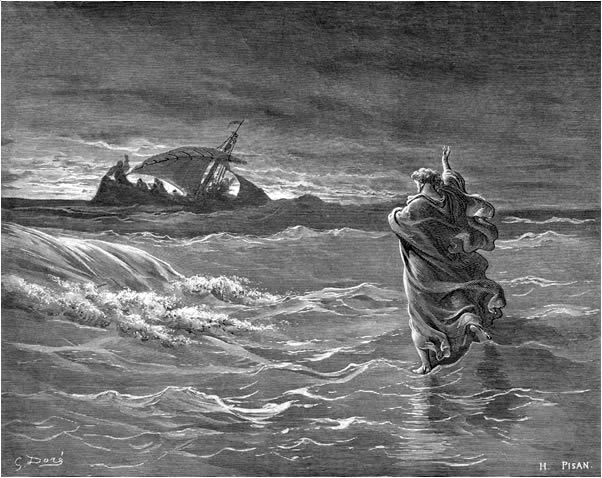
The history contained in these verses is one of singular interest. The miracle here recorded brings out in strong light the character both of Christ and his people. The power and mercy of the Lord Jesus, and the mixture of faith and unbelief in his best disciples, are beautifully illustrated. We learn in the first place, from this miracle what absolute dominion our Saviour has over all created things. We see him “walking on the sea,” as if it was dry land.
The history contained in these verses is one of singular interest. The miracle here recorded brings out in strong light the character both of Christ and his people. The power and mercy of the Lord Jesus, and the mixture of faith and unbelief in his best disciples, are beautifully illustrated. We learn in the first place, from this miracle what absolute dominion our Saviour has over all created things. We see him “walking on the sea,” as if it was dry land. Those angry waves, which tossed the ship of his disciples to and fro, obey the Son of God and become a solid floor under his feet. That liquid surface, which was agitated by the least breath of wind, bears up the feet of our Redeemer like a rock. To our poor, weak minds, the whole event is utterly incomprehensible. The picture of two feet walking on the sea is said by Doddridge to have been the Egyptian emblem of an impossible thing; the man of science will tell us that for material flesh and blood to walk on water is a physical impossibility. Even for us to know that it was done. Enough for us toremember that to him who created the seas at the beginning, it must have been perfectly easy to walk over their waves when he pleased. There is encouragement here for all true Christians. Let them know that there is nothing created which is not under Christ’s control: all things serve him. He may allow his people to be tried for a season, and to be tossed to and fro by storms of trouble; he may be later than they wish in coming to their aid, and not draw near till the “fourth watch of the night:” but never let them forget that winds, and waves and storms are all Christ’s servants. They cannot move without Christ’s permission. “The lord on high is mightier tha the voice of many waters, yea than the mighty waves of the sea.” ( Psalm 93:4 ).
A commentator
Albert Barnes1798–1870
Notes, Explanatory and Practical, on the Old and New Testaments (1832-1869)
proposed
Land of Gennesaret - This region was in Galilee, on the west side of the Sea of Tiberias; and in this land was situated Capernaum, to which he had directed his disciples to go. The hem of his garment - That is, the fringe or border on the outer garment. See the notes at Mat 9:20. Remarks On Matthew 14 1. We learn from this chapter the power of conscience, Mat 14:1-4. Herod’s guilt was the only reason why he thought John the Baptist had risen. At another time he would altogether have disbelieved it. Consciousness of guilt will at some period infallibly torment a man. 2. The duty of faithfulness, Mat 14:4. John reproved Herod at the hazard of his life, and he died for it; but he had the approbation of conscience and of God. So will all who do their duty. Here was an example of fidelity to all ministers of religion. They are not to fear the face of man, however rich, or mighty, or wicked. 3. The righteous will command the respect of the wicked. Herod was a wicked man, but he respected John and feared him, Mar 6:20. The wicked profess to despise religion, and many really do; but their consciences tell them that religion is a good thing. In times of trial they will sooner trust Christians than others. In sickness and death they are often glad to see them and hear them pray, and desire the comfort which they have; and, like Balsam, say, “Let me die the death of the righteous,” Num 23:10. No person, young or old, is ever the less really esteemed for being a Christian. 4. People are often restrained from great sins by mere selfish motives, as Herod was by the love of popularity, Mat 14:5. Herod would have put John to death long before had it not been that he feared the people. His constantly desiring to do it was a kind of prolonged murder. […]
The words behind it
8 Greek wordsEvery Greek word of this verse in the order it stands, with what it means and the door to its own study. The last column counts the times a word stands in the whole Bible: the rarer the word, the more the places it appears belong together.
| Greek | Sound | Meaning | Word study | In the Bible |
|---|---|---|---|---|
| καὶ | kai | And | G2532 → | 9120 times |
| διαπεράσαντες | diaperasantes | having crossed over | G1276 → | |
| ἦλθον | elthon | they came | G2064 → | 628 times |
| εἰς | eis | into | G1519 → | 1755 times |
| τὴν | ten | the | G3588 → | 19766 times |
| γῆν | gen | land | G1093 → | 248 times |
| εἰς | eis | of | G1519 → | 1755 times |
| Γεννησαρέτ. | gennesaret | Gennesaret. | G1082 → |
καὶAnd
kaiG2532 →9120 times
διαπεράσαντεςhaving crossed over
diaperasantesG1276 →
ἦλθονthey came
elthonG2064 →628 times
εἰςinto
eisG1519 →1755 times
τὴνthe
tenG3588 →19766 times
γῆνland
genG1093 →248 times
εἰςof
eisG1519 →1755 times
Γεννησαρέτ.Gennesaret.
gennesaretG1082 →
A shaded row is a word that stands 400 times or fewer in the Bible.
The walk
5 stopsEach card is a verse this one points to, and under it the verses that one points to in turn. Where several paths arrive at the same place, that place is listed first: the text keeps returning to it.
Through
Luke 5:1On one occasion, while Jesus was standing by the Lake of Gennesaret with the crowd pressing in on Him to hear the word of God,
it leads to
- Mark 1:16–20
As Jesus was walking beside the Sea of Galilee, He saw Simon and his brother Andrew. They were casting a net into the sea, for they were fishermen.
- Matthew 4:18–22
As Jesus was walking beside the Sea of Galilee, He saw two brothers, Simon called Peter and his brother Andrew. They were casting a net into the sea, for they were fishermen.
- Mark 3:9
Jesus asked His disciples to have a boat ready for Him so that the crowd would not crush Him.
- Mark 6:53
When they had crossed over, they landed at Gennesaret and moored the boat.
- Joshua 12:3
as well as the Arabah east of the Sea of Chinnereth to the Sea of the Arabah (the Salt Sea), eastward through Beth-jeshimoth, and southward below the slopes of Pisgah.
- Mark 1:16–20
Where this verse is studied
On this page
Studies4
About Matthew
This page draws on 15 works. Open the list of works
This page draws on Adam Clarke, Commentary on the Bible; Albert Barnes, Notes, Explanatory and Practical, on the Gospels; Albert Barnes, Notes, Explanatory and Practical, on the Old and New Testaments (1832-1869); Hilary of Poitiers, Catena Aurea by Aquinas; J.C. Ryle, Expository Thoughts on the Gospels: Matthew; Jerome, Commentary on Matthew; Jerome, Catena Aurea by Aquinas; John Chrysostom, Homily on the Gospel of Matthew 50; John Gill, Exposition of the New Testament; John Gill, Exposition of the New Testament (1746-1748); Matthew Henry, Commentary on the Whole Bible; Rabanus Maurus, Catena Aurea by Aquinas; Remigius of Rheims, Catena Aurea by Aquinas; Theophylact of Ohrid, Commentary on Matthew and Thomas Aquinas, Commentary on Matthew.