
Matthew 14:23
in Matthew 14After He had sent them away, He went up on the mountain by Himself to pray. When evening came, He was there alone,
BSB
The same verse in ASV and KJV ▾
ASV
And after he had sent the multitudes away, he went up into the mountain apart to pray: and when even was come, he was there alone.
KJV
And when he had sent the multitudes away, he went up into a mountain apart to pray: and when the evening was come, he was there alone.
⋯
This verse in Matthew 14
Commentary
19 notes on this verseThat He withdraws to pray alone, you should refer not to Him who fed five thousand on five loaves, but to Him who on hearing of the death of John withdrew into the desert; not that we would separate the Lord's person into two parts, but that His actions are divided between the God and the man. Also He ascends into the mountain alone because the multitude cannot follow Him aloft, until He has instructed it by the shore of the sea.
This site's exposition
Immediately Jesus made the disciples get into the boat
on Matthew 14:22-23
John 6:15 gives the urgency Matthew leaves unstated: the crowd intended to seize him and make him their king. Jesus broke up an acclaim built on bread. “He went up on the mountain by Himself to pray”, alone after a day that began in grief and ended in a miracle.
This site's exposition
He went up on the mountain by Himself to pray
Matthew Henry notes that the Lord of all prayed as a man in the form of a servant. So he kept the rule of secret prayer he gave in chapter 6. John Chrysostom draws a balance: Jesus gives the crowd its time and prayer its time, each in turn.
The record, by era
The Church Fathers5 voices
(De Cons. Ev. ii. 47.) This may seem contrary to that Matthew says, that having sent the multitudes away, He went up into a mountain that He might pray alone; and John again says, that it was on a mountain that He fed this same multitude. But since John himself says further, that after that miracle He retired to a mountain that He might not be held by the multitude, who sought to make Him a king, it is clear that He had come down from the mountain when He fed them. Nor do Matthew's words, He went up into a mountain alone to pray, disagree with this, though John says, When he knew that they would come to make him a king, he withdrew into a mountain himself alone. (John 6:15.) For the cause of His praying is not contrary to the cause of His retiring, for herein the Lord teaches us that we have great cause for prayer when we have cause for flight. Nor, again, is it contrary to this that Matthew says first, that He bade His disciples go into the boat, and then that He sent the multitudes away, and went into a mountain alone to pray; while John relates that He first withdrew to the mountain, and then, when it was late, his disciples went down to the sea, and when they had entered into a boat, &c. for who does not see that John is relating as afterwards done by His disciples what Jesus had commanded before He retired into the mountain?
Or, that He is alone in the evening, signifies His sorrow at the time of His passion, when the rest were scattered from Him in fear.
That He commands His disciples to enter the ship and to go across the sea, while He sends the multitudes away, and after that He goes up into the mountain to pray; He therein bids us to be within the Church, and to be in peril until such time as returning in His splendour He shall give salvation to all the people that shall be remaining of Israel, and shall for give their sins; and having dismissed them into His Father's kingdom, returning thanks to His Father, He shall sit down in His glory and majesty. Meanwhile the disciples are tossed by the wind and the waves; struggling against all the storms of this world, raised by the opposition of the unclean spirit.
(Verse 23) And when the crowd was dismissed, he went up the mountain alone to pray. But when evening came, he was there alone. If Peter, James, and John, who had seen the glory of his transfiguration, had been with him, perhaps they would have gone up the mountain with him. But the crowd cannot follow to the heights, unless he teaches them by the sea on the shore and feeds them in the desert. But as for him going up alone to pray, do not attribute it to the one who satisfied five thousand men with five loaves, excluding women and children; but to the one who, upon hearing of John's death, withdrew into solitude. Not that we should separate the person of the Lord, but that his works are divided between God and man.
And His pretext indeed for dismissing them was the multitude, but He was Himself minded to go up into the mountain; and He did this, instructing us neither to be always in intercourse with multitudes, nor always to fly from the crowd, but each of the two as may be expedient, and giving each duly his turn.
11 more voices on this verse
The Church Fathers2 voices
For what purpose doth He go up into the mountain? To teach us, that loneliness and retirement is good, when we are to pray to God. With this view, you see, He is continually withdrawing into the wilderness, and there often spends the whole night in prayer, teaching us earnestly to seek such quietness in our prayers, as the time and place may confer. For the wilderness is the mother of quiet; it is a calm and a harbor, delivering us from all turmoils. He Himself then went up thither with this object, but the disciples are tossed with the waves again, and undergo a storm, equal even to the former. But whereas before they had Him in the ship when this befell them, now they were alone by themselves. Thus gently and by degrees He excites and urges them on for the better, even to the bearing all nobly. Accordingly we see, that when they were first near that danger, He was present, though asleep, so as readily to give them relief; but now leading them to a greater degree of endurance, He doth not even this, but departs, and in mid sea permits the storm to arise, so that they might not so much as look for a hope of preservation from any quarter; and He lets them be tempest-tost all the night, thoroughly to awaken, as I suppose, their hardened heart. For such is the nature of the fear, which the time concurs with the rough weather in producing. And together with the compunction, He cast them also into a greater longing for Himself, and a continual remembrance of Him.
(ubi sup.) But while Christ prays on high, the boat is tossed with great waves in the deep; and forasmuch as the waves rise, that boat can be tossed; but because Christ prays, it cannot be sunk. Think of that boat as the Church, and the stormy sea as this world.
The Medieval Church3 voices
And having dismissed the crowd, he went up into the mountain alone to pray. There follows the danger, and the danger is shown from the time, from the place, and from the wind. And first the absence of Christ is presented, because while he was …
(App. Serm. 72. 1.) Mystically; The mountain is loftiness. But what is higher than the heavens in the world? And Who it was that ascended into heaven, that our faith knows. Why did He ascend alone into heaven? Because no man has ascended into heaven, but He that came down from heaven. For even when He shall come in the end, and shall have exalted us into heaven, He will yet ascend alone, inasmuch as the head with its body is One Christ, and now the head only is ascended. He went up to pray, because He is ascended to make intercession to His Father for us.
He went up on the mountain to show that we should pray in an undistracted manner; everything He did was for our sake as He Himself had no need of prayer. He prayed on into the evening, teaching us not to cease praying after a …
The Puritans and the Awakening2 voices
And when he had sent the multitudes away,.... Had ordered them at least to go away; for, it seems, according to Joh 6:22 that they did not in general disperse: there was a large body of them that continued upon the spot all night, expecting his return; in which being disappointed, they took shipping, and came to Capernaum. He went up into a mountain apart to pray; perhaps the same he went up to before, and from whence he came down, Joh 6:
That he was alone at prayer; that was his business in this solitude, to pray. Though Christ, as God, was Lord of all, and was prayed to, yet Christ, as Man, had the form of a servant, of a beggar, and prayed. Christ has herein set before us an example of secret prayer, and the performance of it secretly, according to the rule he gave, ch. vi.
The Nineteenth Century3 voices
He went up into a mountain apart, to pray - He whom God has employed in a work of mercy had need to return, by prayer, as speedily, to his Maker, as he can, lest he should be tempted to value himself on account of that in which he has no merit - for the good that is done upon earth, the Lord doth it alone. Some make this part of our Lord’s conduct emblematic of the spirit and practice of prayer, and observe that the proper dispositions and circumstances for praying well are: 1. Retirement from the world.
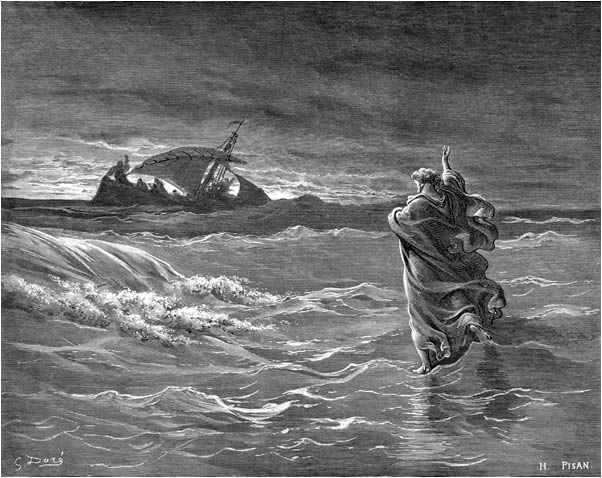
The history contained in these verses is one of singular interest. The miracle here recorded brings out in strong light the character both of Christ and his people. The power and mercy of the Lord Jesus, and the mixture of faith and unbelief in his best disciples, are beautifully illustrated. We learn in the first place, from this miracle what absolute dominion our Saviour has over all created things. We see him “walking on the sea,” as if it was dry land.
The history contained in these verses is one of singular interest. The miracle here recorded brings out in strong light the character both of Christ and his people. The power and mercy of the Lord Jesus, and the mixture of faith and unbelief in his best disciples, are beautifully illustrated. We learn in the first place, from this miracle what absolute dominion our Saviour has over all created things. We see him “walking on the sea,” as if it was dry land. Those angry waves, which tossed the ship of his disciples to and fro, obey the Son of God and become a solid floor under his feet. That liquid surface, which was agitated by the least breath of wind, bears up the feet of our Redeemer like a rock. To our poor, weak minds, the whole event is utterly incomprehensible. The picture of two feet walking on the sea is said by Doddridge to have been the Egyptian emblem of an impossible thing; the man of science will tell us that for material flesh and blood to walk on water is a physical impossibility. Even for us to know that it was done. Enough for us toremember that to him who created the seas at the beginning, it must have been perfectly easy to walk over their waves when he pleased. There is encouragement here for all true Christians. Let them know that there is nothing created which is not under Christ’s control: all things serve him. He may allow his people to be tried for a season, and to be tossed to and fro by storms of trouble; he may be later than they wish in coming to their aid, and not draw near till the “fourth watch of the night:” but never let them forget that winds, and waves and storms are all Christ’s servants. They cannot move without Christ’s permission. “The lord on high is mightier tha the voice of many waters, yea than the mighty waves of the sea.” ( Psalm 93:4 ).
Modern Voices1 voice
The tremendous figure which fills the Gospels towers in this respect, as in every other, above all the thinkers who ever thought themselves tall. His pathos was natural, almost casual. The Stoics, ancient and modern, were proud of concealing their tears. He never concealed His …
The words behind it
17 Greek wordsEvery Greek word of this verse in the order it stands, with what it means and the door to its own study. The last column counts the times a word stands in the whole Bible: the rarer the word, the more the places it appears belong together.
| Greek | Sound | Meaning | Word study | In the Bible |
|---|---|---|---|---|
| Καὶ | kai | And | G2532 → | 9120 times |
| ἀπολύσας | apolusas | having dismissed | G630 → | 63 times |
| τοὺς | tous | the | G3588 → | 19766 times |
| ὄχλους | ochlous | crowds | G3793 → | 175 times |
| ἀνέβη | anebe | He went up | G305 → | 82 times |
| εἰς | eis | on | G1519 → | 1755 times |
| τὸ | to | the | G3588 → | 19766 times |
| ὄρος | oros | mountain | G3735 → | 62 times |
| κατ᾽ | kat᾽ | on | G2596 → | 468 times |
| ἰδίαν | idian | [his] own | G2398 → | 114 times |
| προσεύξασθαι.¶ | proseuxasthai | to pray. | G4336 → | 85 times |
| Ὀψίας | opsias | Evening | G3798 → | 15 times |
| δὲ | de | now | G1161 → | 2765 times |
| γενομένης | genomenes | having arrived | G1096 → | 667 times |
| μόνος | monos | alone | G3441 → | 110 times |
| ἦν | en | He was | G1510 → | 2333 times |
| ἐκεῖ. | ekei | there. | G1563 → | 105 times |
ΚαὶAnd
kaiG2532 →9120 times
ἀπολύσαςhaving dismissed
apolusasG630 →63 times
τοὺςthe
tousG3588 →19766 times
ὄχλουςcrowds
ochlousG3793 →175 times
ἀνέβηHe went up
anebeG305 →82 times
εἰςon
eisG1519 →1755 times
τὸthe
toG3588 →19766 times
ὄροςmountain
orosG3735 →62 times
κατ᾽on
kat᾽G2596 →468 times
ἰδίαν[his] own
idianG2398 →114 times
προσεύξασθαι.¶to pray.
proseuxasthaiG4336 →85 times
ὈψίαςEvening
opsiasG3798 →15 times
δὲnow
deG1161 →2765 times
γενομένηςhaving arrived
genomenesG1096 →667 times
μόνοςalone
monosG3441 →110 times
ἦνHe was
enG1510 →2333 times
ἐκεῖ.there.
ekeiG1563 →105 times
A shaded row is a word that stands 400 times or fewer in the Bible.
The walk
8 stopsEach card is a verse this one points to, and under it the verses that one points to in turn. Where several paths arrive at the same place, that place is listed first: the text keeps returning to it.
Through
Matthew 6:6But when you pray, go into your inner room, shut your door, and pray to your Father, who is unseen. And your Father, who sees what is done in secret, will reward you.
it leads to
- 2 Kings 4:33
So he went in, closed the door behind the two of them, and prayed to the LORD.
- Isaiah 65:24
Even before they call, I will answer, and while they are still speaking, I will hear.
- Psalms 34:15
The eyes of the LORD are on the righteous, and His ears are inclined to their cry.
- Acts 9:40
Then Peter sent them all out of the room. He knelt down and prayed, and turning toward her body, he said, “Tabitha, get up!” She opened her eyes, and seeing Peter, she sat up.
- Isaiah 26:20
Go, my people, enter your rooms and shut your doors behind you. Hide yourselves a little while until the wrath has passed.
- 2 Kings 4:33
Through
Luke 6:12In those days Jesus went out to the mountain to pray, and He spent the night in prayer to God.
it leads to
- Mark 1:35
Early in the morning, while it was still dark, Jesus got up and slipped out to a solitary place to pray.
Reached by 2 separate paths from here.
- Matthew 6:6
But when you pray, go into your inner room, shut your door, and pray to your Father, who is unseen. And your Father, who sees what is done in secret, will reward you.
Reached by 2 separate paths from here.
- Hebrews 5:7
During the days of Jesus’ earthly life, He offered up prayers and petitions with loud cries and tears to the One who could save Him from death, and He was heard because of His…
- Mark 1:35
Where this verse is studied
On this page
About Matthew
This page draws on 15 works. Open the list of works
This page draws on Adam Clarke, Commentary on the Bible; Albert Barnes, Notes, Explanatory and Practical, on the Gospels; Augustine of Hippo, Catena Aurea by Aquinas; GK Chesterton, Orthodoxy, Ch. 9: Authority and the Adventurer (1908); Hilary of Poitiers, Catena Aurea by Aquinas; J.C. Ryle, Expository Thoughts on the Gospels: Matthew; Jerome, Catena Aurea by Aquinas; Jerome, Commentary on Matthew; John Chrysostom, Homily on the Gospel of Matthew 49; John Chrysostom, Homily on the Gospel of Matthew 50; John Gill, Exposition of the New Testament (1746-1748); Matthew Henry, Commentary on the Whole Bible; Pseudo-Augustine, Catena Aurea by Aquinas; Theophylact of Ohrid, Commentary on Matthew and Thomas Aquinas, Commentary on Matthew.