
Matthew 14:22
in Matthew 14Immediately Jesus made the disciples get into the boat and go on ahead of Him to the other side, while He dismissed the crowds.
BSB
The same verse in ASV and KJV ▾
ASV
And straightway he constrained the disciples to enter into the boat, and to go before him unto the other side, till he should send the multitudes away.
KJV
And straightway Jesus constrained his disciples to get into a ship, and to go before him unto the other side, while he sent the multitudes away.
⋯
This verse in Matthew 14
Commentary
16 notes on this verse(Verse 22.) And immediately Jesus compelled his disciples to get into the boat and go ahead of him across the sea, while he dismissed the crowds. He instructed the disciples to cross over and compelled them to get into the boat, which shows by his words that they unwillingly left the Lord, as they did not want to be separated from him even for a moment.
This site's exposition
Immediately Jesus made the disciples get into the boat
on Matthew 14:22-23
John 6:15 gives the urgency Matthew leaves unstated: the crowd intended to seize him and make him their king. Jesus broke up an acclaim built on bread. “He went up on the mountain by Himself to pray”, alone after a day that began in grief and ended in a miracle.
The record, by era
The Church Fathers5 voices
(ubi sup.) But while Christ prays on high, the boat is tossed with great waves in the deep; and forasmuch as the waves rise, that boat can be tossed; but because Christ prays, it cannot be sunk. Think of that boat as the Church, and the stormy sea as this world.
(De Cons. Ev. ii. 47.) This may seem contrary to that Matthew says, that having sent the multitudes away, He went up into a mountain that He might pray alone; and John again says, that it was on a mountain that He fed this same multitude. But since John himself says further, that after that miracle He retired to a mountain that He might not be held by the multitude, who sought to make Him a king, it is clear that He had come down from the mountain when He fed them. Nor do Matthew's words, He went up into a mountain alone to pray, disagree with this, though John says, When he knew that they would come to make him a king, he withdrew into a mountain himself alone. (John 6:15.) For the cause of His praying is not contrary to the cause of His retiring, for herein the Lord teaches us that we have great cause for prayer when we have cause for flight. Nor, again, is it contrary to this that Matthew says first, that He bade His disciples go into the boat, and then that He sent the multitudes away, and went into a mountain alone to pray; while John relates that He first withdrew to the mountain, and then, when it was late, his disciples went down to the sea, and when they had entered into a boat, &c. for who does not see that John is relating as afterwards done by His disciples what Jesus had commanded before He retired into the mountain?
The spiritual significance of this must be discerned, comparing the temporal order with the coming revelation. The historical event of his solitude in the evening anticipates a future event: his solitude at the time of the Passion, when everyone else had fled in fear.He then orders his disciples to get into the boat and cross the sea while he dismisses the crowds. Once they are dismissed, he goes up on the mountain. This prefigures that he is on the sea and within the church. He orders that he be carried throughout the world until he returns in a dazzling second advent to all who are left from the house of Israel, when he will bring salvation and forgive sins. Finally, in dismissing the crowds, the Lord is symbolically permitting them to enter into the kingdom of heaven. Then he proceeds to give thanks to God the Father, which anticipates his taking his place in glory and in majesty.
That He commands His disciples to enter the ship and to go across the sea, while He sends the multitudes away, and after that He goes up into the mountain to pray; He therein bids us to be within the Church, and to be in peril until such time as returning in His splendour He shall give salvation to all the people that shall be remaining of Israel, and shall for give their sins; and having dismissed them into His Father's kingdom, returning thanks to His Father, He shall sit down in His glory and majesty. Meanwhile the disciples are tossed by the wind and the waves; struggling against all the storms of this world, raised by the opposition of the unclean spirit.
These words show that they left the Lord unwillingly, not desiring through their love for their teacher to be separated from Him even for a moment.
9 more voices on this verse
The Church Fathers1 voice
And, having wrought the miracle, "straightway He constrained His disciples to get into a ship, and to go before Him unto the other side, while He sent the multitudes away." For even if He had seemed, when in sight, to be presenting an illusion, and not to have wrought a truth; yet surely not in His absence also. For this cause then, submitting His proceedings to an exact test, He commanded those that had got the memorials, and the proof of the miracles, to depart from Him. And besides this, when He is doing great works, He disposes elsewhere of the multitudes and the disciples, instructing us in nothing to follow after the glory that comes from the people, nor to collect a crowd about us. Now by saying, "He constrained them," He indicates the very close attendance of the disciples.
The Medieval Church2 voices
By saying "constrained," Matthew suggests how inseparable the disciples were from Jesus, for they wanted to be with Him at all times. He sends the multitudes away, not wishing to draw them after Him lest He appear to vaunt in His powers.
And immediately Jesus compelled the disciples. Here the power of Christ's teaching is figured, because it is liberating from dangers, because he freed the disciples from dangers. Hence he does three things. First, the occasion for undergoing danger is presented; second, the danger; third, the …
The Puritans and the Awakening2 voices
15 ); to avoid which, he immediately scattered the people, sent away the disciples, lest they should join with them, and he himself withdrew, John vi. When they had sat down to eat and drink, they did not rise up to play, but each went to his business. Christ sent the people away.
quarantine:debris (2026-07-29) — leading-citation-number+unbalanced-parens
And straightway Jesus constrained his disciples,....
The Nineteenth Century4 voices
Jesus constrained his disciples to get into a ship - Either they were afraid to return into the jurisdiction of Herod, or they were unwilling to embark without their Lord and Protector, and would not enter their boat till Christ had commanded them to embark. From this verse it appears that Christ gave some advices to the multitudes after the departure of his disciples, which he did not wish them to hear. Unto the other side - Towards Capernaum, Mat 14:34. Joh 6:16, Joh 6:17, or Bethsaida, see on Mar 6:45 (note).
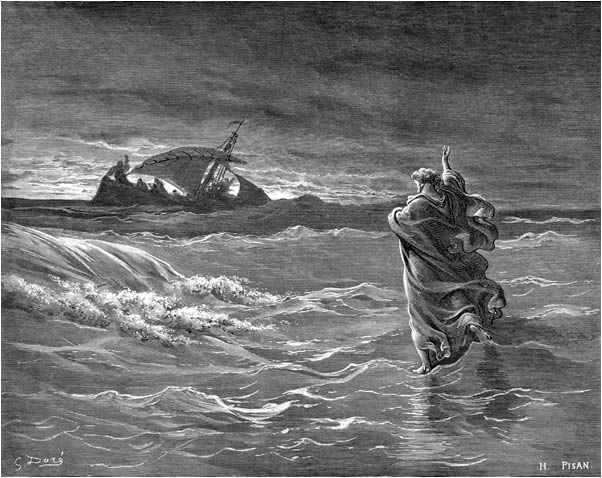
The history contained in these verses is one of singular interest. The miracle here recorded brings out in strong light the character both of Christ and his people. The power and mercy of the Lord Jesus, and the mixture of faith and unbelief in his best disciples, are beautifully illustrated. We learn in the first place, from this miracle what absolute dominion our Saviour has over all created things. We see him “walking on the sea,” as if it was dry land.
The history contained in these verses is one of singular interest. The miracle here recorded brings out in strong light the character both of Christ and his people. The power and mercy of the Lord Jesus, and the mixture of faith and unbelief in his best disciples, are beautifully illustrated. We learn in the first place, from this miracle what absolute dominion our Saviour has over all created things. We see him “walking on the sea,” as if it was dry land. Those angry waves, which tossed the ship of his disciples to and fro, obey the Son of God and become a solid floor under his feet. That liquid surface, which was agitated by the least breath of wind, bears up the feet of our Redeemer like a rock. To our poor, weak minds, the whole event is utterly incomprehensible. The picture of two feet walking on the sea is said by Doddridge to have been the Egyptian emblem of an impossible thing; the man of science will tell us that for material flesh and blood to walk on water is a physical impossibility. Even for us to know that it was done. Enough for us toremember that to him who created the seas at the beginning, it must have been perfectly easy to walk over their waves when he pleased. There is encouragement here for all true Christians. Let them know that there is nothing created which is not under Christ’s control: all things serve him. He may allow his people to be tried for a season, and to be tossed to and fro by storms of trouble; he may be later than they wish in coming to their aid, and not draw near till the “fourth watch of the night:” but never let them forget that winds, and waves and storms are all Christ’s servants. They cannot move without Christ’s permission. “The lord on high is mightier tha the voice of many waters, yea than the mighty waves of the sea.” ( Psalm 93:4 ).
A commentator
Albert Barnes1798–1870
Notes, Explanatory and Practical, on the Old and New Testaments (1832-1869)
proposed
And straightway Jesus constrained ... - See Mar 6:45-56; Joh 6:15-21. The word “straightway” means immediately; that is, as soon as the fragments were gathered up. To “constrain” usually means to compel. It here means to command. There was no need of compulsion. They were at this time on the east side of the Lake of Gennesareth. He directed them to get into a ship and cross over to the other side; that is, to Capernaum. Mark adds that he sent them to Bethsaida Mar 6:45. Bethsaida was situated at the place where the Jordan empties into the lake on the east side of the river. Compare the notes at Mat 11:21. It is probable that he directed them to go in a ship or boat to Bethsaida, and remain there till he should dismiss the people, and that he would meet them there, and with them cross the lake. The effect of the miracle on the multitude was so great Joh 6:14 that they believed him to be that prophet which should come into the world; that is, the Messiah, the king that they had expected, and they were about to take him by force and make him a king, Joh 6:15. To avoid this, Jesus got away from them as privately as possible. He went into a solitary mountain alone. In view of the temptation - when human honors were offered to him and almost forced upon him - he retired for private prayer; an example for all who are tempted with human honors and applause. Nothing is better to keep the mind humble and unambitious than to seek some lonely place; to shut out the world with all its honors; to realize that the great God, before whom all creatures and all honors sink to nothing, is round about us; and to ask him to keep us from pride and vainglory.
The words behind it
20 Greek wordsEvery Greek word of this verse in the order it stands, with what it means and the door to its own study. The last column counts the times a word stands in the whole Bible: the rarer the word, the more the places it appears belong together.
| Greek | Sound | Meaning | Word study | In the Bible |
|---|---|---|---|---|
| Καὶ | kai | And | G2532 → | 9120 times |
| εὐθέως | eutheos | immediately | G2112 → | 87 times |
| ἠνάγκασεν | enagkasen | He compelled | G315 → | |
| τοὺς | tous | the | G3588 → | 19766 times |
| μαθητὰς | mathetas | disciples | G3101 → | 260 times |
| ἐμβῆναι | embenai | to climb | G1684 → | 16 times |
| εἰς | eis | into | G1519 → | 1755 times |
| τὸ | to | the | G3588 → | 19766 times |
| πλοῖον | ploion | boat | G4143 → | 67 times |
| καὶ | kai | and | G2532 → | 9120 times |
| προάγειν | proagein | to go before | G4254 → | 20 times |
| αὐτὸν | auton | Him | G846 → | 5565 times |
| εἰς | eis | to | G1519 → | 1755 times |
| τὸ | to | the | G3588 → | 19766 times |
| πέραν | peran | other side | G4008 → | 23 times |
| ἕως | he'os | until | G2193 → | 146 times |
| οὗ | hou | that | G3739 → | 1405 times |
| ἀπολύσῃ | apoluse | He may have dismissed | G630 → | 63 times |
| τοὺς | tous | the | G3588 → | 19766 times |
| ὄχλους.¶ | ochlous | crowds. | G3793 → | 175 times |
ΚαὶAnd
kaiG2532 →9120 times
εὐθέωςimmediately
eutheosG2112 →87 times
ἠνάγκασενHe compelled
enagkasenG315 →
τοὺςthe
tousG3588 →19766 times
μαθητὰςdisciples
mathetasG3101 →260 times
ἐμβῆναιto climb
embenaiG1684 →16 times
εἰςinto
eisG1519 →1755 times
τὸthe
toG3588 →19766 times
πλοῖονboat
ploionG4143 →67 times
καὶand
kaiG2532 →9120 times
προάγεινto go before
proageinG4254 →20 times
αὐτὸνHim
autonG846 →5565 times
εἰςto
eisG1519 →1755 times
τὸthe
toG3588 →19766 times
πέρανother side
peranG4008 →23 times
ἕωςuntil
he'osG2193 →146 times
οὗthat
houG3739 →1405 times
ἀπολύσῃHe may have dismissed
apoluseG630 →63 times
τοὺςthe
tousG3588 →19766 times
ὄχλους.¶crowds.
ochlousG3793 →175 times
A shaded row is a word that stands 400 times or fewer in the Bible.
The walk
6 stopsEach card is a verse this one points to, and under it the verses that one points to in turn. Where several paths arrive at the same place, that place is listed first: the text keeps returning to it.
Through
Matthew 15:39After Jesus had dismissed the crowds, He got into the boat and went to the region of Magadan.
it leads to
- Mark 8:10
He got into the boat with His disciples and went to the district of Dalmanutha.
- Mark 8:10
Through
Matthew 13:36Then Jesus dismissed the crowds and went into the house. His disciples came to Him and said, “Explain to us the parable of the weeds in the field.”
it leads to
- John 16:17–20
Then some of His disciples asked one another, “Why is He telling us, ‘In a little while you will not see Me, and then after a little while you will see Me’ and ‘Because…
- Matthew 13:11
He replied, “The knowledge of the mysteries of the kingdom of heaven has been given to you, but not to them.
- Matthew 15:15–16
Peter said to Him, “Explain this parable to us.”
- Mark 7:17
After Jesus had left the crowd and gone into the house, His disciples inquired about the parable.
- Matthew 13:1
That same day Jesus went out of the house and sat by the sea.
- John 16:17–20
Where this verse is studied
On this page
About Matthew
This page draws on 14 works. Open the list of works
This page draws on Adam Clarke, Commentary on the Bible; Albert Barnes, Notes, Explanatory and Practical, on the Gospels; Albert Barnes, Notes, Explanatory and Practical, on the Old and New Testaments (1832-1869); Augustine of Hippo, Catena Aurea by Aquinas; Hilary of Poitiers, Commentary on Matthew 14.13; Hilary of Poitiers, Catena Aurea by Aquinas; J.C. Ryle, Expository Thoughts on the Gospels: Matthew; Jerome, Commentary on Matthew; Jerome, Catena Aurea by Aquinas; John Chrysostom, Homily on the Gospel of Matthew 49; John Gill, Exposition of the New Testament (1746-1748); Matthew Henry, Commentary on the Whole Bible; Theophylact of Ohrid, Commentary on Matthew and Thomas Aquinas, Commentary on Matthew.