
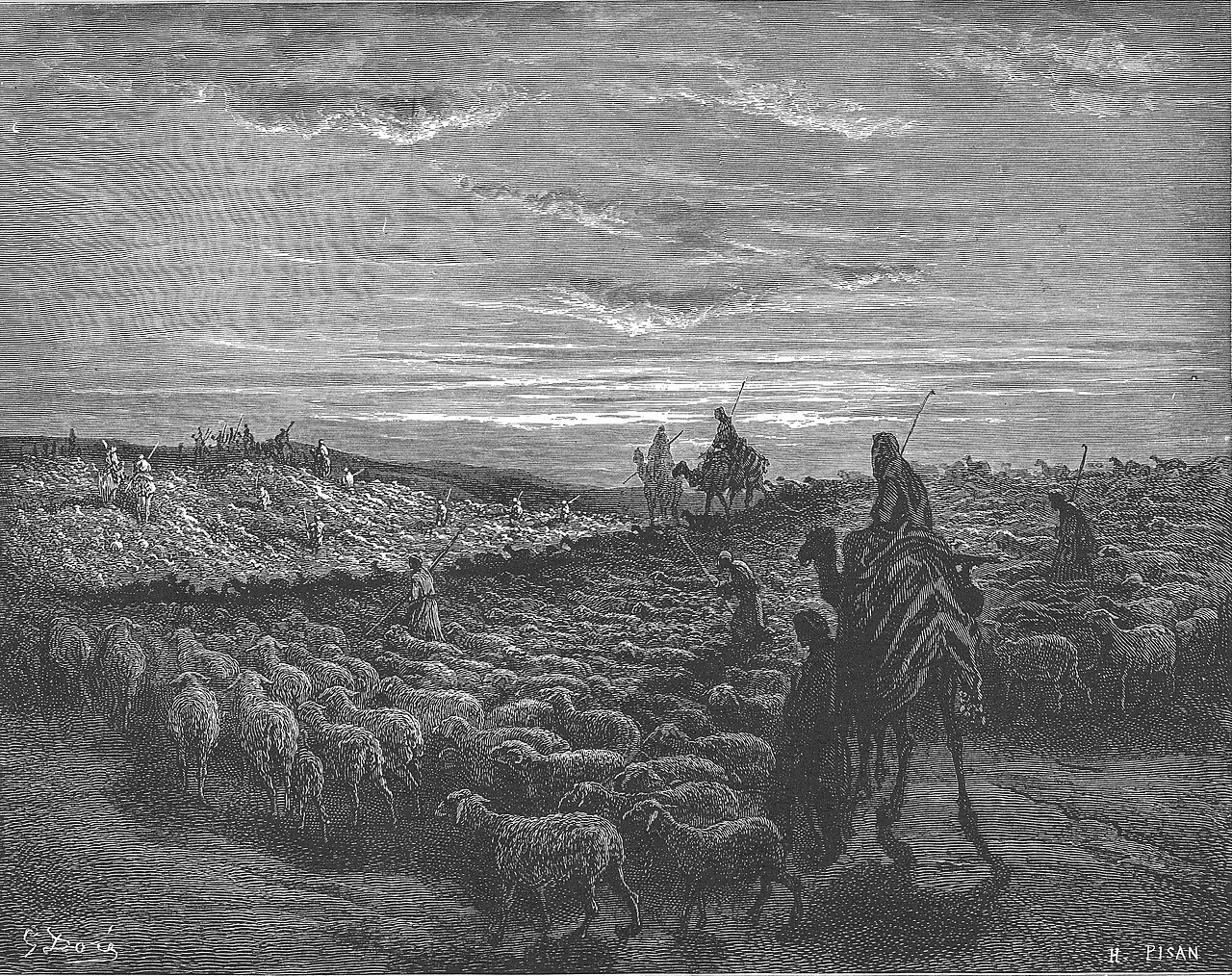
Genesischapter 12
20 verses · Moses, by tradition · 15th to 13th century BC · The Law
Then the LORD said to Abram, “Leave your country, your kindred, and your father’s household, and go to the land I will show you.
Introduction
Moses, by tradition, The Law, Genesis Overview.
Moses wrote this chapter, by tradition, for Israel in the wilderness, a nation marching toward the land it describes. It begins the second part of Genesis, and from here the book follows one man and his descendants. The first half gives God's promise and the road into Canaan, and the second takes the family down into Egypt in a famine. Listen for how often God speaks and how seldom Abram does. Notice where altars are built and where there are none. The promises in the opening lines govern the rest of the Bible, and every later covenant looks back to them.
Context
- Who
- Israel in the wilderness, hearing how the promise of the land they were marching toward began
- What
- The call of Abram, with God's promise of a nation, a name, a land and a blessing for all peoples, followed by Abram's descent into Egypt.
- Where
- Haran, then Shechem and the hill country between Bethel and Ai in Canaan, then the Negev and Egypt.
- When
- The patriarchal age, about 2091 BC on the traditional dating, which some place a few centuries later.
- Why
- To set out the promise on which the rest of Scripture rests and to show that it holds even when the man who carries it fails.
Historical context
The chapter stands inside the generations of Terah and follows Abram, who is seventy-five when he leaves Haran. God speaks the promise at the opening and again at Shechem.
Show the rest of the historical context, 4 more paragraphs
Abram leaves a settled and prosperous world for a tent. Haran sat on the main trade road, and Canaan was a patchwork of small city-states under loose Egyptian influence, thinly settled in the hill country where he pitched.
He stops at two places that matter for centuries afterward. Shechem lies in the pass between Mount Ebal and Mount Gerizim, and the oak of Moreh there was a recognised sacred landmark. Bethel sits on the ridge road that runs the spine of the hill country.
Canaan was rain-fed farming with no great river, so a drought meant famine and a famine meant going down to Egypt, where the Nile flooded whatever the local rain did. Egyptian tomb paintings show Semitic families arriving with their goods for that reason.
The half-truth about Sarai fits the danger of the moment. A husband could be killed to free a beautiful wife, while a brother would be negotiated with and paid a bride price, which is what happens, and Abram leaves richer than he came and shamed by a pagan king.
Significance
This is the charter. Land, descendants, and blessing for all the families of the earth were promised to a man who owned none of it and had no children.
Show the rest of the significance, 1 more paragraph
For Israel camped in the desert it meant that the land ahead of them rested on a promise older than their nation, walked by God with their father.
This chapter in Jewish lifeWhat this chapter is in Jewish life and reading.
What is done
This chapter opens the third portion of the annual cycle, and the portion runs from its first verse to the end of Genesis 17 (src/lib/hebraic/readings.ts). A congregation hears the call of Abram, the covenant of the pieces and the sign of circumcision in one sitting. The card above carries the portion and the prophetic reading set beside it.
How it is read
Rashi is quoted here from the public domain Rosenbaum and Silbermann edition, and Radak from the CC-BY translation of Eliyahu Munk, HaChut Hameshulash.
Rashi reads the words of the call as spoken for the good of the man who is called. The going is for his own benefit, since he would have children there and would be known through the world (Rashi on Genesis 12:1:1, citing Rosh Hashanah 16b and Midrash Tanchuma, Lech Lecha 3). He reads the three blessings of the second verse against the three things travel costs a man. Travel breaks up family life, spends wealth and loses a name, so children, wealth and a great name are promised (Rashi on Genesis 12:2:1, citing Genesis Rabbah 39:11).
On the blessing of the families of the earth Rashi gives the plain sense before the sayings. A man will say to his son that he should become like Abraham, as Israel later blesses children by Ephraim and Manasseh (Rashi on Genesis 12:3:1). Radak reads the going out of the fourth verse as trust rather than obedience alone. Abram asked for no further word, because he believed the promise would be kept (Radak on Genesis 12:4:2).
The souls gotten in Haran are read two ways by Rashi. The plain sense is the servants they had acquired. The other is that Abraham brought the men "beneath the sheltering wings of the Shechinah" and Sarah brought the women. The text counts that as making them (Rashi on Genesis 12:5:1, citing Genesis Rabbah 39:14). He reads the famine of the tenth verse as a test of whether Abram would question the command that sent him to that land (Rashi on Genesis 12:10:1, citing Pirkei DeRabbi Eliezer 26).
Ibn Ezra carries three comments on this chapter that the corpus holds by reference alone, and one comment of Rashi is held the same way. They are Ibn Ezra on Genesis 12:1:1, 12:3:1 and 12:18:1, and Rashi on Genesis 12:17:1.
What the rabbis say
Rashi carries three sayings of the rabbis on this chapter, and each stands here as what they taught.
The first is on the beauty of Sarai. Rashi reports the Midrash that Abram had never seen it until then, because both of them were so modest. He reports a second saying, that travel makes a person plain and that she had kept her beauty through it (Rashi on Genesis 12:11:1, citing Midrash Tanchuma, Lech Lecha 5 and Genesis Rabbah 40:4). He gives the plain sense beside both, that the danger of Egypt was what made him speak.
The second is the chest at the border. Rashi reports that the singular verb of the fourteenth verse teaches that Abram hid Sarai in a chest. The customs men opened it and found her (Rashi on Genesis 12:14:1, citing Genesis Rabbah 40:5).
The third is on the sending away. Rashi sets Pharaoh beside Abimelech, who offered Abraham his land to live in, where Pharaoh told him to go and to stay no longer (Rashi on Genesis 12:19:1, citing Midrash Tanchuma, Lech Lecha 5). Rashi reads the last verse as an escort given for his protection (Rashi on Genesis 12:20:1). Radak reads the fear of Abram in Egypt from the character he gives the Egyptians of that day (Radak on Genesis 12:12:1).
The corpus records forty places where the Midrash and the Talmud cite this chapter, thirty three under Midrash and seven under Talmud, with the locator for each one and no text. Bereshit Rabbah reads the fourth verse at 39:8 and 39:13, the sixth to the eighth at 39:15, the seventh at 39:16 and the tenth at 25:3. It reads the twelfth verse at 39:11, the thirteenth at 52:4, the fourteenth at 40:5, the sixteenth at 52:12 and the eighteenth at 51:6.
Aggadat Bereshit reads the first verse at 31:2 and 47:1, the second at 37:1, the third at 13:3, the eleventh at 34:1 and the seventeenth at 29:3 and 67:1. Bamidbar Rabbah reads the second verse at 11:2, the third at 20:19, the seventh at 10:5 and the fifteenth at 18:2 and 20:2. Bereshit Rabbati reads three verses in Parashat Lech Lecha, at 3, 9 and 12.
The Talmud is cited at Avodah Zarah 9a:7 on the fifth verse, Bava Kamma 60b:6 on the tenth, Bava Batra 16a:15 on the eleventh and Berakhot 56b:19 on the thirteenth. Avot DeRabbi Natan is cited at 12:8 and 1:4, and its second recension at 1:7.
Sources: Rashi, Rashi on Genesis 12, in Pentateuch with Rashi's commentary by M. Rosenbaum and A. M. Silbermann, 1929 to 1934, public domain, about 1090; Radak, Radak on Genesis 12:4:1, 12:4:2 and 12:12:1, in HaChut Hameshulash, translated by Eliyahu Munk, CC-BY, about 1200; Ibn Ezra, his three comments on Genesis 12, cited by reference; the licence Sefaria reports for the English version keeps the text out of the corpus; The Midrash and the Talmud, the forty locators on Genesis 12 in scripts/data/sources/sefaria/genesis/12.json; MannaFest, the annual cycle table at src/lib/hebraic/readings.ts, 2026.
The heads below are this chapter's scenes. The numbered points under each are its verses.
Go, and I Will Bless You
Genesis 12:1-3
The command separates Abram from three things in rising order of cost, his country, then his kindred, then his father's household. The promises answer each loss, a great nation, a great name, and blessing for all the families of the earth. Galatians 3:8 takes that last clause as the gospel announced to Abraham in advance. The land stays unnamed until he goes.
Genesis 12:1
“This call included two promises: the first, showing the land of his future posterity; and the second, that in his posterity all the earth was to be blessed (Ge 12:2). Abraham obeyed, and it is frequently mentioned in the New Testament as a striking instance of his faith (Heb 11:8).”
Jamieson, Fausset & Brown · Commentary Critical and Explanatory on the Whole Bible (1871)reformed
1 more voice on this verseWhat preachers and commentators have said about this verse, in their own words.
Genesis 12:1
“Get out for thyself (so some read it), that is, for thy own good. Note, Those who leave their sins, and turn to God, will themselves be unspeakable gainers by the change, Prov. ix. This command which God gave to Abram is much the same with the gospel call by which all the spiritual seed of faithful Abram are brought into covenant with God.”
Matthew Henry · Commentary on the Whole Bible (1707-1721)puritan
Cross references
Genesis 12:1
- Quoted inActs 7:3“and told him, ‘Leave your country and your kindred and go to the land I will show you.’”
'Get thee out of thy country', Stephen's speech (call of Abraham)
I will make you into a great nation: Adam Clarke takes the great nation as the Jewish people and ties the great name to the change at 17:5, from Abram, high father, to Abraham, father of a multitude. Didymus the Blind took the promise of a nation literally, since history fulfilled it. Abram is to be a blessing himself.
Genesis 12:2
“I will make of thee a great nation - i.e., The Jewish people; and make thy name great, alluding to the change of his name from Abram, a high father, to Abraham, the father of a multitude.”
Adam Clarke · Commentary on the Bible (1810-1826)evangelical
2 more voices on this verse
Genesis 12:2
“As for the promise to make of him "a great nation," is it necessary to give a meaning other than the literal one? Because it is clear that it was realized in its historical sense.”
Didymus the Blind · written before 398 · ON GENESIS 210-11patristic
Genesis 12:2
“THIS was to be the double result of Abraham's coming out from his own country and his father's house. Those Orientals clung with great tenacity to their native homes. We, in these latter ages, are not so restful—we think nothing of crossing the Atlantic and many think little of going to the other side of the globe—but those Easterns trembled, even, to cross the Euphrates or the Tigris!”
Charles Spurgeon · written before 1892 · The Metropolitan Tabernacle Pulpit, Sermon No. 2523: “Abraham's Double Blessing” (lightly modernized text, CCEL edition)Particular Baptist
I will bless those who bless you: The Targum of Jonathan takes those who bless you as the priests who bless Israel, and Gill reads it of all who bless Abram by walking in his faith. Clarke reads blessed through you as blessed through the Messiah, born of Abram's line. The families of the earth are the families scattered at Babel.
Genesis 12:3
“In thee - In thy posterity, in the Messiah, who shall spring from thee, shall all families of the earth be blessed; for as he shall take on him human nature from the posterity of Abraham, he shall taste death for every man, his Gospel shall be preached throughout the world, and innumerable blessings be derived on all mankind through his death and intercession.”
Adam Clarke · Commentary on the Bible (1810-1826)evangelical
Cross references
Genesis 12:3
- Quoted inGalatians 3:8The Scripture foresaw that God would justify the Gentiles by faith, and foretold the gospel to Abraham: “All nations will be blessed through you.”
'In thee shall all nations be blessed' ('the scripture... preached before the gospel unto Abraham')
ConnectionsGalatians 3:8, Genesis 22:18, Genesis 9:26
Abram Journeys into Canaan
Genesis 12:4-5
as the LORD had directed him: Abram leaves at seventy-five, and the text lists what goes with him, his wife Sarai, his nephew Lot, the possessions and the people they had acquired in Haran. Hebrews 11:8 reads the same departure as faith, that he went out without knowing where he was going. The whole household moves on one word from the LORD.
Genesis 12:4
“And Abram was seventy and five years old - As Abram was now seventy-five years old, and his father Terah had just died, at the age of two hundred and five, consequently Terah must have been one hundred and thirty when Abram was born; and the seventieth year of his age mentioned Gen 11:26, was the period at which Haran, not Abram, was born. See on Genesis 11 (note).”
Adam Clarke · Commentary on the Bible (1810-1826)evangelical
all the possessions and people they had acquired in Haran: Adam Clarke gives two readings of the people acquired in Haran, servants of the household or people Abram had brought to know the true God. The Aramaic paraphrases take the second. Jamieson, Fausset and Brown count the safe arrival in Canaan as the first promise kept.
Genesis 12:5
“The souls that they had gotten in Haran - This may apply either to the persons who were employed in the service of Abram, or to the persons he had been the instrument of converting to the knowledge of the true God; and in this latter sense the Chaldee paraphrasts understood the passage, translating it, The souls of those whom they proselyted in Haran.”
Adam Clarke · Commentary on the Bible (1810-1826)evangelical
1 more voice on this verse
Genesis 12:5
“IF you desire to know the character or a child, you will probably learn much about it from observing the father. The young bird flies and sings as its father did before it. If we would know the life of the child of faith, we should study the history of the "father of the faithful." Abraham, the man of faith, is a type of all believing men, and the narrative of his life, if rightly considered, is the mirror of the history of all the saints of God.”
Genesis 12:6-7
the Canaanites were in the land: Abram walks through a land the Canaanites already hold, as far as the Oak of Moreh at Shechem. The LORD appears there and gives the land to his offspring. Abram owns none of it and builds an altar on it. Altars mark every place he stops from here.
Genesis 12:6
“The plain of Moreh - אלון elon should be translated oak, not plain; the Septuagint translate την δρυν την ὑψηλην, the lofty oak; and it is likely the place was remarkable for a grove of those trees, or for one of a stupendous height and bulk. The Canaanite was then in the land - This is thought to be an interpolation, because it is supposed that these words must have been written after the Canaanites were expelled from the land by the Israelites under Joshua; but this by no means follows.”
Adam Clarke · Commentary on the Bible (1810-1826)evangelical
the LORD appeared to Abram: Clarke notes that Abram is the first man in Scripture to whom the LORD appeared, first in Ur by Acts 7:2 and then here in the land. He takes the one who appeared as the angel of the covenant. Paul reads your offspring as one, Christ, at Galatians 3:16.
Genesis 12:7
“The Lord appeared - In what way this appearance was made we know not; it was probably by the great angel of the covenant, Jesus the Christ. The appearance, whatsoever it was, perfectly satisfied Abram, and proved itself to be supernatural and Divine. It is worthy of remark that Abram is the first man to whom God is said to have shown himself or appeared: 1. In Ur of the Chaldees, Act 7:2; and 2. At the oak of Moreh, as in this verse.”
Adam Clarke · Commentary on the Bible (1810-1826)evangelical
Cross references
Genesis 12:7
- Quoted inGalatians 3:16“The promises were spoken to Abraham and to his seed. The Scripture does not say, “and to seeds,” meaning many, but “and to your seed,” meaning One, who is Christ.”
'And to thy seed', Paul's singular-seed argument (w/ Gen 22:18)
ConnectionsGalatians 3:16
Genesis 12:8-9
called on the name of the LORD: East of Bethel he pitches his tent and builds a second altar, Bethel lying to the west of him and Ai to the east. The tent moves when he moves, and the altar stays where it was built. There he calls on the name of the LORD. Then he moves on toward the Negev.
Genesis 12:8
“Beth-el - The place which was afterwards called Beth-el by Jacob, for its first name was Luz. See Gen 28:19. בית אל beith El literally signifies the house of God. And pitched his tent - and - builded an altar unto the Lord - Where Abram has a tent, there God must have an Altar, as he well knows there is no safety but under the Divine protection. How few who build houses ever think on the propriety and necessity of building an altar to their Maker!”
Adam Clarke · Commentary on the Bible (1810-1826)evangelical
1 more voice on this verse
Genesis 12:8
“Where there is Bethel, that is, the house of God, there is also the altar. Where there is the altar, there is also the calling on the name of God. It is not by chance that he made such great progress. He hoped in the help of God. The athlete of God exercised and strengthened himself in adversity. He went into the desert.”
Ambrose of Milan · written before 397 · ON ABRAHAM 1.2.6patristic
Abram journeyed on toward the Negev: The Negev is the southern part of Canaan, the part lying nearest Egypt, as John Gill notes. Matthew Henry takes the frequent moves as the common lot of good men, unsettled in this world. Egypt lies next on that road.
Abram Lies to Pharaoh
there was a famine in the land: The famine lands right after the promise, and Abram goes down to Egypt without a word from the LORD. The rest of the chapter runs the Exodus in miniature, with famine driving the family down and Pharaoh taking a wife who belongs to another man. Plagues fall on Pharaoh's house, and Abram leaves loaded. Israel walks the same road as a nation.
Genesis 12:10
“There was a famine in the land - Of Canaan. This is the first famine on record, and it prevailed in the most fertile land then under the sun; and why? God made it desolate for the wickedness of those who dwelt in it. Went down into Egypt - He felt himself a stranger and a pilgrim, and by his unsettled state was kept in mind of the city that hath foundations that are permanent and stable, whose builder is the living God. See Heb 11:8, Heb 11:9.”
Adam Clarke · Commentary on the Bible (1810-1826)evangelical
1 more voice on this verse
Genesis 12:10
“And there was a famine in the land - Not only to punish the iniquity of the Canaanites, but to exercise the faith of Abram. Now he was tried whether he could trust the God that brought him to Canaan, to maintain him there, and rejoice in him as the God of his salvation, when the fig-tree did not blossom.”
John Wesley · Explanatory Notes upon the Old Testament (1765)evangelical
Genesis 12:11-12
As he was about to enter Egypt: At the border Abram tells Sarai what he expects, that the Egyptians will see a beautiful woman and want her. He reads himself as the one obstacle, the husband they will kill to take the wife. The promise of verse 2 has no place in the plan.
Genesis 12:11
“Thou art a fair woman to look upon - Widely differing in her complexion from the swarthy Egyptians, and consequently more likely to be coveted by them. It appears that Abram supposed they would not scruple to take away the life of the husband in order to have the undisturbed possession of the wife. The age of Sarai at this time is not well agreed on by commentators, some making her ninety, while others make her only sixty-five.”
Adam Clarke · Commentary on the Bible (1810-1826)evangelical
2 more voices on this verse
Genesis 12:11
“There came a famine, and so he went to Egypt. He knew that in Egypt the dissipation of youth was widespread, characterized by lust, impudent desires and unrestrained passions. He understood that among such men the modesty of his wife would be defenseless and that her beauty would be a danger for him. So he told his wife to say that she was his sister. By this we are taught that it is not so much beauty that one should seek in a wife, for this often leads to the death of the husband.”
Ambrose of Milan · written before 397 · ON ABRAHAM 1.2.6patristic
Genesis 12:11
“The counsel of Abram to her was true in words, but it was a deception, intended to give an impression that she was no more than his sister. His conduct was culpable and inconsistent with his character as a servant of God: it showed a reliance on worldly policy more than a trust in the promise; and he not only sinned himself, but tempted Sarai to sin also.”
Jamieson, Fausset & Brown · Commentary Critical and Explanatory on the Whole Bible (1871)reformed
when the Egyptians see you: Henry finds this fear in Abram, a man known for faith, after the LORD had appeared to him and said the land was his. Ambrose reads it as a husband who saw that his wife's beauty would put him in danger in Egypt. Henry calls the plan a fall.
Please say you are my sister: Sarai was his half sister by the same father, so the words are true and the use of them is a lie. He states the gain plainly, good treatment and his own life spared for her sake. The cost of the plan falls on her.
Genesis 12:13
“Say, I pray thee, thou art my sister - Abram did not wish his wife to tell a falsehood, but he wished her to suppress a part of the truth. From Gen 20:12, it is evident she was his step-sister, i.e., his sister by his father, but by a different mother. Some suppose Sarai was the daughter of Haran, and consequently the grand-daughter of Terah: this opinion seems to be founded on Gen 11:29, where Iscah is thought to be the same with Sarai, but the supposition has not a sufficiency of probability to support it.”
Adam Clarke · Commentary on the Bible (1810-1826)evangelical
1 more voice on this verse
Genesis 12:13
“Say thou art my sister - The grace Abram was most eminent for was faith, and yet he thus fell through unbelief and distrust of the divine Providence, even after God had appeared to him twice.”
John Wesley · Explanatory Notes upon the Old Testament (1765)evangelical
Genesis 12:14-16
the woman was very beautiful: Pharaoh's officials commend Sarai to him, and she is taken into the palace. Abram is paid for her in sheep and cattle, donkeys, menservants and maidservants, and camels, and the text counts every kind. The woman who is to bear the promised son is inside another man's house. The man who carries the promise grows rich on it.
Genesis 12:14
“And it came to pass, that, when Abram was come into Egypt,.... To the city of Heliopolis; for there it was that Abram had his abode, as Eupolemus (r) says, when upon the famine he went into Egypt, and where he conversed with the Egyptian priests, and taught them astrology, and other things belonging to it; and of this descent of Abram into Egypt, and teaching astrology, Artapanus (s), another Heathen writer, speaks; Abram, he says, having learned the science of astrology, went first into Phoenicia and taught it the Phoenicians, and afterwards went into Egypt, and taught it there.”
she was taken into the palace of Pharaoh: Jamieson, Fausset and Brown explain that kings took into their house any woman they liked who was unmarried, and her brother could only grieve. Gill, from Arabic writers, places the palace of Pharaoh at Memphis. Clarke takes Pharaoh as the Egyptian word for king.
Genesis 12:15
“The princes also of Pharaoh saw her, and commended her before Pharaoh,.... The king of Egypt; so it seems by this, that Abram and Sarai were at the place where the court was kept, which the Arabic writers (t) say was Mesr (or Memphis), the capital of the kingdom.”
1 more voice on this verse
Genesis 12:15
“The woman was taken into Pharaoh’s house - Pharaoh appears to have been the common appellative of the Cuthite shepherd kings of Egypt, who had conquered this land, as is conjectured, about seventy-two years before this time. The word is supposed to signify king in the ancient Egyptian language. If the meaning be sought in the Hebrew, the root פרע para signifies to be free or disengaged, a name which such freebooters as the Cuthite shepherds might naturally assume. All the kings of Egypt bore this name till the commencement of the Grecian monarchy, after which they were called Ptolemies.”
Adam Clarke · Commentary on the Bible (1810-1826)evangelical
He treated Abram well on her account: Gill reads the sheep, cattle, donkeys and camels as gifts from Pharaoh to win the consent of Sarai's brother to the marriage. Didymus the Blind counts the plan a success. Jamieson, Fausset and Brown call it a sin that led Sarai into sin as well.
Genesis 12:16
“And he entreated Abram well for her sake,.... Pharaoh was very complaisant to him, showed him great respect, and bestowed many favours on him on account of Sarai, whom he took to be his sister, and which were done, that he would consent that she might be his wife: and he had sheep, and oxen, and he asses, and menservants, and maidservants, and she asses, and camels; which were, some at least, if not all, the gifts of Pharaoh to him, or otherwise there seems to be no reason why they should be made mention of here.”
1 more voice on this verse
Genesis 12:16
“He had sheep, and oxen, etc. - As some of these terms are liable to be confounded, and as they frequently occur, especially in the Pentateuch, it may be necessary to consider and fix their meaning in this place. Sheep; צאן tson, from tsaan, to be plentiful or abundant; a proper term for the eastern sheep, which almost constantly bring forth twins, Son 4:2, and sometimes three and even four at a birth. Hence their great fruitfulness is often alluded to in the Scripture.”
Adam Clarke · Commentary on the Bible (1810-1826)evangelical
afflicted Pharaoh and his household: The LORD strikes Pharaoh and his household with severe plagues, and the reason given is Abram's wife Sarai. Abram has no part in the rescue, and no word of his is recorded here. God moves against a king to protect the line He had promised. Abram is saved by the promise he endangered.
Genesis 12:17
“And the Lord plagued Pharaoh and his house - Probably, those princes especially that had commended Sarai to Pharaoh. We are not told, particularly, what these plagues were; but, doubtless, there was something in the plagues themselves, or some explication added to them, sufficient to convince them that it was for Sarai's sake they were thus plagued.”
John Wesley · Explanatory Notes upon the Old Testament (1765)evangelical
2 more voices on this verse
Genesis 12:17
“The Lord plagued Pharaoh - What these plagues were we know not. In the parallel case, Gen 20:18, all the females in the family of Abimelech, who had taken Sarah in nearly the same way, were made barren; possibly this might have been the case here; yet much more seems to be signified by the expression great plagues. Whatever these plagues were, it is evident they were understood by Pharaoh as proofs of the disapprobation of God; and, consequently, even at this time in Egypt there was some knowledge of the primitive and true religion.”
Adam Clarke · Commentary on the Bible (1810-1826)evangelical
Genesis 12:17
“This passage is a great witness and demonstration of the necessity of maintaining chastity, exhorting everyone to show himself chaste, not to long for the bed of another and not to seduce the wife of another, counting on the hope of not being discovered and of going unpunished. It exhorts all not to let themselves be tempted by neglect … or by a prolonged absence. God, the defender of marriage, is present. From him nothing remains hidden, nothing escapes him, and no one can make sport of him.”
Ambrose of Milan · written before 397 · ON ABRAHAM 1.2.7patristic
Genesis 12:18-20
The rebuke in this chapter comes from Pharaoh, and it is aimed at the man God had called. Pharaoh asks three questions and gives one order, take her and go. Abram answers nothing, and Scripture records no word from him here. Pharaoh's men send him out of Egypt with his wife and all he owned.
Genesis 12:18
“What is this that thou hast done? - What an ill thing; how unbecoming a wife and good man! Why didst thou not tell me that she was thy wife? - Intimating, that if he had known that, he would not have taken her. It is a fault, too common among good people, to entertain suspicions of others beyond what there is cause for.”
John Wesley · Explanatory Notes upon the Old Testament (1765)evangelical
1 more voice on this verse
Genesis 12:18
“Here is a most humiliating rebuke, and Abram deserved it. Had not God interfered, he might have been tempted to stay in Egypt and forget the promise (Ps 105:13, 15). Often still does God rebuke His people and remind them through enemies that this world is not their rest.”
Jamieson, Fausset & Brown · Commentary Critical and Explanatory on the Whole Bible (1871)reformed
Chrysostom held that Sarai left Pharaoh's palace untouched, and he gives the LORD the credit. Henry observes that Abram had feared where there was no danger, and that Pharaoh speaks as a king who would have kept away from a wife. Telling the truth would have served Abram better.
Genesis 12:19
“We often fear where no fear is. We fear the fury of the oppressor, as though he were ready to destroy, when really there is no danger, Isa. li. It would have been more for Abram's credit and comfort to have told the truth at first; for, after all, honesty is the best policy.”
Matthew Henry · Commentary on the Whole Bible (1707-1721)puritan
they sent him away with his wife: John Wesley reads Pharaoh's orders as a guard, charging his men to do Abram no harm and to escort him out of the country. Adam Clarke adds that a man leaving Egypt with so much property needed the king's leave. Psalm 105:14 remembers God rebuking kings for them.
Genesis 12:20
“Commanded his men concerning him - Gave particular and strict orders to afford Abram and his family every accommodation for their journey; for having received a great increase of cattle and servants, it was necessary that he should have the favor of the king, and his permission to remove from Egypt with so large a property; hence, a particular charge is given to the officers of Pharaoh to treat him with respect, and to assist him in his intended departure. The weighty and important contents of this chapter demand our most attentive consideration.”
Adam Clarke · Commentary on the Bible (1810-1826)evangelical
1 more voice on this verse
Genesis 12:20
“And Pharaoh commanded his men concerning him - That is, he charged them not to injure him in any thing. And he appointed them, when Abram was disposed to return home, after the famine, to conduct him safe out of the country, as his convoy.”
John Wesley · Explanatory Notes upon the Old Testament (1765)evangelical
How this psalm is built
The form: A call with two promises attached, the land of a future posterity and the blessing of all the earth in that posterity, as Jamieson, Fausset and Brown classes it.
The patterns in this chapter
| Device | What it does | Where to see it |
|---|---|---|
| Three things left and three things given | Verse 1 takes away in a rising order of cost, the country, then the kindred, then the father's household, and verses 2 and 3 answer with a nation, a name and a blessing that reaches every family of the earth. The site's published exposition of verses 1 to 3 sets the losses and the promises against each other in that order. Jamieson, Fausset and Brown reduce the promises to two, the land of his future posterity and the blessing of all the earth in that posterity.Jamieson, Fausset and Brown, Commentary Critical and Explanatory on the Whole Bible, 1871, on Genesis 12:1. | Genesis 12:1, Genesis 12:2, Genesis 12:3 |
| The word blessing in every position | Across verses 2 and 3 the one word turns through every form it has: blessing received, blessing become, blessing returned on those who bless, and blessing spread to every family of the earth. Charles Spurgeon preaches the first two as a double result of Abram's coming out from his own country and his father's house. Adam Clarke reads the great name as pointing forward to the change of the man's own name, from Abram to Abraham, the father of a multitude.Charles Spurgeon, The Metropolitan Tabernacle Pulpit, Sermon No. 2523, 1897, on Genesis 12:2. | Genesis 12:2, Genesis 12:3 |
| Sent out at the beginning and sent out at the end | The chapter opens with the LORD telling Abram to leave and go to a land he will be shown, and it closes with Pharaoh telling him to take his wife and go, and with Pharaoh's men sending him out of Egypt. Jamieson, Fausset and Brown call the scene at verse 18 a most humiliating rebuke that Abram deserved, and hold that had God not interfered he might have been tempted to stay in Egypt and forget the promise. The same man is moved by a word both times, and only one of the two words is God's.Jamieson, Fausset and Brown, Commentary Critical and Explanatory on the Whole Bible, 1871, on Genesis 12:18. | Genesis 12:1, Genesis 12:19, Genesis 12:20 |
| What Egypt paid for Sarai | Verse 16 lists the payment by kind, flocks and cattle, donkeys of both sexes, male and female servants, and camels. Adam Clarke works through the terms and notes that the Hebrew word for the sheep comes from a root meaning to be plentiful or abundant, a fit term for eastern sheep that commonly bear twins. John Gill holds that the list is given because these were the gifts of Pharaoh, and that they were meant to win Abram's consent to the marriage. The site's published exposition of verses 14 to 16 marks what the list costs: the woman who is to bear the promised son is inside another man's house while the man who carries the promise grows rich.Adam Clarke, Commentary on the Bible, 1832, on Genesis 12:16. | Genesis 12:16 |
The debated concept: the date of the patriarchs
13 more paragraphs on the patterns
Nothing in Genesis carries a year, and four positions try to supply one. This site's own published Genesis dossier records that its timeline uses labels drawn from the narrative rather than fixed years before Christ, on the ground that a fixed patriarchal chronology depends on reading the genealogies as a strict count. That is the site's practice and it settles nothing here.
The first position computes the chronology from the Hebrew figures. Adam Clarke does it at verse 4: Abram was seventy five when he left Haran, his father Terah had just died at two hundred and five, and therefore Terah was a hundred and thirty when Abram was born, which makes the seventieth year at 11:26 the year Haran was born rather than Abram. Taken in its own terms this is the strongest position, because every number in it comes from the text and it removes the clash between 11:26, 11:32 and Acts 7:4 without adding anything. The strongest objection is Clarke's own, stated at 11:10, that the Scripture chronology as it exists in the Hebrew text, the Samaritan, the Septuagint, Josephus and some of the fathers is greatly embarrassed, and much more so in the systems of the chronologists, so the numbers do not agree among the witnesses before any arithmetic starts.
The second position follows the longer count of the Greek. Adam Clarke reports at 11:12 that the Septuagint brings in a second Cainan after Arphaxad with an addition of a hundred and thirty years, and that Luke follows the Septuagint and brings the same man into his genealogy. In its own terms the position holds that the apostolic genealogy is a witness to the text the apostles used, so the longer count carries New Testament attestation and pushes the patriarchs further back. The strongest objection is the one Clarke gives beside it, that the Hebrew text here and at 1 Chronicles 1 says nothing of the man and that the best chronologists have agreed in rejecting the generation as spurious.
The third position sets the patriarchs in the second millennium from the customs and the archives rather than from the numbers. This site's published Genesis dossier records the Nuzi tablets of about 1500 to 1400 BC, whose legal customs include a childless couple adopting an heir who could be displaced by a later born son and a wife giving her servant to her husband to bear children for her, and marks those as genuine parallels to Abraham's arrangement with Eliezer at 15:2 to 4 and Sarah's with Hagar at 16:1 to 4. It records the Mari tablets of about 1800 to 1750 BC, describing tribal migrations and covenant cutting and a semi nomadic life that matches the patriarchal social world, and the Ebla tablets of about 2300 BC, carrying West Semitic personal names of the patriarchal type. In its own terms the position holds that a world can be dated even where a man cannot, and that Genesis describes a real second millennium society rather than a late invention. The strongest objection is the spread of those dates: the same dossier puts Ebla, Mari and Nuzi about nine hundred years apart, so customs shared across that span fix a setting and leave the century open.
The fourth position looks for a synchronism with Egypt. Adam Clarke holds that the Pharaoh of this chapter belonged to the Cuthite shepherd kings who had conquered Egypt, conjecturally about seventy two years before Abram came down, which would tie the descent to a datable foreign dynasty and would explain a court that received a Semitic herdsman well and paid him in livestock. The strongest objection is that Clarke states the seventy two years as a conjecture, the chapter never names the king, and nothing in the narrative would read differently under a different dynasty.
The debate over Abram's word in Egypt
Adam Clarke defends the words and condemns the intent. He holds that Abram did not wish his wife to tell a falsehood but wished her to suppress a part of the truth, since Genesis 20:12 shows she was his sister by the same father and a different mother. The strength of this reading is that it keeps the text's own later statement in view. The objection is that a truth told to produce a false belief does the work of a lie, which is the point the next reading presses.
Jamieson, Fausset and Brown call it a deception outright. They grant the counsel was true in words and hold it was intended to give the impression that Sarai was no more than his sister, call the conduct culpable and inconsistent with his character as a servant of God, and note that it showed reliance on worldly policy rather than trust in the promise, and that he tempted Sarai into the same sin. Their ground is that the plan puts the woman who must bear the promised son inside another man's house. The objection a defender would raise is that the chapter passes no sentence on Abram and that God protects the household regardless.
Matthew Henry and John Wesley both read it as a failure of the man's own strongest grace. Each states that the grace Abram was most eminent for was faith, and that he nevertheless fell through unbelief and distrust of divine providence after God had appeared to him twice. Henry adds the practical judgment, that men often fear where no fear is, and that telling the truth at first would have been better for Abram's credit and his comfort. The objection to reading the episode chiefly as a lesson is that the chapter's own emphasis falls on what God did, since the LORD struck Pharaoh's household and Abram is recorded as answering nothing.
The New Testament's use
The apostles use this chapter for the promise and for the obedience.
The site's published exposition of verses 1 to 3 records that Galatians 3:8 takes the last clause of verse 3 as the gospel announced to Abraham in advance, which makes the blessing of every family of the earth a promise about the Gentiles rather than a general good wish. Adam Clarke reads the same clause of the Messiah who would come of Abraham's posterity, taste death for every man and have His gospel preached throughout the world.
The site's published exposition of verses 4 and 5 records that Hebrews 11:8 reads the departure as faith, since Abram went out without knowing where he was going, and Jamieson, Fausset and Brown note that the call is frequently cited in the New Testament as a striking instance of that faith. Adam Clarke sets the wandering of this chapter beside Hebrews 11:8 and 9, where the man who felt himself a stranger and a pilgrim was kept in mind of a city with foundations.
Keep studying
Studies11
People1
Sources for this chapter
The summary
Jamieson, Fausset & Brown, Commentary Critical and Explanatory; John Calvin, Commentaries; John Wesley, Notes on the Old Testament and Matthew Henry, Complete Commentary.
The context
Chuck Missler, Learn the Bible in 24 Hours; John Calvin, Commentary on Genesis and Matthew Henry, Commentary on the Whole Bible.
The form and classifications
Charles Spurgeon, The Metropolitan Tabernacle Pulpit, Sermon No. 843, 1868, on Genesis 12:5; Jamieson, Fausset and Brown, Commentary Critical and Explanatory on the Whole Bible, 1871, on Genesis 12:1; John Wesley, Explanatory Notes upon the Old Testament, 1765, on Genesis 12:10 and Matthew Henry, Commentary on the Whole Bible, 1710, on Genesis 12:1.
The exposition
Adam Clarke, Commentary on the Bible; Ambrose of Milan, On Abraham; Chuck Missler, Learn the Bible in 24 Hours; Didymus the Blind, On Genesis; Jamieson, Fausset & Brown, Commentary Critical and Explanatory on the Whole Bible; John Calvin, Commentary on Genesis; John Chrysostom, Homilies on Genesis; John Gill, Exposition of the Old Testament; John Wesley, Explanatory Notes upon the Old Testament and Matthew Henry, Commentary on the Whole Bible.