
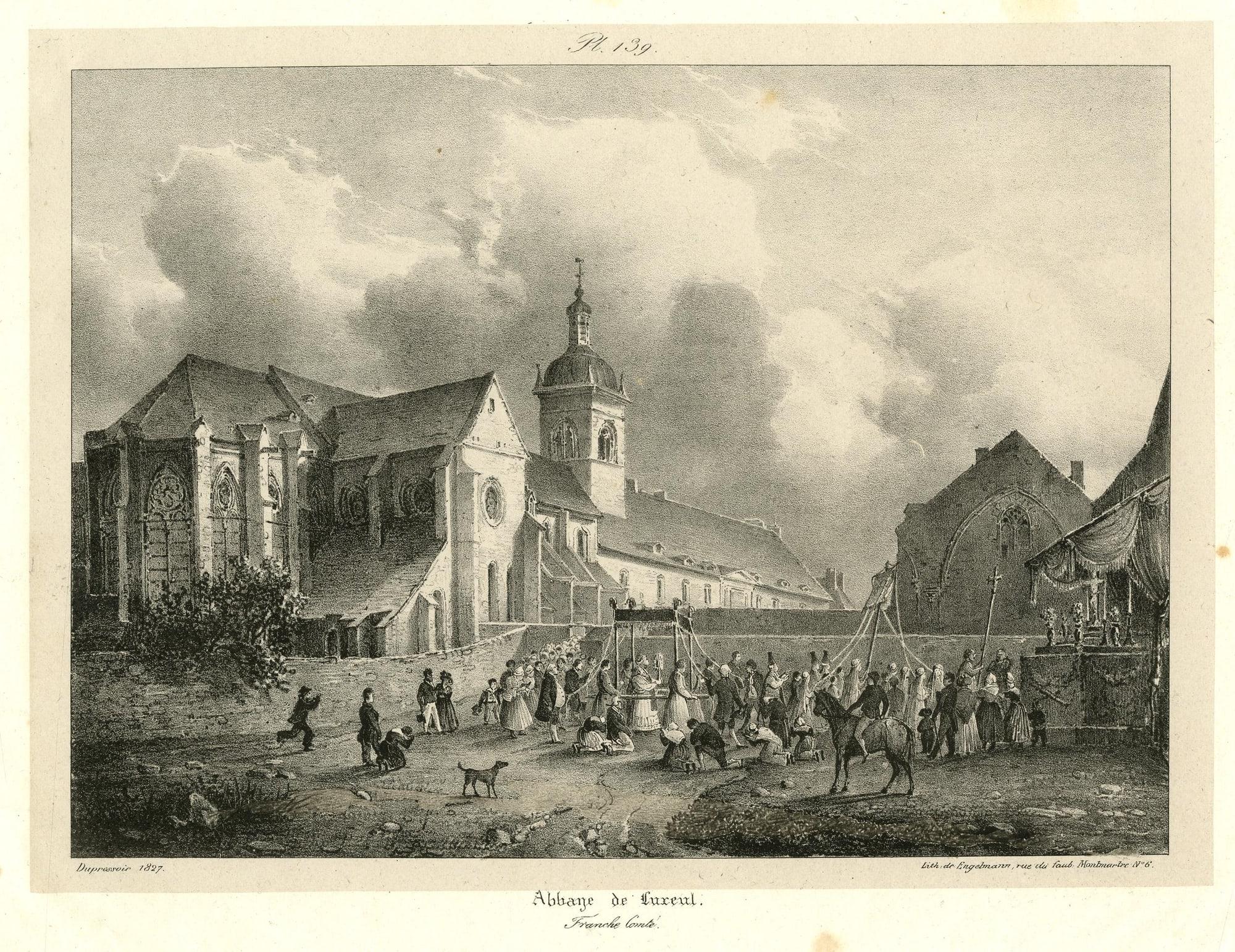
François Joseph Dupressoir, Abbaye de Luxeul, 1827. Public domain.
565 to 615 · Subject · Featured Study
The Celtic Mission
Irish monks left home as pilgrims for Christ, and Columbanus carried their monastic life from Bangor to Gaul and Italy.
- Books
- Genesis, Hebrews, Matthew
- Hold in memory
- Genesis 12:1, Hebrews 11:13
A monk trained in Ireland built three houses in the Vosges before the king's court ordered him out of the kingdom.
Then the LORD said to Abram, “Leave your country, your kindred, and your father’s household, and go to the land I will show you.
Summary
The Irish monks who went abroad for Christ built monasteries wherever they settled.
- Columba crossed to Britain, and the Picts gave him an island for his monastery.
- Columbanus crossed to Gaul and settled in the wilderness of the Vosges.
- He refused when he was told to go home.
- He founded Bobbio in Italy and died there, probably in 615.
The Verses of Leaving Home
Jonas grounds Columbanus's leaving in God's word to Abraham, and the New Testament calls believers strangers on the earth.
Strangers for Christ
All these people died in faith, without having received the things they were promised. However, they saw them and welcomed them from afar. And they acknowledged that they were strangers and exiles on the earth.
Hebrews says the faithful confessed themselves strangers and exiles on the earth.
Beloved, I urge you, as foreigners and exiles, to abstain from the desires of the flesh, which war against your soul.
Peter writes to believers as foreigners and exiles.
1 Peter 2:11BSB
And everyone who has left houses or brothers or sisters or father or mother or wife or children or fields for the sake of My name will receive a hundredfold and will inherit eternal life.
Jesus promises a hundredfold to those who leave home and family for His name.
From Bangor to Bobbio
Columbanus crossed the sea once and was moved on twice, by his own choice and by a king.
Columbanus went from Bangor in Ireland to the Vosges, was sent away to Nantes, and ended at Bobbio in the Apennines.
- Bangor, IrelandHe entered the monastery under the abbot Comgall (Munro, page 5).
- The seaHe went down to the shore with twelve companions (Munro, pages 5 to 6).
- Annegray, in the VosgesHe settled at a ruined castle in the wilderness (Munro, page 7).
- LuxeuilHe built a second house at an old fortified place about eight miles off (Munro, page 11).
- FontainesHe founded a third house nearby (Munro, page 11).
- NantesKing Theuderic's escort took him to the edge of the kingdom (Munro, page 23).
- Bobbio, in the ApenninesKing Agilulf received him, and he restored a church there and died a year later (Munro, pages 35 to 36).
Seven numbered stops of Columbanus's life, each with what Jonas says of it and its page in Munro's translation of 1895.
The era of the long middle holds the wider story of the church from the fall of Rome to the eve of the Reformation.
Columba and Iona
Columba crossed from Ireland to Britain, and the monks of his island sent Aidan to the English.
Bede dates Columba's coming into Britain from Ireland to the year 565. He calls him a priest and abbot, a monk by habit and manner of life.
Adomnan, in his life of Columba, says Columba sailed in his forty-second year, in the second year after the battle of Cooldrevny.
Bede tells that King Oswald asked the elders of the Scots for a bishop, and they sent Aidan, a monk from the island Bede calls Hii. Oswald gave him his see on the Isle of Lindisfarne, and Aidan went through town and country on foot.
Columbanus on the Continent
Jonas follows Columbanus from his training in Ireland to his death in Italy.
Munro's introduction says Jonas became a monk at Bobbio three years after Columbanus died.
Columbanus was born in Ireland and trained at Bangor under the abbot Comgall. After many years there he asked leave to go abroad, and Comgall let him go with companions.
In the Vosges he settled first at Annegray, a castle long in ruins. As the monks grew in number he built Luxeuil about eight miles away, at a fortified place with old baths, and then a third house at Fontaines.
Columbanus rebuked King Theuderic for his concubines. Jonas says the king's grandmother Brunhild turned against him for it, and the king's men ordered him home.
Columbanus refused, and was taken under escort to the boundary of the kingdom at Nantes. He later crossed into Italy, where Agilulf, king of the Lombards, let him settle where he chose.
At Bobbio, a lonely place in the Apennines with a church of the apostle Peter, he restored the church and founded his last house. He died there after a single year, probably in 615 by Munro's note.
In Their Own Words
Columbanus (543 to 615)
as reported in Jonas, Life of St. Columban, chapter 36, page 23
Columbanus would not go back to the home he had left for Christ.
“I do not think it would be pleasing to my Creator if I should go back to the home which I left because of my love for Christ.”
Irish monastic
About this saying1 paragraph
Columbanus gave this answer in the seventh century to the king's men who came to send him back to Ireland.
Jonas of Bobbio (died 665)
Life of St. Columban, chapter 9, page 5
Jonas gives Abraham's call as the reason Columbanus left Ireland.
“After he had been many years in the cloister he longed to go into strange lands, in obedience to the command which the Lord gave Abraham”
Irish monastic (Bobbio)
About this saying1 paragraph
Jonas wrote in the seventh century, and he quotes Genesis 12:1 in full after these words.
Adamnán of Iona (died 704)
Life of Saint Columba, the second preface, page 7
Adomnan named the reason Columba left Ireland.
“In the second year after the battle of Culedrebina (Cooldrevny) and in the forty-second of his age, wishing to make a pilgrimage for Christ from Ireland to Britain, he sailed forth.”
Patristic
About this saying1 paragraph
Adomnan, who died in 704, wrote this in the second preface of his life of Columba.
What the Sources Leave Uncertain
Columbanus's age when he left Ireland and the cause of his breach with the king are read in more than one way.
Munro's text of Jonas has Columbanus set out in the twentieth year of his life. Munro's note reads that thirtieth is more probable and that the manuscripts differ.
Jonas lays the breach with the court on Brunhild and calls her a second Jezebel. He wrote as a monk of Columbanus's own house from the stories of his companions, so his account of the queen is the testimony of an interested witness.
Books to Read Next
Life of St. Columban
Jonas of Bobbio, translated by Dana Carleton Munro · 1895
It is the one early life of Columbanus, written by a monk of Bobbio.
Free scan of the 1895 translationEcclesiastical History of the English Nation
Bede, translated by A. M. Sellar · 1907
Bede gives Columba's coming to Britain and Aidan's mission from Iona in book III.
Free at Project GutenbergLife of Saint Columba
Adomnan, translated by Wentworth Huyshe · 1905
Huyshe's English of 1905, made from Adomnan's Latin.
Free scan of the 1905 translationWhat the Celtic Monks Handed On
Bede, Jonas and Adomnan record the houses at Iona, Luxeuil and Bobbio, founded by Irish monks far from the land they were born in.
Sources
Scripture is the Berean Standard Bible.
- The Holy Bible, Berean Standard Bible (read 2026)
- Jonas of Bobbio, Life of St. Columban, translated by Dana Carleton Munro, Translations and Reprints from the Original Sources of European History, volume II, number 7 (Philadelphia: University of Pennsylvania, 1895), with the translator's introduction.
- Bede, Ecclesiastical History of the English Nation, translated by A. M. Sellar (London: George Bell and Sons, 1907), book III, chapters 3 to 5.
- Adamnan, Life of Saint Columba, translated by Wentworth Huyshe (London: George Routledge and Sons, 1905), the second preface, page 7.
- Margaret Stokes, Three Months in the Forests of France: A Pilgrimage in Search of Vestiges of the Irish Saints in France (London: George Bell and Sons, 1895), figure 12, page 21.
Keep Studying
People and groups3
Church history2