
2 Samuelchapter 19
43 verses · BSB2 Samuel book hub →
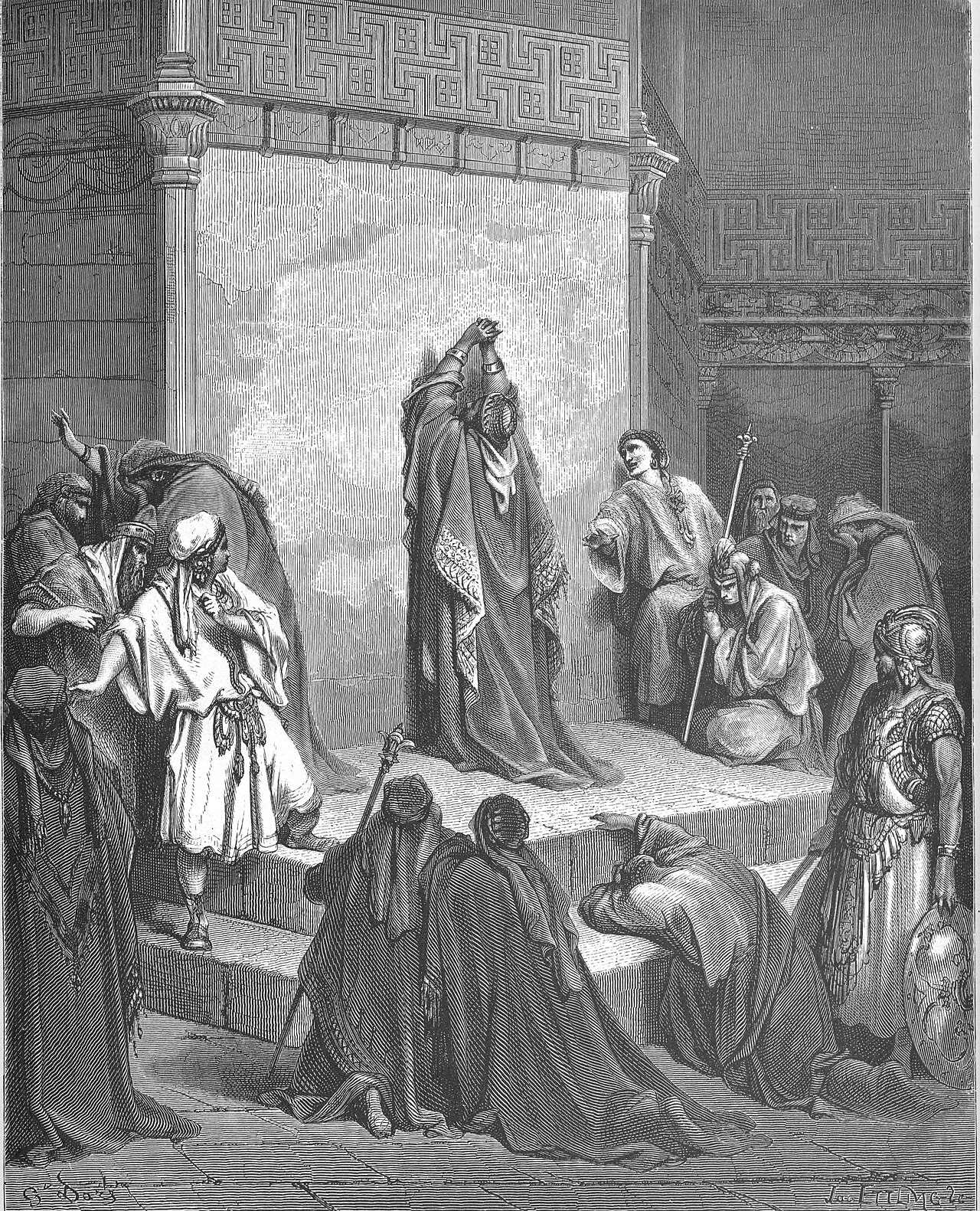
David Mourns the Death of Absalom, Gustave Doré, Doré's English Bible (1866), public domain
Key verse
But the king covered his face and cried out at the top of his voice, “O my son Absalom! O Absalom, my son, my son!”
It stands in scene A of the chapter, verses 1 to 8.
The chapter
Chapter summary
The victory is turned into mourning until Joab confronts the king brutally. Thou lovest them that hate thee and hatest them that love thee; speak comfortably to thy servants or not a man will stay the night. David sits in the gate and the army files past. The return is a negotiation: Judah is coaxed back first, with Amasa promised Joab's command; Shimei runs down with a thousand Benjamites and is spared under oath; Mephibosheth, who had neither dressed his feet nor trimmed his beard since the king left, answers Ziba's slander. Barzillai, eighty years old, declines the court because he can no longer taste or hear the singing. At the Jordan the tribes fall to arguing over who owns the king.
Context
History · Nathan, Gad · 2 Samuel overview
Where the chapter sits
2 Samuel 19 falls in Consequences: Amnon, Absalom, Sheba, the census (chapters 13–24). Tamar's violation; Amnon murdered; Absalom's rebellion; David's flight; Absalom's death; Sheba's revolt; the census and plague; the threshing floor of Araunah.
Before it: The Fall: Bathsheba and Uriah, chapters 11–12.
The whole shape of 2 Samuel→The world behind itThe date, the place, the people, and the works this site draws the setting from.
The history
Joab's rebuke is blunt because the situation is genuinely dangerous. An army that risked its life and comes home to find the king mourning the enemy will melt away by morning. The remedy is public and formal: the king must sit in the gate, where every returning soldier walking past sees him on the seat of judgment. Presence in the gate was how a ruler said the government is functioning.
Bringing the king back is a political negotiation, not a parade. David works through the priests to get Judah's elders to move first, and offers Absalom's commander Amasa the top army post, replacing Joab, who had just killed his son and spoken to him like a servant. Rewarding the enemy's general was a standard way of buying a defeated faction, and it also solved a problem David could not solve directly.
Three men meet him at the river and each represents a different account to settle. Shimei arrives with a thousand Benjaminites, betting that numbers plus a fast apology beats the curse he shouted; Mephibosheth arrives with his beard untrimmed and his clothes unwashed since the day the king left, which is physical evidence against Ziba's story; and Barzillai, eighty years old, who had fed the army, refuses a place at court because he can no longer taste his food or hear the singers.
The quarrel at the end is the old fault line. Judah ferries the king across, and the northern tribes complain they were not invited, claiming ten shares in the king against Judah's one. Escorting a ruler over water was an honor with political weight, and the argument over it is exactly the argument that splits the kingdom two generations later.
What it meant to them
The first hearers heard a restoration that was not clean. The king comes back, and every unresolved thing comes back with him, a liar rewarded, an accuser forgiven for now, a general demoted rather than tried.
The last verse is the warning: the men of Judah spoke more fiercely than the men of Israel. The war is over and the crack is already visible.
Sources cited
- Roland de Vaux, Ancient Israel: Its Life and Institutions
- Keil & Delitzsch, Biblical Commentary on the Books of Samuel
A. Joab's blunt rebuke: you love your enemies and hate your friends
1. (vv. 1-3)
a.David's grief turns Israel's victory into mourning, and the army that won the battle returns to the city by stealth, as men ashamed after a rout rather than men who had just put down a rebellion. The people's shame at their own king's grief is the ground Joab stands on in the verses that follow. Henry reads the moment as the greatest danger David faced to the loyalty of the men who had just saved his life.
2 Samuel 19:3, 1 voiceWhat preachers and commentators have said about these verses, in their own words.
2 Samuel 19:3
“David never more needed the hearts of his subjects than now, nor was ever more concerned to secure his interest in their affections; and therefore whatever tended to disoblige them now was the most impolitic thing he could do, and the greatest wrong imaginable to his friends that adhered to him.”
Matthew Henry· Commentary on the Whole Bible (1707-1721)puritan
2. (v. 4)
a.David covers his face and repeats his son's name, a lament pattern the older commentators call the plainest cry of grief in Scripture. He never speaks Absalom's name without the possessive my son, holding the office of father through the ruin the son made of himself and of the kingdom. Clarke and Henry both weigh the mourning as excessive given what Absalom had done, yet neither dismisses a father's loss as a small thing.
2 Samuel 19:4, 2 voices
2 Samuel 19:4
“The king covered his face - This was the custom of mourners. O my son Absalom - Calmet has properly remarked that the frequent repetition of the name of the defunct, is common in the language of lamentation. Thus Virgil, act. v., ver. 51: - - Daphnin que team tollemus ad astra; Daphnin ad astra feremus: amavit nos quoque Daphnis. “With yours, my song I cheerfully shall join, To raise your Daphnis to the powers Divine.”
Adam Clarke· Commentary on the Bible (1810-1826)evangelical
2 Samuel 19:4
"My servants have all come home safe, but where is my son? He is dead; and, dying in sin, I fear he is lost for ever. I cannot now say, I shall go to him, for my soul shall not be gathered with such sinners; what shall be done for thee, O Absalom! my son, my son! " 2.
Matthew Henry· Commentary on the Whole Bible (1707-1721)puritan
3. (vv. 5-7)
a.Joab's rebuke is blunt to the point of insolence, and the commentators say so plainly even while granting that the substance of it was right: the men who had just saved the king's life, his sons, his wives and his concubines, deserved better than to watch him mourn the man who tried to kill them all. His warning that not one man will stay with David that night if he does not go out to them is a threat as much as counsel, and it works within the verse. This is the last time in the chapter that Joab moves David by force of will rather than by office, before Amasa takes his place at verse 13.
2 Samuel 19:5, 2 voices
2 Samuel 19:5
“Had Absalom gained the victory, it is likely that, according to the manner of Oriental despots, he would have sought to secure his throne by killing all possible competitors Jdg 9:5; 1Ki 15:29.”
2 Samuel 19:5-7
“He speaks a great deal of reason, but not with the respect and deference which he owed to his prince. Is is fit to say to a king, Thou art wicked? A plain case may be fairly pleaded with those that are above us, and they may be reproved for what they do amiss, but it must not be done with rudeness and insolence.”
Matthew Henry· Commentary on the Whole Bible (1707-1721)puritan
4. (v. 8)
a.David does exactly what Joab told him, taking the seat in the public gate where a king heard his people and rendered judgment. Israel's army had already scattered to their own tents, each man going home once Absalom was dead rather than standing by a cause with no one left to lead it. Barnes reads David's obedience to Joab's rebuke as proof that he saw the justice of it despite the manner it was delivered in.
2 Samuel 19:8, 2 voices
2 Samuel 19:8
“David saw the justice of what Joab said, and the new danger which threatened him if he did not rouse himself from his grief. For Israel ... - Not David’s followers, but as before 2Sa 17:26; 2Sa 18:6, 2Sa 18:17, Absalom’s army.”
2 Samuel 19:8
“Hither the people flocked to him to congratulate his and their safety, and all was well. Note, When we are convinced of a fault, we must amend, though we are told of it by our inferiors, and indecently, or in heat and passion.”
Matthew Henry· Commentary on the Whole Bible (1707-1721)puritan
B. Judah fetches the king back over Jordan
1. (vv. 9-10)
a.The tribes argue among themselves over a king they had just driven out, and their own words indict the cause they followed: Absalom, whom we anointed over us, is dead in battle. That verb sits beside the true anointing named at 16:6, the Lord's anointed spoken over David while Saul still reigned, and sets a man-made anointing against the one God made and kept. Spurgeon preached the refrain bring the king back as a figure of the greater invitation still open to a king once rejected who returns in power.
The wording quoted in this note is the King James Version.
2 Samuel 19:10, 1 voice
2 Samuel 19:10
“And Absalom, whom we anointed over us,.... To be king; which either was really done by Absalom's party, or in effect by proclaiming and appointing him king: is dead in battle; which shows the thing was not of God, and by which means they were released from their oath of allegiance to him: now therefore why speak ye not a word of bringing the king back? nobody speaks of it, gives the least hint of it, or shows any concern about it; but the greatest coldness and indifference, as if it was a matter of no importance.”
2. (vv. 11-12)
a.David works through Zadok and Abiathar rather than approaching Judah directly, sending word that ties the elders' silence to shame, since Judah had joined the rebellion and now hesitates to be first in welcoming him back. He calls them my brethren, my bones and my flesh, the same kinship language he extends to Amasa in the next verse, offering forgiveness before anyone asks for it. Clarke reads the approach as calculated rather than naive, since David needed Jerusalem's own tribe secured before anything else could hold.
The wording quoted in this note is the King James Version.
2 Samuel 19:11, 1 voice
2 Samuel 19:11
“Speak unto the elders of Judah - David was afraid to fall out with this tribe: they were in possession of Jerusalem, and this was a city of great importance to him. They had joined Absalom in his rebellion; and doubtless were now ashamed of their conduct. David appears to take no notice of their infidelity, but rather to place confidence in them, that their confidence in him might be naturally excited: and, to oblige them yet farther, purposes to make Amasa captain of the host in the place of Joab.”
Adam Clarke· Commentary on the Bible (1810-1826)evangelical
3. (v. 13)
a.David swears Amasa into Joab's command outright, an oath sworn to the very man who led the army of the rebellion against him days before. Barnes reads it as evidence of how heavily Joab's independence weighed on David, the same weight behind 3:39's I am this day weak and 16:10's what have I to do with you. The promise holds only briefly; Joab kills Amasa within two chapters, one more death from the sword the prophet said would never leave David's house.
2 Samuel 19:13, 2 voices
2 Samuel 19:13
“Of my bone ... - Render as in preceding verse, “art thou not my bone and my flesh?” It is curious to note how the phrase is used in 2Sa 5:1 of common descent from Israel, in 2Sa 19:12 of the closer kindred of the tribe of Judah, and in this verse of the yet nearer kindred between David and Amasa his sister’s son. Captain ... in the room of Joab - It is very plain that David felt the weight of Joab’s overbearing influence to be very oppressive (compare 2Sa 19:22; 2Sa 3:39; 2Sa 16:10).”
2 Samuel 19:13
“He owns him for his kinsman, and promises him that, if he will appear for him now, he will make him captain-general of all his forces in the room of Joab, will not only pardon him (which, it may be, Amasa questioned), but prefer him. Sometimes there is nothing lost in purchasing the friendship of one that has been an enemy.”
Matthew Henry· Commentary on the Whole Bible (1707-1721)puritan
4. (v. 14)
a.The text credits David himself with bending the tribe's heart as one man, language usually kept for what only God does within a man. Judah answers within the same verse, sending back the word David wanted: return thou, and all thy servants. Clarke notes the strategy behind it, trusting men he had reason to distrust so that offered trust might draw trust back in return.
The wording quoted in this note is the King James Version.
5. (v. 15)
2 Samuel 19:15-18
a.The crossing at Jordan draws a company from every side: a thousand men of Benjamin under Shimei, Ziba with his fifteen sons and twenty servants, and a ferry boat to carry the king's household over, the first mention of such a vessel anywhere in Scripture. Henry calls the crossing the most solemn since Joshua led Israel over the same river, and notes that David had already remembered Jordan from exile at Psalm 42:6. Two men who had wronged David in his flight, Shimei and Ziba, are both named here crossing to meet him now that he returns.
The wording quoted in this note is the King James Version.
2 Samuel 19:15, 1 voice
2 Samuel 19:15
“Perhaps Jordan was never passed with so much solemnity, nor with so many remarkable occurrences, as it was now, since Israel passed it under Joshua. David, in his afflictive flight, remembered God particularly from the land of Jordan ( Ps. xlii. 6 ), and now that land, more than any other, was graced with the glories of his return.”
Matthew Henry· Commentary on the Whole Bible (1707-1721)puritan
C. Shimei begs, and lives another day
1. (vv. 16-18)
2 Samuel 19:16, 2 voices
2 Samuel 19:16
“Shimei the son of Gera - It appears that Shimei was a powerful chieftain in the land; for he had here, in his retinue, no less than a thousand men.”
Adam Clarke· Commentary on the Bible (1810-1826)evangelical
2 Samuel 19:16-23
“Expressing the deepest regret for his former outrageous conduct, he was pardoned on the spot; and although the son of Zeruiah urged the expediency of making this chief a public example, his officiousness was repulsed by David with magnanimity, and with the greater confidence that he felt himself now re-established in the kingdom (see on 1Ki 2:8).”
Jamieson, Fausset & Brown· Commentary Critical and Explanatory on the Whole Bible (1871)reformed
2 Samuel 19:17, 1 voice
2 Samuel 19:17
“Before the king - i. e., “to meet the king.” Compare 2Sa 20:8. The king was on the east bank, and they crossed over (by the ford) from the west bank to go to him.”
2 Samuel 19:18, 1 voice
2 Samuel 19:18
“There went over a ferry-boat - This is the first mention of any thing of the kind. Some think a bridge or raft is what is here intended.”
Adam Clarke· Commentary on the Bible (1810-1826)evangelical
2. (vv. 19-20)
a.Shimei names his own sin before anyone can accuse him of it again, come the first this day of all the house of Joseph to meet the king he had cursed at Bahurim. Clarke observes that confession was the only ground available to him, and only his conduct afterward could prove it sincere. The house of Joseph title marks him a leading man among the northern tribes, not merely a private grudge holder acting alone.
The wording quoted in this note is the King James Version.
2 Samuel 19:20, 1 voice
2 Samuel 19:20
“For thy servant doth know that I have sinned - This was all he could do; his subsequent conduct alone could prove his sincerity. On such an avowal as this David could not but grant him his life.”
Adam Clarke· Commentary on the Bible (1810-1826)evangelical
3. (vv. 21-23)
a.Abishai's demand invokes the same title David used to spare Saul twice, the Lord's anointed, but turns it toward vengeance rather than restraint, and it is not the first time a son of Zeruiah has pushed David further than he wanted to go. David's answer, what have I to do with you, ye sons of Zeruiah, matches his words at 16:10 almost exactly, and he swears the oath himself rather than let Abishai's logic decide it. Henry reads David's mercy that day as flowing from his own experience of God's mercy in restoring the kingdom his own sin had nearly cost him.
The wording quoted in this note is the King James Version.
2 Samuel 19:22, 1 voice
2 Samuel 19:22-23
“The pleasantness of his spirit on this great occasion forbade the entrance of any thing that was sour and peevish: joyful days should be forgiving days. Yet this was not all; his experience of God's mercy in restoring him to his kingdom, his exclusion from which he attributed to his sin, inclined him to show mercy to Shimei. Those that are forgiven must forgive.”
Matthew Henry· Commentary on the Whole Bible (1707-1721)puritan
2 Samuel 19:23, 2 voices
2 Samuel 19:23
“Therefore the king said unto Shimei, thou shalt not die,.... This day by my hands, or order, or by the sword, 1Ki 2:8, and the king sware unto him; that he should not die for that offence, or for that only; but if he committed a new one, this oath was no longer binding on him, and not at all upon his heir and successor.”
2 Samuel 19:23
“King - Is not my kingdom, which was in a manner wholly lost, just now restored and assured to me? And when God hath been so merciful to me in forgiving my sin, shall I shew myself revengeful to Shemei? Shall I sully the publick joy and glory of this day, with an act of such severity?”
John Wesley· Explanatory Notes upon the Old Testament (1765)evangelical
D. Mephibosheth's unwashed feet and untrimmed beard
1. (vv. 24-25)
a.Mephibosheth's unwashed feet, untrimmed beard and unwashed clothes since the day the king departed are a mourner's signs worn the whole length of David's exile, offered as evidence before he speaks a word in his own defense. Clarke reads the details as refuting Ziba's earlier report at 16:1-4 without David needing to ask a single question. David's first question still assumes Ziba's account was true, asking why Mephibosheth stayed behind rather than why he had mourned so long.
The wording quoted in this note is the King James Version.
2 Samuel 19:24, 2 voices
2 Samuel 19:24
“Neither dressed his feet - He had given the fullest proof of his sincere attachment to David and his cause; and by what he had done, amply refuted the calumnies of his servant Ziba.”
Adam Clarke· Commentary on the Bible (1810-1826)evangelical
2 Samuel 19:24-30
“Besides dyeing it black or red colors, which, however, is the exception, and not the rule in the East, there are various modes of trimming it: they train it into a massy, bushy form, swelling and round; or they terminate it like a pyramid, in a sharp point. Whatever the mode, it is always trimmed with the greatest care; and they usually carry a small comb for the purpose.”
Jamieson, Fausset & Brown· Commentary Critical and Explanatory on the Whole Bible (1871)reformed
2. (vv. 26-28)
a.Mephibosheth's account contradicts Ziba's directly: he had ordered an ass saddled to ride to David, lame as he was, and Ziba slandered him instead of doing as told. He calls David an angel of God able to judge between the two accounts and submits to whatever David decides, the same kindness of God David promised him at 9:3 now tested against a servant's word. Gregory the Dialogist read the episode centuries later as proof that even a man who usually carried the spirit of prophecy could still be deceived, since he remained a man.
2 Samuel 19:26, 2 voices
2 Samuel 19:26
“And he answered, my lord, O king, my servant deceived me,.... His servant Ziba, who, instead of saddling an ass for him by his order, went off with that and another himself, 2Sa 16:1; for thy servant said, I will saddle me an ass; he not only determined this in his own mind, but gave orders to his servant to saddle one for him: that I may ride thereon, and go to the king, because thy servant is lame; and could not walk afoot, being lame of both his feet, 2Sa 4:4.”
2 Samuel 19:26
“What appears to have happened is, that when Mephibosheth ordered Ziba to saddle the donkeys and ride with him to join David, Ziba left him under pretence of obeying, but instead laded the donkeys with provisions, and went off alone with them, thus making it impossible for Mephibosheth to follow.”
2 Samuel 19:27, 2 voices
2 Samuel 19:27
“Why do you marvel, Peter? for the reason why we are deceived is, because we be men. What? have you forgotten how David, who usually had the spirit of prophecy, pronounced sentence against innocent Mephibosheth, the son of Jonathan, when he gave credit to the lying words of his servant Siba? Which thing notwithstanding because it was done by David, we both believe to be just in the secret judgment of God, and yet by human reason how it was just we cannot perceive.”
Gregory the Dialogist· written before 604· Dialogues, Book 1, Chapter 4patristic
2 Samuel 19:27
“The king is as an angel of God - As if he had said, I state my case plainly and without guile; thou art too wise not to penetrate the motives from which both myself and servant have acted. I shall make no appeal; with whatsoever thou determinest I shall rest contented.”
Adam Clarke· Commentary on the Bible (1810-1826)evangelical
3. (vv. 29-30)
a.David cuts the dispute short rather than settling it, splitting the estate between two men whose stories cannot both be true. Barnes reads the division as David unwilling to make an enemy of Ziba while unable to disprove Mephibosheth, the same haste that marked his earlier sentence at 16:4. Mephibosheth answers by giving up his half outright, content that David has come home in peace, valuing the king's safety over the land Ziba had gained by lying.
2 Samuel 19:29, 1 voice
2 Samuel 19:29
“Unable to get to the bottom of the story, and perhaps unwilling to make an enemy of Ziba, David compromised the matter by dividing the land, thus partially revoking his hasty sentence 2Sa 16:4. We still see the impatient temper of David.”
E. Barzillai at eighty sends Chimham in his place
1. (vv. 31-33)
a.Barzillai crosses Jordan with David after supplying him through the hardest stretch of the exile at Mahanaim, and David offers to bring him to Jerusalem and feed him at his own table in return. Jamieson, Fausset and Brown note that no reward to Barzillai himself is ever recorded, though David's kindness to his son Chimham a few verses later stands in its place. Clarke calls the eighty-year-old's loyalty beyond suspicion, since a man that age has nothing left to gain by flattering a king.
2 Samuel 19:32, 1 voice
2 Samuel 19:32
“Barzillai was a very aged man - This venerable person had given full proof of his attachment to David by the supplies he had given him when he lay at Mahanaim, where his case was all but desperate; the sincerity of his congratulations now none can suspect. David’s offer to him was at once noble and liberal: he wished to compensate such a man, and he wished to have at hand such a friend.”
Adam Clarke· Commentary on the Bible (1810-1826)evangelical
2. (vv. 34-37)
a.Barzillai declines the king's offer on the ground of age alone, fourscore years old and past discerning good from evil, unable to taste what he eats or hear the singers who would perform at court. Henry reads his speech as a pattern for old age generally, dead to the delights of sense that once moved him, asking only to die in his own city and be buried by his father's grave. He asks nothing for himself and everything for Chimham, who goes over with the king in his place.
The wording quoted in this note is the King James Version.
2 Samuel 19:35, 2 voices
2 Samuel 19:35
“Can thy servant taste what I eat - Here is at once an affecting description of the infirmities of old age; and a correct account of the mode of living at an Eastern court in ancient times. Barzillai was fourscore years old; his ear was become dull of hearing, and his relish for his food was gone: he therefore appears to have been not only an old man, but an infirm old man.”
Adam Clarke· Commentary on the Bible (1810-1826)evangelical
2 Samuel 19:35
“Dainties are insipid when desire fails, and songs to the aged ear are little better than those sung to a heavy heart, very disagreeable: how should they be otherwise when the daughters of music are brought low? Let those that are old learn of Barzillai to be dead to the delights of sense; let grace second nature, and make a virtue of the necessity.”
Matthew Henry· Commentary on the Whole Bible (1707-1721)puritan
2 Samuel 19:36, 1 voice
2 Samuel 19:36
“Will the master thank that servant who only does what was his duty to do? He though he had done himself honour enough in doing the king any service. Thus, when the saints shall be called to inherit the kingdom in consideration of what they have done for Christ in this world, they will be amazed at the disproportion between the service and the recompence.”
Matthew Henry· Commentary on the Whole Bible (1707-1721)puritan
2 Samuel 19:37, 2 voices
2 Samuel 19:37
“Chimham - From marginal references it appears that Chimham, having accepted David’s offer, came and settled near Bethlehem. His house was still called after him at the time of the captivity.”
2 Samuel 19:37
“He desires the king to be kind to his son Chimham: Let him go over with my lord the king, and have preferment at court. What favour is done to him Barzillai will take as done to himself. Those that are old must not grudge young people those delights which they themselves are past the enjoyment of, nor confine them to their retirements.”
Matthew Henry· Commentary on the Whole Bible (1707-1721)puritan
3. (vv. 38-39)
a.David grants Barzillai's request in full, taking Chimham in his father's place and promising to do for him whatever Barzillai asks. Barnes notes that Chimham's household is still remembered by name generations later at Jeremiah 41:17, settled near Bethlehem on land that may have come from David's own inheritance. The parting itself is warm rather than formal, a kiss and a blessing before Barzillai turns back toward Rogelim.
2 Samuel 19:39, 1 voice
2 Samuel 19:39
“The “people” is the term especially applied in this narrative to David’s followers 2Sa 15:17; 2Sa 16:14; 2Sa 17:2; 2Sa 18:1-2; 2Sa 19:2-3. They crossed by the ford, while David and his household, accompanied by Barzillai and Chimham, came over in the ferry.”
F. Ten parts in the king: the quarrel at Gilgal
1. (vv. 40-43)
a.Then the king went on to Gilgal: Judah escorts David across on the strength of nearest kinship, but Israel arrives asking why their brethren stole the king away without them, claiming ten parts in the king by tribal count against Judah's one. Judah answers that they gained nothing personally by it, only loyalty, yet the men of Judah spoke fiercer words than Israel did in reply. Henry reads the quarrel as the seed of the division that breaks open in the next chapter, since a people already arguing over who loves the king more is a people not far from arguing over who follows him at all.
The wording quoted in this note is the King James Version.
2 Samuel 19:40, 1 voice
2 Samuel 19:40-43
“Judah grounded their right to take the lead, on the ground of their nearer relationship to the king. This was a claim dangerous to the house of David; and it shows the seeds were already sown for that tribal dissension which, before long, led to the dismemberment of the kingdom.”
Jamieson, Fausset & Brown· Commentary Critical and Explanatory on the Whole Bible (1871)reformed
2 Samuel 19:41, 2 voices
2 Samuel 19:41
“It seems that David and his whole party made a halt at Gilgal 2Sa 19:15; 1Sa 11:14, and possibly made some solemn agreement there about the kingdom. But while they were there, “all the men of Israel,” representatives from the tribes not included in “half the people of Israel” 2Sa 19:40, came up in great wrath at finding that the restoration had been accomplished without consulting them, and accused the men of Judah of unfair dealing.”
2 Samuel 19:41
“Stolen - That is, conveyed thee over Jordan hastily, not expecting our concurrence. David's men - All thy officers, guards, and soldiers. This is mentioned as an aggravation of their fault, that they did not only carry the king over Jordan, but all his men too, without asking their advice.”
John Wesley· Explanatory Notes upon the Old Testament (1765)evangelical
2 Samuel 19:43, 2 voices
2 Samuel 19:43
“More right - As in the general we have more right in the king and kingdom; so particularly, we have more right in David than you, because you were the first beginners, and the most zealous promoters of this rebellion; howsoever, as he is king, we justly claim a greater interest in him, than you; inasmuch as we are the far greatest part of his subjects.”
John Wesley· Explanatory Notes upon the Old Testament (1765)evangelical
2 Samuel 19:43
“They pleaded, " We have ten parts in the king " (Judah having Simeon only, whose lot lay within his, to join with him), "and therefore it is a slight upon us that our advice was not asked about bringing back the king. " See how uncertain the multitude is.”
Matthew Henry· Commentary on the Whole Bible (1707-1721)puritan
The text of this chapter
This page carries no textual note on 2 Samuel 19. Where this site has examined a place the manuscripts differ, the examination is in the manuscripts room. Every place this site examines →
This page draws on 9 works. Open for the list.
This page draws on Adam Clarke; Albert Barnes; Charles Spurgeon, The Metropolitan Tabernacle Pulpit, Bringing the King Back; Gregory the Dialogist; Jamieson, Fausset & Brown, Commentary Critical and Explanatory on the Whole Bible (1871); Jamieson, Fausset and Brown, Commentary Critical and Explanatory on the Whole Bible; John Gill; John Wesley, Explanatory Notes upon the Old Testament (1765) and Matthew Henry.
Keep studying
On this page
Studies1