
2 Chronicleschapter 20
37 verses · BSB2 Chronicles book hub →
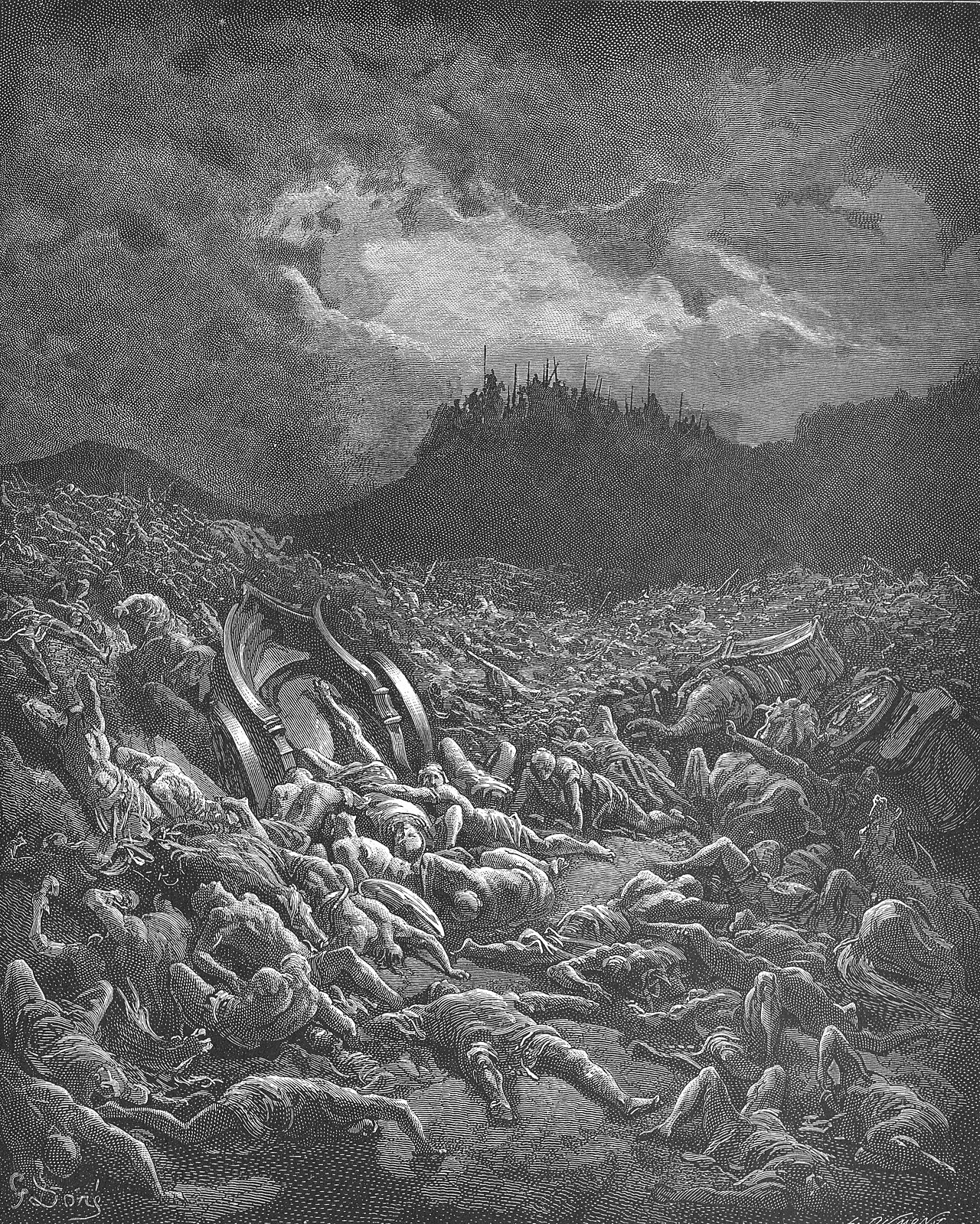
The Ammonite and Moabite Armies Are Destroyed, Gustave Doré, Doré's English Bible (1866), public domain
Original Language
2 Chronicles 20— Hebrew word study · with the Hebrew tradition
How to read a word below: the Hebrewword, then how it sounds, then what it means, then its number in Strong’s concordance, a widely used lookup this site follows (H for Hebrew and Aramaic, G for Greek). Square brackets hold a word the English supplies that the Hebrew does not, angle brackets mark the Hebrew’s own grammatical elements that English renders as separate words, and the mark ס or פ is where the Hebrew manuscripts end a paragraph.
A great multitude comes, and all Judah stands and looks to God1
2 Chronicles 20:1· Hebrew and glosses: STEP Bible
Rashi on II Chronicles 20:1
and with them, some of the Ammonites This is Amalek. Why were they called Ammonites? Because they changed their dress and their language to resemble that of the Ammonites and mingled with them, and came to wage war against Israel.
Read it in full at Sefaria · The Judaica Press complete Tanach with Rashi, translated by A. J. Rosenberg
2 Chronicles 20:2· Hebrew and glosses: STEP Bible
2 Chronicles 20:3· Hebrew and glosses: STEP Bible
2 Chronicles 20:4· Hebrew and glosses: STEP Bible
2 Chronicles 20:5· Hebrew and glosses: STEP Bible
2 Chronicles 20:6· Hebrew and glosses: STEP Bible
2 Chronicles 20:7· Hebrew and glosses: STEP Bible
2 Chronicles 20:8· Hebrew and glosses: STEP Bible
2 Chronicles 20:9· Hebrew and glosses: STEP Bible
2 Chronicles 20:10· Hebrew and glosses: STEP Bible
Rashi on II Chronicles 20:10
And now about all that You promised us to save us from our enemies who are coming upon us.
Read it in full at Sefaria · The Judaica Press complete Tanach with Rashi, translated by A. J. Rosenberg
2 Chronicles 20:11· Hebrew and glosses: STEP Bible
Rashi on II Chronicles 20:11
to drive us out of Your inheritance, which You caused us to inherit You Yourself. Therefore, on what basis can they contest our inheritance?
Read it in full at Sefaria · The Judaica Press complete Tanach with Rashi, translated by A. J. Rosenberg
2 Chronicles 20:12· Hebrew and glosses: STEP Bible
2 Chronicles 20:13· Hebrew and glosses: STEP Bible
Rashi on II Chronicles 20:13
also their infants It is customary that when troops attack a country, the infants, wives, and children flee the villages to the fortified cities.
Read it in full at Sefaria · The Judaica Press complete Tanach with Rashi, translated by A. J. Rosenberg
Jahaziel: the battle is not yours, but God's14
2 Chronicles 20:14· Hebrew and glosses: STEP Bible
2 Chronicles 20:15· Hebrew and glosses: STEP Bible
Rashi on II Chronicles 20:15
You shall not fear, neither shall you be dismayed This refers back to what they said, (verse 12) “we have no strength before this multitude.” The prophet said to them, “Although they outnumber you, do not fear them.”
Read it in full at Sefaria · The Judaica Press complete Tanach with Rashi, translated by A. J. Rosenberg
2 Chronicles 20:16· Hebrew and glosses: STEP Bible
2 Chronicles 20:17· Hebrew and glosses: STEP Bible
2 Chronicles 20:18· Hebrew and glosses: STEP Bible
2 Chronicles 20:19· Hebrew and glosses: STEP Bible
Singers march in front, and three days are spent gathering spoil20
2 Chronicles 20:20· Hebrew and glosses: STEP Bible
2 Chronicles 20:21· Hebrew and glosses: STEP Bible
2 Chronicles 20:22· Hebrew and glosses: STEP Bible
2 Chronicles 20:23· Hebrew and glosses: STEP Bible
2 Chronicles 20:24· Hebrew and glosses: STEP Bible
2 Chronicles 20:25· Hebrew and glosses: STEP Bible
2 Chronicles 20:26· Hebrew and glosses: STEP Bible
2 Chronicles 20:27· Hebrew and glosses: STEP Bible
2 Chronicles 20:28· Hebrew and glosses: STEP Bible
2 Chronicles 20:29· Hebrew and glosses: STEP Bible
2 Chronicles 20:30· Hebrew and glosses: STEP Bible
A good reign, high places left, and ships broken at Ezion-geber31
2 Chronicles 20:31· Hebrew and glosses: STEP Bible
2 Chronicles 20:32· Hebrew and glosses: STEP Bible
2 Chronicles 20:33· Hebrew and glosses: STEP Bible
2 Chronicles 20:34· Hebrew and glosses: STEP Bible
2 Chronicles 20:35· Hebrew and glosses: STEP Bible
2 Chronicles 20:36· Hebrew and glosses: STEP Bible
2 Chronicles 20:37· Hebrew and glosses: STEP Bible