
1 Kingschapter 20
43 verses · Jeremiah, by tradition · 6th century BC · History
Key verse
And a certain man of the sons of the prophets said unto his neighbour in the word of the Lord, Smite me, I pray thee. And the man refused to smite him.
It stands in Busy here and there, and the man was gone, verses 35 to 43.
The chapter
Chapter summary
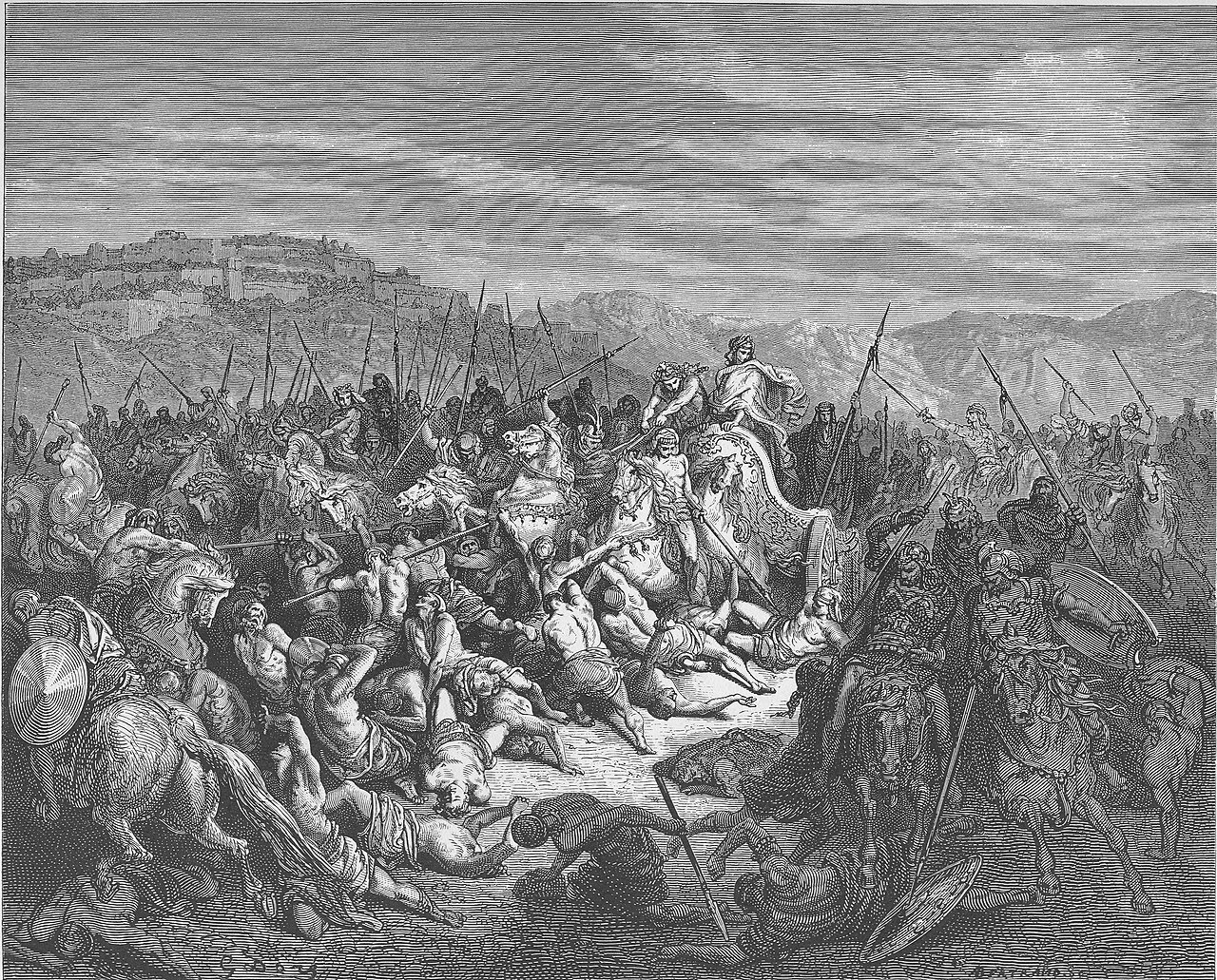
Ben-hadad besieges Samaria with thirty-two kings and escalating demands, until Ahab's elders tell him not to consent. An unnamed prophet promises victory so that Ahab will know that Jehovah is God, and the young men of the provinces rout them. The Syrians reason that Israel's gods are gods of the hills, and return in the spring to the plain at Aphek, where Israel camps before them 'like two little flocks of kids' while the Syrians fill the country. Israel wins again, and Ahab spares Ben-hadad and calls him brother. A prophet in disguise traps the king with a parable of a lost prisoner: 'thy life shall go for his life, and thy people for his people.'
Context
History · Jeremiah · 1 Kings overview
The world of this chapter
- Who
- Israelites facing the army that would dominate the region for the next century
- Where
- Samaria under siege, the hill country above it, and the walled town of Aphek on the plain
- When
- The Aramean wars of Ahab. about 858 to 856 BC on Thiele's chronology, in the years before Qarqar
Historical context
The chapter belongs to Ahab and to two unnamed prophets, one who brings the word before each battle and one of the sons of the prophets who delivers the sentence at the end.
The time is the stretch between Carmel and Ramoth-gilead, and the two campaigns are separated by one turn of the year.
The places are Samaria, which Omri had founded as the northern capital, and Aphek, a walled town on ground the Arameans chose for its flatness.
The occasion is a siege and its terms. Ben-Hadad's first message claims the silver, the gold, the wives and the children, which were the standard terms of submission. The second says his servants will search the palace and every house themselves, which is occupation.
A first hearer knew how a coalition army worked, since the thirty-two kings were city rulers under a dominant king, each bringing a contingent.
He also knew the religious reasoning at verse 23, because assigning a god to its own terrain was a fixed principle of the old polytheism.
The surrender at verse 31 is a recognised ritual, sackcloth on the body and ropes on the head, the posture of a man offering himself as a slave to be spared. What Ben-Hadad buys his life with is a trade concession, the right to set up an Israelite market quarter in Damascus.
Significance
Twice in this chapter God gives victory to a king He has already condemned, and says why both times, that you will know that I am the LORD. The first hearers were shown mercy given for the sake of God's name.
The sting is in the last scene. Ahab treats a defeated enemy king as a business partner and calls him his brother, and a prophet tells him that the man he released will cost him his own life.
Where the chapter sits
1 Kings 20 falls in Divided kingdom and Elijah (chapters 13–22). The man of God from Judah; Ahijah's oracle to Jeroboam's wife; the parade of kings evaluated in formulaic regnal summaries. Elijah arrives in ch. 17 and dominates through Carmel (18), Horeb (19), Naboth's vineyard (21), and the LORD's word that stands against four hundred false prophets (22).
Before it: Division at Shechem, chapters 12.
The whole shape of 1 Kings→The structure of this chapter
People1
The heads below are this chapter's scenes. The numbered points under each are its verses.
Let not him that girdeth on his armor boast as he that putteth it off
gathered all his host together: Ben-hadad's confederation of thirty and two kings recalls a Syria that David had once subdued and made tributary; Israel's apostasy under Ahab lets a broken enemy grow strong again. The siege opens with an unlimited demand for silver, gold, wives and children, framed as though Ahab's surrender were already settled. Scripture gives no stated cause for the war beyond ambition, the same silence it keeps over other unprovoked campaigns.
1 Kings 20:1
“Ben-hadad, the king of Syria - Probably the son of the Ben-hadad who assisted Asa against Baasha (1Ki 15:18 note). Thirty and two kings with him - Not allies, but feudatories 1Ki 20:24. Damascus had in the reign of this Ben-hadad become the center of an important monarchy, which may not improbably have extended from the Euphrates to the northern border of Israel. The Assyrian inscriptions show that this country was about the period in question parcelled out into a multitude of petty kingdoms, the chief tribes who possessed it being the Hittites, the Hamathites, and the Syrians of Damascus.”
1 more voice on this verseWhat preachers and commentators have said about this verse, in their own words.
1 Kings 20:1
“What the ground of the quarrel was we are not told; covetousness and ambition were the principle, which would never want some pretence or other. David in his time had quite subdued the Syrians and made them tributaries to Israel, but Israel's apostasy from God makes them formidable again.”
Matthew Henry· Commentary on the Whole Bible (1707-1721)puritan
1 Kings 20:2
“Ben-hadad's object in these and other boastful menaces was to intimidate Ahab. But the weak sovereign began to show a little more spirit, as appears in his abandoning "my lord the king" for the single "tell him," and giving him a dry but sarcastic hint to glory no more till the victory is won.”
Jamieson, Fausset & Brown· Commentary Critical and Explanatory on the Whole Bible (1871)reformed
1 Kings 20:3
“Thy silver and thy gold is mine,.... Not of right, but reckoning it as good as in his hands, Ahab not being able to resist him: and thy wives also; for it seems he had more than Jezebel: and thy children; which were many, for he had no less than seventy sons, 2Ki 10:1, even the goodliest are mine: some aggravate this, as if his view was to commit the unnatural sin with his male children, when in his possession.”
I am thine, and all that I have: Ahab surrenders outright, hoping total submission will buy peace, but Ben-hadad's second message shows that yielding to an unjust demand only invites a larger one. The first request asked for what Ahab might have handed over as tribute; the second sends servants to search every house in the city and carry off whatever pleases them. The king's poor spirit stands in contrast to the elders he is about to consult, who see the trap for what it is.
1 Kings 20:4
“And the king of Israel answered and said, my lord, O king,.... So he said to Benhadad's messengers, representing him, as acknowledging his sovereignty over him: according to thy saying, I am thine, and all that I have: which he understood of holding all that he had of him, by giving him homage, and paying him tribute; not that he was to deliver all his substance, and especially his wives and children, into his hands.”
1 Kings 20:5
“And the messengers came again,.... From Benhadad: and said, thus speaketh Benhadad, saying, although I have sent unto thee, saying: at the first message: thou shalt deliver me thy silver, and thy gold, and thy wives, and thy children; into his possession, and not as Ahab understood it, that he should be his vassal, and pay a yearly tribute for his quiet enjoyment of them; yet even this he would not now abide by, growing still more haughty upon the mean submission of Ahab, as by what follows.”
1 Kings 20:6
“Whatsoever is pleasant in thine eyes - It is not easy to discern in what this second requisition differed from the first; for surely his silver, gold, wives, and children, were among his most pleasant or desirable things. Jarchi supposes that it was the book of the law of the Lord which Ben-hadad meant, and of which he intended to deprive Israel. It is however evident that Ben-hadad meant to sack the whole city, and after having taken the royal treasures and the wives and children of the king, to deliver up the whole to be pillaged by his soldiers.”
Adam Clarke· Commentary on the Bible (1810-1826)evangelical
called all the elders of the land: Ahab calls the elders of the land, the standing council continued among the ten tribes since the sojourn in Egypt, and lays the second demand before them in public. Their answer is unanimous, hearken not unto him, nor consent, and on that word Ahab draws the line he could not draw for himself. He refuses only the second demand, still standing by the surrender of verse 4, a half-measure that leaves Ben-hadad free to call it treachery.
1 Kings 20:7
“Seeketh mischief - Though he pretended peace, upon these terms propounded, it is apparent by those additional demands, that he intends nothing less than our utter ruin.”
John Wesley· Explanatory Notes upon the Old Testament (1765)evangelical
1 Kings 20:8
“And all the elders and all the people said unto him,.... They were unanimous in their advice: hearken not unto him, nor consent; promising, no doubt, that they would stand by him.”
2 more voices on this verse
1 Kings 20:8
“Hearken not unto him - The elders had every thing at stake, and they chose rather to make a desperate defense than tamely to yield to such degrading and ruinous conditions.”
Adam Clarke· Commentary on the Bible (1810-1826)evangelical
1 Kings 20:8
“The people” had no distinct place in the ordinary Jewish or Israelite constitution; but they were accustomed to signify their approbation or disapprobation of the decisions of the elders by acclamations or complaints (Jos 9:18; Jdg 11:11, etc.).
1 Kings 20:9
“I must not give what is none of my own." It was a mortification to Ben-hadad that even such an abject spirit as Ahab's durst deny him; yet it should seem, by his manner of expressing himself, that he durst not have done it if his people had not animated him.”
Matthew Henry· Commentary on the Whole Bible (1707-1721)puritan
the dust of Samaria shall suffice: Ben-hadad swears by his own gods that his army is so great the dust of Samaria will not fill their hands, a boast the text records without comment. Ahab answers with a proverb rather than a threat, let not him that girdeth on his harness boast himself as he that putteth it off, meaning no man should claim a victory not yet won. The reversal the proverb warns against is exactly what follows within the chapter.
1 Kings 20:10
“If the dust of Samaria shall suffice - This is variously understood. Jonathan translates thus: “If the dust of Shomeron shall be sufficient for the soles of the feet of the people that shall accompany me;” i.e., I shall bring such an army that there will scarcely be room for them to stand in Samaria and its vicinity.”
Adam Clarke· Commentary on the Bible (1810-1826)evangelical
1 Kings 20:11
“Let not him that girdeth on - This was no doubt a proverbial mode of expression. Jonathan translates, “Tell him, Let not him who girds himself and goes down to the battle, boast as he who has conquered and returned from it.”
Adam Clarke· Commentary on the Bible (1810-1826)evangelical
1 more voice on this verse
1 Kings 20:11
“THESE two kings were about to proceed to war and they irritated one another by insulting messages. That was the custom of all combatants in the old heathen times. They seemed to delight in stinging each other and exciting each other's worst passions before they commenced the battle. Let it not be so among us. If we have to contend for the Truth of God let us endeavor to do it in the kindest spirit.”
1 Kings 20:12-13
as he was drinking: Ben-hadad orders his army into position while still at his wine, a detail the narrator plants before the battle rather than after it. Into this scene an unnamed prophet comes to Ahab with a promise and its purpose stated together, I will deliver it into thine hand, and thou shalt know that I am the Lord. The same formula, that ye shall know that I am the Lord, runs through the plagues of Exodus, spoken here over a king who has asked for no sign at all.
1 Kings 20:12
“In the pavilions - This word comes from papilio, a butterfly, because tents, when pitched or spread out, resembled such animals; partly because of the mode of their expansion, and partly because of the manner in which they were painted. Set yourselves in array - The original word, שימו simu, which we translate by this long periphrasis, is probably a military term for Begin the attack, Invest the city, Every man to his post, or some such like expression.”
Adam Clarke· Commentary on the Bible (1810-1826)evangelical
Young men of the provinces rout a drunken camp
1 Kings 20:13
“The rabbinical commentators conjecture that this prophet was Micaiah, the son of Imlah, who is mentioned below 1Ki 22:8. Hast thou seen all this great multitude? - The boast of Ben-hadad 1Ki 20:10, was not without a basis of truth; his force seems to have exceeded 130, 000 (compare 1Ki 20:25, 1Ki 20:29-30). In his wars with the Assyrians we find him sometimes at the head of 100, 000 men.”
2 more voices on this verse
1 Kings 20:13
“Behold, and wonder, that God should send a prophet with a kind and gracious message to so wicked a prince as Ahab was; but he did it, (1.) For his people Israel's sake, who, though wickedly degenerated, were the seed of Abraham his friend and Jacob his chosen, the children of the covenant, and not yet cast off.”
Matthew Henry· Commentary on the Whole Bible (1707-1721)puritan
1 Kings 20:13
“This glorious victory, won so easily, and with such a paltry force opposed to overwhelming numbers, was granted that Ahab and his people might know (1Ki 20:13) that God is the Lord. But we do not read of this acknowledgment being made, or of any sacrifices being offered in token of their national gratitude.”
Jamieson, Fausset & Brown· Commentary Critical and Explanatory on the Whole Bible (1871)reformed
Who shall order the battle?: God names the instrument before naming the victory, young men of the princes of the provinces, two hundred and thirty two of them, with seven thousand more behind. Ahab himself, not a general, is told he must order the battle, so the outcome cannot be credited to royal strategy. Matthew Henry notes the seven thousand match the number of those in 19:18 who had not bowed to Baal, though he is careful to say they are likely not the same men.
1 Kings 20:14
“By the young men of the princes of the provinces - These were probably some chosen persons out of the militia of different districts, raised by the princes of the provinces; the same as we would call lord-lieutenants of counties.”
Adam Clarke· Commentary on the Bible (1810-1826)evangelical
1 Kings 20:15
“Seven thousand - Considering how populous Palestine was in the time of the earlier Israelite kings (see 2Ch 13:3; 2Ch 14:8; 2Ch 17:14-18), the smallness of this number is somewhat surprising. If the reading be sound, we must suppose, first, that Ben-hadad’s attack was very sudden, and that Ahab had no time to collect forces from distant parts of the country; and secondly, that during the long siege the garrison of Samaria had been greatly reduced, until it now did not exceed 7,000 men fit for service.”
1 more voice on this verse
1 Kings 20:15
“It is observable that it is the same number with theirs that he not bowed the knee to Baal ( ch. xix. 18 ), though, it is likely, not the same men. The issue was accordingly.”
Matthew Henry· Commentary on the Whole Bible (1707-1721)puritan
drinking himself drunk: The army goes out at noon while Ben-hadad is drinking himself drunk in the pavilions with the thirty and two kings, a contempt Barnes compares to Belshazzar's feast before Babylon fell. Told that men are coming out of Samaria, Ben-hadad orders them taken alive whether they come for peace or war, so confident of victory that he wants prisoners to question rather than an enemy to fear. The order never anticipates that the men coming out are the attack itself.
1 Kings 20:17
Ben-hadad sent out, and they told him - The Septuagint has a better reading: “they sent and told the king of Syria.”
1 Kings 20:18
“And he said, whether they be come out for peace,.... To propose terms of peace: take them alive; make them prisoners, which was contrary to the laws of nations: or whether they be come out for war, take them alive; he made no doubt of their being easily taken; but he would not have them be put to death, that he might examine them, and know the state of things in Samaria, and what Ahab intended to do, that he might take his measures accordingly.”
the army which followed them: The young men and the seven thousand behind them rout an army under thirty and two kings, and Ben-hadad himself escapes on a horse with his cavalry while the king of Israel presses the advantage against the horses and chariots left behind. Matthew Henry asks where the silver and gold and the handfuls of Samaria's dust are now, since the boast of verse 10 has come to nothing. The victory answers the prophet's word of verse 13 without Ahab having supplied so much as a battle plan.
1 Kings 20:19
“So these young men of the princes of the provinces came out of the city,.... First, as before observed, and marched forwards towards the Syrian camp: and the army which followed them; consisting of 7000 men.”
1 Kings 20:20
“And they slew everyone his man,.... The Syrian army, or at least a body of men detached from them, met them, opposed them, and fought them, and they slew of them 7232 men; as many as they themselves were: and the Syrians fled; not expecting such a rebuff: and Israel pursued them; to make some further advantage of their victory: and Benhadad the king of Syria escaped on an horse, with the horsemen; with two couple of horsemen, as the Targum; with these to guard him he galloped away as fast as he could for his life.”
1 more voice on this verse
1 Kings 20:20
“Now where are the silver and gold he demanded of Ahab? Where are the handfuls of Samaria's dust? Those that are most secure are commonly least courageous.”
Matthew Henry· Commentary on the Whole Bible (1707-1721)puritan
1 Kings 20:21
“28 And there came a man of God, and spake unto the king of Israel, and said, Thus saith the L ORD , Because the Syrians have said, The L ORD is God of the hills, but he is not God of the valleys, therefore will I deliver all this great multitude into thine hand, and ye shall know that I am the L ORD .”
Matthew Henry· Commentary on the Whole Bible (1707-1721)puritan
God of the hills: and of the valleys too
strengthen thyself, and mark: A prophet, likely the same one, warns Ahab that Syria will return at the turn of the year and tells him to strengthen himself in the meantime. Ben-hadad's own servants read the defeat through the logic of their religion, the Lord is a god of the hills, so a battle fought on the plain will favor Syria's horses and chariots instead. Barnes notes this territorial reading of the gods was a fixed principle of the old polytheism, each people's god bound to its own ground.
1 Kings 20:22
“Go, strengthen thyself ... - That is, “collect troops, raise fortifications, obtain allies ... take all the measures thou canst to increase thy military strength. Be not rash, but consider well every step ... for a great danger is impending.” At the return of the year - i. e., “When the season for military operations again comes round.” The wars of the Oriental monarchs at this time, like those of early Rome, were almost always of the nature of annual incursions into the territories of their neighbors, begun in spring and terminating in early autumn.”
1 more voice on this verse
1 Kings 20:22
“God had decreed the end, but Ahab must use the means, else he tempts God: "Help thyself, strengthen thyself, and God will help and strengthen thee." The enemies of God's Israel are restless in their malice, and, though they may take some breathing-time for themselves, yet they are still breathing out threatenings and slaughter against the church.”
Matthew Henry· Commentary on the Whole Bible (1707-1721)puritan
1 Kings 20:23
“Their gods are gods of the hills - The local power and influence of deities was a fixed principle of the ancient polytheism. Each country was considered to have its own gods; and wars were regarded as being to a great extent struggles between the gods of the nations engaged in them. This is apparent throughout the Assyrian inscriptions. Compare also 2Ki 18:33-35; 2Ki 19:12. The present passage gives an unusual modification of this view.”
1 more voice on this verse
1 Kings 20:23
“In the plain - Wherein there was not only superstition, but policy; because the Syrians excelled the Israelites in horses, which are most serviceable in plain ground.”
John Wesley· Explanatory Notes upon the Old Testament (1765)evangelical
Take the kings away: Syria's response is entirely tactical, remove the thirty and two feudal kings, who know little of war, and put trained captains in their place, then rebuild the army horse for horse and chariot for chariot. The plan sounds reasonable and Ben-hadad follows it exactly, which is the chapter's quiet point, that Israel's coming victory will owe nothing to any comparable strategy on its own side. Matthew Henry notes the ease with which Syria refits after so great a loss, a sign of how rich and populous the kingdom still was.
1 Kings 20:24
“Captains - That is, experienced soldiers of his own subjects, who would faithfully obey the commands of the general (to which the kings would not so readily yield) and use their utmost skill and valour for their own interest and advancement.”
John Wesley· Explanatory Notes upon the Old Testament (1765)evangelical
1 more voice on this verse
1 Kings 20:24
“Let every man be employed in that which he is brought up to and used to, and preferred to that which he is fit for. Syria, it seems, was rich and populous, when it could furnish recruits sufficient, after so great a defeat, horse for horse, chariot for chariot.”
Matthew Henry· Commentary on the Whole Bible (1707-1721)puritan
went up to Aphek: Ben-hadad musters Syria again and marches to Aphek to force the fight onto ground his servants judged favorable to their gods. Israel's whole muster, the same two hundred and thirty two and seven thousand, is described as two little flocks of kids pitched against a countryside filled with the Syrian host. The disproportion is stated plainly rather than softened, so the outcome cannot be read as a matter of numbers.
1 Kings 20:26
“Ben-hadad numbered the Syrians, and went up to Aphek - There were several towns of this name; see the notes on Jos 12:18. It is supposed that the town mentioned here was situated in Libanus, upon the river Adonis, between Heliopolis and Biblos.”
Adam Clarke· Commentary on the Bible (1810-1826)evangelical
1 Kings 20:27
“Were all present - The marginal rendering is adopted by almost all critics. Like two little flocks of kids - The word translated “little flocks” does not occur elsewhere in Scripture. It seems to mean simply “flocks.” Compare the Septuagint, who render ὡσεί δύο ποίμνια αἰγῶν hōsei duo poimnia aigōn.”
there came a man of God: A man of God tells Ahab the ground itself is the point, because the Syrians have said the Lord is God of the hills and not of the valleys, he will deliver the whole multitude so that Israel shall know that I am the Lord. Matthew Henry stresses the victory comes not because Ahab has prayed or offered sacrifice but because the Syrians blasphemed, and God acts to vindicate his own name. After a seven day standoff the battle is joined on the seventh day and a hundred thousand footmen fall in a single day.
1 Kings 20:28
“God would not do it because Ahab had praised God or prayed to him (we do not read that he did either), but because the Syrians had blasphemed God, and had said, He is the God of the hills and not of the valleys; therefore God will do it in his own vindication, and to preserve the honour of his own name.”
Matthew Henry· Commentary on the Whole Bible (1707-1721)puritan
2 more voices on this verse
1 Kings 20:28
“Thus the saints go up to the Lord, the wicked go down to sin; the saints are on the mountains, the guilty in the valleys. "For he is the God of the mountains and not the God of the valleys." Those who dwelt in the houses of the plain where God does not dwell could not have the house of God within them, for this is the house that God sought from them so that they might build up themselves and rear within themselves the temple of God from living stones of faith.”
Ambrose of Milan· written before 397· LETTER 80patristic
1 Kings 20:28
“THE Syrians had been defeated by the Israelites whom they despised. This victory had been achieved by so small a number of men over so vast a host that the Syrians were driven to the conclusion that there was something supernatural about it and they ascribed their defeat to the God of Israel. They were right in doing so. Brothers and Sisters, let not these heathen shame us!”
1 Kings 20:29
“Slew a hundred thousand footmen in one day - This number is enormous; but the MSS. and versions give no various reading.”
Adam Clarke· Commentary on the Bible (1810-1826)evangelical
1 Kings 20:30-31
a wall fell upon: The survivors flee into Aphek where a wall falls on twenty and seven thousand of them; Wesley reads the collapse as possibly the ministry of a storm or earthquake sent by God rather than mere siege damage, while Clarke allows for a more ordinary military cause. Ben-hadad himself hides in an inner chamber, and his servants appeal to Israel's reputation for mercy, a reputation about to be tested in the worst possible circumstance. The plan to beg for the king's life on the strength of that reputation succeeds far better than it should.
1 Kings 20:30
“A wall fell upon twenty and seven thousand - From the first view of this text it would appear that when the Syrians fled to Aphek, and shut themselves within the walls, the Israelites immediately brought all hands, and sapped the walls, in consequence of which a large portion fell, and buried twenty-seven thousand men. But perhaps the hand of God was more immediately in this disaster; probably a burning wind is meant. See at the end of the chapter, 1Ki 20:43 (note).”
Adam Clarke· Commentary on the Bible (1810-1826)evangelical
2 more voices on this verse
1 Kings 20:30
“The wall - Or, the walls (the singular number, for the plural) of the city; in which they were now fortifying themselves. This might possibly happen thro' natural causes; but most probably, was effected by the mighty power of God, sending some earthquake, or violent storm which threw down the walls upon them; or doing this by the ministry of angels.”
John Wesley· Explanatory Notes upon the Old Testament (1765)evangelical
1 Kings 20:30
“Ben-hadad succeeded in extricating himself, and, with his attendants, sought concealment in the city, fleeing from chamber to chamber; or, as some think it, an inner chamber, that is, a harem; but seeing no ultimate means of escape, he was advised to throw himself on the tender mercies of the Israelitish monarch.”
Jamieson, Fausset & Brown· Commentary Critical and Explanatory on the Whole Bible (1871)reformed
Sackcloth, ropes, and a treaty with a doomed king
1 Kings 20:31
“It was an honour to the kings of Israel to be thus represented, as indeed every Israelite is then dressed as becomes him when he puts on bowels of mercies. "They are merciful kings, therefore we may hope to find mercy upon our submission." This encouragement poor sinners have to repent and humble themselves before God.”
Matthew Henry· Commentary on the Whole Bible (1707-1721)puritan
2 more voices on this verse
1 Kings 20:31
“And ropes upon our heads - “Ropes about our necks” is probably meant. They, as it were, put their lives at Ahab’s disposal, who, if he pleased, might hang them at once.”
1 Kings 20:31
“ALTHOUGH the manners and customs of warfare were exceedingly rough and cruel in those primitive ages, yet it appears that the kings of Israel gained a name for being merciful. I do not find recorded in Scripture any particularly merciful acts of theirs and I should conclude that the kings of other countries must have been very ferocious, if the kings of Israel were at all merciful.”
Is he yet alive? he is my brother: Ben-hadad's servants come in sackcloth and ropes, the posture of men surrendering their lives outright, and Ahab's first question, is he yet alive, gives them the opening they came for. He calls the defeated king his brother and brings him up into his own chariot; Jamieson, Fausset and Brown read Ahab as flattered by the submission and thinking only of the honor of the moment. Ben-hadad is sent away under covenant with cities restored and trading rights in Damascus, sparing exactly the king the Lord had appointed to destruction, the same shape as Saul sparing Agag.
1 Kings 20:32
“Thy servant Ben-hadad - See the vicissitude of human affairs! A little before he was the haughtiest of all tyrants, and Ahab calls him his lord; now, so much is he humbled, that he will be glad to be reputed Ahab’s slave!”
Adam Clarke· Commentary on the Bible (1810-1826)evangelical
1 more voice on this verse
1 Kings 20:32
“Their voluntary attitude and language of submission flattered the pride of Ahab, who, little concerned about the dishonor done to the God of Israel by the Syrian king, and thinking of nothing but victory, paraded his clemency, called the vanquished king "his brother," invited him to sit in the royal chariot, and dismissed him with a covenant of peace.”
Jamieson, Fausset & Brown· Commentary Critical and Explanatory on the Whole Bible (1871)reformed
1 Kings 20:33
“The meaning of this verse is that the men from the first moment of their arrival were on the watch to note what Ahab would say; and the moment he let fall the expression “He is my brother,” they caught it up and repeated it, fixing him to it, as it were, and preventing his retreat.”
1 Kings 20:34
“Thou shalt make streets for thee in Damascus - It appears that it was customary for foreigners to have a place assigned to them, particularly in maritime towns, where they might deposit and vend their merchandise. This was the very origin of European settlements in Asiatic countries: “The people gave an inch to those strangers; and in consequence they took an ell.” Under the pretense of strengthening the place where they kept their wares, to prevent depredations, they built forts, and soon gave laws to their entertainers.”
Adam Clarke· Commentary on the Bible (1810-1826)evangelical
Busy here and there, and the man was gone
sons of the prophets: A member of the sons of the prophets, a title Barnes notes appears here for the first time in Scripture, tells his neighbor to strike him at the word of the Lord; the man refuses and is killed by a lion for that refusal. Matthew Henry compares the refusing prophet to the disobedient prophet of chapter 13, also slain by a lion, a warning that disregarding a plain command carries its own sentence regardless of the reason given. The whole strange scene exists to set up the parable Ahab is about to hear.
1 Kings 20:35
“Smite me--This prophet is supposed (1Ki 20:8) to have been Micaiah. The refusal of his neighbor to smite the prophet was manifestly wrong, as it was a withholding of necessary aid to a prophet in the discharge of a duty to which he had been called by God, and it was severely punished [1Ki 20:36], as a beacon to warn others (see on 1Ki 13:2-24).”
Jamieson, Fausset & Brown· Commentary Critical and Explanatory on the Whole Bible (1871)reformed
1 Kings 20:36
“This was intended, not only to show, in general, how provoking disobedience is ( Col. iii. 6 ), but to intimate to Ahab (who no doubt was told the story) that if a good prophet were thus punished for sparing his friend and God's, when God said, Smite, of much sorer punishment should a wicked king be thought worthy, who spared his enemy and God's, when God said, Smite.”
Matthew Henry· Commentary on the Whole Bible (1707-1721)puritan
Then he found another man: A second man is willing to strike, and this time the blow wounds him enough to draw blood, the physical proof the sign requires. The wounded prophet then waits for the king by the road, disguised with ashes so Ahab will not recognize him until the parable has done its work. Wesley notes the wound is meant to be visible, since the whole device depends on Ahab seeing a beaten, anonymous soldier rather than a known prophet.
1 Kings 20:37
“He fetched blood with the blow, probably in his face. Wounded as he was, and disguised with ashes that he might not be known to be a prophet, he made his application to the king in a story wherein he charged himself with such a crime as the king was now guilty of in sparing Ben-hadad, and waited for the king's judgment upon it.”
Matthew Henry· Commentary on the Whole Bible (1707-1721)puritan
1 Kings 20:38
“Disguised himself with ashes upon his face - It does not immediately appear how putting ashes upon his face could disguise him. Instead of אפר apher, dust, Houbigant conjectures that it should be אפד aphad, a fillet or bandage. It is only the corner of the last letter which makes the difference; for the ד daleth and ר resh are nearly the same, only the shoulder of the former is square, the latter round.”
Adam Clarke· Commentary on the Bible (1810-1826)evangelical
Thy servant went out into the midst of the battle: The disguised prophet tells Ahab a soldier's story, a captured man was given into his care with the sentence that his own life, or a talent of silver, would answer for the prisoner's escape. When the prophet confesses the prisoner got away while he was busy elsewhere, Ahab pronounces the sentence himself, so shall thy judgment be, before he knows what he has judged. Wesley calls the device a parable, the usual way of instruction in the east and the only way an obscure prophet could reach a king too proud for a direct rebuke.
1 Kings 20:39
“He said - This relation is a parable; an usual way of instruction in the eastern parts, and most fit for this occasion wherein an obscure prophet was to speak to a great king; impatient of a down-right reproof, and exceeding partial in his own cause.”
John Wesley· Explanatory Notes upon the Old Testament (1765)evangelical
1 Kings 20:40
“And as thy servant was busy here and there, he was gone,.... Employed in one thing or another relative to the battle, his prisoner committed to his care made his escape: and the king of Israel said unto him, so shall thy judgment be, thyself hast decided it; the sentence was plain and open against him, that either he must die or pay the money, for he himself had agreed to it.”
he was of the prophets: The prophet removes the ashes and Ahab recognizes him as one of the prophets, and only then does the parable turn, thou hast let go out of thy hand a man whom I appointed to utter destruction, therefore thy life shall go for his life. The language of a man appointed to utter destruction echoes Saul's sentence over sparing Agag, a king spared in place of the enemy the Lord had marked for the ban. Clarke notes the sentence is carried out exactly at Ramoth-gilead, where Ahab is killed by the Syrians in 1 Kings 22.
1 Kings 20:41
“And he hasted, and took away the ashes from his face,.... Took off the linen cloth from his eyes, unveiled or unmasked himself: and the king of Israel discerned him, that he was of the prophets; he knew him again, having seen him once or twice before; otherwise there could be nothing in his face that could discover him to be a prophet, rather he was to be known by his habit.”
1 Kings 20:42
“Thy life shall go for his life - This was fulfilled at the battle of Ramoth-gilead, where he was slain by the Syrians; see 1Ki 22:34, 1Ki 22:35.”
Adam Clarke· Commentary on the Bible (1810-1826)evangelical
1 more voice on this verse
1 Kings 20:42
“Thy life - "What was the great sin of Ahab in this action, for which God so severely punisheth him?" The great dishonour hereby done to God, in suffering so horrid a blasphemer, to go unpunished, which was contrary to an express law, Lev. xxiv, 16.”
John Wesley· Explanatory Notes upon the Old Testament (1765)evangelical
went to his house heavy and displeased: Ahab goes home heavy and displeased, and Barnes distinguishes the mood from repentance, sullen anger at the sentence, not the sackcloth he will put on after Elijah's rebuke in chapter 21. The victories that opened the chapter close on a king who has twice heard that I am the Lord and answered neither time with worship.
1 Kings 20:43
“And the king of Israel went to his house heavy and displeased,.... With the prophet for what he had said, and with himself for what he had done in letting Benhadad go; the Targum is, he was "troubled and grieved,'' not so much for the sin he had committed, as for the punishment of it on him and his people: and came to Samaria; with a heavy heart, for the message of the prophet had spoiled the joy of his victory.”
1 more voice on this verse
1 Kings 20:43
“Heavy and displeased - Rather, “sullen and angry” (and so marginal reference), not repentant, as after Elijah’s warning 1Ki 21:27 - not acknowledging the justice of his sentence - but full of sullenness and suppressed anger.”
Keep studying
On this page
Studies1
People1
Sources for this chapter
The summary
Jamieson, Fausset & Brown, Commentary Critical and Explanatory; John Wesley, Notes on the Old Testament and Matthew Henry, Complete Commentary.
The exposition
Adam Clarke, Commentary on the Bible; Albert Barnes, Notes on the Old Testament; Jamieson, Fausset & Brown, Commentary Critical and Explanatory on the Whole Bible; John Gill, Exposition of the Old Testament; John Wesley, Explanatory Notes upon the Old Testament and Matthew Henry, Commentary on the Whole Bible.