
1 Kings 20:2
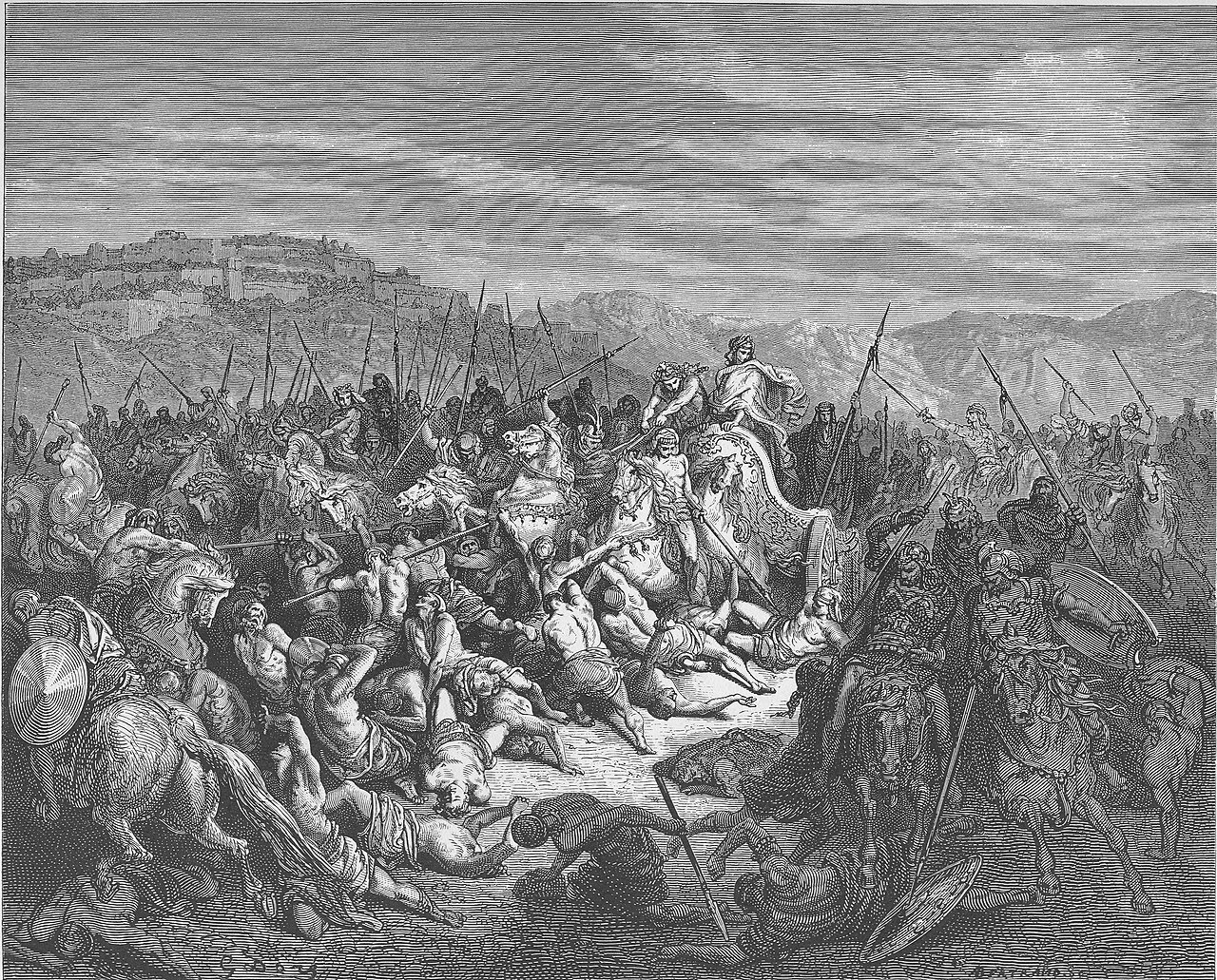
in 1 Kings 20Then he sent messengers into the city to Ahab king of Israel,
BSB
The same verse in ASV and KJV ▾
ASV
And he sent messengers to Ahab king of Israel, into the city, and said unto him, Thus saith Ben-hadad,
KJV
And he sent messengers to Ahab king of Israel into the city, and said unto him, Thus saith Ben–hadad,
⋯
This verse in 1 Kings 20
Commentary
6 notes on this verseA commentator
Jamieson, Fausset & Brown1802–1910
Commentary Critical and Explanatory on the Whole Bible (1871)
Ben-hadad's object in these and other boastful menaces was to intimidate Ahab. But the weak sovereign began to show a little more spirit, as appears in his abandoning "my lord the king" for the single "tell him," and giving him a dry but sarcastic hint to glory no more till the victory is won.
This site's exposition
gathered all his host together
on 1 Kings 20:1-3
Ben-hadad's confederation of thirty and two kings recalls a Syria that David had once subdued and made tributary; Israel's apostasy under Ahab lets a broken enemy grow strong again. The siege opens with an unlimited demand for silver, gold, wives and children, framed as though Ahab's surrender were already settled. Scripture gives no stated cause for the war beyond ambition, the same silence it keeps over other unprovoked campaigns.
The record, by era
The Puritans and the Awakening3 voices
"All shall be mine, without exception." 2. Ahab's poor spirit sends Ben-hadad a very disgraceful submission. It is general indeed (he cannot mention particulars in his surrender with so much pleasure as Ben-hadad did in his demand), but it is effectual: I am thine, and all that I have,
Ahab, encouraged by a prophet, overthrows him twice, ver. 13-30. Makes a covenant with him, ver. 31-34. Is reproved and threatened by a prophet, ver. 35-43.
quarantine:anchor (2026-07-29) — cites-ver-31/35-anchored-1-12
And he sent messengers to Ahab king of Israel, into the city,.... Who there remained, and attempted not to go forth and meet him, and stop his progress, though he must have passed great part of his dominions to come to Samaria: and said unto him, thus saith Benhadad; by them, his messengers, as follows.
The Nineteenth Century1 voice
A commentator
Albert Barnes1798–1870
Notes, Explanatory and Practical, on the Old and New Testaments (1832-1869)
proposed
It may be supposed that a considerable time had passed in the siege, that the city had been reduced to an extremity, and that ambassadors had been sent by Ahab to ask terms of peace short of absolute surrender, before Ben-hadad would make such a demand. He would expect and intend his demand to be rejected, and this would have left him free to plunder the town, which was evidently what he desired and purposed.
The words behind it
7 Hebrew wordsEvery Hebrew word of this verse in the order it stands, with what it means and the door to its own study. The last column counts the times a word stands in the whole Bible: the rarer the word, the more the places it appears belong together.
| Hebrew | Sound | Meaning | Word study | In the Bible |
|---|---|---|---|---|
| וַיֹּ֣אמֶר | vaiyomer | and he said | H559 → | 5305 times |
| ל֗וֹ | lo | to him | ||
| כֹּ֚ה | koh | thus | H3541 → | 577 times |
| אָמַ֣ר | ʾamar | he says | H559 → | 5305 times |
| בֶּן־ | ben- | Ben | H1130 → | 50 times |
| הֲדַ֔ד | hadad | Hadad | H1130 → | 50 times |
| הָעִֽירָה׃ | hairah | the city towards | H5892 → | 1090 times |
וַיֹּ֣אמֶרand he said
vaiyomerH559 →5305 times
ל֗וֹto him
lo
כֹּ֚הthus
kohH3541 →577 times
אָמַ֣רhe says
ʾamarH559 →5305 times
בֶּן־Ben
ben-H1130 →50 times
הֲדַ֔דHadad
hadadH1130 →50 times
הָעִֽירָה׃the city towards
hairahH5892 →1090 times
A shaded row is a word that stands 400 times or fewer in the Bible.
The walk
3 stopsEach card is a verse this one points to, and under it the verses that one points to in turn. Where several paths arrive at the same place, that place is listed first: the text keeps returning to it.
Through
2 Kings 19:9Now Sennacherib had been warned about Tirhakah king of Cush: “Look, he has set out to fight against you.” So Sennacherib again sent messengers to Hezekiah, saying,
it leads to
- 1 Samuel 23:27
Then a messenger came to Saul, saying, “Come quickly, for the Philistines have raided the land!”
- Isaiah 37:9
Now Sennacherib had been warned about Tirhakah king of Cush: “He has set out to fight against you.” On hearing this, Sennacherib sent messengers to Hezekiah, saying,
- 2 Kings 18:17
Nevertheless, the king of Assyria sent the Tartan, the Rabsaris, and the Rabshakeh, along with a great army, from Lachish to King Hezekiah at Jerusalem. They advanced up to Jerusalem and stationed themselves by…
- 1 Samuel 23:27
About 1 Kings
Who and where
1 name in this verse with a page on the site.
This page draws on Albert Barnes, Notes on the Old Testament; Albert Barnes, Notes, Explanatory and Practical, on the Old and New Testaments (1832-1869); Jamieson, Fausset & Brown, Commentary Critical and Explanatory on the Whole Bible; John Gill, Exposition of the Old Testament (1748-1763); John Wesley, Explanatory Notes upon the Old Testament and Matthew Henry, Commentary on the Whole Bible.