
1 Kings 20:1
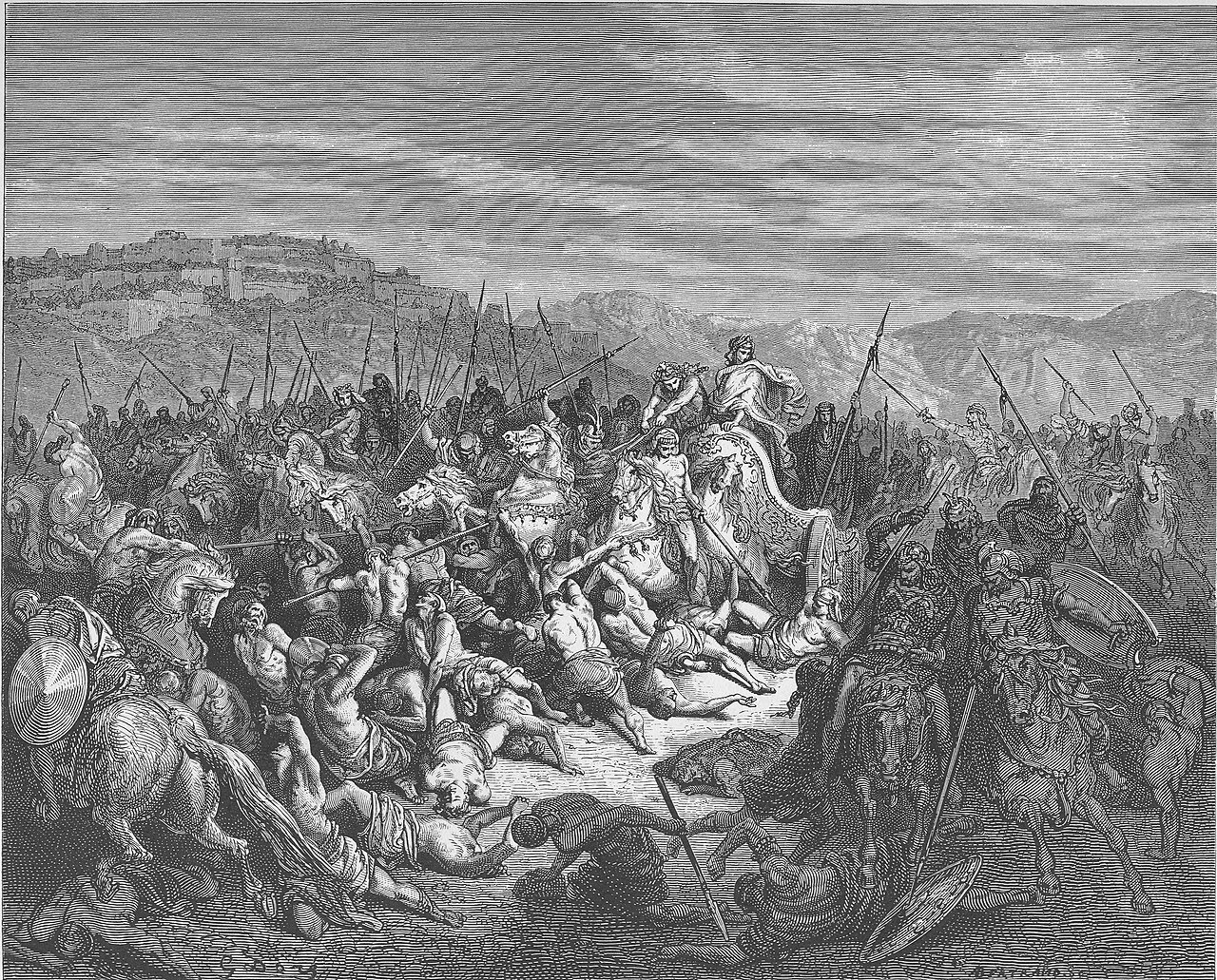
in 1 Kings 20Now Ben-hadad king of Aram assembled his entire army. Accompanied by thirty-two kings with their horses and chariots, he marched up, besieged Samaria, and waged war against it.
BSB
The same verse in ASV and KJV ▾
ASV
And Ben-hadad the king of Syria gathered all his host together; and there were thirty and two kings with him, and horses and chariots: and he went up and besieged Samaria, and fought against it.
KJV
And Ben–hadad the king of Syria gathered all his host together: and there were thirty and two kings with him, and horses, and chariots: and he went up and besieged Samaria, and warred against it.
⋯
This verse in 1 Kings 20
Commentary
8 notes on this verseA commentator
Albert Barnes1798–1870
Notes, Explanatory and Practical, on the Old and New Testaments (1832-1869)
Ben-hadad, the king of Syria - Probably the son of the Ben-hadad who assisted Asa against Baasha (1Ki 15:18 note). Thirty and two kings with him - Not allies, but feudatories 1Ki 20:24. Damascus had in the reign of this Ben-hadad become the center of an important monarchy, which may not improbably have extended from the Euphrates to the northern border of Israel. The Assyrian inscriptions show that this country was about the period in question parcelled out into a multitude of petty kingdoms, the chief tribes who possessed it being the Hittites, the Hamathites, and the Syrians of Damascus.
This site's exposition
gathered all his host together
on 1 Kings 20:1-3
Ben-hadad's confederation of thirty and two kings recalls a Syria that David had once subdued and made tributary; Israel's apostasy under Ahab lets a broken enemy grow strong again. The siege opens with an unlimited demand for silver, gold, wives and children, framed as though Ahab's surrender were already settled. Scripture gives no stated cause for the war beyond ambition, the same silence it keeps over other unprovoked campaigns.
The record, by era
The Puritans and the Awakening4 voices
What the ground of the quarrel was we are not told; covetousness and ambition were the principle, which would never want some pretence or other. David in his time had quite subdued the Syrians and made them tributaries to Israel, but Israel's apostasy from God makes them formidable again.
Ahab, encouraged by a prophet, overthrows him twice, ver. 13-30. Makes a covenant with him, ver. 31-34. Is reproved and threatened by a prophet, ver. 35-43.
quarantine:anchor (2026-07-29) — cites-ver-31/35-anchored-1-12
Gathered his host - To war against Israel: wherein his design was to enlarge the conquest which his father had made, but God's design was to punish Israel for their apostacy and idolatry.
And Benhadad the king of Syria gathered all his host together,....
The Nineteenth Century1 voice
A commentator
Jamieson, Fausset & Brown1802–1910
Commentary Critical and Explanatory on the Whole Bible (1871)
proposed
The thirty-two kings that were confederate with him were probably tributary princes. The ancient kings of Syria and Phœnicia ruled only over a single city, and were independent of each other, except when one great city, as Damascus, acquired the ascendency, and even then they were allied only in time of war.
quarantine:debris (2026-07-29) — unbalanced-curly-quotes
1 more voice on this verse
The Nineteenth Century1 voice
Ben-hadad - Several MSS., and some early printed editions, have Ben-hadar, or the son of Hadar, as the Septuagint. He is supposed to be the same whom Asa stirred up against the king of Israel, 1Ki 15:18; or, as others, his son or grandson. Thirty and two kings - Tributary chieftains of Syria and the adjacent countries. In former times every town and city had its independent chieftain. Both the Septuagint and Josephus place this war after the history of Naboth.
The words behind it
20 Hebrew wordsEvery Hebrew word of this verse in the order it stands, with what it means and the door to its own study. The last column counts the times a word stands in the whole Bible: the rarer the word, the more the places it appears belong together.
| Hebrew | Sound | Meaning | Word study | In the Bible |
|---|---|---|---|---|
| וּבֶן־ | uven- | and Ben | H1130 → | 50 times |
| הֲדַ֣ד | hadad | Hadad | H1130 → | 50 times |
| מֶֽלֶךְ־ | melekh- | [the] king of | H4428 → | 2525 times |
| אֲרָ֗ם | ʾaram | Aram | H758 → | 143 times |
| קָבַץ֙ | kavatz | he gathered | H6908 → | 127 times |
| אֶת־ | ʾet- | <obj.> | H853 → | 10935 times |
| כָּל־ | kol- | all | H3605 → | 5413 times |
| חֵיל֔וֹ | cheilo | army his | H2428 → | 246 times |
| וּשְׁלֹשִׁ֨ים | usheloshim | and thirty | H7970 → | 172 times |
| וּשְׁנַ֥יִם | ushenayim | and two | H8147 → | 768 times |
| מֶ֛לֶךְ | melekh | king[s] | H4428 → | 2525 times |
| אִתּ֖וֹ | ʾito | [were] with him | H854 → | 929 times |
| וְס֣וּס | vesus | and horse[s] | H5483 → | 140 times |
| וָרָ֑כֶב | varakhev | and chariotry | H7393 → | 119 times |
| וַיַּ֗עַל | vaiyaal | and he went up | H5927 → | 890 times |
| וַיָּ֙צַר֙ | vaiyatzar | and he laid siege | H6696 → | 38 times |
| עַל־ | ʾal- | on | H5921 → | 5755 times |
| שֹׁ֣מְר֔וֹן | shomeron | Samaria | H8111 → | 109 times |
| וַיִּלָּ֖חֶם | vaiyilachem | and he fought | H3898 → | 177 times |
| בָּֽהּ׃ | bah | against it |
וּבֶן־and Ben
uven-H1130 →50 times
הֲדַ֣דHadad
hadadH1130 →50 times
מֶֽלֶךְ־[the] king of
melekh-H4428 →2525 times
אֲרָ֗םAram
ʾaramH758 →143 times
קָבַץ֙he gathered
kavatzH6908 →127 times
אֶת־<obj.>
ʾet-H853 →10935 times
כָּל־all
kol-H3605 →5413 times
חֵיל֔וֹarmy his
cheiloH2428 →246 times
וּשְׁלֹשִׁ֨יםand thirty
usheloshimH7970 →172 times
וּשְׁנַ֥יִםand two
ushenayimH8147 →768 times
מֶ֛לֶךְking[s]
melekhH4428 →2525 times
אִתּ֖וֹ[were] with him
ʾitoH854 →929 times
וְס֣וּסand horse[s]
vesusH5483 →140 times
וָרָ֑כֶבand chariotry
varakhevH7393 →119 times
וַיַּ֗עַלand he went up
vaiyaalH5927 →890 times
וַיָּ֙צַר֙and he laid siege
vaiyatzarH6696 →38 times
עַל־on
ʾal-H5921 →5755 times
שֹׁ֣מְר֔וֹןSamaria
shomeronH8111 →109 times
וַיִּלָּ֖חֶםand he fought
vaiyilachemH3898 →177 times
בָּֽהּ׃against it
bah
A shaded row is a word that stands 400 times or fewer in the Bible.
The walk
8 stopsEach card is a verse this one points to, and under it the verses that one points to in turn. Where several paths arrive at the same place, that place is listed first: the text keeps returning to it.
Through
1 Kings 22:31Now the king of Aram had ordered his thirty-two chariot commanders, “Do not fight with anyone, small or great, except the king of Israel.”
it leads to
- 1 Kings 20:24
So do this: Dismiss all the kings from their positions and replace them with other officers.
- 2 Chronicles 18:30
Now the king of Aram had ordered his chariot commanders, “Do not fight with anyone, small or great, except the king of Israel.”
- 1 Kings 20:24
Through
1 Kings 15:20And Ben-hadad listened to King Asa and sent the commanders of his armies against the cities of Israel, conquering Ijon, Dan, Abel-beth-maacah, and the whole land of Naphtali, including the region of Chinnereth.
it leads to
- 2 Kings 15:29
In the days of Pekah king of Israel, Tiglath-pileser king of Assyria came and captured Ijon, Abel-beth-maacah, Janoah, Kedesh, Hazor, Gilead, and Galilee, including all the land of Naphtali, and he took the people…
- Judges 18:29
They named it Dan, after their forefather Dan, who was born to Israel—though the city was formerly named Laish.
- 2 Kings 15:29
Through
1 Kings 15:18So Asa withdrew all the silver and gold that remained in the treasuries of the house of the LORD and the royal palace. He entrusted it to his servants and sent them with this…
it leads to
- 1 Kings 14:26
He seized the treasures of the house of the LORD and of the royal palace. He took everything, including all the gold shields that Solomon had made.
- 2 Kings 12:18
So King Joash of Judah took all the sacred objects dedicated by his fathers—Jehoshaphat, Jehoram, and Ahaziah, the kings of Judah—along with his own consecrated items and all the gold found in the treasuries…
- 1 Kings 11:23–24
And God raised up against Solomon another adversary, Rezon the son of Eliada, who had fled from his master, Hadadezer king of Zobah,
- 1 Kings 14:26
Through
1 Kings 16:24He bought the hill of Samaria from Shemer for two talents of silver and built a city there, calling it Samaria after the name of Shemer, who had owned the hill.
it leads to
- 1 Kings 13:32
for the message that he cried out by the word of the LORD against the altar in Bethel and against all the shrines on the high places in the cities of Samaria will surely…
- 1 Kings 13:32
About 1 Kings
Who and where
1 name in this verse with a page on the site.
This page draws on Adam Clarke, Commentary on the Bible; Albert Barnes, Notes, Explanatory and Practical, on the Old and New Testaments (1832-1869); Albert Barnes, Notes on the Old Testament; Jamieson, Fausset & Brown, Commentary Critical and Explanatory on the Whole Bible; John Gill, Exposition of the Old Testament (1748-1763); John Wesley, Explanatory Notes upon the Old Testament and Matthew Henry, Commentary on the Whole Bible.