
1 Kings 20:30
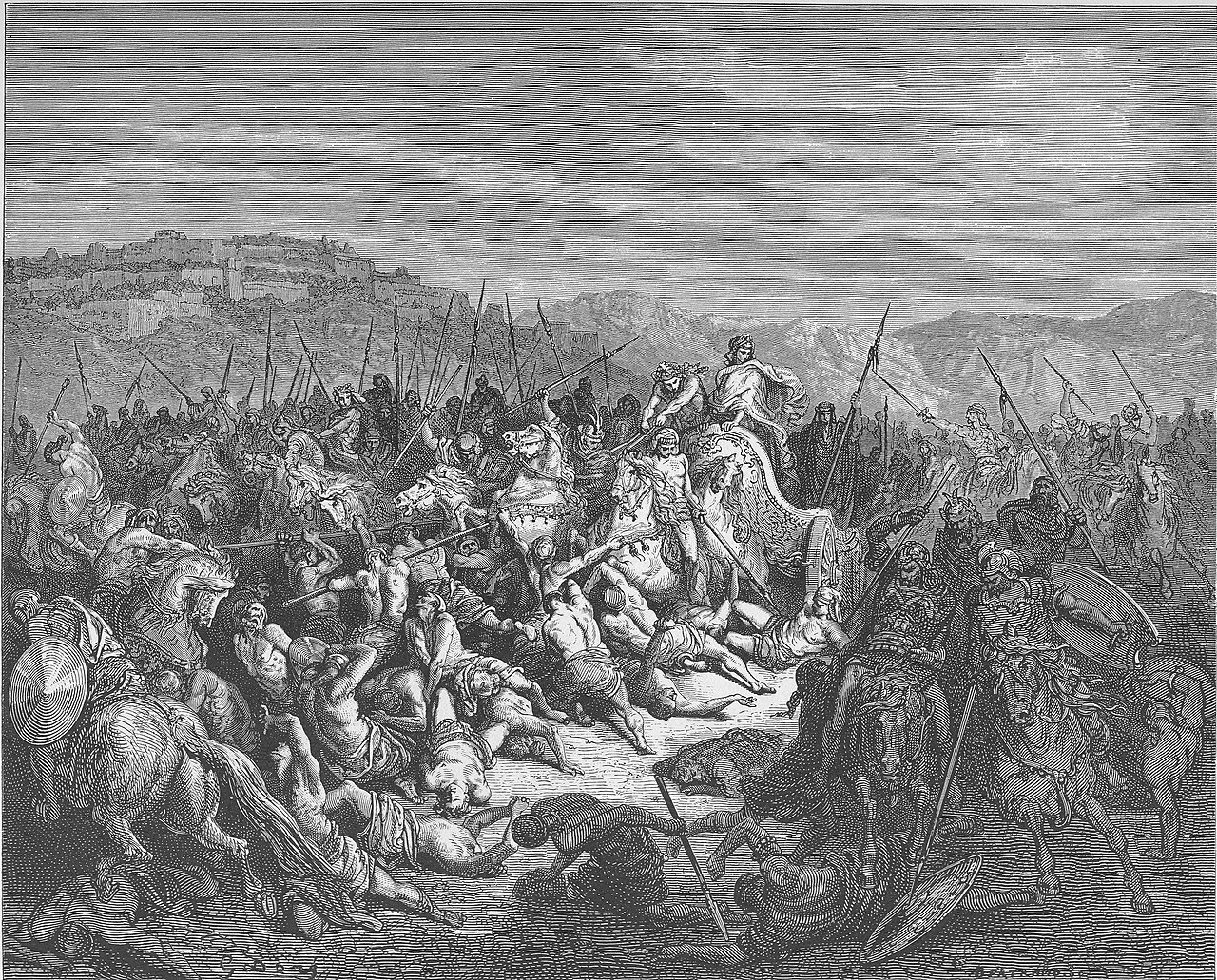
in 1 Kings 20The rest of them fled into the city of Aphek, where the wall fell on twenty-seven thousand of the remaining men. Ben-hadad also fled to the city and hid in an inner room.
BSB
The same verse in ASV and KJV ▾
ASV
But the rest fled to Aphek, into the city; and the wall fell upon twenty and seven thousand men that were left. And Ben-hadad fled, and came into the city, into an inner chamber.
KJV
But the rest fled to Aphek, into the city; and there a wall fell upon twenty and seven thousand of the men that were left. And Ben–hadad fled, and came into the city, into an inner chamber.
⋯
This verse in 1 Kings 20
Commentary
8 notes on this verseA wall fell upon twenty and seven thousand - From the first view of this text it would appear that when the Syrians fled to Aphek, and shut themselves within the walls, the Israelites immediately brought all hands, and sapped the walls, in consequence of which a large portion fell, and buried twenty-seven thousand men. But perhaps the hand of God was more immediately in this disaster; probably a burning wind is meant. See at the end of the chapter, 1Ki 20:43 (note).
This site's exposition
the wall fell on twenty-seven thousand
on 1 Kings 20:30-31
The survivors flee into Aphek, where “the wall fell on twenty-seven thousand of the remaining men”. His servants then appeal to what they have heard of Israel's kings: “the kings of the house of Israel are merciful”. They plan to go out in sackcloth and beg for his life.
The record, by era
The Church Fathers2 voices
Did not the Lord wish Ben-hadad, king of Syria, whom besides countless thousands of his own people, thirty-two kings and armies of the same number of kings served, to be conquered by a few foot soldiers of the princes in order that he who was …
Here the Scripture relates the two battles of the king of Israel against the Arameans, at which we have already hinted, and the twin slaughters of the Arameans, of which the second caused the death of 127,000 men, as God took his revenge on the …
The Puritans and the Awakening2 voices
The wall - Or, the walls (the singular number, for the plural) of the city; in which they were now fortifying themselves. This might possibly happen thro' natural causes; but most probably, was effected by the mighty power of God, sending some earthquake, or violent storm which threw down the walls upon them; or doing this by the ministry of angels.
But the rest fled to Aphek, into the city,....
The Nineteenth Century1 voice
A commentator
Jamieson, Fausset & Brown1802–1910
Commentary Critical and Explanatory on the Whole Bible (1871)
Ben-hadad succeeded in extricating himself, and, with his attendants, sought concealment in the city, fleeing from chamber to chamber; or, as some think it, an inner chamber, that is, a harem; but seeing no ultimate means of escape, he was advised to throw himself on the tender mercies of the Israelitish monarch.
1 more voice on this verse
The Nineteenth Century1 voice
A commentator
Albert Barnes1798–1870
Notes, Explanatory and Practical, on the Old and New Testaments (1832-1869)
proposed
A wall - “The wall,” i. e., the wall of the town. We may suppose a terrific earthquake during the siege of the place, while the Syrians were manning the defenses in full force, which threw down the wall where they were most thickly crowded upon it, and buried them in its ruins. Ben-hadad fled from the wall, where he had been at the time of the disaster, into the inner parts of the city - probably to some massive stronghold - and there concealed himself.
The words behind it
21 Hebrew wordsEvery Hebrew word of this verse in the order it stands, with what it means and the door to its own study. The last column counts the times a word stands in the whole Bible: the rarer the word, the more the places it appears belong together.
| Hebrew | Sound | Meaning | Word study | In the Bible |
|---|---|---|---|---|
| וַיָּנֻ֨סוּ | vaiyanusu | and they fled | H5127 → | 159 times |
| הַנּוֹתָרִ֥ים׀ | hanotarim | the [ones who] remained | H3498 → | 106 times |
| אֲפֵקָה֮ | ʾafekah | Aphek towards | H663 → | |
| אֶל־ | ʾel- | into | H413 → | 5510 times |
| הָעִיר֒ | hair | the city | H5892 → | 1090 times |
| וַתִּפֹּל֙ | vatipol | and it fell | H5307 → | 435 times |
| הַחוֹמָ֔ה | hachomah | the wall | H2346 → | 133 times |
| עַל־ | ʾal- | on | H5921 → | 5755 times |
| עֶשְׂרִ֨ים | ʾesrim | twenty | H6242 → | 315 times |
| וְשִׁבְעָ֥ה | veshivah | and seven | H7651 → | 394 times |
| אֶ֛לֶף | ʾelef | thousand | H505 → | 505 times |
| אִ֖ישׁ | ʾish | man | H376 → | 1663 times |
| הַנּוֹתָרִ֑ים | hanotarim | who remained | H3498 → | 106 times |
| וּבֶן־ | uven- | and Ben | H1130 → | 50 times |
| הֲדַ֣ד | hadad | Hadad | H1130 → | 50 times |
| נָ֔ס | nas | he fled | H5127 → | 159 times |
| וַיָּבֹ֥א | vaiyavo' | and he went | H935 → | 2568 times |
| אֶל־ | ʾel- | into | H413 → | 5510 times |
| הָעִ֖יר | hair | the city | H5892 → | 1090 times |
| חֶ֥דֶר | cheder | a room | H2315 → | 38 times |
| בְּחָֽדֶר׃ ס | bechader | in a room | H2315 → | 38 times |
וַיָּנֻ֨סוּand they fled
vaiyanusuH5127 →159 times
הַנּוֹתָרִ֥ים׀the [ones who] remained
hanotarimH3498 →106 times
אֲפֵקָה֮Aphek towards
ʾafekahH663 →
אֶל־into
ʾel-H413 →5510 times
הָעִיר֒the city
hairH5892 →1090 times
וַתִּפֹּל֙and it fell
vatipolH5307 →435 times
הַחוֹמָ֔הthe wall
hachomahH2346 →133 times
עַל־on
ʾal-H5921 →5755 times
עֶשְׂרִ֨יםtwenty
ʾesrimH6242 →315 times
וְשִׁבְעָ֥הand seven
veshivahH7651 →394 times
אֶ֛לֶףthousand
ʾelefH505 →505 times
אִ֖ישׁman
ʾishH376 →1663 times
הַנּוֹתָרִ֑יםwho remained
hanotarimH3498 →106 times
וּבֶן־and Ben
uven-H1130 →50 times
הֲדַ֣דHadad
hadadH1130 →50 times
נָ֔סhe fled
nasH5127 →159 times
וַיָּבֹ֥אand he went
vaiyavo'H935 →2568 times
אֶל־into
ʾel-H413 →5510 times
הָעִ֖ירthe city
hairH5892 →1090 times
חֶ֥דֶרa room
chederH2315 →38 times
בְּחָֽדֶר׃ סin a room
bechaderH2315 →38 times
A shaded row is a word that stands 400 times or fewer in the Bible.
The walk
8 stopsEach card is a verse this one points to, and under it the verses that one points to in turn. Where several paths arrive at the same place, that place is listed first: the text keeps returning to it.
Through
Psalms 18:25To the faithful You show Yourself faithful, to the blameless You show Yourself blameless;
it leads to
- Matthew 5:7
Blessed are the merciful, for they will be shown mercy.
- Psalms 62:12
and loving devotion to You, O Lord. For You will repay each man according to his deeds.
- Matthew 18:33–35
Shouldn’t you have had mercy on your fellow servant, just as I had on you?’
- Matthew 5:7
Through
1 Kings 20:26In the spring, Ben-hadad mobilized the Arameans and went up to Aphek to fight against Israel.
it leads to
- 2 Kings 13:17
“Open the east window,” said Elisha. So he opened it and Elisha said, “Shoot!” So he shot. And Elisha declared: “This is the LORD’s arrow of victory, the arrow of victory over Aram, for…
- 2 Kings 13:17
Through
1 Kings 22:25Micaiah replied, “You will soon see, on that day when you go and hide in an inner room.”
it leads to
- Jeremiah 28:16–17
Therefore this is what the LORD says: ‘I am about to remove you from the face of the earth. You will die this year because you have preached rebellion against the LORD.’”
Reached by 2 separate paths from here.
- Jeremiah 29:32
this is what the LORD says: ‘I will surely punish Shemaiah the Nehelamite and his descendants. He will have no one left among this people, nor will he see the good that I will…
Reached by 2 separate paths from here.
- Revelation 19:20
But the beast was captured along with the false prophet, who on its behalf had performed signs deceiving those who had the mark of the beast and worshiped its image. Both the beast and…
- Jeremiah 28:16–17
Through
Luke 13:4Or those eighteen who were killed when the tower of Siloam collapsed on them: Do you think that they were more sinful than all the others living in Jerusalem?
it leads to
- Nehemiah 3:15
The Fountain Gate was repaired by Shallun son of Col-hozeh, ruler of the district of Mizpah. He rebuilt it, roofed it, and installed its doors, bolts, and bars. He also repaired the wall of…
- Nehemiah 3:15
About 1 Kings
This page draws on Adam Clarke, Commentary on the Bible; Albert Barnes, Notes, Explanatory and Practical, on the Old and New Testaments (1832-1869); Ephrem the Syrian, ON THE FIRST BOOK OF KINGS 20:1; Jamieson, Fausset & Brown, Commentary Critical and Explanatory on the Whole Bible; John Gill, Exposition of the Old Testament (1748-1763); John Wesley, Explanatory Notes upon the Old Testament and Salvian the Presbyter, THE GOVERNANCE OF GOD 7.8.