
1 Kings 20:14
in 1 Kings 20“By whom?” Ahab asked. And the prophet replied, “This is what the LORD says: ‘By the young officers of the district governors.’” “Who will start the battle?” asked Ahab. “You will,” answered the prophet.
BSB
The same verse in ASV and KJV ▾
ASV
And Ahab said, By whom? And he said, Thus saith Jehovah, By the young men of the princes of the provinces. Then he said, Who shall begin the battle? And he answered, Thou.
KJV
And Ahab said, By whom? And he said, Thus saith the Lord, Even by the young men of the princes of the provinces. Then he said, Who shall order the battle? And he answered, Thou.
⋯
This verse in 1 Kings 20
Commentary
6 notes on this verseBy the young men of the princes of the provinces - These were probably some chosen persons out of the militia of different districts, raised by the princes of the provinces; the same as we would call lord-lieutenants of counties.
This site's exposition
Who shall order the battle
on 1 Kings 20:14-15
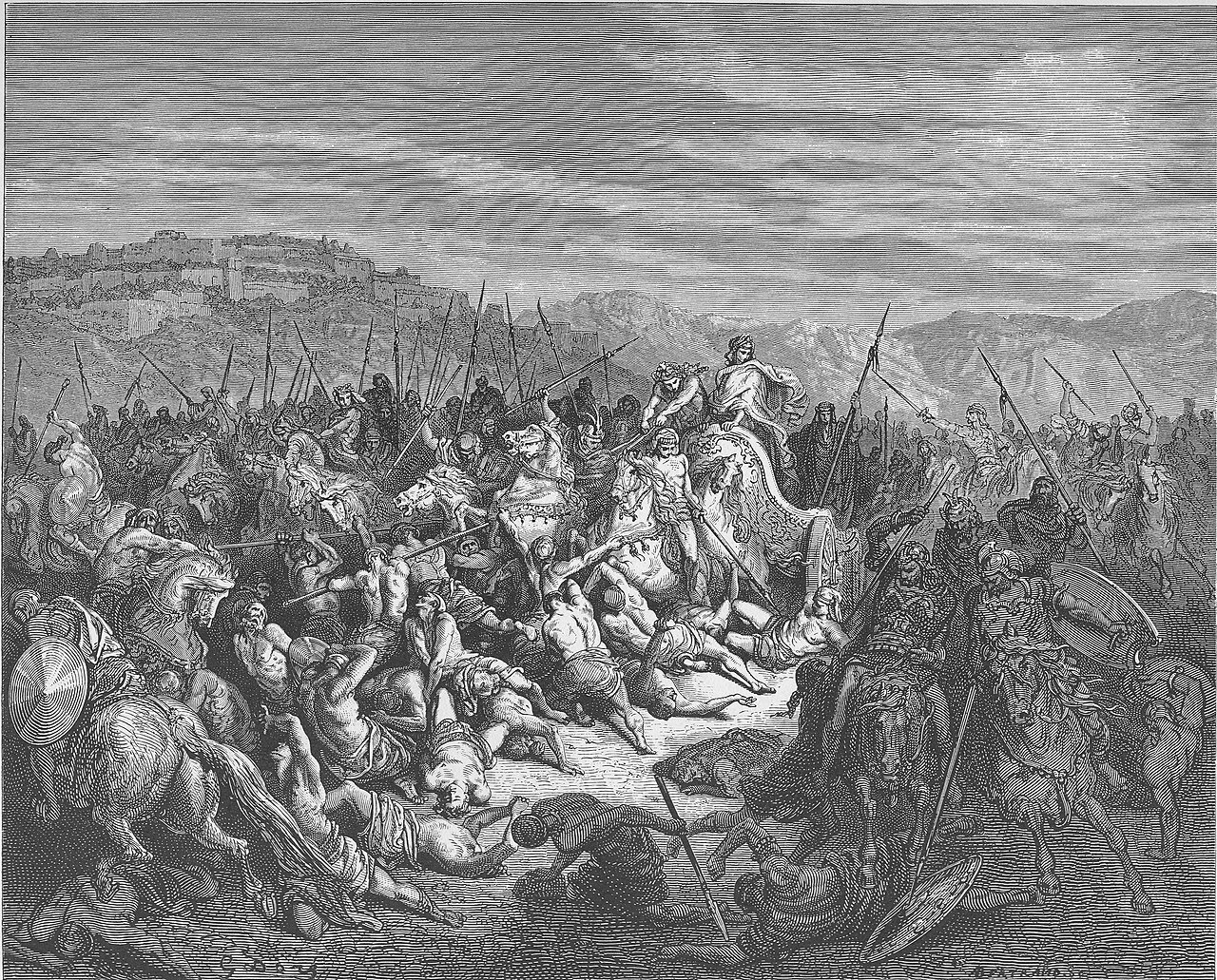
God names the instrument before naming the victory, young men of the princes of the provinces, two hundred and thirty two of them, with seven thousand more behind. Ahab himself, not a general, is told he must order the battle, so the outcome cannot be credited to royal strategy. Matthew Henry notes the seven thousand match the number of those in 19:18 who had not bowed to Baal, though he is careful to say they are likely not the same men.
The record, by era
The Puritans and the Awakening2 voices
He said, &c. - Not by old and experienced soldiers, but by those young men; either the sons of the princes, and great men of the land, who were fled thither for safety; or their pages, or servants that used to attend them: who are bred up delicately, and seem unfit for the business.
And Ahab said, by whom?....
The Nineteenth Century2 voices
A commentator
Jamieson, Fausset & Brown1802–1910
Commentary Critical and Explanatory on the Whole Bible (1871)
This glorious victory, won so easily, and with such a paltry force opposed to overwhelming numbers, was granted that Ahab and his people might know (1Ki 20:13) that God is the Lord. But we do not read of this acknowledgment being made, or of any sacrifices being offered in token of their national gratitude.
A commentator
Albert Barnes1798–1870
Notes, Explanatory and Practical, on the Old and New Testaments (1832-1869)
proposed
The “princes of the provinces” are the governors of districts, many of whom may have fled to the capital, as the hostile army advanced through Galilee and northern Samaria. The “young men” are their attendants, youths unaccustomed to war. Who shall order the battle? - i. e., “Who shal join battle, begin the attack? We or the enemy?” The reply was, that the Israelites were to attack.
How the passage was read
What the Jewish commentators add
By the youths of the officers of the provinces. They are the hostages, for all the governors of the other nations would give their children into his custody [as a guarantee] that they will not rebel against him.
2 more on this passage, in their own words ▾
A certain prophet. That was Michoyhu the son of Yimloh. 9 See below:8.
Seven thousand. I say that they are the ones about whom it is stated, “All those whose knees did not bend to the Baal,” were seven thousand. 12 Above:18.
This section is reception history: how the passage was read and kept in the Jewish tradition. Where a reading parts from an essential of the Christian faith, the section says so at that point.
Texts and citation data: Sefaria; each excerpt follows its version’s licence. 4 further sources are cited on this chapter that carry no English text this site may quote or only restate the verse.
The words behind it
16 Hebrew wordsEvery Hebrew word of this verse in the order it stands, with what it means and the door to its own study. The last column counts the times a word stands in the whole Bible: the rarer the word, the more the places it appears belong together.
| Hebrew | Sound | Meaning | Word study | In the Bible |
|---|---|---|---|---|
| וַיֹּ֤אמֶר | vaiyomer | and he said | H559 → | 5305 times |
| אַחְאָב֙ | ʾachav | Ahab | H256 → | 92 times |
| בְּמִ֔י | bemi | by whom? | H4310 → | 423 times |
| וַיֹּ֙אמֶר֙ | vaiyomer | and he said | H559 → | 5305 times |
| כֹּֽה־ | koh- | thus | H3541 → | 577 times |
| אָמַ֣ר | ʾamar | he says | H559 → | 5305 times |
| יְהוָ֔ה | yahweh | Yahweh | H3068 → | 6520 times |
| בְּנַעֲרֵ֖י | benaarei | by [the] young men of | H5288 → | 239 times |
| שָׂרֵ֣י | sarei | [the] officials of | H8269 → | 421 times |
| הַמְּדִינ֑וֹת | hamedinot | the provinces | H4082 → | 53 times |
| וַיֹּ֛אמֶר | vaiyomer | and he said | H559 → | 5305 times |
| מִֽי־ | mi- | who? | H4310 → | 423 times |
| יֶאְסֹ֥ר | ye'sor | will he begin | H631 → | |
| הַמִּלְחָמָ֖ה | hamilchamah | the battle | H4421 → | 320 times |
| וַיֹּ֥אמֶר | vaiyomer | and he said | H559 → | 5305 times |
| אָֽתָּה׃ | ʾatah | you | H859 → | 1094 times |
וַיֹּ֤אמֶרand he said
vaiyomerH559 →5305 times
אַחְאָב֙Ahab
ʾachavH256 →92 times
בְּמִ֔יby whom?
bemiH4310 →423 times
וַיֹּ֙אמֶר֙and he said
vaiyomerH559 →5305 times
כֹּֽה־thus
koh-H3541 →577 times
אָמַ֣רhe says
ʾamarH559 →5305 times
יְהוָ֔הYahweh
yahwehH3068 →6520 times
בְּנַעֲרֵ֖יby [the] young men of
benaareiH5288 →239 times
שָׂרֵ֣י[the] officials of
sareiH8269 →421 times
הַמְּדִינ֑וֹתthe provinces
hamedinotH4082 →53 times
וַיֹּ֛אמֶרand he said
vaiyomerH559 →5305 times
מִֽי־who?
mi-H4310 →423 times
יֶאְסֹ֥רwill he begin
ye'sorH631 →
הַמִּלְחָמָ֖הthe battle
hamilchamahH4421 →320 times
וַיֹּ֥אמֶרand he said
vaiyomerH559 →5305 times
אָֽתָּה׃you
ʾatahH859 →1094 times
A shaded row is a word that stands 400 times or fewer in the Bible.
The walk
8 stopsEach card is a verse this one points to, and under it the verses that one points to in turn. Where several paths arrive at the same place, that place is listed first: the text keeps returning to it.
Through
1 Kings 18:44On the seventh time the servant reported, “There is a cloud as small as a man’s hand rising from the sea.” And Elijah replied, “Go and tell Ahab, ‘Prepare your chariot and go down…
it leads to
- Luke 12:54
Then Jesus said to the crowds, “As soon as you see a cloud rising in the west, you say, ‘A shower is coming,’ and that is what happens.
- Job 8:7
Though your beginnings were modest, your latter days will flourish.
- Zechariah 4:10
For who has despised the day of small things? But these seven eyes of the LORD, which scan the whole earth, will rejoice when they see the plumb line in the hand of Zerubbabel.”
- Micah 1:13
Harness your chariot horses, O dweller of Lachish. You were the beginning of sin to the Daughter of Zion, for the transgressions of Israel were found in you.
- 1 Samuel 6:10
So the men did as instructed. They took two milk cows, hitched them to the cart, and penned up their calves.
- Luke 12:54
Through
1 Samuel 17:50Thus David prevailed over the Philistine with a sling and a stone; without a sword in his hand he struck down the Philistine and killed him.
it leads to
- Judges 15:15
He found the fresh jawbone of a donkey, reached out his hand and took it, and struck down a thousand men.
- 1 Samuel 21:9
The priest replied, “The sword of Goliath the Philistine, whom you killed in the Valley of Elah, is here; it is wrapped in a cloth behind the ephod. If you want, you may take…
- 1 Samuel 17:39
David strapped his sword over the tunic and tried to walk, but he was not accustomed to them. “I cannot walk in these,” David said to Saul. “I am not accustomed to them.” So…
- Judges 15:15
About 1 Kings
Who and where
1 name in this verse with a page on the site.
This page draws on Adam Clarke, Commentary on the Bible; Albert Barnes, Notes, Explanatory and Practical, on the Old and New Testaments (1832-1869); Jamieson, Fausset & Brown, Commentary Critical and Explanatory on the Whole Bible; John Gill, Exposition of the Old Testament (1748-1763); John Wesley, Explanatory Notes upon the Old Testament and Matthew Henry, Commentary on the Whole Bible.