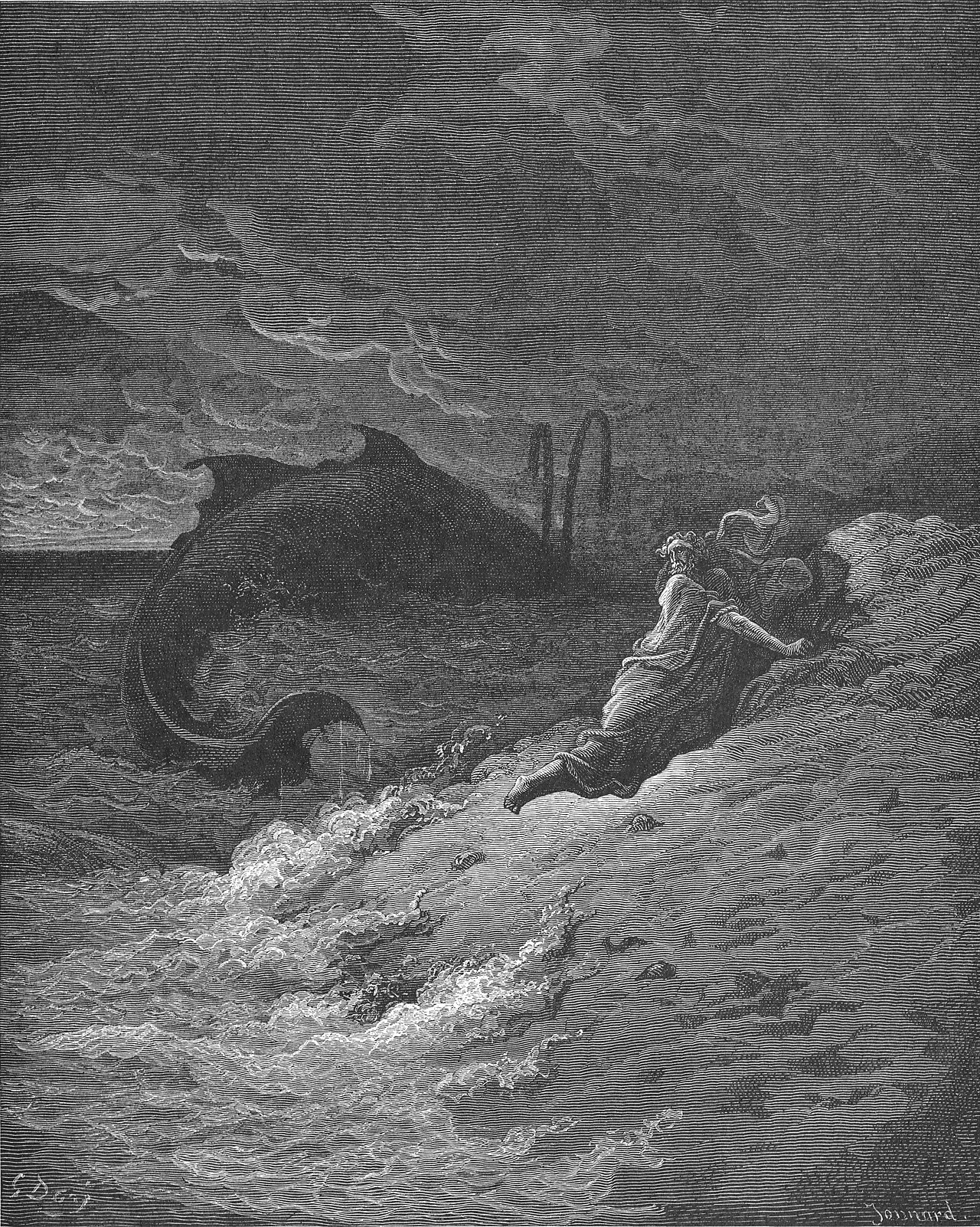
Prophetic Narrative · Jonah
Mercy Outruns the Prophet
A prophet commissioned to preach mercy to Israel's enemy flees instead, is pursued and delivered by the God whose mercy he resents, obeys under compulsion, and watches that mercy save an entire pagan city — and is angrier at the mercy than he ever was at the danger. The book ends not with resolution but with God's own unanswered question to the reader.

The Descent, and the Turn
— 1:1–3:2 — the prophet's own repeated “going down,” arrested by a prayerJonah's flight is told almost entirely in the vocabulary of descent — down to Joppa, down into the ship, down into its hold, down into the sea, down into the fish, down to the very bottoms of the mountains. Every step deepens the book's central irony: the man sent to lift a nation up is himself going, verse by verse, down. Then, from the deepest point the text can describe, a prayer — and the whole movement reverses.
- The commissionJonah 1:1–2“Arise, go to Nineveh, that great city, and cry against it.” Jonah hears it and does the opposite.
- Down to JoppaJonah 1:3aHe rises — not to obey, but to flee “from the presence of the LORD,” and goes down to the port that faces away from Nineveh.
- Down into the shipJonah 1:3bHe pays the fare and goes down into a vessel bound for Tarshish, the far edge of the known world.
- Down into the hold, asleepJonah 1:5While the LORD hurls a great wind at the sea and pagan sailors cry each to his own god, Jonah is down in the ship's innermost parts — asleep.
- Cast into the seaJonah 1:12, 15At his own word — “take me up, and cast me forth into the sea” — the sailors do, and the sea ceases from her raging.
- Swallowed — the appointed fishJonah 1:17; 2:6The LORD “appointed” (manah) a great fish; Jonah goes down “to the bottoms of the mountains,” to the very bars of the earth — as far down as the book's language can put a living man.
- The prayer from the deepJonah 2:1–9From the belly of Sheol he prays — and names, in Hebrew, the very word that becomes the Savior's name: “Salvation (yeshuʿah) is of the LORD.”
- Vomited onto dry landJonah 2:10The LORD speaks to the fish, and it vomits Jonah out — brought up from the pit, alive.
- The commission, renewedJonah 3:1–2The word of the LORD comes “the second time” — nearly the same sentence as 1:1–2. Grace does not withdraw the assignment; it repeats it.
Indentation tracks the text's own language of depth — from the surface of the commission down to “the bottoms of the mountains” (2:6), and back up as the second commission arrives. The renewed commission of 3:1–2 opens Panel Two, set beside Panel One below.
The Mirrored Commissions
— the diptych — nearly the same sentence twice, and one constant across both halves“Arise, go to Nineveh, that great city, and cry against it; for their wickedness is come up before me.”
Jonah
Flees. Descends — Joppa, ship, hold, sleep — and finally offers himself to the sea rather than carry the word.
The pagans
Pagan sailors fear, pray to the LORD, sacrifice, and vow — the book's first converts, made before Jonah has preached a syllable.
“Arise, go unto Nineveh, that great city, and preach unto it the preaching that I bid thee.”
Jonah
Obeys — under compulsion, not delight — preaches eight Hebrew words, then sits outside the city hoping to watch it burn.
The pagans
A pagan city repents wholesale, king to cattle, sackcloth and fasting from the throne down — and the LORD relents of the evil.
Both hinges turn the same way: it is the pagans — sailors in Panel One, an entire Assyrian city in Panel Two — who respond rightly, while Jonah remains the one hard case in either half. The fourfold “appointed” (manah) sequence brackets the second half: the fish (1:17), then the plant, the worm, and the east wind (4:6–8), each one an object lesson aimed squarely at the prophet. The book gives God the last word, but not an answer — it closes on His own unanswered question: “should not I have regard for Nineveh… wherein are more than sixscore thousand persons… and also much cattle?” (4:11).
Christ in Jonah
— the book's non-negotiable center — Jesus makes it His own signJesus makes Jonah's ordeal His one Old Testament sign for His generation: as Jonah was three days and three nights in the fish's belly, so the Son of Man would be three days and three nights in the heart of the earth. A prophet's three-day preservation from death becomes the pattern for the Son of Man's three-day conquest of it.
Open the study →“A greater than Jonah is here”Matt 12:41; Luke 11:32“When Christ lay, as Jonah, three days and three nights in the grave, though he prayed not, as Jonah did, yet his very lying there cried to God for poor sinners, and the cry was heard.”
Matthew Henry, Commentary on the Whole Bible (1710), on Jonah 2:2 · public domain
Nineveh repented at a reluctant prophet's eight-word sermon. Jesus' own generation would not repent at the willing, perfect Son with a far greater sign and a far greater word — the comparison itself is the indictment.
Open the study →Yeshuʿah — “salvation” — spoken from the fish's belly, is the same root that becomes the name Yeshua. The theological center of chapter 2 names, in Hebrew, the Savior's own name.
“Cast me forth into the sea… for my sake this great tempest is upon you.” One man offered that many might live — imperfect (Jonah is guilty; Christ is innocent) but the same shape: a man goes down into the deep that others may be spared.
“Herein Jonah is a type of Messiah, the one man who offered Himself to die, in order to allay the stormy flood of God's wrath (compare Ps 69:1, 2, as to Messiah), which otherwise must have engulfed all other men.”
Jamieson, Fausset & Brown, Commentary Critical and Explanatory on the Whole Bible (1871), on Jonah 1:12 · public domain
Jonah is the Old Testament's loudest single-book preview of the gospel going to the nations. Jonah flees mercy from Joppa — the very port where Peter, centuries later, receives the vision that opens the gospel to the Gentiles.
Themes
— five load-bearing lines through the bookThe scope of God's mercy
The book's central nerve. Grace reaches Gentile sailors, a whole pagan capital, even the cattle. Jonah 4:2 quotes the LORD's own self-revelation (Exod 34:6, “gracious and merciful, slow to anger”) as a complaint — the prophet's problem is precisely that it is true even for Nineveh.
The sovereignty of God over creation
The same verb — manah, “appointed” — governs the fish, the plant, the worm, and the east wind: four times in four verses. The storm has a verb of its own — at 1:4 the LORD hurls a great wind onto the sea. Nature obeys instantly; the prophet does not.
Repentance and God's relenting
Not a change in God's character but the consistent outworking of it — the same dynamic Jeremiah later states as a standing principle (Jer 18:7–8).
The reluctant, hard-hearted covenant servant
The book is a mirror for Israel, and for every believer who wants mercy for himself and judgment reserved for his enemy.
God's care extends past the human frame
“And also much cattle” widens the lens to all creation in the very last word of the book.
The Keynote Words
— five words that carry the book's argumentManah's exact lexicon entry is being checked before publication (working number H4487 above). The paired “gracious and merciful” formula Jonah quotes back at God in 4:2 (Exod 34:6, echoed at Joel 2:13, Ps 86:15, Neh 9:17) is held for the same verification pass and left unlinked here rather than asserted.
One versification trap worth knowing before you open a Hebrew tool: the fish verse that English Bibles number Jonah 1:17 is Hebrew 2:1, so a concordance, interlinear, or Hebrew text will file the “great fish” at the head of chapter 2 and run the rest of the chapter one verse ahead of the English numbering.
The Approved Voices on Jonah
— the roster applied — the specific work named, so you can go to itLearn the Bible in 24 Hours (2002)
Marcus Brown's formative teacher, and a committed typologist who treats Old Testament types as deliberate design rather than happy coincidence. His framework is the natural lens for the sign of Jonah as a Christ-authored pattern.
The Holiness of God (1985)
Sproul's Isaiah-6 “trauma of holiness encountering sinful humanity” illuminates the paradox of 1:9 — a prophet who rightly confesses Jehovah “who hath made the sea and the dry land” can still flee Him. Right theology, unreverenced heart.
expository preaching on Jonah 4 — specific sermon pending
Reads Jonah's anger in chapter 4 as a failure to delight in God's glory as it is displayed in mercy to enemies — not merely a failure of duty, but a failure of joy.
The Knowledge of the Holy
Tozer's recurring diagnostic — what comes into our minds when we think about God is the most important thing about us — bears directly on 4:2: Jonah's correct belief about God's mercy is exactly what he cannot bear.
Exposition of the Old and New Testaments, on Jonah
Reads Jonah's flight as a decision made in the heat of the moment — a man who would rather die than carry this particular errand.
Commentary on the Whole Bible, on Jonah
On 1:9, reads Jonah's confession as orthodoxy of creed paired with an unreverenced practice — right words, wrong feet.
Commentary on the Old Testament, on Jonah
The standard philological voice behind the manah/raʿah wordplay and the book's Nineveh geography; treats Jonah's 4:2 complaint as proof his theology was never in question — only his willingness to see it extended to Nineveh.
The Minor Prophets: A Commentary, on Jonah
Reads the diptych structure as deliberate design — pagan repentance framing Israelite hardness on both panels of the book.
Commentaries on the Twelve Minor Prophets, on Jonah
Treats the flight as a real, culpable act of unbelief by a true prophet — Calvin resists any reading that softens Jonah's sin.
Explanatory Notes Upon the Old Testament, on Jonah
Reads the closing question (4:11) as God's appeal to a natural compassion Jonah has failed even by his own light.
Number in Scripture
On “forty” as the number of probation and testing — applied to Nineveh's forty-day window (3:4), alongside the flood, Sinai, the spies, and Christ's own temptation.
Specific Spurgeon sermon numbers and a dedicated Missler Jonah/Passion-Week title are pending the founder's verify pass and are not asserted here. Marcus Brown's own commentary leads above all; within a tier, all voices are equal.
Contested Points
— presented at full strength, then MannaFest's flagHistorical narrative, or parable?
The historical reading — MannaFest's flag
A real prophet (named and dated by 2 Kgs 14:25), a real deliverance, a real repentance. The book opens like Kings — “Now the word of Jehovah came unto Jonah.” Decisively: Jesus treats both Jonah's ordeal and Nineveh's repentance as real, comparable events in the same breath as His own resurrection and the final judgment (Matt 12:40–41).
The parable / didactic-fiction reading
Held broadly across modern critical scholarship: the near-perfect symmetry, the satire of an overreacting prophet, an implausibly total repentance, a comic gourd, and an unnamed king all read, on this view, as literary artistry aimed at a theological point rather than history.
MannaFest flag — The book's craft is real and its aim is genuinely theological — no honest reading denies either — but craft and history are not exclusive (Genesis and Kings are also crafted). Jesus' direct comparative citation of Jonah alongside Solomon and the queen of the South (Luke 11:31–32, another treated as historical) weights the scale to history. A national-allegory reading (Jonah as Israel's own exile-and-return in miniature) is also real and welcome — riding on top of, not replacing, a historical account.
Nineveh's size — “three days' journey”
Literal city-crossing
A literal three-day crossing of Nineveh proper, implying an urban footprint archaeology does not confirm for the city alone.
“Greater Nineveh”
Nineveh as an administrative district — the city plus its satellite towns (Calah/Nimrud, Rehoboth-Ir, Resen; cf. Gen 10:11–12's own four-city cluster) — a reading with real support in the region's known urban geography.
MannaFest flag — The “Greater Nineveh” reading resolves the size question without weakening historicity; both are presented, neither erased.
The fish — species, and a popular story to avoid
The text's own restraint
“A great fish” (dag gadol) is generic, not a species claim — the text's emphasis is the divine appointing verb (manah), a control against overclaiming a specific creature.
The James Bartley story
A widely circulated 1891 tale of a sailor swallowed and later recovered alive from a whale, popular in early-20th-century apologetics.
MannaFest flag — The Bartley story is weakly evidenced and should not be cited as corroboration — its documentation is thin even among sympathetic researchers. The miracle stands on the text's own claim of divine appointment, not on a modern anecdote.
A further harmonization question — how “three days and three nights” (Matt 12:40) fits a Friday-to-Sunday timeline — belongs to the sign itself rather than to this book's own contested points, and is treated in full on the sign-of-Jonah study.
People & Places
— the book's whole geography, in three stopsTarshish (the far-western limit of the known world, widely identified with Tartessus in Spain) and Gath-hepher (Jonah's small Galilean hometown near Nazareth, the detail behind John 7:52's overlooked irony) are named in the dossier but do not yet have dedicated MannaFest place pages.