
Jonah 2:6
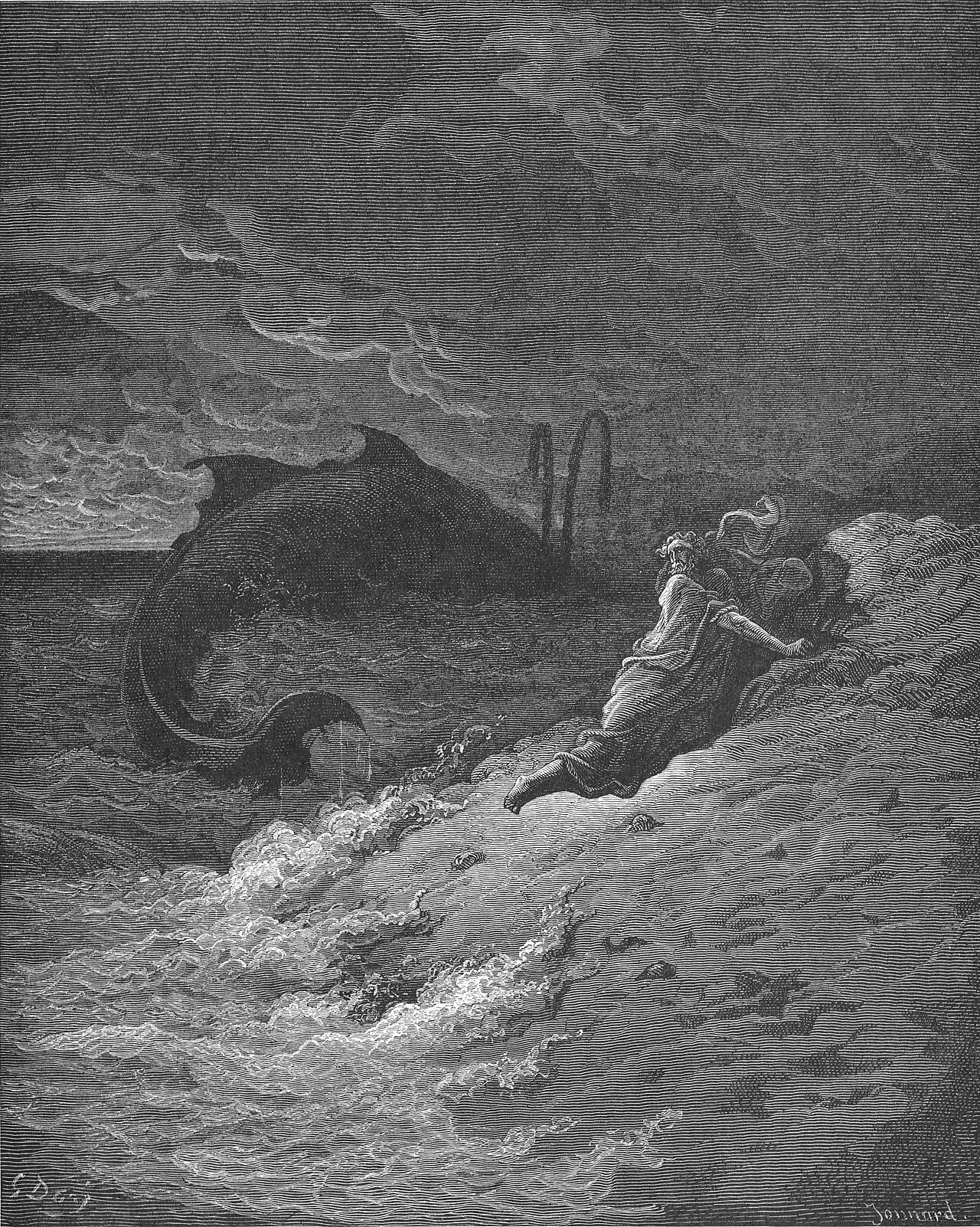
in Jonah 2To the roots of the mountains I descended; the earth beneath me barred me in forever! But You raised my life from the pit, O LORD my God!
BSB
The same verse in ASV and KJV ▾
ASV
I went down to the bottoms of the mountains; The earth with its bars closed upon me for ever: Yet hast thou brought up my life from the pit, O Jehovah my God.
KJV
I went down to the bottoms of the mountains; the earth with her bars was about me for ever: yet hast thou brought up my life from corruption, O Lord my God.
⋯
This verse in Jonah 2
Commentary
13 notes on this verseI went down to the bottoms of the mountains - This also may be literally understood. The fish followed the slanting base of the mountains, till they terminated in a plain at the bottom of the great deep. The earth with her bars - He represents himself as a prisoner in a dungeon, closed in with bars which he could not remove, and which at first appeared to be for ever, i.e., the place where his life must terminate.
This site's exposition
The waters engulfed me to take my life
on Jonah 2:5-6
The waters close over Jonah. He goes down to "the roots of the mountains," which Barnes and Wesley read as poetic language for the place of the dead. Against that stands the turn of the verse: "But You raised my life from the pit, O LORD my God!"
This site's exposition
To the roots of the mountains I descended
This is the lowest point of the book's descent, below the sea to the foundations of the earth, with the earth's bars shut behind him. Matthew Henry says he seemed cut off from any hope of return. Then the verse turns.
The record, by era
The Church Fathers3 voices
"the weeds were wrapped about my head. I went down to the bottoms of the mountains; the earth with her bars was about me for ever:" LXX: 'my head has penetrated to the base of mountains; I descended to into the earth whose bars are eternal bonds'. No one doubts that the ocean covered Jonah's head, that he went down to the roots of mountains and came to the depths of the earth by which as bars and columns by the will of God the earthly sphere is supported. This earth about which is said elsewhere, "I consolidated her columns" [Ps. 74:4]. With regard to the Lord Saviour, according to the two editions, this seems to me to be what is meant. His heart and his head, that is the spirit that he thought worthy to take with a body for our safety, went down to the base of the mountains which were covered by waves; they were restrained by the will of God, the deep covered them, they were parted by the majesty of God. His spirit then went down into hell, into those places to which in the last of the mud, the spirits of sinners were held, so too the psalmist says: "they will go down to the depths of the earth, they will be the lot of wolves" [Ps. 62:10.11]. These are the bars of the earth and like the locks of a final prison and tortures, which do not let the captive spirits out of hell. This is why the Septuagint has translated this is a pertinent way: "eternal bonds", that is, wanting to keep in all those whom it had once captured. But our Lord, about which we read these lines of Cyrus in Isaiah: "I will break the bronze bars, I will crack the iron bars" [Is. 45:2], He went down to the roots of the mountains, and was enclosed by eternal bars to free all the prisoners.
Jonah fulfilled a type of our Savior when he prayed from the belly of the fish and said, "I cried for help from the midst of the netherworld." He was in fact in the fish, yet he says that he is in the netherworld. In a later verse he manifestly prophesies in the person of Christ: "My head went down into the chasms of the mountains." Yet he was still in the belly of the fish. What mountains encompass you? But I know, he says, that I am a type of him who is to be laid in the sepulcher hewn out of rock. While he was in the sea, Jonah says, "I went down into the earth," for he typified Christ, who went down into the heart of the earth.
"yet have you brought up my life from corruption, O LORD my God." LXX: 'and from corruption my life comes up to me, O Lord my God.' He says rightly "you have brought up" or "let my life come up from corruption", because it had descended to corruption in hell.
The Puritans and the Awakening2 voices
Or, rather, we may suppose it spoken while he was yet in the fish's belly, and then it is the language of his faith: "Thou hast kept me alive here, in the pit, and therefore thou canst, thou wilt, bring up my life from the pit; " and he speaks of it with as much assurance as if it were done already: Thou has brought up my life.
The earth was so shut and locked, so barred and bolted, against him, that he was quite cut off from any hope of ever returning to it. Thus helpless, thus hopeless, did Jonah's case seem to be. Those whom God contends with the whole creation is at war with.
5 more voices on this verse
The Puritans and the Awakening3 voices
Yet - By what was first my danger, thou hast wonderfully secured me. From corruption - Or the pit, a description of the state of the dead. O Lord - In the assurance of faith, he speaks of the thing as already done.
I went down to the bottom of the mountains,....
Faith corrected and controlled the surmises of fear and distrust. Here was a fierce struggle between sense and faith, but faith had the last word and came off a conqueror. In trying times, the issue will be good at last, providing our faith do not fail; it was therefore the continuance of that in its vigour that Christ secured to Peter.
The Nineteenth Century2 voices
A commentator
Jamieson, Fausset & Brown1802–1910
Commentary Critical and Explanatory on the Whole Bible (1871)
Compare Ps 18:7, "the foundations of the hills" (Ps 18:15). earth with her bars was about me--Earth, the land of the living, is (not "was") shut against me. for ever--so far as any effort of mine can deliver me. yet hast thou brought up my life from corruption--rather, "Thou bringest . . . from the pit" [MAURER].
A commentator
Albert Barnes1798–1870
Notes, Explanatory and Practical, on the Old and New Testaments (1832-1869)
proposed
I went down to the bottoms, (literally “the cuttings off”) of the mountains - , the “roots” as the Chaldee and we call them, the hidden rocks, which the mountains push out, as it were, into the sea, and in which they end. Such hidden rocks extend along the whole length of that coast. These were his dungeon walls; “the earth, her bars,” those long submarine reefs of rock, his prison bars, “were around” him “forever:” the seaweeds were his chains: and, even thus, when things were at their uttermost, “Thou hast brought up my life from corruption,” to which his body would have fallen a prey, had not God sent the fish to deliver him. The deliverance for which be thanks God is altogether past: “Thou broughtest me up.” He calls “the” Lord, “my” God, because, being the God of all, He was especially his God, for whom He had done things of such marvelous love. God loves each soul which He has made with the same infinite love with which He loves all. Whence Paul says of Jesus Gal 2:20, “Who loved me and gave Himself for me.” He loves each, with the same undivided love, as if he had created none besides; and He allows each to say, “My God,” as if the Infinite God belonged wholly to each. So would He teach us the oneness of Union between the soul which God loves and which admits His love, and Himself.
The words behind it
12 Hebrew wordsEvery Hebrew word of this verse in the order it stands, with what it means and the door to its own study. The last column counts the times a word stands in the whole Bible: the rarer the word, the more the places it appears belong together.
| Hebrew | Sound | Meaning | Word study | In the Bible |
|---|---|---|---|---|
| לְקִצְבֵ֤י | lekitzvei | to extremities of | H7095 → | |
| הָרִים֙ | harim | mountains | H2022 → | |
| יָרַ֔דְתִּי | yaradti | I went down | H3381 → | 381 times |
| הָאָ֛רֶץ | haaretz | the earth | H776 → | |
| בְּרִחֶ֥יהָ | bericheiha | bars its | H1280 → | |
| בַעֲדִ֖י | vaadi | [were] behind me | H1157 → | |
| לְעוֹלָ֑ם | leolam | for ever | H5769 → | |
| וַתַּ֧עַל | vataal | and you brought up | H5927 → | 890 times |
| מִשַּׁ֛חַת | mishachat | from [the] pit | H7845 → | |
| חַיַּ֖י | chaiyai | life my | H2416 → | 498 times |
| יְהוָ֥ה | yahweh | O Yahweh | H3068 → | 6520 times |
| אֱלֹהָֽי׃ | ʾelohai | God my | H430 → | 2601 times |
לְקִצְבֵ֤יto extremities of
lekitzveiH7095 →
הָרִים֙mountains
harimH2022 →
יָרַ֔דְתִּיI went down
yaradtiH3381 →381 times
הָאָ֛רֶץthe earth
haaretzH776 →
בְּרִחֶ֥יהָbars its
bericheihaH1280 →
בַעֲדִ֖י[were] behind me
vaadiH1157 →
לְעוֹלָ֑םfor ever
leolamH5769 →
וַתַּ֧עַלand you brought up
vataalH5927 →890 times
מִשַּׁ֛חַתfrom [the] pit
mishachatH7845 →
חַיַּ֖יlife my
chaiyaiH2416 →498 times
יְהוָ֥הO Yahweh
yahwehH3068 →6520 times
אֱלֹהָֽי׃God my
ʾelohaiH430 →2601 times
A shaded row is a word that stands 400 times or fewer in the Bible.
The walk
8 stopsEach card is a verse this one points to, and under it the verses that one points to in turn. Where several paths arrive at the same place, that place is listed first: the text keeps returning to it.
Through
Psalms 16:10For You will not abandon my soul to Sheol, nor will You let Your Holy One see decay.
it leads to
- Acts 2:27–31
because You will not abandon my soul to Hades, nor will You let Your Holy One see decay.
- Acts 13:35–38
So also, He says in another Psalm: ‘You will not let Your Holy One see decay.’
- Psalms 49:15
But God will redeem my life from Sheol, for He will surely take me to Himself. Selah
- Revelation 1:18
the Living One. I was dead, and behold, now I am alive forever and ever! And I hold the keys of Death and of Hades.
- Acts 2:27–31
Through
Psalms 143:7Answer me quickly, O LORD; my spirit fails. Do not hide Your face from me, or I will be like those who descend to the Pit.
it leads to
- Psalms 28:1
To You, O LORD, I call; be not deaf to me, O my Rock. For if You remain silent, I will be like those descending to the Pit.
Reached by 2 separate paths from here.
- Psalms 69:17
Hide not Your face from Your servant, for I am in distress. Answer me quickly!
- Psalms 28:1
Through
Isaiah 38:17Surely for my own welfare I had such great anguish; but Your love has delivered me from the pit of oblivion, for You have cast all my sins behind Your back.
it leads to
- Psalms 86:13
For great is Your loving devotion to me; You have delivered me from the depths of Sheol.
Reached by 2 separate paths from here.
- Isaiah 43:25
I, yes I, am He who blots out your transgressions for My own sake and remembers your sins no more.
- Psalms 86:13
Where this verse is studied
On this page
Studies5
About Jonah
This page draws on 9 works. Open the list of works
This page draws on Adam Clarke, Commentary on the Bible; Albert Barnes, Notes on the Old Testament; Albert Barnes, Notes, Explanatory and Practical, on the Old and New Testaments (1832-1869); Cyril of Jerusalem, Catechetical Lecture 14:20; Jamieson, Fausset & Brown, Commentary Critical and Explanatory on the Whole Bible; Jerome, Commentary on Jonah, Chapter 2; John Gill, Exposition of the Old Testament (1748-1763); John Wesley, Explanatory Notes upon the Old Testament and Matthew Henry, Commentary on the Whole Bible.