
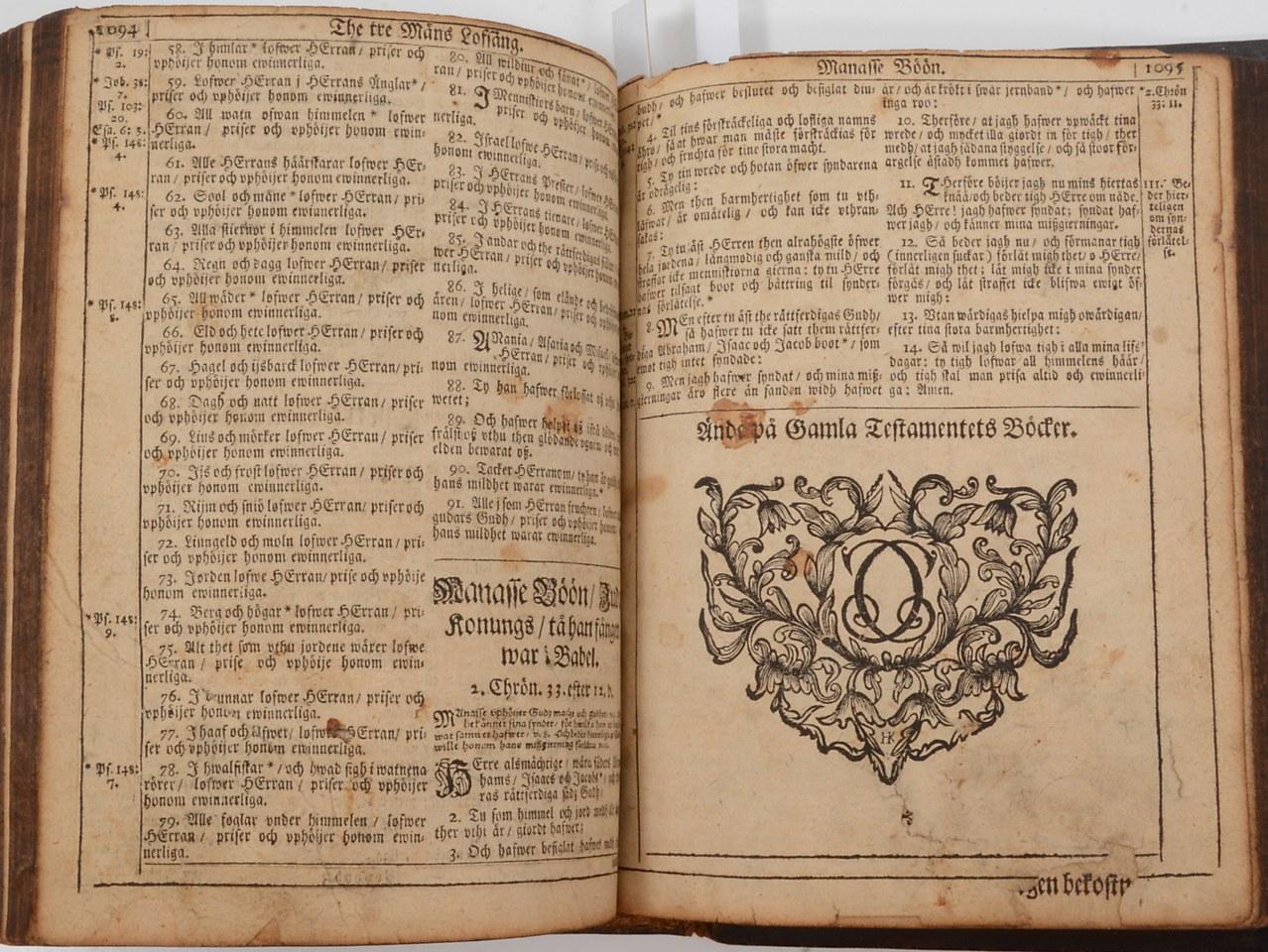
The Charles XII Bible, Swedish, 1709. Public domain.
Prayer of Manasseh 1 to 15 · Book · Apocrypha, a study resource beside the canon
The Prayer of Manasseh
A book of the Apocrypha, the books outside the Hebrew Bible, in fifteen verses, in which King Manasseh of Judah confesses his sins and asks to be forgiven.
If we confess our sins, He is faithful and just to forgive us our sins and to cleanse us from all unrighteousness.
- Date
- before the third century AD, by Ryle's reckoning (probable)
- Occasion
- A prayer of repentance in a king's voice, for his time of distress.
- Edition
- The Prayer of Manasseh in the King James Version Apocrypha, 1769 text (eBible.org); the Berean Standard Bible for the canon
Ryle found two ideas at the heart of the prayer: "the infinite compassion of the Almighty" and "the efficacy of true repentance".
Summary
The churches have read this prayer for life, printed it apart from their canons and sung it in their services. The site reads it beside the Bible as a study resource and rests no doctrine on it.
- Its witnesses run from an early church order to a modern Episcopal Prayer Book.
- H. E. Ryle and R. H. Charles, in the same volume of 1913, disagreed on its first language.
- A Swedish Bible of 1709 printed it as the last of the books of the Old Testament.
The Prayer of Manasseh
The prayer stands alone, and Matthew Henry pointed readers of Chronicles to it.
The Prayer of Manasseh is one prayer of fifteen verses with no story around it. Its speaker is Manasseh son of Hezekiah, king of Judah, and its occasion is the distress in which Chronicles says he sought the LORD.
The site holds the sixty-six books of the Bible as Scripture. The Prayer is quoted from the King James Version Apocrypha, 1769 text, by verse.
The Prayer at a Glance
The prayer moves from the God it names, through confession, to the praise it ends in.
The fifteen verses move in five steps: the God named, His mercy, the sinner's place, the confession and the plea.
- The God namedVerses 1 to 4: the God of Abraham, Isaac and Jacob, who made heaven and earth and shut up the deep.
- His wrath and His mercyVerses 5 to 7: His threatening against sinners cannot be borne, and His promise of mercy cannot be measured.
- Repentance for a sinnerVerse 8: the speaker's own place as one who has sinned.
- The confessionVerses 9 to 12: sins past numbering, the speaker bowed under them, and his plea for grace.
- The plea and the praiseVerses 13 to 15: a plea to be forgiven and spared, and praise for ever.
A sequence of five steps in the order of the verses, each with its verses.
Where the Prayer Came From
Ryle traced the prayer through its witnesses, and Charles answered him on its language.
H. E. Ryle introduced the Prayer in R. H. Charles's Apocrypha and Pseudepigrapha of the Old Testament in 1913. He reported that it first appears in the Didascalia, an early church order. The Didascalia was later taken into the Apostolical Constitutions, "a work of the fourth or fifth century".
From the Didascalia Ryle reasoned that the Prayer "must have been well known in the beginning of the third century A.D.", and that it was written earlier still. He judged that "it seems most probable that the Prayer was originally written in Greek". Charles, as editor of the volume, added a note arguing from "one real piece of evidence on behalf of a Semitic original".
Ryle noted that Codex Alexandrinus sets the Prayer among the canticles after the Psalter. To him this showed the Prayer "in use for liturgical psalmody in the fifth century". He also noted that it "was never included in the LXX version", the Greek Old Testament, and that Jerome did not translate it.
Among the Dead Sea Scrolls, the Hebrew psalm collection 4Q381 holds another prayer under Manasseh's name. Pajunen studied it beside 2 Chronicles 33 in 2012.
Who Receives the Prayer
The churches have set the prayer outside their canons, read it for life and sung it in Lent.
Five rulings and printings from 1546 to 1979, and the Orthodox in their fasts, each give the prayer its place.
| When | Who | What they do with the prayer |
|---|---|---|
| 1546 | The Council of Trent, session 4 | leaves it out of the list of the books of the Old Testament |
| 1571 | The Church of England, Article VI | names The Prayer of Manasses among the books read for example of life, and not to establish doctrine |
| 1592 | The Clementine Vulgate | prints it with 3 and 4 Esdras in an appendix after the New Testament |
| 1611 | The King James Version | prints it among the Apocrypha, between Bel and the Dragon and 1 Maccabees |
| 1979 | The Book of Common Prayer of the Episcopal Church | sets verses as Canticle 14, A Song of Penitence, for Lent and other penitential occasions |
| In the fasts | The Orthodox Church | chants it at Great Compline, on weeknights of Great Lent, in Holy Week and in the lesser fasts |
The Catholic Encyclopedia records that Vulgate editions before Trent placed the Prayer after the books of Chronicles. The Clementine Vulgate moved it to the appendix, where reprints of the standard text still carry it. Ryle reports that Thielmann and Berger told Nestle that, so far as they knew, no Vulgate manuscript held it from before the thirteenth century.
So the Prayer stands outside the Roman canon and outside the Protestant one. The site reads it for its confession and its long use in the churches' worship, and rests no doctrine on it.
The Voices
A church order of the fourth or fifth century and an English commentator of 1710 read the prayer for the church.
Matthew Henry (1662 to 1714)
The Apostolic Constitutions gives the Prayer in full under the heading "That David, the Ninevites, Hezekiah, and His Son Manasseh, are Eminent Examples of Repentance".
Matthew Henry pointed his readers to it.
“He prayed to him for the pardon of sin and the return of his favour. Prayer is the relief of penitents, the relief of the afflicted. That is a good prayer, and very pertinent in this case, which we find among the apocryphal books, entitled, The prayer of Manasses, king of Judah, when he was holden captive in Babylon.”
Matthew Henry · Commentary on the Whole Bible · on 2 Chronicles 33:12 to 13Puritan
Books to Read Next
Four works on the Prayer are free to read.
The Prayer of Manasseh, King James Version Apocrypha
The King James translators · 1611
It gives the whole prayer in the King James English.
Read it free at eBible.orgThe Apocrypha and Pseudepigrapha of the Old Testament, vol. I
R. H. Charles, ed.; the Prayer of Manasses by H. E. Ryle · 1913
Ryle sets out the Prayer's witnesses, language, date and use, and annotates the text.
Read it free at archive.orgConstitutions of the Holy Apostles, Book 2
Ante-Nicene Fathers, vol. 7 · 1886
Section 22 gives the whole prayer under its heading.
Read it free at New AdventThe Book of Common Prayer
The Episcopal Church · 1979
Canticle 14 sets verses of the prayer for Morning Prayer.
Read it free at bcponline.orgA Prayer Read Beside the Bible
Isaiah gives the canon's call to the repentance the prayer practises.
The Prayer calls God "the God of them that repent" (Prayer of Manasseh 13), and Isaiah answers from the canon.
Let the wicked man forsake his own way and the unrighteous man his own thoughts; let him return to the LORD, that He may have compassion, and to our God, for He will freely pardon.Sources
Scripture is the Berean Standard Bible.
- The Prayer of Manasseh, King James Version Apocrypha, 1769 text (eBible.org USFX edition), public domain.
- H. E. Ryle, The Prayer of Manasses, in R. H. Charles (ed.), The Apocrypha and Pseudepigrapha of the Old Testament, vol. I, Oxford, 1913; public domain.
- Constitutions of the Holy Apostles, Book 2, section 22, Ante-Nicene Fathers vol. 7; public domain.
- The Catholic Encyclopedia, Apocrypha, 1907; public domain.
- The Council of Trent, session 4, 8 April 1546, tr. J. Waterworth, 1848.
- The Church of England, Articles of Religion, 1571, Article VI, in the Book of Common Prayer of 1863, pp. 438 to 440.
- The Book of Common Prayer, the Episcopal Church, 1979, Morning Prayer Rite Two, Canticle 14.
- OrthodoxWiki, Prayer of Manasseh and Compline.
- The Leon Levy Dead Sea Scrolls Digital Library, 4Q381, Non-Canonical Psalms B; Wikipedia, Prayer of Manasseh; the Orion Center bibliography entry for Pajunen, The Prayer of Manasseh in 4Q381 and the Account of Manasseh in 2 Chronicles 33, 2012.
Keep Studying
Studies6
Places1
Go further1
Subjects1