
Exodus 7:15
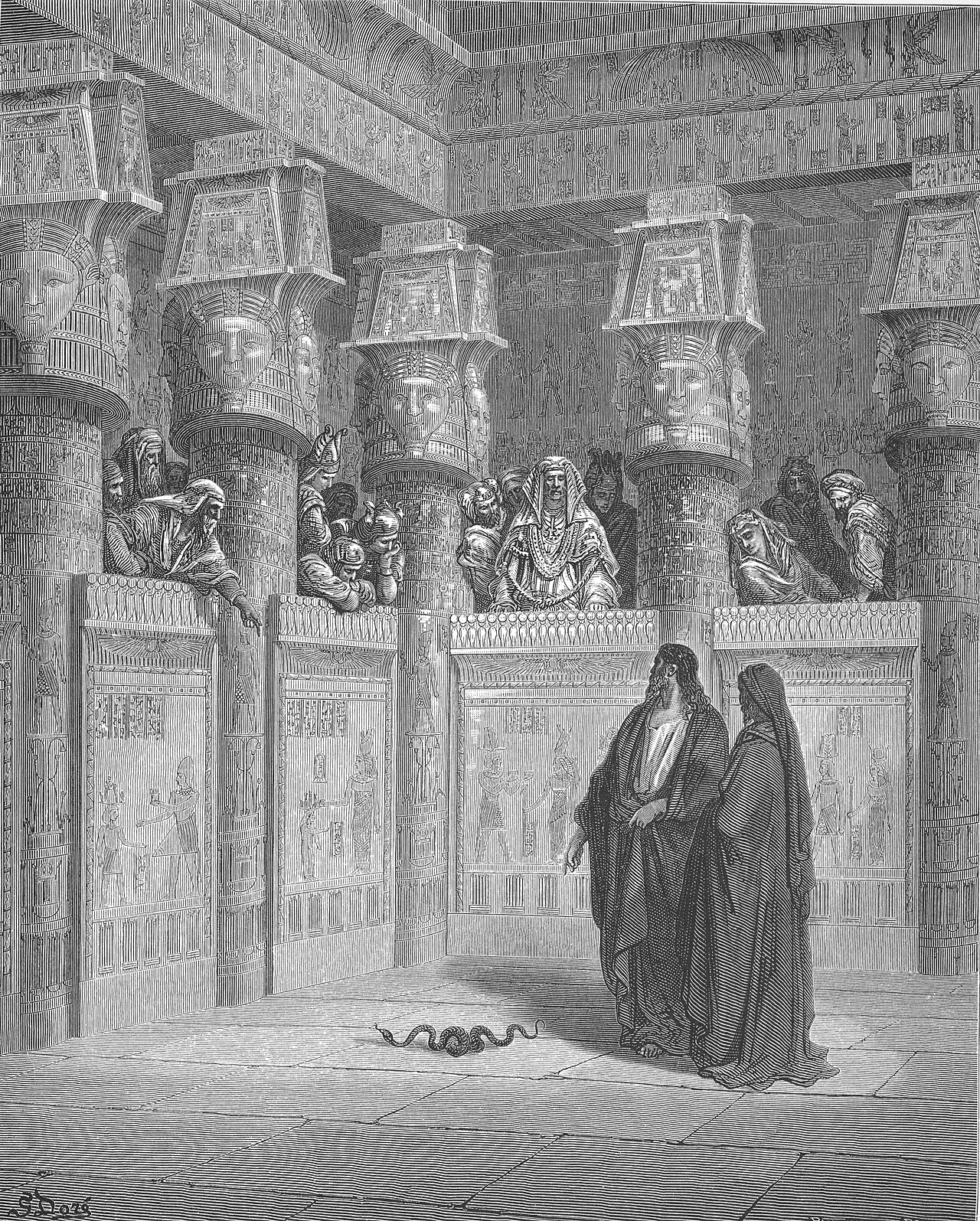
in Exodus 7Go to Pharaoh in the morning as you see him walking out to the water. Wait on the bank of the Nile to meet him, and take in your hand the staff that was changed into a snake.
BSB
The same verse in ASV and KJV ▾
ASV
Get thee unto Pharaoh in the morning; lo, he goeth out unto the water; and thou shalt stand by the river’s brink to meet him; and the rod which was turned to a serpent shalt thou take in thy hand.
KJV
Get thee unto Pharaoh in the morning; lo, he goeth out unto the water; and thou shalt stand by the river’s brink against he come; and the rod which was turned to a serpent shalt thou take in thine hand.
⋯
This verse in Exodus 7
Commentary
6 notes on this verseGet thee unto Pharaoh in the morning,.... The next morning, a time in which the mind is most composed and sedate, and fit to attend to what may be suggested: lo, he goeth out unto the water; the river Nile, either to take his morning's walk, and to refresh himself at the waterside, as the Jerusalem Targum; or to observe divinations upon the water, as a magician, as the Targum of Jonathan. So in the Talmud (d) it is said, that the Pharaoh in the days of Moses was a magician.
This site's exposition
Get thee unto Pharaoh in the morning
on Exodus 7:15-16
Plague one opens the first of three triads, and the opening line is where the pattern shows: the first plague of each set is warned at the river in the morning, at 7:15, 8:20 and 9:13, the second is warned inside the palace, at 8:1, 9:1 and 10:1, and the third falls with no warning at all, at 8:16, 9:8 and 10:21. Verse 16 gives the demand in the form it keeps for the rest of the book, Let my people go, that they may serve me, which is release for a purpose rather than release on its own. That purpose clause is attached seven times, at 4:23, 7:16, 8:1, 8:20, 9:1, 9:13 and 10:3, and the Hebrew root inside it is the one Exodus 1:13 and 1:14 used five times over for the bondage.
The record, by era
The Puritans and the Awakening1 voice
Moses is expressly ordered to take the rod with him, that Pharaoh might be alarmed at the sight of that rod which had so lately triumphed over the rods of the magicians. That the judgments of God are all known to himself beforehand. He knows what he will do in wrath as well as in mercy.
The Nineteenth Century3 voices
A commentator
Albert Barnes1798–1870
Notes, Explanatory and Practical, on the Old and New Testaments (1832-1869)
He goeth out unto the water - The Nile was worshipped under various names and symbols; at Memphis especially, as Hapi, i. e. Apis, the sacred bull, or living representation of Osiris, of whom the river was regarded as the embodiment or manifestation. If, as is probable, the king went to offer his devotions, the miracle would have special force and suitableness. It was also the season of the yearly overflowing, about the middle of June; and the daily rise of the water was accurately recorded, under the personal superintendence of the king.
A commentator
Jamieson, Fausset & Brown1802–1910
Commentary Critical and Explanatory on the Whole Bible (1871)
proposed
Get thee unto Pharaoh--Now began those appalling miracles of judgment by which the God of Israel, through His ambassadors, proved His sole and unchallengeable supremacy over all the gods of Egypt, and which were the natural phenomena of Egypt, at an unusual season, and in a miraculous degree of intensity.
Lo, he goeth out unto the water - Probably for the purpose of bathing, or of performing some religious ablution. Some suppose he went out to pay adoration to the river Nile, which was an object of religious worship among the ancient Egyptians. “For,” says Plutarch, De Iside., ουδεν οὑτω τιμη Αιγυπτιοις ὡς ὁ Νειλος “nothing is in greater honor among the Egyptians than the river Nile.” Some of the ancient Jews supposed that Pharaoh himself was a magician, and that he walked by the river early each morning for the purpose of preparing magical rites, etc.
How the passage was read
What the Jewish commentators add
On the verses either side of this one
AND THE LORD SAID…PHARAOH’S HEART IS STUBBORN. Kaved (is stubborn) is a verb in the perfect.
This section is reception history: how the passage was read and kept in the Jewish tradition. Where a reading parts from an essential of the Christian faith, the section says so at that point.
Texts and citation data: Sefaria; each excerpt follows its version’s licence. 1 further source is cited on this chapter that carry no English text this site may quote or only restate the verse.
The words behind it
18 Hebrew wordsEvery Hebrew word of this verse in the order it stands, with what it means and the door to its own study. The last column counts the times a word stands in the whole Bible: the rarer the word, the more the places it appears belong together.
| Hebrew | Sound | Meaning | Word study | In the Bible |
|---|---|---|---|---|
| לֵ֣ךְ | lekh | go | H1980 → | 1546 times |
| אֶל־ | ʾel- | to | H413 → | 5510 times |
| פַּרְעֹ֞ה | paroh | Pharaoh | H6547 → | 274 times |
| בַּבֹּ֗קֶר | baboker | in the morning | H1242 → | 214 times |
| הִנֵּה֙ | hineh | there! | H2009 → | 843 times |
| יֹצֵ֣א | yotze' | [he is] going out | H3318 → | 1067 times |
| הַמַּ֔יְמָה | hamaymah | the water towards | H4325 → | 581 times |
| וְנִצַּבְתָּ֥ | venitzavta | and you will stand | H5324 → | 75 times |
| לִקְרָאת֖וֹ | likrato | to meet him | H7122 → | 139 times |
| עַל־ | ʾal- | on | H5921 → | 5755 times |
| שְׂפַ֣ת | sefat | [the] bank of | H8193 → | 176 times |
| הַיְאֹ֑ר | hayor | the River | H2975 → | 65 times |
| וְהַמַּטֶּ֛ה | vehammateh | and the staff | H4294 → | 252 times |
| אֲשֶׁר־ | ʾasher- | which | H834 → | 5497 times |
| נֶהְפַּ֥ךְ | nehpakh | it was changed | H2015 → | 94 times |
| לְנָחָ֖שׁ | lenachash | into a snake | H5175 → | |
| תִּקַּ֥ח | tikach | you will take | H3947 → | 966 times |
| בְּיָדֶֽךָ׃ | beyadekha | in hand your | H3027 → | 1618 times |
לֵ֣ךְgo
lekhH1980 →1546 times
אֶל־to
ʾel-H413 →5510 times
פַּרְעֹ֞הPharaoh
parohH6547 →274 times
בַּבֹּ֗קֶרin the morning
babokerH1242 →214 times
הִנֵּה֙there!
hinehH2009 →843 times
יֹצֵ֣א[he is] going out
yotze'H3318 →1067 times
הַמַּ֔יְמָהthe water towards
hamaymahH4325 →581 times
וְנִצַּבְתָּ֥and you will stand
venitzavtaH5324 →75 times
לִקְרָאת֖וֹto meet him
likratoH7122 →139 times
עַל־on
ʾal-H5921 →5755 times
שְׂפַ֣ת[the] bank of
sefatH8193 →176 times
הַיְאֹ֑רthe River
hayorH2975 →65 times
וְהַמַּטֶּ֛הand the staff
vehammatehH4294 →252 times
אֲשֶׁר־which
ʾasher-H834 →5497 times
נֶהְפַּ֥ךְit was changed
nehpakhH2015 →94 times
לְנָחָ֖שׁinto a snake
lenachashH5175 →
תִּקַּ֥חyou will take
tikachH3947 →966 times
בְּיָדֶֽךָ׃in hand your
beyadekhaH3027 →1618 times
A shaded row is a word that stands 400 times or fewer in the Bible.
The walk
8 stopsEach card is a verse this one points to, and under it the verses that one points to in turn. Where several paths arrive at the same place, that place is listed first: the text keeps returning to it.
Through
Exodus 2:5Soon the daughter of Pharaoh went down to bathe in the Nile, and her attendants were walking along the riverbank. And when she saw the basket among the reeds, she sent her maidservant to…
it leads to
- Acts 7:21
When he was set outside, Pharaoh’s daughter took him and brought him up as her own son.
- Psalms 9:9
The LORD is a refuge for the oppressed, a stronghold in times of trouble.
- Psalms 12:5
“For the cause of the oppressed and for the groaning of the needy, I will now arise,” says the LORD. “I will bring safety to him who yearns.”
- Exodus 8:20
Then the LORD said to Moses, “Get up early in the morning, and when Pharaoh goes out to the water, stand before him and tell him that this is what the LORD says: ‘Let…
- Psalms 46:1
God is our refuge and strength, an ever-present help in times of trouble.
- Acts 7:21
Through
Ezekiel 29:3Speak to him and tell him that this is what the Lord GOD says: Behold, I am against you, O Pharaoh king of Egypt, O great monster who lies among his rivers, who says,…
it leads to
- Isaiah 27:1
In that day the LORD will take His sharp, great, and mighty sword, and bring judgment on Leviathan the fleeing serpent—Leviathan the coiling serpent—and He will slay the dragon of the sea.
- Ezekiel 32:2
“Son of man, take up a lament for Pharaoh king of Egypt and say to him: ‘You are like a lion among the nations; you are like a monster in the seas. You thrash…
- Jeremiah 44:30
This is what the LORD says: Behold, I will deliver Pharaoh Hophra king of Egypt into the hands of his enemies who seek his life, just as I delivered Zedekiah king of Judah into…
- Isaiah 27:1
Where this verse is studied
On this page
Studies1
About Exodus
This page draws on Adam Clarke, Commentary on the Bible; Albert Barnes, Notes, Explanatory and Practical, on the Old and New Testaments (1832-1869); Jamieson, Fausset & Brown, Commentary Critical and Explanatory on the Whole Bible; John Gill, Exposition of the Old Testament (1748-1763); Keil and Delitzsch, Biblical Commentary on the Old Testament: The Pentateuch and Matthew Henry, Commentary on the Whole Bible.