
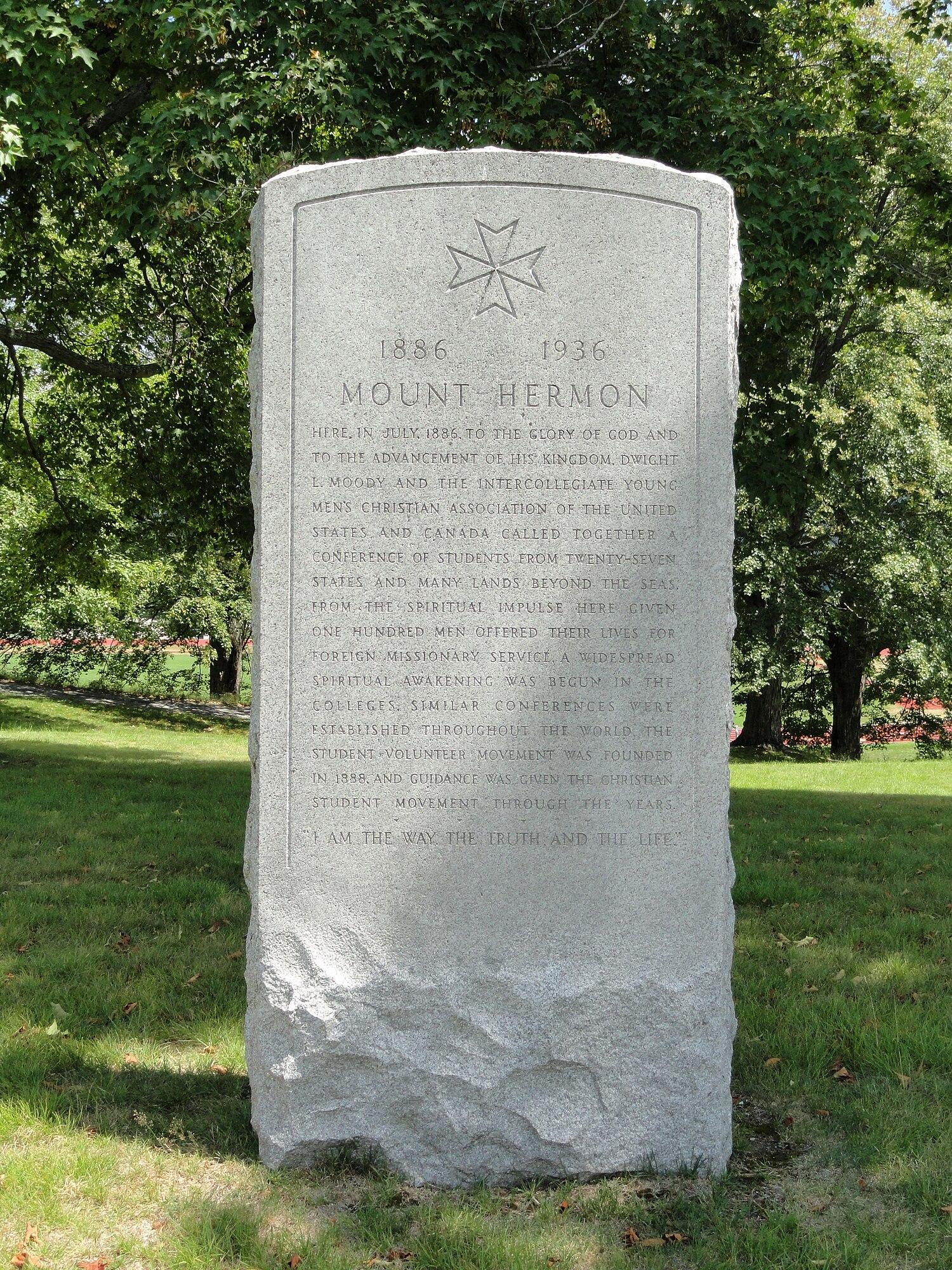
Mount Hermon Conference memorial, Daderot, 2011. CC0.
1886 to 1910 · The churches · Featured Study
The Student Volunteer Movement
A student movement that pledged volunteers for service abroad and sent them out through the mission boards of the churches.
When the first students' conference opened, fewer than a score of its delegates were thinking of becoming missionaries.
And He said to them, “Go into all the world and preach the gospel to every creature.
And He said to them, “Go into all the world and preach the gospel to every creature.
- Began
- 1886, the conference at Mount Hermon
- Bodies
- The Student Volunteer Movement for Foreign Missions, The Student Volunteer Missionary Union of Great Britain
Summary
The movement drew its members from colleges in the United States and Canada. Each one signed a pledge to go abroad as a missionary, God permitting. It began at a students' meeting in 1886. Its conventions met every four years.
- One hundred students signed up at its first meeting.
- Its watchword, adopted in 1888, was The Evangelization of the World in This Generation.
- John R. Mott, later its chairman, defended the watchword in print.
- Its volunteers went to China more than to any other field.
The Commands Behind the Watchword
Mott grounded the watchword in four commands of Christ, which he cites in his footnotes.
John R. Mott wrote in 1900 that Christ logically implied the evangelization of the world when He gave His last commands. On page 3 of his book he cites four of them in his footnotes, from Mark, Matthew, Luke and Acts.
Therefore go and make disciples of all nations, baptizing them in the name of the Father, and of the Son, and of the Holy Spirit,Mott cites this verse for the command to make disciples of all the nations.
and in His name repentance and forgiveness of sins will be proclaimed to all nations, beginning in Jerusalem.Mott cites this verse as the third of the commands, from the close of Luke's Gospel.
But you will receive power when the Holy Spirit comes upon you, and you will be My witnesses in Jerusalem, and in all Judea and Samaria, and to the ends of the earth.”Mott cites it last, for the witness carried to the ends of the earth.
The Branch from the Haystack to Edinburgh
Each generation stands with the dates its records give.
The student volunteers grew from the Haystack meeting of 1806 to the conference at Edinburgh.
1806
- The Haystack Prayer-meeting, Williams College
1885 to 1886
- The Cambridge Seven
- The conference at Mount Hermon
1887 to 1888
- The appeal from Northfield
- The movement organized, with its watchword
1896 to 1900
- The British Union takes the watchword at Liverpool
- Mott's The Evangelization of the World in This Generation
1906 to 1910
- The convention at Nashville
- The World Missionary Conference, Edinburgh
The Haystack date is from the movement's report, and the Cambridge Seven from Pierson's book.
The Missionary Century sets the student volunteers among the missions of the nineteenth century, from Carey to Edinburgh.
How the Movement Began: Mount Hermon, 1886
The movement's own report and a missions history tell the start.
The movement's report on its first twenty years, which Mott presented as chairman in 1906, tells the story. It says 251 delegates from eighty-nine colleges of the United States and Canada met at Mount Hermon for the first international Christian student conference ever held.
The report sets the meeting beside the Haystack Prayer-meeting at Williams College in 1806, which began the American foreign missionary enterprise eighty years before.
Arthur T. Pierson's history of 1901 records that the Student Volunteers organized “a hundred strong” at Mount Hermon. It adds that the yearly gatherings since had met at Mr. Moody's home at Northfield.
Pierson set that student stirring beside Cambridge and Oxford, which sent out the Cambridge Seven for China in 1885.
In 1886 and 1887 Robert P. Wilder and John N. Forman went through the colleges as the first travelling secretaries. Mott records that they pressed the duty of evangelizing the world in a generation as a motive for volunteering.
The Truth They Pressed: Every Person's Opportunity to Hear
Mott's book of 1900 sets out what the watchword meant and what it did not mean.
Mott defined the watchword as giving all men “an adequate opportunity to know Jesus Christ as their Saviour.” He added that they should become His real disciples. He wrote that the knowledge of Christ comes before the acceptance of Him.
His analytical index states the watchword negatively as well. It does not mean the conversion of the world in this generation, it is not a prophecy, and it supports no special theory of the last things.
Mott also wrote that the idea did not begin with the student volunteers. He held that leaders of the church had urged it in other generations, and that the movement was the first body to take it as a watchword.
How then can they call on the One in whom they have not believed? And how can they believe in the One of whom they have not heard? And how can they hear without someone to preach?Paul's question, how they can hear without a preacher, is the need Mott's definition answers.
The Movement's Own Statements
The declaration, the watchword and the purpose are read from the movement's reports and from Mott.
The movement stated its pledge, its watchword and its purpose in its own documents.
| Statement | Document | Its words |
|---|---|---|
| The volunteer declaration | The report of 1906 | Students signed it to indicate “their desire and purpose, God permitting, to become foreign missionaries.” |
| The watchword | Adopted by the Executive Committee in 1888, as Mott records in 1900 | “The Evangelization of the World in this Generation” |
| The purpose | The report of 1906 | “It is rather a recruiting society for the various missionary boards. Its highest ambition is to serve the Church.” |
The Volunteers Who Sailed
The movement counted its sailed volunteers as the test of its work, and said its count was incomplete.
More volunteers sailed in each four years from 1898 to 1910.
The three counts as a table
| Four years ending | Volunteers who sailed |
|---|---|
| The Toronto convention, 1902 | 780 |
| The Nashville convention, 1906 | 1,000 |
| The Rochester convention, 1910 | 1,275 |
The counts of each quadrennium are the Executive Committee's own, in its report.
The report of 1910 calls the number of sailed volunteers “the great test by which the Movement should be judged.” It counts 4,346 volunteers sailed since the movement began, from some fifty communions. It warns that the figures are “doubtless incomplete.”
The twenty-year report had counted 2,953 sailed before 1 January 1906, about one third of them women.
Where the Volunteers Went
The Executive Committee's report places its sailed volunteers by country.
China received the most volunteers, then India, Burma and Ceylon.
The six counts as a table
| Field | Volunteers who sailed there |
|---|---|
| China | 1,253 |
| India, Burma and Ceylon | 840 |
| Africa | 466 |
| Japan | 374 |
| South America | 266 |
| Korea | 200 |
Six of the fields in the report's table.
The twenty-year report says the movement had touched nearly a thousand colleges and seminaries, and had worked steadily in eight hundred of them.
In Their Own Words
The Executive Committee of the Student Volunteer Movement (born 1888)
Students of North America in Relation to the Non-Christian World, page 2
The great test
“The best evidence of the efficiency and power of the Student Volunteer Movement is the number of sailed Volunteers”
Interdenominational Protestant
About this saying1 paragraph
The movement's report of 1910 states the measure it judged itself by.
John R. Mott
The Evangelization of the World in This Generation, chapter 1, page 3
Mott's definition of the watchword
“It means to give all men an adequate opportunity to know Jesus Christ as their Saviour and to become His real disciples.”
Methodist
About this saying1 paragraph
Mott opens his book of 1900 with this definition, on page 3.
James McCosh
Letter to The Philadelphian, as printed in Students and the Modern Missionary Crusade, page 40
A college president's wonder
“The deepest feeling which I have is that of wonder as to what this work may grow to. Has any such offering of living young men and young women been presented in our age, in our country, in any age, or in any country since the Day of Pentecost?”
Presbyterian
About this saying1 paragraph
The report of 1906 prints what President McCosh of Princeton wrote to The Philadelphian before the movement was a year old.
Early Mistakes and the Charge of Haste
The movement owned mistakes in its recruiting, and a German scholar questioned the theory behind the watchword.
The twenty-year report admits “mistakes made in the early years” in raising missionary candidates. It says the movement had since grown more and more conservative in that work.
By then some mission board secretaries asked the opposite question, whether the movement had swung to an extreme of caution.
Gustav Warneck of Halle wrote a paper on what he called the modern theory of the evangelization of the world. Mott records Warneck's fear that some translations already made were provisional, because their translators lacked the training the work needs.
Mott answered with George Robson of the United Presbyterian Missionary Record. Robson wrote that the open field could be covered with centres of evangelization within one generation, if the church gave its resources to the work.
Books to Read Next
The Evangelization of the World in This Generation
John R. Mott · 1900
Mott makes his own case for the watchword and replies to its critics.
Free at the Internet ArchiveStudents and the Modern Missionary Crusade
The Student Volunteer Movement · 1906
It holds the Executive Committee's report on the first twenty years.
Free at the Internet ArchiveStudents of North America in Relation to the Non-Christian World
The Student Volunteer Movement · 1910
It counts the sailed volunteers by year and by country.
Free at the Internet ArchiveThe Modern Mission Century
Arthur T. Pierson · 1901
Pierson places the Cambridge Seven and the student volunteers side by side.
Free at the Internet ArchiveWhat the Movement Handed On
The movement handed on thousands of missionaries recruited from the colleges for the boards of some fifty churches. Its chairman, Mott, chaired the Committee of the World Missionary Conference at Edinburgh.
Sources
Scripture is the Berean Standard Bible.
- The Holy Bible, Berean Standard Bible (read 2026)
- John R. Mott, The Evangelization of the World in This Generation (New York: Student Volunteer Movement for Foreign Missions, 1901 printing of the book of 1900), pages 1 to 3, 41, 155, 196 to 197 and the analytical index.
- Students and the Modern Missionary Crusade: Addresses Delivered before the Fifth International Convention of the Student Volunteer Movement, Nashville, 28 February to 4 March 1906 (New York: Student Volunteer Movement for Foreign Missions, 1906), the Executive Committee's report, pages 39 to 42.
- Students of North America in Relation to the Non-Christian World: Report of the Executive Committee presented at the Sixth International Convention, Rochester, 29 December 1909 to 2 January 1910 (New York: Student Volunteer Movement, 1910), page 2.
- Arthur T. Pierson, The Modern Mission Century Viewed as a Cycle of Divine Working (New York: Baker and Taylor, 1901), page 65.
Keep Studying
Read it1