
Genesis 9:25
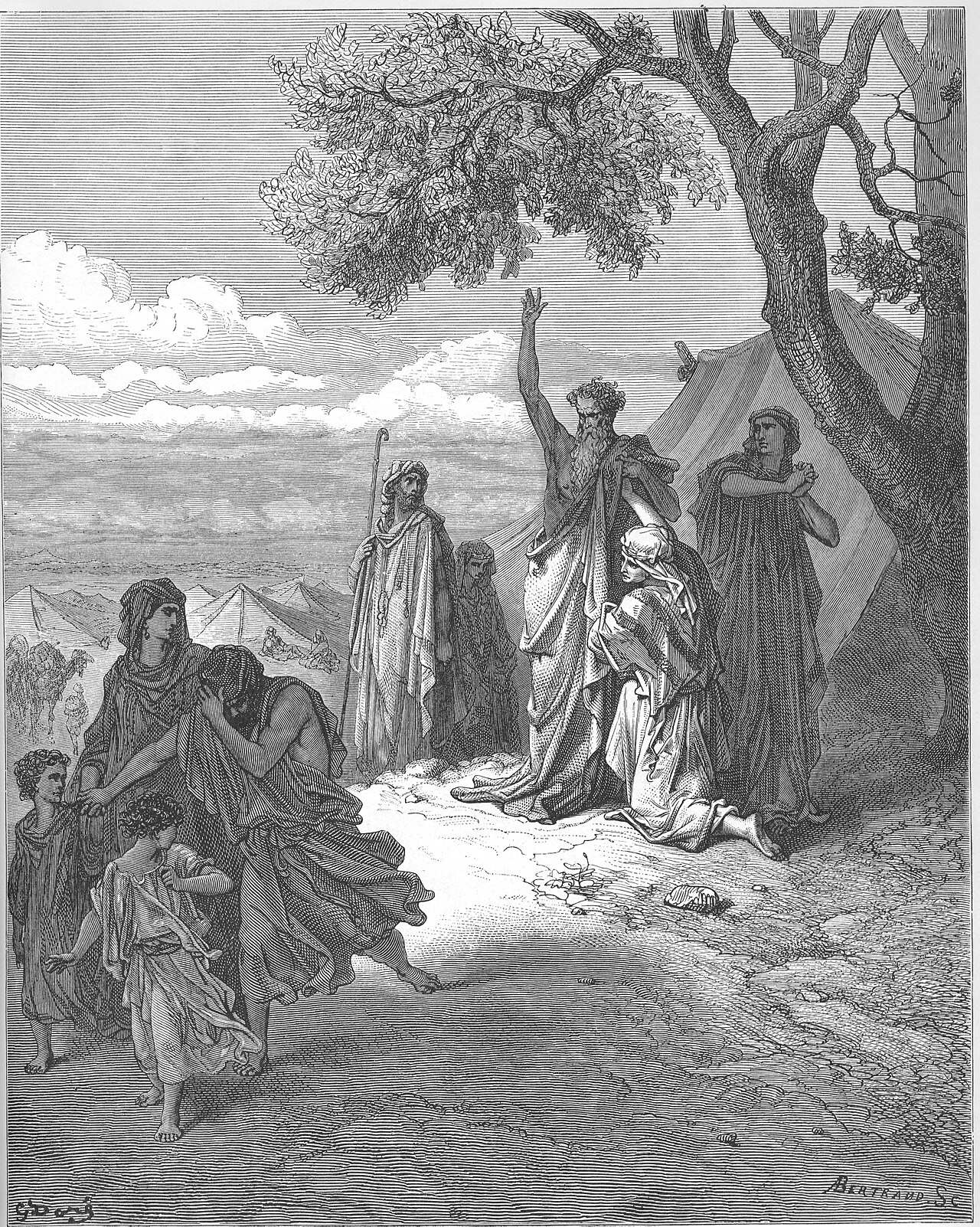
in Genesis 9he said, “Cursed be Canaan! A servant of servants shall he be to his brothers.”
BSB
The same verse in ASV and KJV ▾
ASV
And he said, Cursed be Canaan; A servant of servants shall he be unto his brethren.
KJV
And he said, Cursed be Canaan; a servant of servants shall he be unto his brethren.
⋯
This verse in Genesis 9
Commentary
14 notes on this verseFor another mystery was accomplished and predicted in the days of Noah, of which you are not aware. It is this: in the blessings wherewith Noah blessed his two sons, and in the curse pronounced on his son's son. For the Spirit of prophecy would not curse the son that had been by God blessed along with [his brothers]. But since the punishment of the sin would cleave to the whole descent of the son that mocked at his father's nakedness, he made the curse originate with his son.
This site's exposition
When Noah awoke from his drunkenness
on Genesis 9:24-25
Noah speaks this curse, and it falls on Canaan. Justin Martyr read the shift as deliberate: the word could not land on a son God had blessed by name in verse 1, so it settled on his line. John Gill takes Noah to be prophesying on learning what his youngest son had done. The curse names the Canaanite nations, and Genesis 15:16 grounds their judgment on their own iniquity.
This site's exposition
A servant of servants
A servant of servants means the lowest of servants. Canaan is named servant again in verses 26 and 27, under Shem and under Japheth. Matthew Henry notes that the Canaanites long prospered while cursed, until their iniquity was full.
The record, by era
The Church Fathers5 voices
Noah cursed Canaan, saying, "Cursed be Canaan. A slave of slaves shall he be to his brothers." But what sin could Canaan have committed even if he had been right behind his father when Ham observed the nakedness of Noah?
To be sure, some will say, this shows that the reason he did not curse Ham was that he had enjoyed blessing from God. Nevertheless, why is it that though Ham was the sinner, Canaan had to pay the penalty? This does not happen idly either. Ham did not endure less punishment than his son. He too felt its effects. You know well, of course, how in many cases fathers have begged to endure punishment in place of their children. Seeing their children bearing punishment proves a more grievous form of chastisement for the fathers than being subject to it themselves. Accordingly, this incident occurred so that Ham should endure greater anguish on account of his natural affection, so that God's blessing should continue without impairment and so that his son in being the object of the curse should atone for his own sins. You see, even if in the present instance he bears the curse on account of his father's sin, nevertheless it was likely that he was atoning for his own failings. In other words, it was not only for his father's sin that he bore the curse but perhaps also for the purpose of his suffering a heavier penalty on his own account. After all, for proof that parents are not punished for their children, nor children for their parents, each being liable for the sins he has committed, you can find frequent statements among the inspired authors—as, for instance, when they say, "The teeth of the one eating sour grapes shall be set on edge," "The soul that shall die is the soul that sins," and again, "Parents shall not die for their children, nor children for their parents."
This is prescribed by the order of nature: it is thus that God has created man. For "let them," He says, "have dominion over the fish of the sea, and over the fowl of the air, and over every creeping thing which creepeth on the earth." He did not intend that His rational creature, who was made in His image, should have dominion over anything but the irrational creation,-not man over man, but man over the beasts. And hence the righteous men in primitive times were made shepherds of cattle rather than kings of men, God intending thus to teach us what the relative position of the creatures is, and what the desert of sin; for it is with justice, we believe, that the condition of slavery is the result of sin. And this is why we do not find the word "slave" in any part of Scripture until righteous Noah branded the sin of his son with this name. It is a name, therefore, introduced by sin and not by nature. The origin of the Latin word for slave is supposed to be found in the circumstance that those who by the law of war were liable to be killed were sometimes preserved by their victors, and were hence called servants. And these circumstances could never have arisen save through sin. For even when we wage a just war, our adversaries must be sinning; and every victory, even though gained by wicked men, is a result of the first judgment of God, who humbles the vanquished either for the sake of removing or of punishing their sins. Witness that man of God, Daniel, who, when he was in captivity, confessed to God his own sins and the sins of his people, and declares with pious grief that these were the cause of the captivity. The prime cause, then, of slavery is sin, which brings man under the dominion of his fellow,-that which does not happen save by the judgment of God, with whom is no unrighteousness, and who knows how to award fit punishments to every variety of offence.
A commentator
IrenaeusThe Demonstration of the Apostolic Preaching, Sections 19-21 · Written before 202.
proposed
Now the three sons of Noah were Shem, Ham and Japheth, from whom again the race was multiplied: for these were the beginning of mankind after the flood. Now of these one fell under a curse, and the two (others) inherited a blessing by reason of their works.
First of all, let us show great reverence to our parents, as we read in Genesis 9:25-27, that whoever was blessed by their father, was blessed, and whoever was cursed by their father, was cursed! Therefore, God has granted this grace to parents, so that the piety of their children may be provoked. Therefore, it is the duty of children to obey their parents. Honor your father, so that he may bless you.
6 more voices on this verse
The Church Fathers1 voice
Why did Ham sin and yet vengeance was declared against his son Canaan? Why was the son of Solomon punished by the breaking up of the kingdom? Why was the sin of Ahab, king of Israel, visited upon his posterity? How do we read in the sacred books, "Returning the iniquity of the fathers into the bosom of their children after them" and "Visiting the iniquity of the fathers upon the children unto the third and fourth generation?" The number here can be taken for all the descendants. Are these statements false? Who would say this but the most open enemy of the divine words? Then carnal generation even of the people of God of the Old Testament binds children for the sins of their parents.
The Medieval Church1 voice
But Noah, awakening from his wine, when he had learned what his younger son had done to him, said: Cursed be Canaan, a servant of servants shall he be to his brothers.
The Puritans and the Awakening3 voices
And he said,.... Not in a drunken fit, as some profane persons would suggest, for he was awaked from his wine; nor in the heat of passion, but by inspiration, under a spirit of prophecy: cursed be Canaan; or, "O cursed Canaan", or rather, "Canaan is", or "shall be cursed" (q); for the words are either a declaration of what was his case, or a prediction of what it should be.
The Canaanites were under a curse of slavery, and yet, for a great while, had the dominion; for a family, a people, a person, may lie under the curse of God, and yet may long prosper in the world, till the measure of their iniquity, like that of the Canaanites, be full. Many are marked for ruin that are not yet ripe for ruin. Therefore, Let not thy heart envy sinners.
The Canaanites were under a curse of slavery, and yet, for a great while, had the dominion; for a family, a people, a person, may lie under the curse of God, and yet may long prosper in the world, till the measure of their iniquity, like that of the Canaanites, be full. Many are marked for ruin that are not yet ripe for ruin. Therefore, Let not thy heart envy sinners.
The Nineteenth Century1 voice
Cursed be Canaan - See on the preceding verses. In the 25th, 26th, and 27th verses, instead of Canaan simply, the Arabic version has Ham the father of Canaan; but this is acknowledged by none of the other versions, and seems to be merely a gloss.
The words behind it
7 Hebrew wordsEvery Hebrew word of this verse in the order it stands, with what it means and the door to its own study. The last column counts the times a word stands in the whole Bible: the rarer the word, the more the places it appears belong together.
| Hebrew | Sound | Meaning | Word study | In the Bible |
|---|---|---|---|---|
| וַיֹּ֖אמֶר | vaiyomer | and he said | H559 → | 5305 times |
| אָר֣וּר | ʾarur | [be] cursed | H779 → | 63 times |
| כְּנָ֑עַן | kenaan | Canaan | H3667 → | 94 times |
| עֶ֥בֶד | ʾeved | a slave of | H5650 → | 799 times |
| עֲבָדִ֖ים | ʾavadim | slaves | H5650 → | 799 times |
| יִֽהְיֶ֥ה | yihyeh | he will be | H1961 → | 3559 times |
| לְאֶחָֽיו׃ | leechav | of brothers his | H251 → | 630 times |
וַיֹּ֖אמֶרand he said
vaiyomerH559 →5305 times
אָר֣וּר[be] cursed
ʾarurH779 →63 times
כְּנָ֑עַןCanaan
kenaanH3667 →94 times
עֶ֥בֶדa slave of
ʾevedH5650 →799 times
עֲבָדִ֖יםslaves
ʾavadimH5650 →799 times
יִֽהְיֶ֥הhe will be
yihyehH1961 →3559 times
לְאֶחָֽיו׃of brothers his
leechavH251 →630 times
A shaded row is a word that stands 400 times or fewer in the Bible.
The walk
8 stopsEach card is a verse this one points to, and under it the verses that one points to in turn. Where several paths arrive at the same place, that place is listed first: the text keeps returning to it.
Through
John 8:34Jesus replied, “Truly, truly, I tell you, everyone who sins is a slave to sin.
it leads to
- Romans 6:16
Do you not know that when you offer yourselves as obedient slaves, you are slaves to the one you obey, whether you are slaves to sin leading to death, or to obedience leading to…
- 2 Peter 2:19
They promise them freedom, while they themselves are slaves to depravity. For a man is a slave to whatever has mastered him.
- Proverbs 5:22
The iniquities of a wicked man entrap him; the cords of his sin entangle him.
- 1 John 3:8–10
The one who practices sin is of the devil, because the devil has been sinning from the very start. This is why the Son of God was revealed, to destroy the works of the…
- Romans 6:12
Therefore do not let sin reign in your mortal body so that you obey its desires.
- Romans 6:16
Through
Deuteronomy 27:16‘Cursed is he who dishonors his father or mother.’ And let all the people say, ‘Amen!’
it leads to
- Leviticus 19:3
Each of you must respect his mother and father, and you must keep My Sabbaths. I am the LORD your God.
- Exodus 21:17
Anyone who curses his father or mother must surely be put to death.
- Leviticus 19:3
Through
Joshua 9:23Now therefore you are under a curse and will perpetually serve as woodcutters and water carriers for the house of my God.”
it leads to
- Joshua 9:21
They continued, “Let them live, but let them be woodcutters and water carriers for the whole congregation.” So the leaders kept their promise.
- Joshua 9:21
Where this verse is studied
About Genesis
Who and where
1 name in this verse with a page on the site.
This page draws on 13 works. Open the list of works
This page draws on Adam Clarke, Commentary on the Bible; Ambrose of Milan, On the Blessings of the Patriarchs, 1.1; Augustine of Hippo, City of God 19.15; Augustine of Hippo, AGAINST JULIAN 6.25.82; Bede, Commentary on Genesis (Hexaemeron); Ephrem the Syrian, COMMENTARY ON GENESIS 7.3.1-2; Irenaeus, The Demonstration of the Apostolic Preaching, Sections 19-21; John Chrysostom, HOMILIES ON GENESIS 29.21; John Gill, Exposition of the Old Testament; John Gill, Exposition of the Old Testament (1748-1763); Justin Martyr, Dialogue with Trypho, Chapter CXXXIX; Justin Martyr, Dialogue with Trypho and Matthew Henry, Commentary on the Whole Bible.