
Acts 2 · 10 · 19 · Featured Study
The Three Pentecosts
Luke tells the story of the Spirit falling three times, and he tells it in nearly the same words each time, which for a careful historian is not repetition but argument. Once on Jews at a feast in Jerusalem. Once on uncircumcised Gentiles in a Roman officer's house. Once on twelve men in Ephesus who had only ever heard of John's baptism. Three audiences, three walls, one outpouring: wherever the gospel has a border to cross, the Spirit crosses it first.
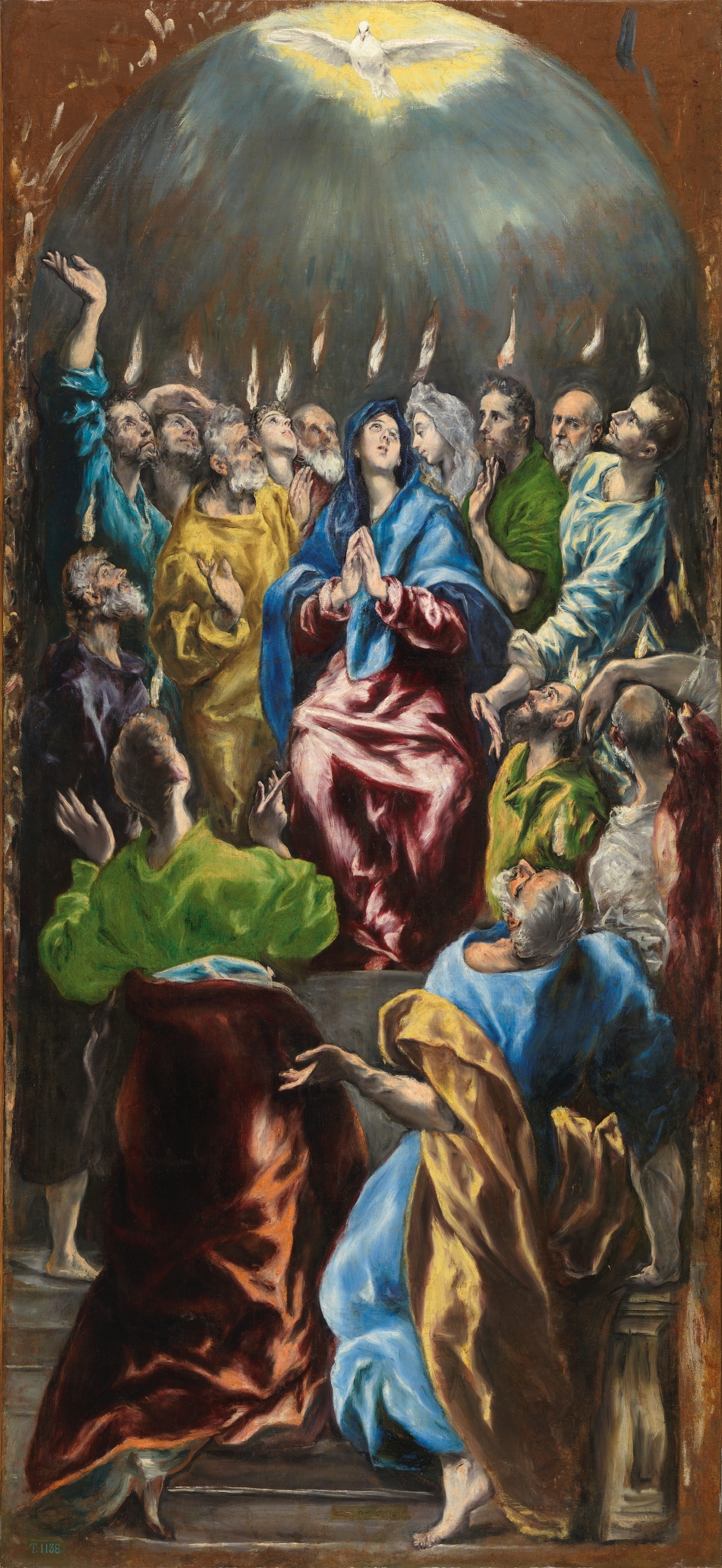
El Greco, Pentecost (c. 1597): public domain.
THE ARTWORKEl Greco paints the first outpouring: the upper room, tongues of fire, the Spirit falling on the gathered disciples. Two more scenes just like it, a Roman house and an Ephesian workshop, follow it below; the painter shows the first wall coming down, the page shows all three.
Summary
This page sets Acts 2, 10, and 19 side by side as three outpourings crossing three different walls, and tracks what the pattern settles versus what is still argued.
- A shared rail of questions runs across all three panels: where, who, who preached, what was seen, and what it proves
- Each outpouring reaches a wider circle than the last, from Jews at the feast to Gentiles to disciples of John
- Peter's Joel quotation at Acts 2:17-39 is traced clause by clause
- What the three settle and what remains argued, including tongues as evidence and the status of the Ephesian twelve, are listed separately
- Missler, Prince, Chrysostom, and Wesley's readings close the page
The Widening
each outpouring reaches further out than the last
The three scenes are not three versions of one story. They are three positions on the map of Acts 1:8: Jerusalem, then the Gentile door, then the Aegean world, and in each of them the Spirit arrives ahead of the church's willingness to be there. Peter had to be shown a sheet three times before he would enter Cornelius's house. He was still talking when the Spirit interrupted him.
Three Panels
read down a column for one event; read across a row for the pattern
The upper room, then the Temple courts
The house of Cornelius, a Roman centurion
Ephesus, on Paul's third journey
The Feast of Weeks: the fiftieth day after the Passover of the crucifixion
Some years on, after a rooftop vision Peter needed three times before he would go
Roughly twenty years after the first Pentecost, and a thousand miles from it
About a hundred and twenty already-believing disciples, praying with one accord, and then three thousand hearers before the day was out
Cornelius, his kinsmen and his near friends: uncircumcised Gentiles who feared God but had never joined Israel
About twelve men, disciples of John's baptism, who had not so much as heard whether the Holy Spirit was given
A sound as of a rushing mighty wind filling the house; tongues parting asunder, like as of fire, sitting upon each of them; and all of them filled and speaking with other tongues, heard as their own native language by pilgrims from fifteen named nations.
Acts 2:4 →The Holy Spirit fell on all them that heard the word, while Peter was still speaking, before he could finish, before anyone could be baptized. The Jewish believers who had come with him were astonished, and the reason Luke gives is exact: they heard them speak with tongues and magnify God.
Acts 10:46 →Paul's first question is diagnostic, did ye receive the Holy Spirit when ye believed? They are baptized into the name of the Lord Jesus, Paul lays hands on them, the Holy Spirit comes on them, and they speak with tongues and prophesy.
Acts 19:6 →Language itself. The crowd is Jewish, but it is the whole Diaspora. Parthians, Medes, Elamites, Cretans, Arabians: and the curse of Babel is running backwards.
Circumcision: the oldest wall in the book. Peter had to be argued into the house; God does not wait for the argument to finish.
The old covenant's last frontier: a real, God-given, preparatory faith that had simply not caught up. Not paganism; incompleteness.
The promise of the Father has been given. Joel's last days have begun, the Spirit is poured out on all flesh rather than on a prophetic elite, and the gift is offered on the spot to everyone who repents and is baptized.
God gave them the like gift. Water baptism cannot be refused where the Spirit has already come, and Peter has an answer for Jerusalem that no one can rebut: this is the same thing that happened to us at the beginning.
The pattern is not sealed in Jerusalem, is not confined to the first generation, and does not run only through Peter. Two decades and one apostle later, the same Spirit does the same thing.
Read the bottom row across and the case makes itself. A repeated event with a repeated sign, given to three groups who had nothing in common except that each of them was on the far side of a line the church had not yet crossed. Luke is not closing an era in these chapters. He is widening a circle, and he stops describing the widening only because he runs out of book.
Joel at Pentecost
Peter's text, and the word the rest of the New Testament builds on
“In the last days, God says, I will pour out My Spirit on all people.”
Not on a prophet, a priest or a king. On all people, all flesh in the Greek: the category that had never been used for this before.
“Your sons and daughters will prophesy… Even on My menservants and maidservants I will pour out My Spirit in those days.”
Peter reads out the categories that had been shut out of the prophetic office: the young, the female, the enslaved. All three are named.
“And everyone who calls on the name of the Lord will be saved.’”
The hinge word. Joel's whosoever is quoted at the birth of the church, and Paul will build the Gentile mission on it (Rom 10:13).
“This promise belongs to you and your children and to all who are far off, to all whom the Lord our God will call to Himself.””
Three concentric circles in one sentence: you, your children, the far-off, and a limit that is not a date but a calling. The promise runs exactly as far as the call does.
Peter preaches this on the first morning, before Cornelius, before the Council, before anyone has worked out what it will cost. Everything Acts 10 and Acts 19 later prove was already promised in the sermon that started it, which is why the second and third Pentecosts read less like surprises and more like receipts.
The Feast Underneath
Shavuot: why this day and no other
The count
Shavuot, the Feast of Weeks, is fixed by counting fifty days from the wave-sheaf of firstfruits (Lev 23:15–16). The church is not born on a random morning; it is born on a date God put in the calendar.
The harvest
It is the grain-harvest feast, two loaves baked with leaven and waved before the LORD. The first ingathering of the church happens on the day Israel brought in its first ingathering.
The mountain
Jewish tradition ties Shavuot to the giving of the Law at Sinai, fire, a voice heard by a whole nation, and a covenant made. At Sinai three thousand fell; at Pentecost three thousand were added.
The writing
The prophets had promised a covenant written not on stone but inside people (Jer 31:33; Ezek 36:27). Acts 2 is what that looks like when it happens.
A note on the Sinai link: the association of Shavuot with the giving of the Law is a Jewish tradition whose earliest datable witnesses are debated, and the New Testament never states it. The feast page handles the evidence; the parallels are offered here as resonance, not as proof.
What the Three Settle
and what they do not
Settled
- The gift of the Spirit is not a Jerusalem phenomenon, a first-generation phenomenon, or a Petrine phenomenon. It happens at three places, in three decades, through two apostles.
- It is not earned by ethnicity, by circumcision, or by the completeness of a person's prior instruction. Cornelius had none of the covenant signs; the Ephesians had none of the news.
- Tongues accompany the outpouring in all three narratives, and Luke names them as the thing that convinced the sceptical observers at Caesarea.
- The promise is explicitly open-ended: to you, to your children, and to all that are afar off (2:39).
Still argued
- Whether these are three normative instances of a repeatable experience, or three transitional seams certifying a unique era, the reading that treats Samaria, Caesarea and Ephesus as one-off certifications is a serious one and gets its full hearing on the doctrine page.
- Whether tongues are the initial evidence of Spirit-baptism, a common accompaniment, or one gift among many that God distributes as He wills.
- Whether the Ephesian twelve were Christians who lacked the Spirit or pre-Christians who lacked the gospel, the answer changes what Acts 19 is evidence for.
The Keynote Words
the Greek under the three scenes
The Voices
the roster on the three outpourings
Learn the Bible in 24 Hours
Missler reads Pentecost as the fourth spring feast fulfilled to the day, exactly as Passover and Firstfruits had been, evidence that the calendar itself is prophecy, and that the church age begins on schedule rather than by accident.
From Jordan to Pentecost
Prince argues from the repetition rather than from a single verse: three separate outpourings, three different audiences, one recognisable pattern, which is precisely how a narrative teaches a norm rather than reporting an anomaly.
Homilies on the Acts of the Apostles (public domain)
Chrysostom presses the wording of 2:3: tongues AS OF fire, not fire itself, because the Spirit works by likeness and not by substance, and dwells on the scandal that unlearned Galileans were the ones made wise.
Explanatory Notes upon the New Testament, on Acts 10:34–35 (public domain)
Wesley takes Caesarea as a statement about God's character before it is a statement about church policy: He is no respecter of persons, and the household that receives the Spirit uninvited settles the matter for everyone still arguing about it.
Notable art
— click a piece to enlargeKeep studying
On this page
Places1
Symbols1
Go further1