
Rome, AD 312, to Nicomedia, AD 313 · Story · Featured Study
Constantine and the Edict of Milan
The emperor who ended the Great Persecution fought under a sign of Christ that his own witnesses told in different ways.
Eusebius writes that he himself saw the standard of gold and precious stones that Constantine had made after his vision.
- Where
- The Milvian Bridge, Rome, Milan, Nicomedia
- Who
- Constantine, Licinius, Maxentius, Lactantius, Eusebius of Caesarea
- When
- October 312 to June 313
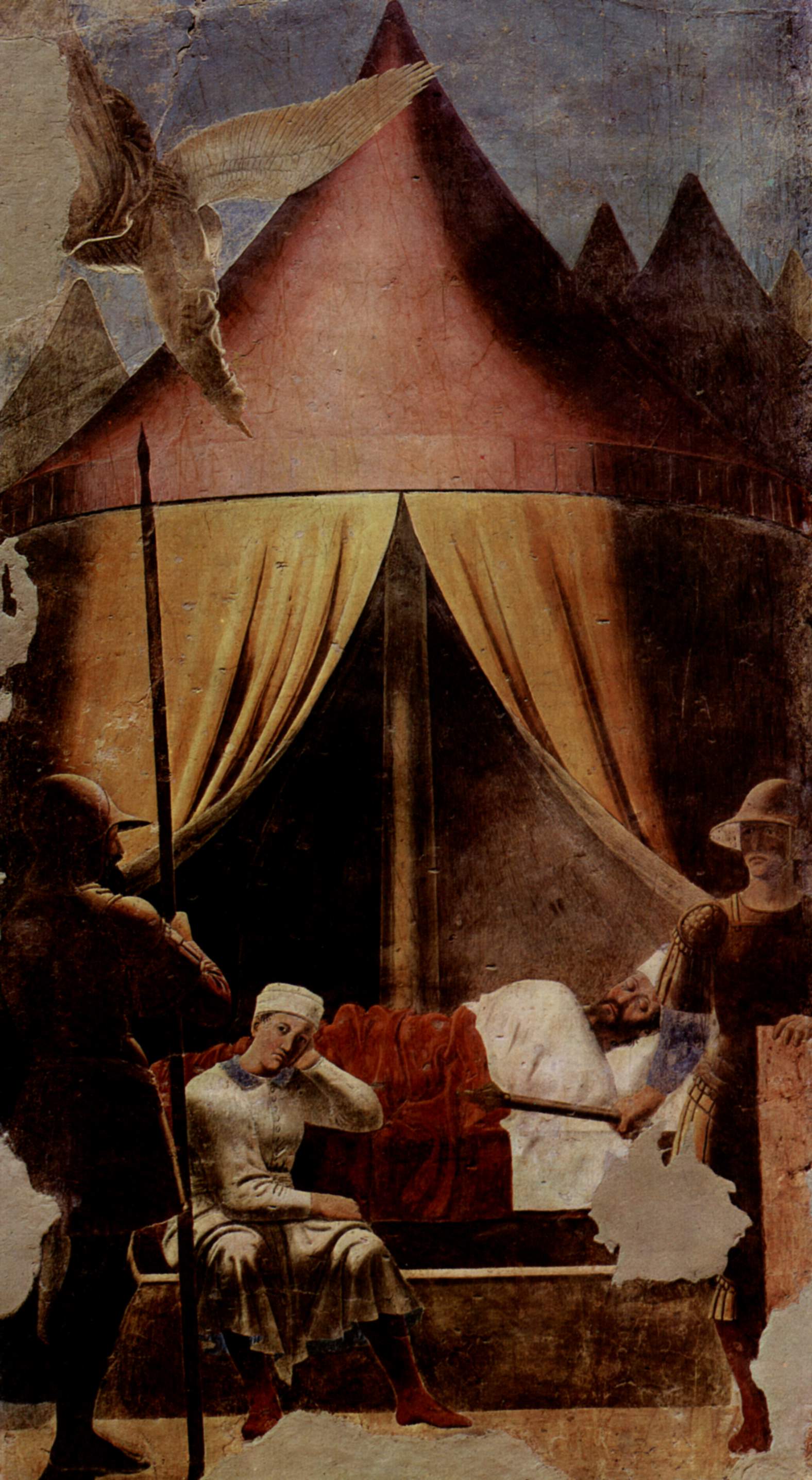
Piero della Francesca, The Dream of Constantine, 1452 to 1466. Public domain.
Jesus answered, “My kingdom is not of this world; if it were, My servants would fight to prevent My arrest by the Jews. But now My kingdom is not of this realm.”
Summary
In October 312 Constantine defeated Maxentius at the Milvian Bridge outside Rome after marking a sign of Christ on his soldiers' shields, as Lactantius tells it. In June 313 he and his colleague Licinius granted freedom of religion to the Christians and to all, and ordered the churches' property returned.
- Lactantius tells of a dream before the battle.
- Eusebius, writing after Constantine died, tells of a cross of light at noon on the emperor's sworn word.
- The letter was posted as an order to a governor, and later writers called it the Edict of Milan.
- Before Miltiades of Rome died in January 314, the emperor had sent him a quarrel among the bishops of Africa to judge.
The Texts of the Two Kingdoms
Eusebius set the victory beside the Exodus, and the church had long read what Jesus and Paul said of rulers.
The song Eusebius set over the battle
Pharaoh’s chariots and army He has cast into the sea; the finest of his officers are drowned in the Red Sea.
Eusebius says Maxentius and his guards went down into the river as Pharaoh's host went down into the sea.
Exodus 15:4BSB
Then Moses and the Israelites sang this song to the LORD: “I will sing to the LORD, for He is highly exalted. The horse and rider He has thrown into the sea.
Eusebius says Constantine's men might fitly sing Moses's song over the fallen tyrant.
Exodus 15:1BSB
But You blew with Your breath, and the sea covered them. They sank like lead in the mighty waters.
Eusebius applies the verse to Maxentius's guards going down in the Tiber.
Exodus 15:10BSB
Paul writes of the rulers
Everyone must submit himself to the governing authorities, for there is no authority except that which is from God. The authorities that exist have been appointed by God.
Paul wrote this to Christians at Rome under pagan emperors, and the same church now had an emperor who favoured it.
Romans 13:1BSB
Romans 13:1
Three Accounts of the Sign
Lactantius gives a dream, and Eusebius gives first a prayer and then a vision.
The accounts grow fuller the further they stand from the battle.
| The account | Written | What Constantine saw |
|---|---|---|
| Lactantius, On the Deaths of the Persecutors 44 | After the persecutors had died | A dream before the battle that told him to mark the heavenly sign on his soldiers' shields |
| Eusebius, Church History 9.9 | Before 314, by McGiffert's dating of books 1 to 9 | No sign, only his prayer to God, His Word and Jesus Christ |
| Eusebius, Life of Constantine 1.28 to 1.31 | Between 337 and 340, after Constantine's death | A cross of light above the sun at noon, with the words Conquer by this, and Christ in a dream that night |
To the Milvian Bridge and Into Rome
Lactantius tells the campaign from the camp to the river, and Eusebius tells the entry into Rome.
Maxentius held Rome, Lactantius writes, because the soothsayers had told him he would die if he left it, and his army was larger. Constantine led his whole force to the city and camped opposite the Milvian Bridge on the Tiber.
Lactantius ties the day to the anniversary of Maxentius's reign, the sixth day before the Kalends of November, which Fletcher's note of 1886 reads as 27 October.
In Rome the crowd at the games cried that Constantine could not be overcome, and the Sibylline books were searched. They answered that the enemy of the Romans would perish that day, and Maxentius went out to the field.
The bridge behind his army was broken down. His troops were routed, and Maxentius, pressed by his own fleeing men, was driven into the Tiber.
The senate gave Constantine the title Maximus, the Greatest. Eusebius writes that he set a cross in the hand of his own statue in the most public place in Rome.
The Letter of Milan
Constantine and Licinius agreed at Milan, and the order went out over both their names.
After his own victory in the East, Licinius entered Nicomedia, gave thanks to God and on 13 June 313 had the order posted, addressed to the president of the province. It opens, in Fletcher's English, "When we, Constantine and Licinius, emperors, had an interview at Milan".
It ordered that every place the Christians had met in be given back to them, and every place their churches had held in common, "without money demanded or price claimed". Those who had bought the places could apply to the judge of their district for amends from the emperors.
Eusebius gives a Greek version of the same order in his Church History, book 10, and its heading calls it imperial decrees. McGiffert, in 1890, named it "the famous Edict of Milan" and dated it late in 312.
Lactantius counted ten years and about four months from the overthrow of the church at Nicomedia in 303 to this restoring.
The Emperor Judged the Church's Quarrel
The church that had been persecuted now had a ruler who favoured it.
The charges that bishops of Africa brought against Caecilian of Carthage reached the emperor through Anulinus, the proconsul of Africa. Constantine wrote to Miltiades, bishop of Rome, that Caecilian should sail to Rome with ten of his accusers and ten of his defenders to be heard.
He wrote to Anulinus that the clergy of the church over which Caecilian presided should be freed from every public duty, so that they could serve God without hindrance.
The church that had been stripped of its buildings in 303 now had its clergy exempted by the same empire.
How the Key Verse Was Taught
Three writers of three centuries on the kingdom that is not of this world.
Tertullian (died 220)
On Idolatry
Tertullian read Christ's refusal of a crown as an example for His people to turn from the pride of power.
“If, also, He exercised no right of power even over His own followers, to whom He discharged menial ministry; if, in short, though conscious of His own kingdom, He shrank back from being made a king, He in the fullest manner gave His own an example for turning coldly from all the pride and garb, as well of dignity as of power.”
on John 18:36Patristic
Cyril of Alexandria (died 444)
Commentary on the Gospel of John, Book 12
Cyril of Alexandria read the answer as Christ setting Pilate's fear of a rising to rest.
“He dispelled the fear Pilate felt as the appointed guardian of Caesar's kingdom, for he supposed that Christ was meditating insurrection against temporal rule, as the Jews had vainly talked. For they hinted at this when they said: If this Man were not an evildoer, we should not have delivered Him up unto thee; meaning insurrection by the evil they said He was doing. For they affected to be so well-disposed to the Romans, as not even to be able to utter the word revolt. For this cause, then, they said they had brought Him to Pilate, to suffer judgment.”
on John 18:36Patristic
Theophylact of Ohrid (died 1107)
Catena Aurea by Aquinas
Theophylact read the answer as Christ reigning over the world while His kingdom comes from above.
“Or He says, from hence, not, here; because He reigns in the world, and carries on the government of it, and disposes all things according to His will; but His kingdom is not from below, but from above, and before all ages.”
on John 18:36Patristic
In Their Own Words
Constantine's own orders and letters, in the English of Fletcher and McGiffert.
Constantine (died 337)
The letter of Constantine and Licinius, in Lactantius, Of the Manner in Which the Persecutors Died, 48
Liberty to follow
“it seemed to us that, amongst those things that are profitable to mankind in general, the reverence paid to the Divinity merited our first and chief attention, and that it was proper that the Christians and all others should have liberty to follow that mode of religion which to each of them appeared best”
Emperor
About this saying1 paragraph
Constantine and Licinius wrote this in 313 to the governors of the provinces.
Constantine
The inscription of his statue at Rome, in Eusebius, Church History, 9.9.11
The statue in Rome
“By this salutary sign, the true proof of bravery, I have saved and freed your city from the yoke of the tyrant and moreover, having set at liberty both the senate and the people of Rome, I have restored them to their ancient distinction and splendor.”
Emperor
About this saying1 paragraph
Constantine had this carved under his statue in Rome after the victory of 312, as Eusebius gives the inscription.
Constantine
Letter to Miltiades, bishop of Rome, in Eusebius, Church History, 10.5.20
The first appeal to Rome
“I have such reverence for the legitimate Catholic Church that I do not wish you to leave schism or division in any place.”
Emperor
About this saying1 paragraph
Constantine wrote this to Miltiades of Rome, bishop from 310 to 314 by McGiffert's note, when the African bishops' charges against Caecilian reached him.
Constantine
Letter to Anulinus, in Eusebius, Church History, 10.7.2
Constantine frees the clergy
“For it seems that when they show greatest reverence to the Deity, the greatest benefits accrue to the state.”
Emperor
About this saying1 paragraph
Constantine gave this reason in a letter of the fourth century, as Eusebius keeps it.
Constantine, Constantine
What Constantine Saw
Three readings of the sign stand with their holders.
Eusebius says Constantine told him of the vision long afterwards and confirmed it by an oath, and asks who could doubt it. Richardson, his translator of 1890, names Newman's Miracles of 1875 as its clearest defender.
Richardson's note lists the other witnesses to some sign from God at this time. They are a speech of 313, the triumphal arch at Rome, Lactantius, a speech of Nazarius in 321 and the standard of the cross that was made.
Richardson judged that the lack of detail in the early witnesses and Lactantius's dream are "fatal to any idea of a miraculous image with inscriptions clearly seen by all". He thought some sign in the clouds or the sun may have been seen and later grew in the emperor's telling, and he still called the sign providential.
A second question asks whether Constantine's faith was sincere. The Fathers and the Creeds sets it out with its holders, Jacob Burckhardt in Die Zeit Constantins des Grossen against and T. D. Barnes in Constantine and Eusebius for.
The page on the era holds the rest of the reign, from Nicaea to the emperor's baptism.
Books to Read Next
The Life of Constantine
Eusebius of Caesarea, translated by Ernest Cushing Richardson · 1890
Book 1 gives the vision on the emperor's own word, with Richardson's notes on its credit.
Read Eusebius free at CCELOf the Manner in Which the Persecutors Died
Lactantius, translated by William Fletcher · 1886
Lactantius gives the dream, the battle and the letter in chapters 44 and 48.
Read Lactantius free at CCELWhat the Peace Brought
Christ told Pilate that His servants do not fight for His kingdom. Before two years had passed since the battle at the bridge, the church had an emperor who fought under the sign of Christ and judged its bishops.
Sources
Scripture is the Berean Standard Bible.
- The Holy Bible, Berean Standard Bible (read 2026)
- Lactantius, Of the Manner in Which the Persecutors Died 44 and 48, translated by William Fletcher, Ante-Nicene Fathers, volume 7 (1886)
- Eusebius, Church History 9.9, 10.5 and 10.7, translated by Arthur Cushman McGiffert, Nicene and Post-Nicene Fathers, second series, volume 1 (1890)
- Eusebius, Life of Constantine 1.27 to 1.31, translated by Ernest Cushing Richardson, with his prolegomena and note 3109, Nicene and Post-Nicene Fathers, second series, volume 1 (1890)
- Jacob Burckhardt, Die Zeit Constantins des Grossen, the reprint of the second edition (Leipzig: Seemann, 1898)
- T. D. Barnes, Constantine and Eusebius (Harvard University Press; the paperback of 1984), the publisher's description.
Keep Studying
People and groups5