
The Diet of Worms and the Wartburg · Story · Featured Study
Worms, 1521
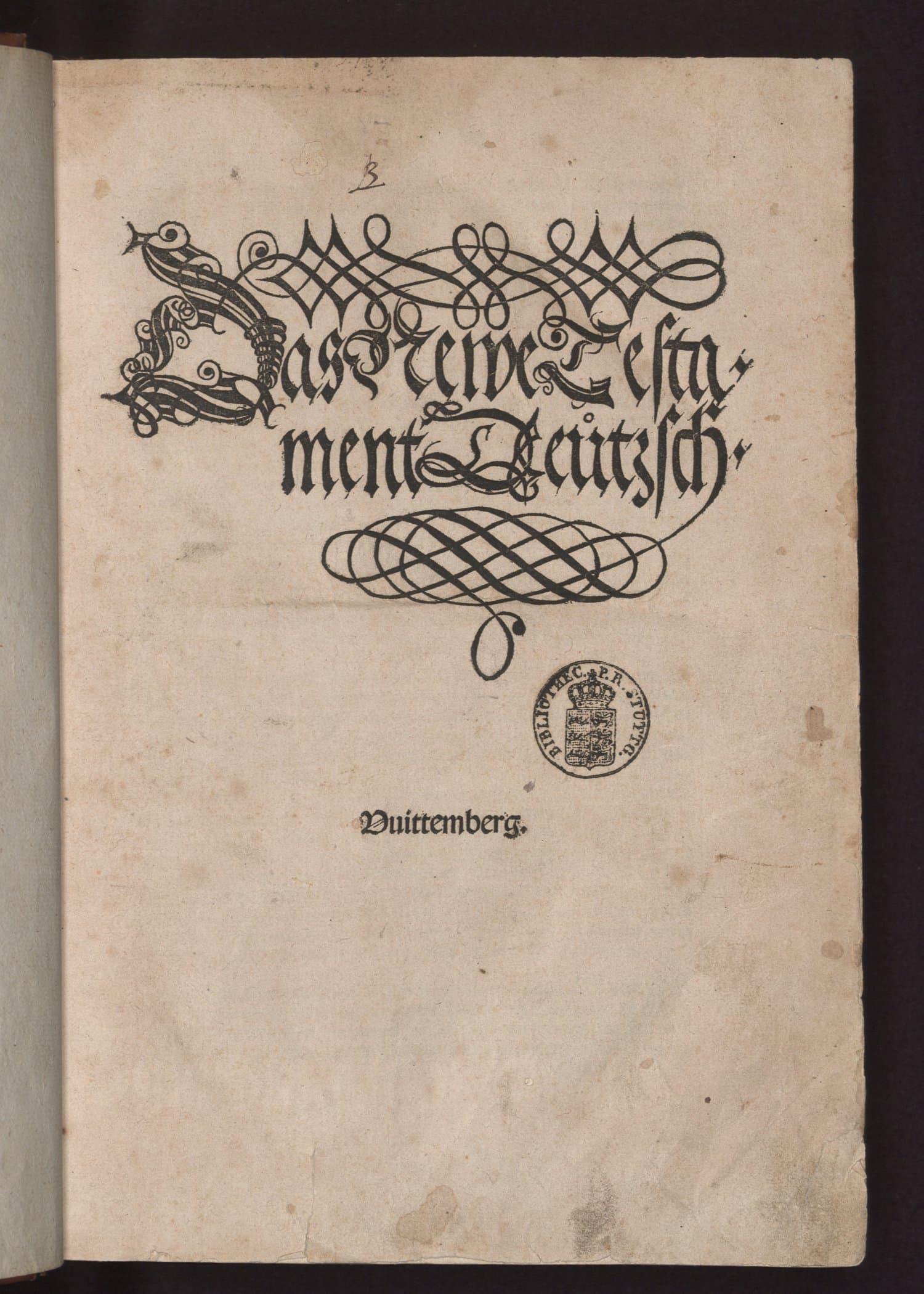
Within a month of his hearing Luther was in hiding, and within a year he had translated the New Testament.
The Emperor's summons to Worms addressed the excommunicated man as “honorable, dear, and pious.”
- When
- 6 March 1521 to 21 September 1522
Martin Luther, translator, 1522. Public domain.
But Peter and the other apostles replied, “We must obey God rather than men.
Summary
Luther stood before the Diet of Worms in April and would not recant his books. The Edict of Worms made him an outlaw, and at the Wartburg he put the New Testament into German.
- The Emperor's citation of 6 March gave him twenty-one days to reach Worms.
- Aleander wrote in February that nine tenths of the Germans shouted for Luther.
- The Edict gave Luther twenty days, ending on 14 May, before its ban took hold.
- The New Testament he made at the Wartburg came out without his name.
The Verses Named at Worms
Luther named texts from Matthew, John and Acts at the hearings and in the talks after them.
Luther answered the Diet from Scripture, and the record keeps the verses he named.
Therefore everyone who confesses Me before men, I will also confess him before My Father in heaven. But whoever denies Me before men, I will also deny him before My Father in heaven.At the first hearing he gave these words of Jesus as his reason for asking a day to answer.
Jesus replied, “If I said something wrong, testify as to what was wrong. But if I spoke correctly, why did you strike Me?”In his answer he took up Jesus' words to the officer who struck Him.
So in the present case I advise you: Leave these men alone. Let them go! For if their purpose or endeavor is of human origin, it will fail. But if it is from God, you will not be able to stop them. You may even find yourselves fighting against God.”Schaff says Luther offered to abide by Gamaliel's test in the talks after the hearings.
Who Recorded Worms
The table sets six records of the Diet beside their dates.
Every witness to Worms wrote from one side of the quarrel.
| Witness | Written | Its side |
|---|---|---|
| The acts of the Diet, edited by Adolf Wrede in the Reichstagsakten of 1896 | January to May | The Empire's own record |
| Aleander's dispatches to Rome, in Paul Kalkoff's German of 1897 | February to May | The pope's envoy, who held Luther already condemned |
| The Emperor's declaration, in Wrede's French and the English Kidd prints from Armstrong | 19 April | Charles V, who judged the case |
| Luther's letters to Spalatin, Cranach and Lang, in Smith's English of 1911 and Currie's of 1908 | April to December | Luther himself |
| The first printed copies of his answer | The same year | Printers in Luther's own town |
| Cochlaeus on the German New Testament, as Köstlin quotes him in 1883 | After the New Testament came out | A theologian who opposed Luther |
From the Summons to the Wartburg
Two months ran from the Emperor's citation to the horsemen in the forest.
The Emperor's citation was dated at Worms on 6 March.
Its purpose, in Smith's English, was “to obtain information about certain doctrines originating with you and certain books written by you.”
A safe conduct of the same date went with it. The herald Kaspar Sturm brought both to Wittenberg on 26 March.
Luther set out on 2 April, the Tuesday after Easter, with Amsdorf, Peter Swaven and Brother Pezensteiner, in a carriage the town provided.
Erfurt received him on 6 April. Next day he preached at the Augustinian church on peace through Christ, “without any works or merit of our own,” Köstlin writes.
He entered Worms on 16 April at ten in the morning, Köstlin writes, and “Thousands streamed hither to see Luther.”
Aleander, the pope's nuncio, wrote to Rome the same day that after the meal everyone ran to see him.
He stood before the Emperor and the Diet on 17 and 18 April, and on the second day he refused to recant.
The Archbishop of Trier then led two days of talks with him. On 25 April, by Spalatin's report, Luther said, “Most gracious Lord, I cannot yield.”
Three hours later the Emperor sent him home with a safe conduct and an order not to preach on the way. Köstlin gives the conduct twenty-one days, and the account Michelet follows gives twenty.
He left on Friday 26 April. From Frankfurt on 28 April he wrote that all the Diet had asked was whether the books were his and whether he would recant.
He preached at Hersfeld and at Eisenach on the way, though the Emperor had forbidden it. On 4 May, near Altenstein, armed horsemen stopped his carriage and carried him off, and Amsdorf, who rode with him, “was in the secret.”
They reached the Wartburg that night, about eleven by Köstlin's account and about midnight by Schaff's. On 14 May Luther wrote to Spalatin that the most popular opinion held he “was captured by friends from Franconia.”
The Emperor's Answer and the Edict
The Emperor answered Luther in his own words, and the Edict followed in May.
Charles V wrote his declaration of 19 April in French, in his own hand, and had it read to the princes. Wrede prints it from the one known copy in French, and Kidd prints it in English from Armstrong's Charles V.
Kidd's English reads, “A single monk, led astray by private judgement, has set himself against the faith held by all Christians.”
The Emperor went on, “I now repent that I have so long delayed proceedings against him.” Aleander and Caracciolo, the pope's envoys, reported that many who heard it turned pale as death.
The Edict of Worms bears the date of 8 May. Smith dates the signing to 26 May, and Buchheim says it went out on 25 May, dated back to a fuller Diet.
It named Luther “manifestum pertinacemque haereticum,” a manifest and stubborn heretic, and forbade anyone to shelter or feed him.
What the Record Leaves Unsaid
The printer of the German New Testament goes unnamed.
Schaff, Smith and Köstlin give the September Testament's day, price and woodcuts, and none of them names its printer or the number of copies printed.
The Wartburg and the German New Testament
The hidden months ended with the New Testament in German.
At the Wartburg Luther wore a knight's dress under the name Junker Georg. On 18 December he wrote to John Lang that he would “translate the New Testament into German, a thing which my friends demand.”
Schaff says he began in November or December and finished the next March, before he left the castle. On 30 March he wrote that he had translated “the whole New Testament while I was at my Patmos.”
It came out on 21 September, Schaff writes, and Smith calls it “a handsome quarto with woodcuts from Cranach's workshop.”
Köstlin gives its price as a florin and a half, a high one for the time, and says a second edition was wanted by December.
Cochlaeus, one of Luther's fiercest opponents, complained that “even shoemakers and women” read it “greedily as the fountain of all truth.”
How the Key Verse Was Taught
A martyr, a preacher and a commentator each took up Acts 5:29.
John Chrysostom (died 407)
Homilies on the Acts of the Apostles, Homily 13, on Acts 5:29
From the early church, a homily on the manner of the apostles' answer.
“Again in the way of exhortation and advice, and with much mildness, they make answer.”
Patristic
Adam Clarke (1762 to 1832)
Commentary on the Bible, on Acts 5:29
From a Methodist commentary on the whole Bible, three centuries after Worms.
“We have received our commission from God; we dare not lay it down at the desire or command of men.”
Methodist
Felix of Thibiuca
The Acts of Felix, in Arthur James Mason, The Persecution of Diocletian, page 173
A martyr of the persecution under Diocletian answered his judges with the apostles' words.
“It is better ... for me to be burned myself than for the Divine Scriptures, for it is better to obey God than men.”
Martyr
In Their Own Words
Luther wrote these letters on the road to Worms, on the road home and at the Wartburg.
Martin Luther (1483 to 1546)
Letter to George Spalatin, Frankfort on the Main, (April 14), 1521, in Preserved Smith, The Life and Letters of Martin Luther, page 111
On the road to Worms
“Truly Christ lives and I shall enter Worms in the face of the gates of hell and the princes of the air.”
Other
About this saying1 paragraph
In April 1521, two days before he reached Worms, with the mandate against his books already published.
Martin Luther
Letter to Lucas Cranach, Frankfort, 28 April 1521, in The Letters of Martin Luther, the letter to Cranach
A little while
“But we must first suffer a little. ‘A little while and ye shall not see me,’ says Christ, ‘and again a little while and ye shall see me.’”
Other
About this saying1 paragraph
In April 1521, two days after he left Worms, on his way into hiding.
Martin Luther
Letter to John Lang at Erfurt, The Wilderness, December 18, 1521, in Preserved Smith, The Life and Letters of Martin Luther, the letter to Lang
Every town its interpreter
“Would that every town had its interpreter, and that this book alone might be on the tongues and in the hands, the eyes, the ears, and the hearts of all men.”
Other
About this saying1 paragraph
From the Wartburg in December 1521, as he planned his German New Testament.
Where Historians Disagree
Historians differ on two questions of the Diet.
What were Luther's last words to the Diet?2 paragraphs
Wrede found in 1896 that the Diet's record ends Luther's answer with the words “Gott helf mir” and “Amen,” God help me, Amen. He found the longer words “Here I stand” only in two prints of 1521 from Grünenberg's press at Wittenberg, one source and not two.
Kalkoff in 1897 says the Wittenberg prints' longer words have no claim to belief. Köstlin and Knaake held the longer form, as Wrede reports them.
Was the Emperor bound to hear him?1 paragraph
Kidd says Aleander's instructions were to see that Luther was treated as a heretic already condemned. Kidd cites the Emperor's election promise that no German be judged unheard, and Buchheim says the Diet chose a short questioning over a debate.
Books to Read Next
The Life and Letters of Martin Luther
Preserved Smith · 1911
Smith prints Luther's letters of that year in English beside the story of the Diet.
Free at the Internet ArchiveLife of Luther
Julius Köstlin · 1883
Köstlin gives each day of the road from Wittenberg to the Wartburg.
Free at the Internet ArchiveDocuments Illustrative of the Continental Reformation
B. J. Kidd · 1911
Kidd prints the Emperor's declaration in English and the Edict in Latin.
Free at the Internet ArchiveWhat Worms Left
The Diet meant to end Luther's cause, and the hiding it forced on him gave Germany a New Testament that many thousands read.
Sources
Scripture is the Berean Standard Bible.
- The Holy Bible, Berean Standard Bible (read 2026)
- Adolf Wrede, ed., Deutsche Reichstagsakten unter Kaiser Karl V., Jüngere Reihe, volume 2 (Gotha: Perthes, 1896), numbers 73, 74, 79 and 82.
- Paul Kalkoff, Die Depeschen des Nuntius Aleander vom Wormser Reichstage 1521, second edition (Halle, 1897), the dispatches of 8 February and 16 April and the notes to dispatch 20.
- B. J. Kidd, Documents Illustrative of the Continental Reformation (Oxford: Clarendon Press, 1911), numbers 39, 43 and 45.
- Preserved Smith, The Life and Letters of Martin Luther (Boston and New York: Houghton Mifflin, 1911), the chapter on the Diet of Worms, the letter to John Lang of 18 December 1521 and the account of the New Testament of 1522.
- Preserved Smith and Charles M. Jacobs, eds., Luther's Correspondence and Other Contemporary Letters, volume 2 (Philadelphia: Lutheran Publication Society, 1918), number 483 (14 May 1521) and the letter of 30 March 1522.
- Margaret A. Currie, tr., The Letters of Martin Luther (London: Macmillan, 1908), the letter to Lucas Cranach of 28 April 1521.
- Julius Köstlin, Life of Luther, translated from the German (New York: Scribner, 1883), pages 232 to 250 and 279.
- Philip Schaff, History of the Christian Church, volume VII, Modern Christianity: The German Reformation, sections on Worms and the Wartburg.
- C. A. Buchheim, the historical essay in Henry Wace and C. A. Buchheim, First Principles of the Reformation (London: John Murray, 1883)
- Jules Michelet, The Life of Luther, translated by G. H. Smith (London, 1846, from the French of 1835)
- The Acts of Felix, in Arthur James Mason, The Persecution of Diocletian (Cambridge: Deighton Bell, 1876), page 173.
- John Chrysostom, Homilies on the Acts of the Apostles, Homily 13, in Nicene and Post-Nicene Fathers, first series, volume 11, ed. Philip Schaff (Edinburgh: T. and T. Clark)
- Adam Clarke, Commentary on the Bible (1832), on Acts 5:29.
Keep Studying
Studies5
Church history1