
2 Samuel 12:21
in 2 Samuel 12“What is this you have done?” his servants asked. “While the child was alive, you fasted and wept, but when he died, you got up and ate.”
BSB
The same verse in ASV and KJV ▾
ASV
Then said his servants unto him, What thing is this that thou hast done? thou didst fast and weep for the child, while it was alive; but when the child was dead, thou didst rise and eat bread.
KJV
Then said his servants unto him, What thing is this that thou hast done? thou didst fast and weep for the child, while it was alive; but when the child was dead, thou didst rise and eat bread.
⋯
This verse in 2 Samuel 12
Commentary
6 notes on this verseA commentator
Ambrose of MilanCONSOLATION ON THE DEATH OF EMPEROR VALENTINIAN 47.48 · Written before 397.
Thus David wept for his son who was about to die; he did not grieve for him when dead. He wept that he might not be snatched from him, but he ceased to weep when he was snatched away, for he knew that he was with Christ. And that you may know what I declare is true, he wept for his incestuous son Amnon when he was killed, and he mourned for the parricide Absalom when he perished, saying, "My son Absalom, my son Absalom!"
This site's exposition
washed, and anointed himself, and changed his apparel
on 2 Samuel 12:20-23
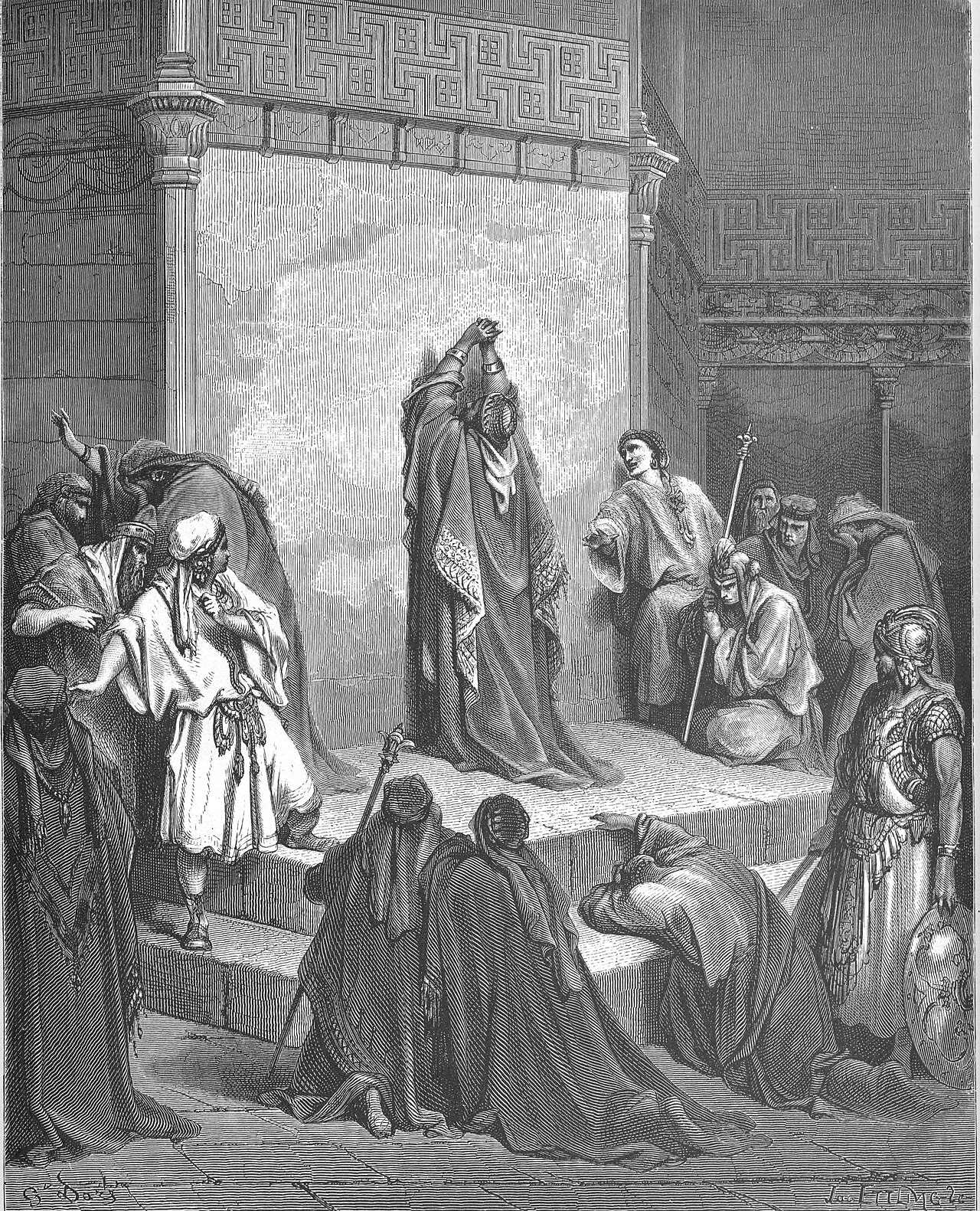
David rises, washes, changes his apparel and goes first to the house of the Lord to worship before he eats, reversing every sign of mourning the household had just watched him carry for seven days. His servants ask the plain question, and his answer turns on one line, I shall go to him, but he shall not return to me, spoken while fasting could still move God and set aside once it no longer could. Adam Clarke reads the line as at least the shape of a hope beyond this life, whether or not David meant to state the doctrine outright, and John Wesley reads it as David's own confidence that he would find his son in the state where the dead are kept. The worship before the meal is itself an answer to the household's confusion, for David has already made his case to God and now receives whatever God gives.
This site's exposition
What is this you have done?
John Gill says the servants knew what David had done and asked only what it meant. They had expected his sorrow to grow once the child died.
The record, by era
The Church Fathers1 voice
Holy David lost two sons. One was guilty of incest, the other of fratricide. To have had them caused him shame; to have lost them brought him grief. He also lost a third, a child whom he loved. He wept over him while he was still alive, but he did not long for him after he died. For so we read that when the boy fell sick, David besought the Lord for him and fasted and lay upon sackcloth, and, although the elders approached him and tried to make him get up from the ground, he resolved neither to rise nor to eat. After he learned that the boy was dead, however, he arose from the ground, bathed upon the spot, anointed himself, changed clothing, worshiped the Lord and took food. Since this seemed strange to his servants, he answered that while the child was still alive, he had rightly fasted and wept, because he justly thought that God might pity him and was certain that he who could restore the dead to life could surely preserve the life of one still living. But now that the child was dead, why should he fast, since he could not bring him back from death and restore him to life. "I shall go to him rather;" he said, "but he shall not return to me."What greater consolation to a mourner! What a true judgment from a wise man! What wonderful wisdom exhibited by a servant! [Thus] no one should protest that some misfortune has befallen him and complain that he has been afflicted contrary to his merit. For who are you to proclaim your merit beforehand? Why do you desire to anticipate your judge? Why do you snatch the verdict from the mouth of him who is going to pronounce it?
The Puritans and the Awakening2 voices
), in answer to which he gives this plain account of his conduct, (1.) That while the child was alive he thought it his duty to importune the divine favour towards it,
quarantine:debris (2026-07-29) — leading-punctuation+unbalanced-parens
Then said his servants unto him, what thing is this that thou hast done?.... Or what is the reason of such conduct and behaviour? they knew what was done, but they did not know the meaning of it, which is what they inquired after: thou didst fast and weep for the child, while it was alive; prayed with fasting and weeping for it, that it might live and not die: but when the child was dead thou didst rise and eat bread; and appeared cheerful; this seemed strange to them, when they expected his sorrow would be increased.
The words behind it
19 Hebrew wordsEvery Hebrew word of this verse in the order it stands, with what it means and the door to its own study. The last column counts the times a word stands in the whole Bible: the rarer the word, the more the places it appears belong together.
| Hebrew | Sound | Meaning | Word study | In the Bible |
|---|---|---|---|---|
| וַיֹּאמְר֤וּ | vaiyomeru | and they said | H559 → | 5305 times |
| עֲבָדָיו֙ | ʾavadav | servants his | H5650 → | 799 times |
| אֵלָ֔יו | ʾelav | to him | H413 → | 5510 times |
| מָֽה־ | mah- | what? | H4100 → | 752 times |
| הַדָּבָ֥ר | hadavar | [is] the thing | H1697 → | 1440 times |
| הַזֶּ֖ה | hazeh | <the> this | H2088 → | 1180 times |
| אֲשֶׁ֣ר | ʾasher | which | H834 → | 5497 times |
| עָשִׂ֑יתָה | ʾasitah | you have done | H6213 → | 2628 times |
| בַּעֲב֞וּר | baavur | forsake of | H5668 → | 49 times |
| הַיֶּ֤לֶד | haiyeled | the child | H3206 → | 89 times |
| חַי֙ | chai | [was] alive | H2416 → | 498 times |
| צַ֣מְתָּ | tzamta | you fasted | H6684 → | 21 times |
| וַתֵּ֔בְךְּ | vatevek | and you wept | H1058 → | 114 times |
| וְכַֽאֲשֶׁר֙ | vekhaasher | and just when | H834 → | 5497 times |
| מֵ֣ת | met | he died | H4191 → | 839 times |
| הַיֶּ֔לֶד | haiyeled | the child | H3206 → | 89 times |
| קַ֖מְתָּ | kamta | you arose | H6965 → | 628 times |
| וַתֹּ֥אכַל | vatokhal | and you ate | H398 → | 810 times |
| לָֽחֶם׃ | lachem | food | H3899 → | 298 times |
וַיֹּאמְר֤וּand they said
vaiyomeruH559 →5305 times
עֲבָדָיו֙servants his
ʾavadavH5650 →799 times
אֵלָ֔יוto him
ʾelavH413 →5510 times
מָֽה־what?
mah-H4100 →752 times
הַדָּבָ֥ר[is] the thing
hadavarH1697 →1440 times
הַזֶּ֖ה<the> this
hazehH2088 →1180 times
אֲשֶׁ֣רwhich
ʾasherH834 →5497 times
עָשִׂ֑יתָהyou have done
ʾasitahH6213 →2628 times
בַּעֲב֞וּרforsake of
baavurH5668 →49 times
הַיֶּ֤לֶדthe child
haiyeledH3206 →89 times
חַי֙[was] alive
chaiH2416 →498 times
צַ֣מְתָּyou fasted
tzamtaH6684 →21 times
וַתֵּ֔בְךְּand you wept
vatevekH1058 →114 times
וְכַֽאֲשֶׁר֙and just when
vekhaasherH834 →5497 times
מֵ֣תhe died
metH4191 →839 times
הַיֶּ֔לֶדthe child
haiyeledH3206 →89 times
קַ֖מְתָּyou arose
kamtaH6965 →628 times
וַתֹּ֥אכַלand you ate
vatokhalH398 →810 times
לָֽחֶם׃food
lachemH3899 →298 times
A shaded row is a word that stands 400 times or fewer in the Bible.
The walk
5 stopsEach card is a verse this one points to, and under it the verses that one points to in turn. Where several paths arrive at the same place, that place is listed first: the text keeps returning to it.
Through
1 Corinthians 2:15The spiritual man judges all things, but he himself is not subject to anyone’s judgment.
it leads to
- 1 Thessalonians 5:21
but test all things. Hold fast to what is good.
- Proverbs 28:5
Evil men do not understand justice, but those who seek the LORD comprehend fully.
- Hebrews 5:14
But solid food is for the mature, who by constant use have trained their senses to distinguish good from evil.
- 1 John 4:1
Beloved, do not believe every spirit, but test the spirits to see whether they are from God. For many false prophets have gone out into the world.
- 1 Corinthians 14:37
If anyone considers himself a prophet or spiritual person, let him acknowledge that what I am writing you is the Lord’s command.
- 1 Thessalonians 5:21
Where this verse is studied
About 2 Samuel
This page draws on Adam Clarke, Commentary on the Bible; Ambrose of Milan, CONSOLATION ON THE DEATH OF EMPEROR VALENTINIAN 47.48; Ambrose of Milan, On the Death of Satyrus 2.25-26; John Gill, Exposition of the Old Testament; John Gill, Exposition of the Old Testament (1748-1763); John Wesley, Explanatory Notes upon the Old Testament and Matthew Henry, Commentary on the Whole Bible.