
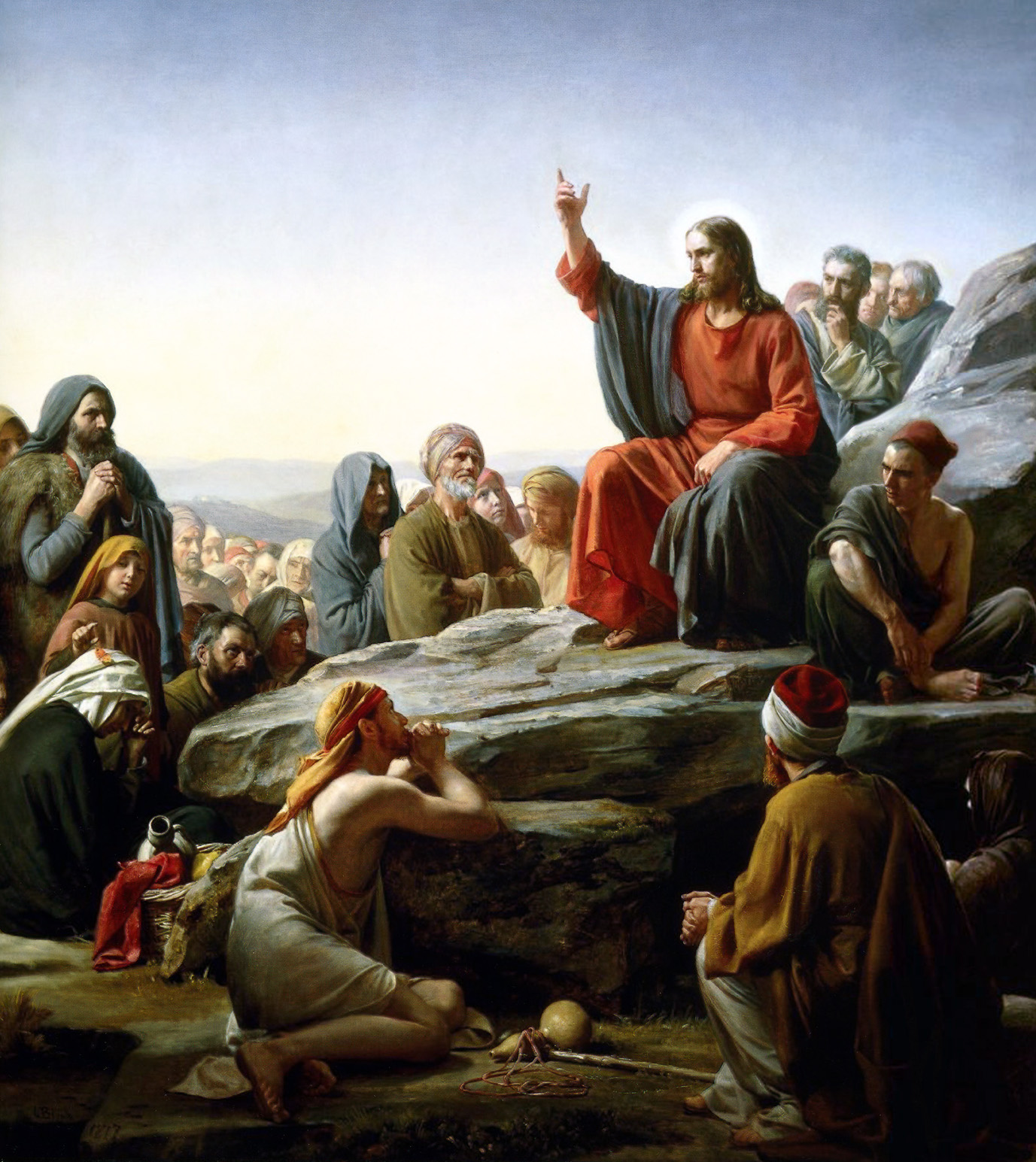
Matthewchapter 8
34 verses · Matthew, by tradition · AD 50 to 65 · The Gospels
This was to fulfill what was spoken through the prophet Isaiah: “He took on our infirmities and carried our diseases.”
Introduction
Matthew, by tradition, The Gospels, Matthew Overview.
This chapter comes down the mountain with Jesus and shows in deeds what the sermon taught in words. The people He meets are those the religious world kept at a distance: a man with leprosy, a Roman officer, a woman in a fever and men possessed by demons. Matthew writes for readers who knew exactly which of these people made a Jew unclean. Listen for how Jesus deals with each one and what He asks of them. Listen also for the two men who want to follow Him and what He tells them it will cost.
Context
- Who
- Jewish readers watching the boundaries of clean and unclean being crossed one by one
- What
- The cleansing of a leper, the healing of a centurion's servant and of Peter's mother-in-law, sayings on the cost of discipleship, the calming of a storm, and the healing of two men possessed by demons.
- Where
- Capernaum and its surroundings, the Sea of Galilee, and the region of the Gadarenes on the eastern shore.
- When
- About AD 28, in the early Galilean ministry, directly after the Sermon on the Mount.
- Why
- To show that the one who taught with authority also acts with authority over sickness, nature and evil spirits, and to show who receives Him in faith.
Historical context
A centurion commanded roughly eighty to a hundred men and was the backbone of the army, a career professional who had risen from the ranks, paid many times a common soldier's wage, and expected instant obedience. Galilee was governed by Herod Antipas rather than directly by Rome, so this officer may have served in Antipas's forces, which were organised on the Roman model.
Show the rest of the historical context, 3 more paragraphs
What makes his approach remarkable is the direction of it. An officer of the occupying power came to a Jewish village preacher and asked, rather than commanded. His own words explain the rest: a strict Jew entering a Gentile's house contracted ritual defilement, so the centurion spares him the trip and asks only for a word.
Skin disease under the Law meant exclusion. A person declared unclean lived apart, kept his clothing torn, and warned others off; touching him transferred the impurity. Jesus reaches out and touches first, and the impurity runs the wrong way.
The lake sits nearly seven hundred feet below sea level in a bowl ringed by hills, and cold air spilling down from the Golan heights can turn flat water into a dangerous chop within minutes. The far shore was Gentile country, the Decapolis, a league of Greek-speaking cities, which is why a herd of two thousand pigs was grazing there at all. The exact town is uncertain; the manuscripts vary between Gadara, Gerasa, and Gergesa, all in that same region.
Significance
Matthew stacks the cases deliberately: a leper, a Gentile's servant, a woman in a sickbed, the sea, and demons in a graveyard. To Jewish readers, each was a category the world had marked as beyond reach.
Show the rest of the significance, 1 more paragraph
The centurion's line lands hardest. Jesus says he has found no such faith in Israel, then speaks of many coming from east and west to sit at Abraham's table. For a congregation being told they had abandoned their heritage, that was both comfort and warning.
The heads below are this chapter's scenes. The numbered points under each are its verses.
A Leper Made Clean by a Willing Touch
Matthew 8:1-4
came down from the mountain: A leper met Him first, opening the ten miracles Matthew gathers in chapters 8 and 9. The leper granted His power and asked only if He was willing. Jesus touched the man, though the law said such a touch conveyed defilement; here cleanness ran the other way.
Matthew 8:1
“When he was come down from the mountain,.... Into which he went up, and preached the sermon recorded in the "three" preceding chapters: great multitudes followed him: which is mentioned, partly to shew, that the people which came from several parts, still continued with him, being affected with his discourses and miracles; and partly on account of the following miracle, of healing the leper, which was not done in a corner, but before great multitudes, who were witnesses of it: though some think this miracle was wrought more privately.”
1 more voice on this verseWhat preachers and commentators have said about this verse, in their own words.
Matthew 8:1
“The eighth chapter of St. Matthew’s Gospel is full of our Lord’s miracles: no less than five are specially recorded. There is beautiful fitness in this. It was fitting that the greatest sermon ever preached should be immediately followed by mighty proofs that the preacher was the Son of God. Those who heard the Sermon on the Mount would be obliged to confess that as “none spake such words as this man,” so also no one did such works.”
J.C. Ryle · Expository Thoughts on the Gospels: Matthew (1856)Reformed Evangelical
if You are willing: Leprosy was seldom curable by natural means, and John Wesley thinks this man had probably heard Jesus teach. Matthew Henry notes that the Jews took the disease as a mark of God's displeasure, as with Miriam, Gehazi and Uzziah. The first cure answers that sign of wrath, in Henry's reading.
Matthew 8:2
“A leper came - Leprosies in those countries were seldom curable by natural means, any more than palsies or lunacy. Probably this leper, though he might not mix with the people, had heard our Lord at a distance.”
John Wesley · Explanatory Notes upon the New Testament (1755)evangelical
2 more voices on this verse
Matthew 8:2
“And, behold, there came a leper - The leprosy λεπρα, from λεπις, a scale, was an inveterate cutaneous disease, appearing in dry, thin, white scurfy scales or scabs, either on the whole body, or on some part of it, usually attended with violent itching, and often with great pain. The eastern leprosy was a distemper of the most loathsome kind, highly contagious, so as to infect garments, (Lev 13:47, etc)., and houses, (Lev 14:34, etc)., and was deemed incurable by any human means.”
Adam Clarke · Commentary on the Bible (1810-1826)evangelical
Matthew 8:2
“But one thing he was sure of, that He had but to "will" it. This shows with what "worship" of Christ this leper fell on his face before Him. Clear theological knowledge of the Person of Christ was not then possessed even by those who were most with Him and nearest to Him.”
Jamieson, Fausset & Brown · Commentary Critical and Explanatory on the Whole Bible (1871)reformed
touched the man: Jerome warns against running the reply together, since Jesus first answers the man's wish and then gives the command as a separate word. Adam Clarke notes he speaks by his own authority. Jamieson, Fausset and Brown add from Mark that the cure was as complete as it was instant.
Matthew 8:3
“And Jesus ...touched him - It was an offence to the Jews to “touch” a leprous person, and was regarded as making him who did it ceremonially impure, Lev 13:3. The act of putting forth his hand and “touching” him, therefore, expressed the intention of Jesus to cure him, and was a pledge that he “was,” in fact, already cured.”
3 more voices on this verse
Matthew 8:3
“It is not to be read, as most of the Latins think, 'I will to cleanse thee;' but separately, He first answers, I will, and then follows the command, be thou clean. The leper has said, If thou wilt; the Lord answers, I will; he first said, Thou canst make me clean; the Lord spake, Be thou clean.”
Jerome · written before 420 · Catena Aurea by Aquinaspatristic
Matthew 8:3
“The leprosy was a noisome, loathsome disease, yet Christ touched him; for he did not disdain to converse with publicans and sinners, to do them good. There was a ceremonial pollution contracted by the touch of a leper; but Christ would show, that when he conversed with sinners, he was in no danger of being infected by them, for the prince of this world had nothing in him.”
Matthew Henry · Commentary on the Whole Bible (1707-1721)puritan
Matthew 8:3
“And immediately his leprosy was cleansed--Mark, more emphatic, says (Mr 1:42), "And as soon as He had spoken, immediately the leprosy departed from him, and he was cleansed"--as perfectly as instantaneously.”
Jamieson, Fausset & Brown · Commentary Critical and Explanatory on the Whole Bible (1871)reformed
tell anyone: Albert Barnes limits the silence to the time on the road, for the man's duty was to reach the priest. Adam Clarke gives a wider reason. An open claim to be the Messiah might have moved the people to make Jesus king and stirred the rulers and Rome against him.
Matthew 8:4
“Jesus saith - See thou tell no man - Had our Lord, at this early period, fully manifested himself as the Messiah, the people in all likelihood would have proclaimed him King; this, however, refused by him, must have excited the hatred of the Jewish rulers, and the jealousy of the Roman government; and, speaking after the manner of men, his farther preachings and miracles must have been impeded. This alone seems to be the reason why he said to the leper, See thou tell no man.”
Adam Clarke · Commentary on the Bible (1810-1826)evangelical
1 more voice on this verse
Matthew 8:4
“That he might not enrage the chief priests, scribes, and Pharisees, who were the most bitter against him, any more than was unavoidable, Matt. xvi, 20, 21. For a testimony - That I am the Messiah; to them - The priests, who otherwise might have pleaded want of evidence.”
John Wesley · Explanatory Notes upon the New Testament (1755)evangelical
The Centurion Who Only Asked a Word
Matthew 8:5-9
a centurion came and pleaded with Him: A centurion, a Roman officer over a hundred men, pleads for a servant, and his words I am not worthy stand against his rank. He reasons from his own post: a man under authority knows that a command needs no presence, so he asks Jesus to say the word.
Matthew 8:5
“And when Jesus was entered into Capernaum,.... Was returned from his journey through Galilee, to the place where he before dwelt, and is called his own city, Mat 9:1 there came unto him a centurion, a Roman officer, שר מאה, "a commander of an hundred men", as the Hebrew Gospel by Munster reads it: though the number of men under a "centurion" was more, according to some accounts.”
2 more voices on this verse
Matthew 8:5
“Capernaum - See the notes at Mat 4:13. There came unto him a centurion - A centurion was the commander of 100 men in the Roman armies. Judea was a Roman province, and garrisons were kept there to preserve the people in subjection. This man was probably by birth a pagan. See Mat 8:10.”
Matthew 8:5
“Probably he came a little way toward him, and then went back. He thought himself not worthy to come in person, and therefore spoke the words that follow by his messengers. As it is not unusual in all languages, so in the Hebrew it is peculiarly frequent, to ascribe to a person himself the thing which is done, and the words which are spoken by his order.”
John Wesley · Explanatory Notes upon the New Testament (1755)evangelical
The Greek word for servant more often means a child, John Gill observes, and Luke settles the sense with the ordinary word for a servant. Adam Clarke reads lies as stretched out and helpless. Albert Barnes suggests a palsy with violent cramps that put the man's life in danger.
Matthew 8:6
“A centurion came to the Lord saying: "Lord, my servant lies paralyzed in my house and is grievously tormented." To whom Jesus immediately responds: "I will come and heal him." What does it mean that the royal official asks him to come to his son, and yet he refuses to go bodily; but to the centurion's servant he is not invited, and yet he promises to go bodily? He does not deign to be present to the royal official's son through bodily presence, yet he does not disdain to go to meet the centurion's servant.”
Gregory the Dialogist · written before 604 · Forty Gospel Homilies, Homily 28patristic
John Chrysostom notes that Jesus here offers more than was asked. By promising to come to the house, he draws out the humility of the next verse, which would otherwise have stayed hidden. Matthew Henry sets this plain promise to heal beside a minister's promise only to come and pray.
Matthew 8:7
“I will come and heal him - Εγω ελθων θεραπευσω αυτον, I am coming, and will heal him. This saying is worthy of observation. Jesus did not positively say, I will came and heal him; this could not have been strictly true, because our Lord healed him without going to the house: and the issue shows that the words ought to be taken in the most literal sense: thus understood, they contained a promise which it seems none of them distinctly comprehended.”
Adam Clarke · Commentary on the Bible (1810-1826)evangelical
1 more voice on this verse
Matthew 8:7
“They who wrought miracles by a derived power, did not speak thus positively, as Christ did, who wrought them by his own power, as one that had authority. When a minister is sent for to a sick friend, he can but say, I will come and pray for him; but Christ says, I will come and heal him: it is well that Christ can do more for us than our ministers can.”
Matthew Henry · Commentary on the Whole Bible (1707-1721)puritan
I am not worthy to have You come under my roof: Augustine turns the confession around. By calling himself unworthy of Christ in his house, the centurion showed himself worthy to receive him into his heart. John Gill notes from Luke that friends carried these words in the centurion's name while Jesus was already on the road.
Matthew 8:8
“As we commend the centurion's faith in that he believed that the Saviour was able to heal the paralytic; so his humility is seen in his professing himself unworthy that the Lord should come under his roof; as it follows, And the centurion answered and said into him, Lord, I am not worthy that thou shouldest come under my roof. The thoughtfulness of the centurion appears herein, that he saw the Divinity hidden beneath the covering of body; wherefore he adds, But speak the word only, and my servant will be healed.”
Jerome · written before 420 · Catena Aurea by Aquinaspatristic
4 more voices on this verse
Matthew 8:8
“The centurion answered, and said,.... This, according to Luk 7:6 was said by his friends in his name, when he understood that Christ had agreed to come to his house, with the elders of the Jews, he first sent to him; and after he was actually set out with them, and was in the way to his house; who, conscious of his own unworthiness, deputes some persons to him, to address him in this manner, Lord, I am not worthy that thou shouldst come under my roof.”
Matthew 8:8
“THIS centurion was a worthy man from the human point of view, but he called himself unworthy when he turned towards our Lord. He was so excellent a man that the elders of the Jews, who were by no means partial to Roman soldiers, pleaded with Jesus that he was worthy. Had he been personally there, he would have repudiated their plea and he did so by the second party of friends whom he sent to our Lord.”
Matthew 8:8
“But speak the word only - Or instead of ειπε λογον read ειπε λογω, speak by word or command. This reading is supported by the most extensive evidence from MSS., versions, and fathers. See here the pattern of that living faith and genuine humility which ought always to accompany the prayer of a sinner: Jesus can will away the palsy, and speak away the most grievous torments.”
Adam Clarke · Commentary on the Bible (1810-1826)evangelical
Matthew 8:8
“The more humility the more faith; the more diffident we are of ourselves, the stronger will be our confidence in Jesus Christ. He had an assurance of faith not only that Christ could cure his servant, but, (1.) That he could cure him at a distance.”
Matthew Henry · Commentary on the Whole Bible (1707-1721)puritan
a man under authority: Jerome reads the soldiers as a picture of unseen servants. As the centurion's men obey in his absence, so the Lord can fulfil his will through angels without coming in body. John Wesley reasons that if an inferior officer is obeyed, the Lord of all will be obeyed far more.
Matthew 8:9
“For I am a man under authority - I am only an inferior officer: and what I command, is done even in my absence: how much more what thou commandest, who art Lord of all!”
John Wesley · Explanatory Notes upon the New Testament (1755)evangelical
1 more voice on this verse
Matthew 8:9
“The centurion applies not to witches or wizards for his servant, but to Christ. The palsy is a disease in which the physician's skill commonly fails; it was therefore a great evidence of his faith in the power of Christ, to come to him for a cure, which was above the power of natural means to effect.”
Matthew Henry · Commentary on the Whole Bible (1707-1721)puritan
Matthew 8:10-13
He marveled: Jesus marveled at such great faith in a Gentile, one of two times the Gospels record His marveling. Mark 6:6 records the other, at the unbelief of Nazareth. Many will come from the east and the west, while the sons of the kingdom are thrown out.
Matthew 8:10
“When Jesus heard it, he marvelled,.... Which must be understood of him as man; for as God, nothing could present itself unto him at unawares, unthought of, and not known before; and so could not raise admiration in him, and which cannot properly fall on a divine person: or he behaved, both by words and gesture, as persons do when they are astonished at anything; and this he might do, to raise the attention and wonder of those that were with him: and said to them that followed.”
2 more voices on this verse
Matthew 8:10
“You remember that we commenced this morning's sermon by observing that Jesus is not reported to have marvelled either at the gigantic architecture of the Temple, or at the wonderful discipline of the Roman army, or at the profound knowledge of the rabbis. He only wondered twice, according to the record, and on both of those occasions he marvelled concerning faith—once at the absence of it, and once at its presence. In the case which we spoke of this morning, He marvelled at the unbelief of His fellow townsmen.”
Matthew 8:10
“Verily, I have not found so great faith, no, not in Israel. Now this speaks, First, Honour to the centurion; who, though not a son of Abraham's loins, was an heir of Abraham's faith, and Christ found it so. Note, The thing that Christ seeks is faith, and wherever it is, he finds it, though but as a grain of mustard-seed.”
Matthew Henry · Commentary on the Whole Bible (1707-1721)puritan
many will come from the east and the west: Augustine takes east and west to stand for the whole world. Adam Clarke explains that the rabbis pictured the blessings of the kingdom as a banquet, eaten reclining. The nations come to that table because they hold the faith of Abraham, Isaac and Jacob, as Augustine argues against Faustus.
Matthew 8:11
“Secondly, Christ gives us an idea of the salvation itself. They shall come, shall come together, shall come together to Christ, 2 Thess. ii. They shall be admitted into the kingdom of grace on earth, into the covenant of grace made with Abraham, Isaac, and Jacob; they shall be blessed with faithful Abraham, whose blessing comes upon the Gentiles, Gal. iii.”
Matthew Henry · Commentary on the Whole Bible (1707-1721)puritan
thrown into the outer darkness: Adam Clarke and John Wesley explain the picture from feasts held at night. The guests shut out stand in the dark outside. Jerome draws a further point from the weeping and gnashing of teeth, which need eyes and bones, and so imply the resurrection of the body.
Matthew 8:12
“Shall be cast out into outer darkness - As the enjoyment of that salvation which Jesus Christ calls the kingdom of heaven is here represented under the notion of a nuptial festival, at which the guests sat down in a reclining posture, with the master of the feast; so the state of those who were excluded from the banquet is represented as deep darkness; because the nuptial solemnities took place at night.”
Adam Clarke · Commentary on the Bible (1810-1826)evangelical
3 more voices on this verse
Matthew 8:12
“The outer darkness - Our Lord here alludes to the custom the ancients had of making their feast in the night time. Probably while he was speaking this, the centurion came in person.”
John Wesley · Explanatory Notes upon the New Testament (1755)evangelical
Matthew 8:12
“But the children of the kingdom,.... The Jews, who were subjects of the kingdom, and commonwealth of Israel, from which the Gentiles were aliens; and who were also in the church of God, which is his kingdom on earth; and besides, had the promise of the Gospel dispensation, sometimes called the kingdom of heaven, and by them, often the world to come; and were by their own profession, and in their apprehension and expectation, children, and heirs of the kingdom of glory.”
Matthew 8:12
“The children of the kingdom shall be cast out; the Jews that persist in unbelief, though they were by birth children of the kingdom, yet shall be cut off from being members of the visible church: the kingdom of God, of which they boasted that they were the children, shall be taken from them, and they shall become not a people, not obtaining mercy, Rom. xi.”
Matthew Henry · Commentary on the Whole Bible (1707-1721)puritan
John Chrysostom sets this word beside the one to the Syrophoenician woman, whose daughter was likewise made whole. Adam Clarke takes the measure of faith here as a general rule of God's dealings with people. Albert Barnes reports doubt whether Luke 7 records this same case.
Matthew 8:13
“And Jesus said unto the centurion,.... Christ having finished the digression, returns an answer to the centurion, agreeably to his desire, saying to him, go thy way; not as displeased with him, but as granting his request: for it follows, and as thou hast believed, so be it done unto thee. As he had faith to believe, that Christ could cure his servant by a word speaking, it was done accordingly. Christ by his almighty "fiat" said, let him be healed, and he was healed: just as God in the creation said, "let there be light, and there was light".”
1 more voice on this verse
Matthew 8:13
“He was healed in that self-same hour - This showed decisively the goodness and power of Jesus. No miracle could be more complete. There could be no imposition or deception. This account, or one similar to this, is found in Luk 7:1-10. There has been a difference of opinion whether the account in Luke refers to the same case as that recorded in Matthew, or whether a second centurion, encouraged by the success of the first, applied to our Saviour in a similar case and manner, and obtained the same success.”
Peter's Mother-in-Law and an Evening of Healing
Matthew 8:14-15
Peter’s house: At Peter’s house, the shortest of the ten miracles takes place: He touched her hand, and the fever left her. Peter was a married man, which 1 Corinthians 9:5 confirms with his wife traveling beside him. Archaeology has a strong candidate for the house beneath the octagonal church at Capernaum.
Matthew 8:14
“And when Jesus was come into Peter's house,.... And which was also Andrew's, Mar 1:29 for these two brothers lived together, and this was in Capernaum, as appears from the context.”
1 more voice on this verse
Matthew 8:14
“This event took place at Capernaum, but Peter's residence was at Bethsaida, for we read, "Philip was of Bethsaida, the city of Andrew and Peter." How came Peter to have a house at Capernaum? Poor fishermen do not often have two houses. May not the conjecture be highly probable that, finding the Lord Jesus Christ was frequently at Capernaum, Peter thought it best to have a dwelling there, that he might always be present when the Master was preaching and that he might do his best to entertain Him between visits?”
began to serve Him: John Gill compares three cures in the chapter. The centurion's servant was healed by a word, this woman by a touch, and the leper by both. Adam Clarke finds the strongest support in manuscripts, versions and fathers for the reading that she served him, which the Berean text follows.
Matthew 8:15
“And he touched her hand,.... Sometimes he healed by a word, as the centurion's servant; and sometimes by a touch, as here; and sometimes by both, as the leper. Luke says, that he "stood over her", reached over her to take her by the hand, and lift her up, "and rebuked the fever". Just as he did the winds and sea, having all diseases, as well as the elements, at his beck and control; and the fever left her immediately, as the other evangelists say.”
2 more voices on this verse
Matthew 8:15
“He touched her hand - Can any thing on this side the unlimited power of God effect such a cure with only a touch? If the Scriptures had not spoken of the divinity of Christ, these proofs of his power must have demonstrated it to the common sense of every man whose creed had not previously blinded him. Ministered unto them - Αυτοις, them, is the reading of most of the printed editions, but αυτω, to him, has the utmost evidence in its support from MSS., versions, and fathers.”
Adam Clarke · Commentary on the Bible (1810-1826)evangelical
Matthew 8:15
“We may not, I say, we may not call into question the truth of the (poor vilified) senses, lest we should even in Christ Himself, bring doubt upon the truth of their sensation; lest perchance it should be said that He did not really "behold Satan as lightning fall from heaven; " that He did not really hear the Father's voice testifying of Himself; or that He was deceived in touching Peter's wife's mother; or that the fragrance of the ointment which He afterwards smelled was different from that which He accepted for His burial; and that the taste of…”
Tertullian · written before 220 · A Treatise on the Soulpatristic
Matthew 8:16-17
He drove out the spirits with a word: Matthew reads the evening through Isaiah 53:4 in a rendering closer to the Hebrew than the Septuagint. The Hebrew has choliim, sicknesses, and nasa, to lift and carry, placing the Servant's burden-bearing in the ministry as well as at the cross.
Matthew 8:16
“When the even was come - The Jews kept their sabbath from evening to evening, according to the law, Lev 23:32, From evening to evening shall ye celebrate your sabbath. And the rabbins say, The sabbath doth not enter but when the sun is set. Hence it was that the sick were not brought out to our Lord till after sun-set, because then the sabbath was ended. Many that were possessed with devils - Dr. Lightfoot gives two sound reasons why Judea, in our Lord’s time, abounded with demoniacs.”
Adam Clarke · Commentary on the Bible (1810-1826)evangelical
1 more voice on this verse
Matthew 8:16
“IT was the evening—in all probability it was the evening of a Sabbath day. The Jews were so tender not to break the Sabbath that they did not even bring forth the sick to the Savior until the evening was come. The Savior would gladly have healed them on the Sabbath, for that was to Him a high day for holy work—but they did not think it right—and so they kept back their sick till the day was ended.”
Adam Clarke reports that the rabbis read this passage of the Messiah's sufferings, saying that the diseases due to Israel would be borne by him. Matthew Henry ties the two burdens together. Sin, he says, is both the cause and the sting of sickness.
Matthew 8:17
“That it might be fulfilled which was spoken by Esaias the prophet,.... In Isa 53:4 "He hath borne our griefs and carried our sorrows", here rendered, himself took our infirmities and bare our sicknesses: very agreeable to the Hebrew text, הוא, "he himself", not another; נשא, "took up", upon himself voluntarily, freely, as a man lifts up a burden, and takes it on his shoulders; חלינו, "our infirmities", diseases, sicknesses, whether of body or soul, ומכאבינו סבלם, "and bare", or carried, as a man does a burden upon his back, "our sicknesses", or diseases, which occasion pain and sorrow.”
4 more voices on this verse
Matthew 8:17
“That it might be fulfilled ... - This passage is found in Isa 53:4. Our English translation of that important passage is, “Surely he hath borne our griefs and carried our sorrows.” The Greek in Matthew is an exact translation of the Hebrew, and the same translation should have been made in both places. In Isa 53:1-12, Isaiah fully states the doctrine of the atonement, or that the Messiah was to suffer for sin. In the verse quoted here, however, he states the very truth which Matthew declares.”
Matthew 8:17
“Notice that Matthew has no doubt who is the person referred to in Isaiah 53, for he applies it to Jesus. Notice also that Matthew, who was a Jew and understood Hebrew, had no doubt that the application of those verses in Isaiah 53 is physical.”
Derek Prince · Jesus Carried Away Your Diseases (devotional, Claiming Your Inheritance series)Pentecostal-Charismatic
Matthew 8:17
“Such instances are frequent in the sacred writings, and are elegancies rather than imperfections. He fulfilled these words in the highest sense, by bearing our sins in his own body on the tree: in a lower sense, by sympathizing with us in our sorrows, and healing us of the diseases which were the fruit of sin.”
John Wesley · Explanatory Notes upon the New Testament (1755)evangelical
Matthew 8:17
“Christ bore away sin by the merit of his death, and bore away sickness by the miracles of his life; nay, though those miracles are ceased, we may say, that he bore our sicknesses then, when he bore our sins in his own body upon the tree; for sin is both the cause and the sting of sickness.”
Matthew Henry · Commentary on the Whole Bible (1707-1721)puritan
Cross references
Matthew 8:17
- QuotingIsaiah 53:4“Surely He took on our infirmities and carried our sorrows; yet we considered Him stricken by God, struck down and afflicted.”
'Himself took our infirmities', healing fulfillment formula
ConnectionsIsaiah 53:4
Nowhere to Lay His Head: the Cost of Following
Matthew 8:18-22
He gave orders to cross to the other side of the sea: The scribe offers I will follow You wherever You go, and Jesus answers that the Son of Man has no place to lay His head. It is the title's first use in Matthew, carrying both the exalted figure of Daniel 7:13 and the plain Hebrew idiom for a man.
Matthew 8:18
“But it is only to the disciples that Jesus "gave orders to cross over to the other side," lest, from the crowds pressing about him, his disciples should be prevented from hearing those very teachings that were most appropriate for them. To the disciples he revealed God's future mysteries more deeply than in the things that were spoken to the crowds only "in parables." Only the disciples had left behind all present goods and followed him through love of learning.”
Cyril of Alexandria · written before 444 · FRAGMENT 97patristic
3 more voices on this verse
Matthew 8:18
“Now when Jesus saw great multitudes about him,.... Who got together, partly out of novelty to see his person, of whom they had heard so much; and partly to see the miracles he wrought: some came to have their bodily diseases healed; few, if any, to hear the Gospel preached by him, and for the good of their immortal souls: the most part came with some sinister, selfish, and carnal views, wherefore he gave commandment to depart unto the other side.”
Matthew 8:18
“Unto the other side - Jesus was now in Capernaum, a city at the northwest corner of the Sea of Tiberias, or Sea of Galilee. See the notes at Mat 4:18. The country to which he purposed to go was the region on the east of the Sea of Tiberias.”
Matthew 8:18
“Thus was the disciple better provided for than his Lord. (3.) That he had a house at Capernaum, though he was originally of Bethsaida; it is probably, he removed to Capernaum, when Christ removed thither, and made that his principal residence. Note, It is worth while to change our quarters, that we may be near to Christ, and have opportunities of converse with him.”
Matthew Henry · Commentary on the Whole Bible (1707-1721)puritan
Matthew Henry notes how rarely a scribe comes forward in the Gospels, for the class usually stands with the Pharisees against Jesus. Jerome weighs the title. The man calls him Teacher, as one master among many, where the next speaker in verse 21 calls him Lord.
Matthew 8:19
“And a certain Scribe came,.... "As they went in the way", Luk 9:57 to go to the sea side, in order to take shipping, and pass to the other shore; and said unto him, Master, or Rabbi, I will follow thee whithersoever thou goest.”
3 more voices on this verse
Matthew 8:19
“And a certain scribe came ... - It is not improbable that this man had seen the miracles of Jesus, and had formed an expectation that by following him he would obtain some considerable worldly advantage. Christ, in reply to his professed purpose to follow him, proclaimed his own poverty, and dashed the hopes of the avaricious scribe. The very foxes and birds, says he, have places of repose and shelter, but the Son of man has no home and no pillow.”
Matthew 8:19
“In the first part of these verses we see a striking example of our Lord’s wisdom in dealing with those who professed a willingness to be his disciples. The passage throws so much light on a subject frequently misunderstood in these days, that it deserves more than ordinary attention. A certain scribe offers to follow our Lord whithersoever he goes. It was a remarkable offer when we consider the class to which the man belonged, and the time at which it was made. But the offer receives a remarkable answer. It is not directly accepted nor yet flatly rejected.”
J.C. Ryle · Expository Thoughts on the Gospels: Matthew (1856)Reformed Evangelical
Matthew 8:19
“The Son of man - The expression is borrowed from Dan. vii, 13, and is the appellation which Christ generally gives himself: which he seems to do out of humility, as having some relation to his mean appearance in this world.”
John Wesley · Explanatory Notes upon the New Testament (1755)evangelical
John Chrysostom hears the reply answering the man's motive. He had seen the signs and hoped to gain by following, so Jesus tells him he has no lodging of his own. Augustine gives a figurative reading, with the foxes as deceit and the birds as pride nesting in the heart.
Matthew 8:20
“That Lord walked in humility and obscurity, with no definite home: for "the Son of man," said He, "hath not where to lay His head; " unadorned in dress, for else He had not said, "Behold, they who are clad in soft raiment are in kings' houses: " in short, inglorious in countenance and aspect, just as Isaiah withal had fore-announced.”
Tertullian · written before 220 · On Idolatrypatristic
1 more voice on this verse
Matthew 8:20
“The foxes have holes, etc. - Reader! art thou a poor man? and dost thou fear God? Then, what comfort must thou derive from the thought, that thou so nearly resemblest the Lord Jesus! But how unlike is the rich man, who is the votary of pleasure and slave of sin, to this heavenly pattern! Son of man - A Hebrew phrase, expressive of humiliation and debasement; and, on that account, applied emphatically to himself, by the meek and lowly Jesus.”
Adam Clarke · Commentary on the Bible (1810-1826)evangelical
Adam Clarke and Hilary of Poitiers both note that disciple here reaches beyond the twelve to the wider company of hearers. John Chrysostom contrasts the two men. The scribe offered himself boldly, while this one asks leave for a duty of piety.
Matthew 8:21
“And another of his disciples ... - The word “disciple” properly signifies “learner,” and was given to the followers of Jesus because they received him as their teacher. See the notes at Mat 5:1. It does not of necessity mean that a “disciple” was a pious man, but only one of the multitude, who, for various causes, might attend on his instructions. See Joh 6:66; Joh 9:28. Suffer me first to go and bury my father - This seemed to be a reasonable request, as respect for parents, living or dead, is one of the first duties of religion.”
3 more voices on this verse
Matthew 8:21
“In what one thing is this disciple like the Scribe? The one called Him Master, the other confesses Him as his Lord. The one from filial piety asks permission to go and bury his father; the other offers to follow, not seeking a master, but by means of his master seeking gain for himself.”
Jerome · written before 420 · Catena Aurea by Aquinaspatristic
Matthew 8:21
“Another said - I will follow thee without any such view; but I must mind my business first. It is not certain that his father was already dead. Perhaps his son desired to stay with him, being very old, till his death.”
John Wesley · Explanatory Notes upon the New Testament (1755)evangelical
Matthew 8:21
“And another of his disciples said unto him,.... That is, one of his disciples; for this does not suppose, that the other, the Scribe before mentioned, was one. It is possible, he might be one of the twelve.”
Jesus uses dead in two senses, Albert Barnes explains. Adam Clarke adds that Jews called a man dead who had left the precepts of the law, so the saying was familiar to its hearers. Luke's version, Jamieson, Fausset and Brown note, adds a call to preach the kingdom.
Matthew 8:22
“But Jesus said unto him, Follow me; and let the dead bury their dead--or, as more definitely in Luke, "Let the dead bury their dead: but go thou and preach the kingdom of God" (Lu 9:60). This disciple did not, like the former, volunteer his services, but is called by the Lord Jesus, not only to follow, but to preach Him. And he is quite willing; only he is not ready just yet.”
Jamieson, Fausset & Brown · Commentary Critical and Explanatory on the Whole Bible (1871)reformed
1 more voice on this verse
Matthew 8:22
“Let the dead bury their dead - It was usual for the Jews to consider a man as dead who had departed from the precepts of the law; and, on this ground, every transgressor was reputed a dead man. Our Lord’s saying, being in common use, had nothing difficult in it to a Jew. Natural death is the separation of the body and soul; spiritual death, the separation of God and the soul: men who live in sin are dead to God. Leave the spiritually dead to bury their natural dead.”
Adam Clarke · Commentary on the Bible (1810-1826)evangelical
The Storm That Obeyed His Voice
Matthew 8:23-27
When He got into the boat: The storm is seismos, the word for an earthquake, and Jesus was sleeping. He got up and rebuked the winds and the sea, the act Psalm 89:9 and Psalm 107:29 give to God. The men ask What kind of man is this, and the chapter leaves the question standing.
Matthew 8:23
“And when he was entered into a ship,.... Which was got ready by his disciples, or hired by them for his use, according to the directions he had given, his disciples followed him into the ship, and they only; for as for the men hereafter mentioned, they were the men that belonged to the ship, and had the management of it: the multitude were dismissed, and in order to be clear of them, Christ took this method; and being desirous also of trying the faith of his disciples, he ordered it so, that they should be alone with him.”
1 more voice on this verse
Matthew 8:23
“Into a ship - This was on the Sea of Tiberias. The “ship” in which they sailed was probably a small open boat with sails, such as was commonly used for fishing on the lake. His disciples - Not merely the apostles, but probably many others. There were many other ships in company with him, Mar 4:36. This circumstance would render the miracle much more striking and impressive.”
Jesus was sleeping: Jerome finds the pattern of this scene in Jonah, who slept while the others were in danger and was woken. In his reading the sign looks ahead. By the power of his passion Christ saves those who wake him.
Matthew 8:24
“And behold, there arose a great tempest,.... "A great concussion", or "shaking" of the sea; the stormy wind moved the sea, and the waves thereof; and both wind and sea shook the ship, and the men that were in it. Luke calls this tempest a "storm wind", Luk 8:23 and Mark says, it was "a great storm of wind", Mar 4:37 and both use the word "loelaps", which signifies a particular kind of wind, which is suddenly whirled about upwards and downwards; or rather, a conflict of many winds: it seems to be a whirlwind, or hurricane.”
1 more voice on this verse
Matthew 8:24
“Arose a great tempest in the sea - Probably excited by Satan, the prince of the power of the air, who, having got the author and all the preachers of the Gospel together in a small vessel, thought by drowning it, to defeat the purposes of God, and thus to prevent the salvation of a ruined world. What a noble opportunity must this have appeared to the enemy of the human race!”
Adam Clarke · Commentary on the Bible (1810-1826)evangelical
John Chrysostom finds the cry faithful and still incomplete. The disciples knew Jesus could calm the sea once awake, and had yet to learn he could do it asleep. He adds that the wonder was done away from the crowds, so the disciples were spared shame before them.
Matthew 8:25
“Save us - Save our lives. We perish - We are in danger of perishing. This showed great confidence in the Saviour. It shows, also, where sinners and Christians should always go who feel that they are in danger of perishing. There is none that can save from the storms of divine wrath but the Son of God.”
rebuked the winds and the sea: Adam Clarke notes the order of the command. The winds were the cause of the waves, so Jesus rebukes them together with the sea. Jerome concludes that all creation knows its Creator's voice, while denying the heretics' claim that everything in nature has a soul.
Matthew 8:26
“Why are ye fearful, O ye of little faith? - Faith is ever bold - incredulity always timid. When faith fails in temptation, there is the utmost danger of shipwreck. Lord, increase our faith! is a necessary prayer for all who desire to be saved. Then he arose and rebuked the winds, etc. - As the agitation of the sea was only the effect of the wind, it was necessary to remove the cause of the disturbance, that the effect might cease.”
Adam Clarke · Commentary on the Bible (1810-1826)evangelical
3 more voices on this verse
Matthew 8:26
And he saith unto them, why are ye fearful?.... Though they had some faith in him, yet there was a great deal of fear and unbelief, for which Christ blames them, saying, O ye of little faith: See Gill on Mat 6:30. In Luke, the phrase is, "where is your faith?" what is become of it? You professed but just now to believe in me, is your faith gone already? In Mark it is, "how is it that ye have no faith?"
Matthew 8:26
“From this passage we understand, that all creation is conscious of its Creator; for what may be rebuked and commanded is conscious of the mind commanding. I do not mean as some heretics hold, that the whole creation is animatec—but by the power of the Maker things which to us have no consciousness have to Him.”
Jerome · written before 420 · Catena Aurea by Aquinaspatristic
Matthew 8:26
“THE winds were howling, the waters were roaring and the disciples thought that the little ship must surely be engulfed in the raging sea, so they awakened their Master from His sorely-needed sleep and cried to Him, "Lord, save us! We are perishing." Note well the first words that He speaks to His frightened followers. Generally, when a man is in trouble, it is best, first, to help him out of it if we can, and then to give him any rebuke that he may deserve.”
Charles Spurgeon · written before 1892 · The Metropolitan Tabernacle Pulpit, Sermon No. 2852: “Comfort for the Fearful” (lightly modernized text, CCEL edition)Particular Baptist
Jerome and John Gill think the men who marvel may be the sailors aboard, since Mark and Luke give the fear to the disciples. Jerome allows the other reading too. Even disciples are fitly called men while they have yet to learn the Saviour's power.
Matthew 8:27
“The men marveled - Wondered, or were amazed. What manner of man - What kind of a personage. How unlike other men! What a vast display of power! and how far exalted above mortals must he be! Jesus spake to the winds; rebuked their raging, and the sea was suddenly calm. The storm subsided; the ship glided smoothly; danger fled; and in amazement they stood in the presence of him who controlled the tempests that God had raised; and they felt that “he” must be God himself, for none but God could calm the heaving billows and scatter the tempest.”
2 more voices on this verse
Matthew 8:27
“But the men marvelled,.... Mark says, "they feared exceedingly"; and Luke, "they being afraid, wondered": they were filled with astonishment and fear, or reverence: there was such a shine of majesty, such a lustre of divine power appeared in this affair. The other two evangelists seem to refer this to the disciples, which Matthew seems to ascribe to the men, the mariners that were in the ship; it is likely it had the same effect on both; and both were abundantly convinced of his deity and dignity, saying, what manner of man, or person is this?”
Matthew 8:27
“THIS story of the storm upon the lake is wonderfully full of spiritual interest. Not only does it, literally, show to us the Divine power of our blessed Master in lulling the storm, rendered the more conspicuous by being placed, side by side, with the human weakness which made Him sleep in the ship upon a pillow, but, spiritually, it is a kind of ecclesiastical history, a miniature outline of the story of the Church in all ages.”
The Demons of Gadara and the Swine
Matthew 8:28-29
two demon-possessed men: Matthew tells of two demon-possessed men where Mark and Luke tell of one; two were there, and one was the speaker. Their cry of Son of God and before the appointed time shows they know the person and know a fixed judgment awaits the fallen powers.
Matthew 8:28
“Hence the country between them took its name, sometimes from the one, sometimes from the other. There met him two demoniacs - St. Mark and St. Luke mention only one, who was probably the fiercer of the two, and the person who spoke to our Lord first. But this is no way inconsistent with the account which St. Matthew gives.”
John Wesley · Explanatory Notes upon the New Testament (1755)evangelical
3 more voices on this verse
Matthew 8:28
“The divine nature of the only begotten Son was already scorching the demons in unspeakable flames. Christ was shutting up the fiercest demons in blocked roads. He was undoing the devil's tyranny. "You have come before the time," they cried out. For they knew from the Scriptures that Christ was going to come and would judge them. Treating the incarnation as if it had happened at the wrong time, they pled that he had come in an untimely way. This misrepresentation is not surprising. In their deceptiveness, they did not hesitate to say even this.”
Cyril of Alexandria · written before 444 · FRAGMENT 101patristic
Matthew 8:28
“The country of the Gergesenes - This word is variously written in the MSS, and versions; Gergasenes, Gerasenes, Gadarenes, Gergesions, and Gersedonians, The three first are supported by the greater authorities.”
Adam Clarke · Commentary on the Bible (1810-1826)evangelical
Matthew 8:28
“The subject of these seven verses is deep and mysterious. The casting out of a devil is here described with special fulness. It is one of those passages which throw strong light on a dark and difficult point. Let us settle it firmly in our minds that there is such a being as the devil. It is an awful truth, and one too much overlooked. There is an unseen spirit ever near us, of mighty power and full of endless malice against our souls. From the beginning of creation he has labored to injure man.”
J.C. Ryle · Expository Thoughts on the Gospels: Matthew (1856)Reformed Evangelical
Jerome calls this a confession forced by fear. A runaway slave who sees his master again thinks first of the whip, and the demons react the same way. Augustine limits what they knew to the outward signs of his power, which evil spirits perceive more readily than human beings.
Matthew 8:29
“This is no voluntary confession followed up by a reward to the utterer, but one extorted by the compulsion of necessity. A runaway slave, when after long time he first beholds his master, straight thinks only of deprecating the scourge; so the dæmons, seeing the Lord suddenly moving upon the earth, thought He was come to judge them. Some absurdly suppose, that these dæmons knew the Son of God, while the Devil knew Him not, because their wickedness was less than his. But all the knowledge of the disciple must be supposed in the Master.”
Jerome · written before 420 · Catena Aurea by Aquinaspatristic
1 more voice on this verse
Matthew 8:29
“What have we to do with thee - The literal translation of τι ημιν και σοι, is, What is it to us and to thee; which perhaps might be understood to imply their disclaiming any design to interfere with the work of Christ, and that he should not therefore meddle with them; for it appears they exceedingly dreaded his power. What have we to do with thee, is a Jewish phrase, which often occurs in the Old Testament, signifying an abrupt refusal of some request, or a wish not to be troubled with the company or importunity of others.”
Adam Clarke · Commentary on the Bible (1810-1826)evangelical
Matthew 8:30-34
a large herd of pigs was feeding: The pigs mark the country as Gentile or lawless, and to the demons' plea for the herd of pigs Jesus gives one word, Go. The rush into the sea makes visible the destruction the men had carried, and the whole town begged Him to leave their region.
Matthew 8:30
“And there was a good way off from them,.... "Nigh unto the mountains", as Mark says, or "on the mountain", as Luke, bordering on the sea shore; so that though it was at some distance, yet within sight. The Vulgate Latin, and the Hebrew edition of Munster read, "not far off"; and the Persic version, "near them": which agree with the accounts of Mark and Luke, who say, that there were "there", or hard by, "an herd of many swine feeding".”
1 more voice on this verse
Matthew 8:30
“A herd of many swine - These were in all probability Jewish property, and kept and used in express violation of the law of God; and therefore their destruction, in the next verse, was no more than a proper manifestation of the justice of God.”
Adam Clarke · Commentary on the Bible (1810-1826)evangelical
Adam Clarke defends the reading in which the demons ask to be sent, which Griesbach adopted on the authority of ancient manuscripts and versions. In his view that wording expresses more fully the absolute power Jesus held over them. Their request is a plea for leave.
Matthew 8:31
“Suffer us to go away - Επιτρεψον ημιν απελθειν: this is the common reading; but αποστειλον ημας, send us away, appears more likely to be genuine. This latter reading Griesbach has adopted, on the authority of three ancient MSS., the Coptic, Sahidic, Ethiopic, Syriac, all the Arabic, Saxon, most of the Itala, and the Vulgate. Send us away seems to express more fully the absolute power Jesus Christ had over them - permission alone was not sufficient; the very power by which they were to go away, must come from Christ himself!”
Adam Clarke · Commentary on the Bible (1810-1826)evangelical
the whole herd rushed down the steep bank: John Gill compares the permission to the leave God gave Satan over Job. Without such permission evil spirits can do nothing. Jerome turns the loss of the herd against the Manichees, who held that the souls of men and of beasts were of one substance.
Matthew 8:32
“The Saviour bade them go, not as yielding to their request, but that by the death of the swine, an occasion of man's salvation might be offered. But they went out, (to wit, out of the men,) and went into the swine; and, lo, the whole herd rushed violently headlong into the sea, and perished in the waters. Let Manichæus blush; if the souls of men and of beasts be of one substance, and one origin, how should two thousand swine have perished for the sake of the salvation of two men?”
Jerome · written before 420 · Catena Aurea by Aquinaspatristic
2 more voices on this verse
Matthew 8:32
“They went into the herd of swine - Instead of την αγελην των χοιρων, the herd of swine, Griesbach reads τους χοιρους, the swine, on the authority of many MSS. and versions. The whole herd of swine - Των χοιρων, of swine, is omitted by many MSS. and versions. See Griesbach, and see on Luk 8:20, etc. Ran violently down a steep place, etc. - The prayer of these demons is heard and answered! Strange! But let it be noted, that God only hears demons and certain sinners when their prayer is the echo of his own justice.”
Adam Clarke · Commentary on the Bible (1810-1826)evangelical
Matthew 8:32
“And he said unto them, go, &c. He gave them leave, as God did to Satan, in the case of Job; for without divine permission, these evil spirits cannot do anything to the bodies, souls, or estates of men: they could not enter into the swine without leave, and much less do things of greater moment and consequence; and therefore are not to be feared, or dreaded by men, especially by the people of God.”
ran off into the town: John Gill pictures the herdsmen running in fear of their masters' anger at the loss. John Chrysostom sees a purpose in their report. When the town sent Jesus away, the freed men and these swineherds remained behind to teach it what had happened.
Matthew 8:33
“And they that kept them fled,.... The hog herds, men of very low life, and whose employment was very infamous and reproachful, as has been observed. These, amazed at what they had seen, distressed with the loss of the swine, and so of their employment, and frightened also lest they should incur the blame and displeasure of their masters, ran away in great haste, fear, and astonishment; and went their way into the city; either of Gergesa, or Gadara.”
they begged Him to leave their region: Jerome offers a gentler reading of the request. The townspeople may have judged themselves unworthy of his presence, as Peter did in Luke 5:8. Adam Clarke thinks they came out angry at the loss of the swine and were awed into asking only that he leave.
Matthew 8:34
“The whole city came out - Probably with the intention to destroy Jesus for having destroyed their swine; but, having seen him, they were awed by his presence; and only besought him to depart from their borders. Many rather chose to lose Jesus Christ than those temporal goods by which they gratify their passions at the expense of their souls. They love even their swine better than their salvation.”
Adam Clarke · Commentary on the Bible (1810-1826)evangelical
How this psalm is built
The form: A narrative section of miracles placed after the Sermon on the Mount to confirm its teaching, as Barnes classes it.
The patterns in this chapter
How this chapter is built
2 more paragraphs on the patterns
Chapters 8 and 9 follow the Sermon on the Mount with a series of miracles, and Albert Barnes reads the order as deliberate, since the miracles confirm the impression the sermon made that Jesus was sent from God. J. C. Ryle counts five miracles specially recorded in this chapter. The miracles come in groups, and verses 18 to 22 set two short exchanges about the cost of following Jesus between them. The chapter moves from a single leper to a Gentile officer, a household, the forces of nature and a pair of men possessed by demons.
Sources: Albert Barnes, Notes, Explanatory and Practical, on the Old and New Testaments, 1832 to 1869, on Matthew 8:1; J. C. Ryle, Expository Thoughts on the Gospels: Matthew, 1856, on Matthew 8:1.
Keep studying
Studies7
Places1
Words12
Subjects1
Sources for this chapter
The summary
Jamieson, Fausset & Brown, Commentary Critical and Explanatory; John Calvin, Commentaries; John Wesley, Explanatory Notes Upon the New Testament and Matthew Henry, Complete Commentary.
The context
Albert Barnes, Notes on the Book of Isaiah and Franz Delitzsch, Biblical Commentary on the Prophecies of Isaiah.
The form and classifications
Albert Barnes, Notes, Explanatory and Practical, on the Old and New Testaments, 1832 to 1869, on Matthew 8:1.
The exposition
Adam Clarke, Commentary on the Bible; Albert Barnes; Augustine of Hippo, Catena Aurea by Aquinas; Carl Friedrich Keil, Biblical Commentary on Isaiah, on chapter 53; Hilary of Poitiers, Catena Aurea by Aquinas; Jamieson, Fausset & Brown, Commentary Critical and Explanatory on the Whole Bible; Jerome; John Chrysostom; John Gill, Exposition of the New Testament; John Wesley, Explanatory Notes upon the New Testament and Matthew Henry, Commentary on the Whole Bible.