
Markchapter 15
47 verses · Mark · AD 55 to 65 · The Gospels
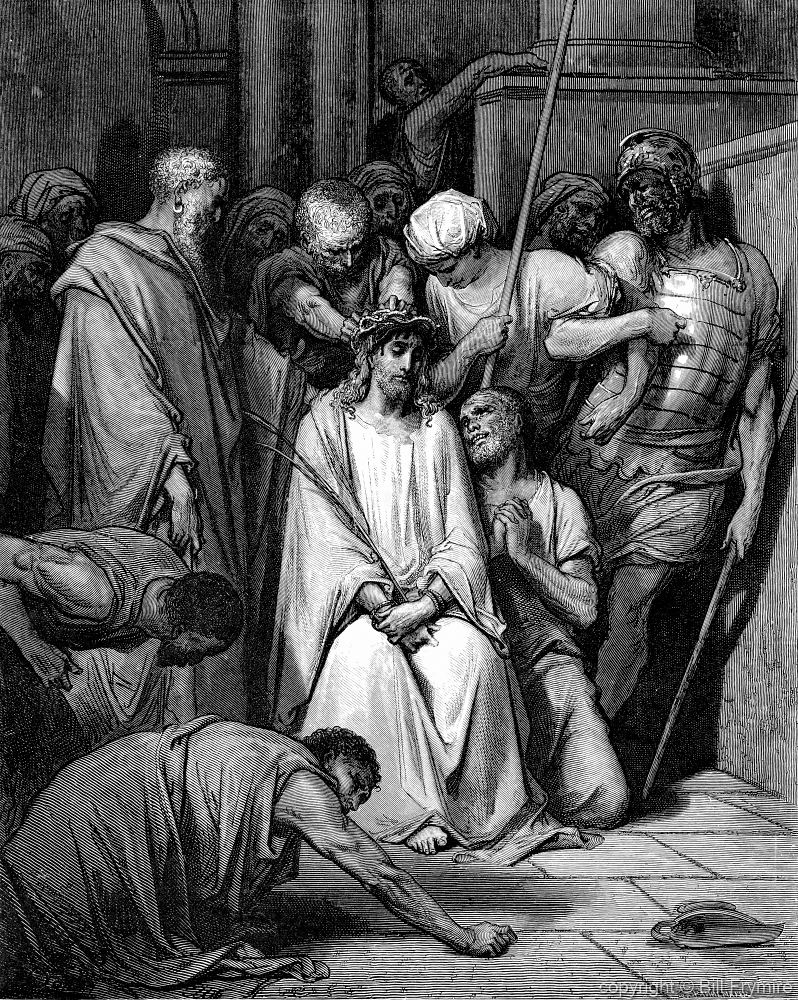
They dressed Him in a purple robe, twisted together a crown of thorns, and set it on His head.
Introduction
Mark, The Gospels, Mark Overview.
Mark wrote for believers in Rome who had seen crucifixions and whose friends had died under Nero. This chapter covers one day, from dawn before the governor to sunset at a tomb. Mark counts the hours, and his readers could follow them. The charge is political and the sentence Roman. Listen for the titles given to Jesus, first by his enemies in mockery and last by one man in earnest. Notice who is named among the bystanders and why Mark's first hearers might have known them. The chapter ends with his body laid in a borrowed grave.
Context
- Who
- Roman readers who had watched crucifixions in their own city
- What
- The trial before Pilate, the release of Barabbas, the mocking, the crucifixion, the death of Jesus and his burial.
- Where
- The governor's headquarters in Jerusalem, the soldiers' courtyard, Golgotha outside the city, and a tomb cut in rock nearby.
- When
- The Friday of Passover week, from early morning to evening, about AD 30 or 33.
- Why
- To show the King of the Jews crowned with thorns and killed, and a Roman officer confessing him as the Son of God.
Historical context
The Jewish council could not execute; Rome kept capital power in the governor's hands. So the charge presented to Pilate is political, king of the Jews, because that is a charge a Roman official must act on.
Show the rest of the historical context, 4 more paragraphs
The mockery happens inside the praetorium, and Mark says the whole cohort was called together. A cohort on paper was around six hundred men. The purple cloak and the twisted thorn crown are a soldiers' parody of an emperor's triumph, complete with a mock salute.
Mark names Simon of Cyrene as the father of Alexander and Rufus. He gives those names because his readers evidently knew them, a Rufus is greeted in Paul's letter to the Roman church, which means the man pressed into carrying the crossbeam had sons sitting in the congregation Mark wrote for. Roman soldiers had the legal right to compel a provincial to carry a load, and they used it here.
Crucifixion normally took a long time, which is why Pilate is surprised at the quick death and checks with the centurion. The victim was fixed with iron nails through the wrists and feet, a heel bone with a nail still through it, from a crucified man of this period, was found near Jerusalem in 1968, and death came by exhaustion and suffocation, sometimes over days. The execution squad divided the clothing among themselves as a matter of course.
Mark marks the hours in the Roman-influenced reckoning of the day: the third hour when he was crucified, darkness from the sixth to the ninth, and death at the ninth.
Significance
Mark has kept the true identity half-hidden the whole book. It breaks open here, and the person who says it is the centurion in charge of the execution: truly this man was the Son of God. A Roman officer, over a Roman execution, in a Gospel written for Romans.
Show the rest of the significance, 1 more paragraph
For a church whose own people were dying under Nero, the torn curtain mattered as much. The barrier into the holiest place split from top to bottom at the moment he died, and access to God was no longer held behind anyone's gate.
The heads below are this chapter's scenes. The numbered points under each are its verses.
Pilate, Barabbas, and the Shouting Crowd
the whole Sanhedrin devised a plan: Early in the morning the Sanhedrin handed Jesus over to Pilate, because under the occupation Rome alone held the power of capital punishment. The charge moves from blasphemy, a religious charge, to kingship, a Roman civil one.
Mark 15:1
“For Him it behoved to be made a sacrifice on behalf of all Gentiles, who "was led as a sheep for a victim, and, like a lamb voiceless before his shearer, so opened not His mouth" (for He, when Pilate interrogated Him, spake nothing ); for "in humility His judgment was taken away: His nativity, moreover, who shall declare?”
Tertullian · written before 220 · An Answer to the Jewspatristic
1 more voice on this verseWhat preachers and commentators have said about this verse, in their own words.
Mark 15:1
“These verses begin the chapter in which Mark describes the slaying of "the Lamb of God, who takes away the sin of the world." It is a part of the Gospel history which should always be read with peculiar reverence. We should call to mind, that Christ was cut off, not for Himself, but for us. (Dan. 9:26.) We should remember that His death is the life of our souls, and that unless His blood had been shed, we must have perished miserably in our sins.”
Mark 15:2-3
Pilate asks, Are You the King of the Jews, using the political title in place of the religious one. Jesus answers, You have said so, then keeps silent as He did before the Sanhedrin at 14:61.
Mark 15:2
“Note, As Christ spoke to admiration, so he kept silence to admiration. The proposal Pilate made to the people, to have Jesus released to them, since it was the custom of the feast to grace the solemnity with the release of one prisoner.”
Matthew Henry · Commentary on the Whole Bible (1707-1721)puritan
accuse Him of many things: Gill lists the many things as perhaps blasphemy, a claim to be King of the Jews, and a ban on paying tax to Caesar. Augustine, on verse 4, points to Luke 23:2 for the charges the chief priests were bringing.
Mark 15:3
“And the chief priests accused him of many things,.... As that he was a magician, and a blasphemer, and gave out that he was the Son of God; and that he made himself a king, and even forbad the people to give tribute to Caesar, and moved discord, sedition, and rebellion throughout the land; but he answered nothing. This clause is wanting in the Vulgate Latin, Syriac, Arabic, and Persic versions; but is in the Greek text of the Complutensian edition, and in the Ethiopic version, and agrees with Mat 27:12; see Gill on Mat 27:12.”
Mark 15:4-5
Pilate questioned Him again, Have You no answer, and set the many charges before Him, but Jesus made no further reply, to Pilate’s amazement. A Roman governor was unused to a prisoner who declined every chance to defend himself, and this is the silence described in Isaiah 53:7.
Mark 15:4
“And Pilate asked him again,.... In the presence of the chief priests, who laid so many things to his charge; for the former question was put, when Jesus and he were alone in the judgment hall, whither the Jews would not enter for fear of being defiled; see Joh 18:28; saying, answerest thou nothing behold how many things they witness against thee? The charges were many, and very heinous, and which Pilate thought called for self-defence; See Gill on Mat 27:13.”
2 more voices on this verse
Mark 15:4
“A lamb, he is silent—yet he is "word," proclaimed by "the voice of one crying in the wilderness." He is weakened, wounded—yet he cures every disease and every weakness. He is brought up to the tree and nailed to it—yet by the tree of life he restores us.”
Gregory of Nazianzus · written before 390 · Oration 29, on the Son 20patristic
Mark 15:4
“The destruction of Jerusalem by the Chaldeans is said to be for the iniquity of the priests that shed the blood of the just, Lam. iv. Note, Wicked priests are generally the worst of men. The better any thing is, the worse it is when it is corrupted.”
Matthew Henry · Commentary on the Whole Bible (1707-1721)puritan
Jesus made no further reply: Augustine counts this silence as one of several, before the priests, before Herod and before Pilate, and links it to the lamb of Isaiah 53. Bede says Jesus declined a defence that might have won acquittal and so set aside the cross.
Mark 15:5
“He is the One who, although he was silent in his passion, will not be silent finally in the day of reckoning. He is our God, even if unrecognized. He is already known among the faithful and all who believe. When he comes manifesting himself in his second coming, he will not be silent. For although he was formerly hidden in humility, he will come manifested in power.”
Cyprian · written before 258 · Treatise IX. On the Advantage of Patience 23patristic
Mark 15:6-8
Pilate’s custom at the feast: It was Pilate’s custom at the feast to release to the people a prisoner of their choosing. No record of the custom survives outside the Gospels, though a governor's amnesty at a local festival was known in the Roman world.
Mark 15:6
“Now at that feast,.... The feast of the passover, which was at that instant; see Joh 18:39. The Syriac, Arabic, Persic, and Ethiopic versions read, "at every feast"; as if the following custom was used at every feast in the year, at the feasts of pentecost and tabernacles, as well as at the passover; whereas it was only at the latter: he released unto them one prisoner, whomsoever they desired; of this custom See Gill on Mat 27:15.”
1 more voice on this verse
Mark 15:6
“Here are two goats; one is the scape goat, that is, one loosed and sent out into the wilderness of hell with the sin of the people; the other is slain, as a lamb, for the sins of those who are forgiven. The Lord's portion is always slain; the devil's part, (for he is the master of those men, which is the meaning of Barabbas,) when freed, is cast headlong into hell.”
Pseudo-Jerome · Catena Aurea by Aquinaspatristic
a man named Barabbas: Mark names the crime of Barabbas so the choice before the crowd is plain, the Glossa Ordinaria notes. Bede, on verse 6, sees Pilate setting a murderer from the insurrection beside Jesus as a way to release Him. Pseudo-Jerome, on verse 6, recalls the two goats of Leviticus 16.
Mark 15:7
“And that the wickedness of the Jews might appear the greater, the enormity of the sin of the robber, whom they preferred to Christ, is next described. Wherefore there follows: And there was one Barabbas, who lay bound with them that had made insurrection with him, who had committed murder in the insurrection.”
Glossa Ordinaria · written before 1274 · Catena Aurea by Aquinaspatristic
keep his custom: Manuscripts differ on the crowd's first move. Gill knew both readings, a crowd that went up to Pilate and a crowd that shouted, and he preferred the second. The verse above follows the first.
Mark 15:8
“The multitude crying aloud - Αναβοησας. The word itself strongly marks the vociferations, or, to come nearer the original word, the bellowing of the multitude. It signifies, properly, a loud and long cry, such as Christ emitted on the cross. See the whole history of these proceedings against our Lord treated at large, on Matthew 27 (note).”
Adam Clarke · Commentary on the Bible (1810-1826)evangelical
Mark 15:9-11
Pilate knew it was out of envy that the chief priests had handed Jesus over. But the chief priests stirred up the crowd to have him release Barabbas to them instead, turning a crowd that had cried Hosanna days before.
Mark 15:9
“But Pilate answered them; saying,.... Being satisfied of the innocence of Jesus, and being willing to dismiss him: will ye that I release unto you the king of the Jews? he who is called so; and which he either said by way of derision both of Christ, and them; or else in order to prevail upon them to ask his release, it being scandalous and reproachful to put their king to death.”
out of envy: Gill says the envy of the chief priests came from the crowds Jesus had drawn. Henry says Pilate knew it by setting their many charges beside how little they could prove. It explains the offer in verse 9.
Mark 15:10
“For he knew that the chief priests,.... The Persic version reads in the singular, "the chief of the priests", or the high priest, Caiaphas, had delivered him for envy; at his popularity through his doctrine and miracles, and not from any principle of equity and justice, or from any regard to Caesar; See Gill on Mat 27:18.”
1 more voice on this verse
Mark 15:10
“It was easy to see, comparing the eagerness of the prosecutors with the slenderness of the proofs, that it was not his guilt, but his goodness, not any thing mischievous or scandalous, but something meritorious and glorious, that they were provoked at.”
Matthew Henry · Commentary on the Whole Bible (1707-1721)puritan
stirred up the crowd: Gill pictures the chief priests stirring up the crowd in person and through officers among them. The crowd asked, but Mark names who moved it. Bede states the result: the crowd chose a murderer from the insurrection over Jesus.
Mark 15:11
“But the chief priests moved the people,.... Greatly solicited and persuaded them, both in person, and by their officers they employed, and dispersed among them, to make use of arguments with them to prevail upon them: that he should rather release Barabbas unto them; than Jesus of Nazareth; choosing rather to have a murderer granted unto them, than the holy and just one.”
Mark 15:12-14
Pilate asks, What evil has He done, and the crowd never answers it; they shouted all the louder. Their only reply is the demand for a Roman crucifixion.
Mark 15:12
“And Pilate answered and said again unto them,.... Being astonished that they should ask the release of such an infamous person; and being very desirous of saving Jesus: what will ye then that I shall do unto him, whom ye call the king of the Jews? at least many of you; would you have me put him to death? surely this can never be desired; or would you have me inflict some slight punishment on him, as scourging him, and so dismiss him? See Gill on Mat 27:22.”
1 more voice on this verse
Mark 15:12
“Though he was not so weak as to be governed by their opinion, to believe him guilty, yet he was so wicked as to be swayed by their outrage, to condemn him, though he believed him innocent; induced thereunto by reasons of state, and the wisdom of the world. Our Lord Jesus dying as a sacrifice for the sins of many, he fell a sacrifice to the rage of many.”
Matthew Henry · Commentary on the Whole Bible (1707-1721)puritan
they shouted back: Augustine reads this as a cry raised again, which shows the crowd had already shouted for Barabbas. Gill points to Luke 23:21, where the cry to crucify had been heard once before. Augustine praises Mark for putting a long exchange into few words.
Mark 15:13
“And they cried out again, crucify him. For they had cried so once before, though Matthew and Mark relate it not, yet Luke does, Luk 23:21.”
Gill counts this as Pilate's third question about what evil Jesus had done, following Luke 23:22. The crowd never answers it, as Bede observes. Bede hears their shouting in Jeremiah 12:8, where the Lord's own heritage cries out against Him like a lion.
Mark 15:14
“Then Pilate said unto them,.... The third time, Luk 23:22; why, what evil hath he done? worthy of death. They had charged him with many things, but proved nothing against him. Pilate could find no fault in him, and judged him an innocent person, and therefore was loth to condemn him: and they cried out the more exceedingly; with louder voices, and greater vehemency, the more they found he was inclined to save him: crucify him; nothing short of death would satisfy them, and no other death but that of the cross; See Gill on Mat 27:22, Mat 27:23.”
wishing to satisfy the crowd: , Pilate condemns a man in whom he could name no evil, because acquitting Him would cost a riot. He had Jesus flogged, and handed Him over to be crucified.
Mark 15:15
“He himself suffered the lash, in whose name his servants now scourge the devil and his angels. He who now crowns the martyrs with eternal garlands was himself crowned with thorns.”
Cyprian · written before 258 · Treatise IX. On the Advantage of Patience 7patristic
1 more voice on this verse
Mark 15:15
“A bloody death, and without blood no remission, Heb. ix. The blood is the life ( Gen. ix. 4 ); it is the vehicle of the animal spirits, which connect the soul and body, so that the exhausting of the blood is the exhausting of the life.”
Matthew Henry · Commentary on the Whole Bible (1707-1721)puritan
Mocked in the Praetorium
Mark 15:16-19
led Jesus away into the palace: The soldiers called the whole company together, likely several hundred men, and dressed Jesus in a purple robe with a crown of thorns. Their salute, Hail, King of the Jews, the blows and the kneeling made a parody of homage.
Mark 15:16
“Called Praetorium - The hall of the “praetor,” or Roman governor, where he sat to administer justice. Whole band - See the notes at Mat 27:27.”
1 more voice on this verse
Mark 15:16
“The passage we have now read, is one of those which show us the infinite love of Christ toward sinners. The sufferings described in it would fill our minds with mingled horror and compassion, if they had been inflicted on one who was only a man like ourselves. But when we reflect that the sufferer was the eternal Son of God, we are lost in wonder and amazement.”
twisted together a crown of thorns: Matthew calls the robe scarlet. Augustine explains that the soldiers used a scarlet cloak to mock the royal purple, a red close enough to pass for it. Cyril of Jerusalem notes that they meant it as parody, yet it was still a crown.
Mark 15:17
“With purple - Matthew says scarlet. See the notes at Mat 27:28. About his head - In the form of a garland or diadem. The whole head was not covered, but it was placed in a circle round the temples.”
1 more voice on this verse
Mark 15:17
“He who now gives true palms to the victors was beaten in the face with hostile palms; he who clothes all others with the garment of immortality was stripped of his earthly garment.”
Cyprian · written before 258 · Treatise IX. On the Advantage of Patience 7patristic
began to salute Him: Gill hears the soldiers' greeting as a mock wish for long life to a king on the day he receives his crown. Bede adds, from Matthew, a staff for a sceptre and soldiers kneeling as before a king. The title repeats Pilate's question in verse 2.
Mark 15:18
“And began to salute him, hail, king of the Jews! In a mock way, wishing him long life and prosperity, as if he was a king just come to his throne, and this was his coronation day.”
knelt down and bowed before Him: Gill notes that the staff was the reed they had given him for a sceptre, so each blow drove the thorns deeper. Barnes reads the kneeling as mock homage to a would-be king, Bede as mockery of one they thought falsely claimed to be God.
Mark 15:19
“And they smote him on the head with a reed,.... Or cane, a walking stick which they had put into his hands for a sceptre: this they took out again, and struck him on the head with it, which drove the sharp pointed thorns into his temples: and did spit upon him; "upon his face", as the Syriac, Arabic, and Persic versions read: and bowing their knees, as to a sovereign prince, worshipped him; saying the above words, hail, king of the Jews? See Gill on Mat 27:29, Mat 27:30.”
2 more voices on this verse
Mark 15:19
“In that very hour of his passion and cross, before they had come to the cruel act of his slaughter and the shedding of his blood, what violent abuses he listened to with patience, and what shameful insults he endured! He was even covered with the spittle of his revilers, when, but a short time before, with his own spittle he had cured the eyes of the blind man.”
Cyprian · written before 258 · Treatise IX. On the Advantage of Patience 7patristic
Mark 15:19
“Worshipped him - Mocked him with the “appearance” of homage. The word “worship” here denotes only the respect and honor shown to princes and kings. It does not refer to any “religious” homage. They regarded him as foolishly and madly claiming to be a king - not as claiming to be divine.”
Mark 15:20-21
removed the purple robe: The soldiers forced Simon of Cyrene, passing by on his way in from the country, to carry the cross of Jesus. Mark names him the father of Alexander and Rufus, men apparently known to his first readers as members of the early church.
Mark 15:20
“He who has given the food of heaven was fed with gall; he who has offered us the cup of salvation was given vinegar to drink. He the innocent, he the just, nay rather, innocence itself and justice itself is counted among criminals, and truth is concealed by false testimonies. He who is to judge is judged and the Word of God, silent, is led to the cross.”
Cyprian · written before 258 · Treatise IX. On the Advantage of Patience 7patristic
1 more voice on this verse
Mark 15:20
“WHEN our Lord had been condemned to die, the execution of His sentence was hurried. The Jews were in great haste to shed His blood. So intense was the enmity of the chief priests and Pharisees, that every moment of delay was wearisome to them. Besides, it was the day of the Passover and they wished to have this matter finished before they went, with hypocritical piety, to celebrate the festival of Israel's deliverance!”
Golgotha: Crucified at the Third Hour
Simon of Cyrene: John 19:17 says Jesus carried his own cross. Chrysostom answers the apparent conflict: Jesus carried it out of the Praetorium, and Simon took it on the way.
Mark 15:21
“A Cyrenian - One of Cyrene, a celebrated city in the Pentapolis of Libya. The father of Alexander and Rufus - It appears that these two persons were well known among the first disciples of our Lord. It is not unlikely that this is the same Alexander who is mentioned, Act 19:33, and that the other is the Rufus spoken of by St. Paul, Rom 16:13.”
Adam Clarke · Commentary on the Bible (1810-1826)evangelical
2 more voices on this verse
Mark 15:21
“Christ, moreover, he affirms to have been sent, not by this maker of the world, but by the above-named Abraxas; and to have come in a phantasm, and been destitute of the substance of flesh: that it was not He who suffered among the Jews, but that Simon was crucified in His stead: whence, again, there must be no believing on him who was crucified, lest one confess to having believed on Simon.”
Tertullian · written before 220 · Pseudo-Tertullian Against All Heresiespatristic
Mark 15:21
“JOHN tells us that our Savior went forth bearing His Cross (John 19:17). We are much indebted to John for inserting that fact. The other Evangelists mention Simon the Cyrenian as bearing the Cross of Christ, but John, who often fills up gaps which are left by the other three, tells us that Jesus set out to Calvary carrying His own Cross.”
Mark 15:22-23
a place called Golgotha: Golgotha means The Place of the Skull, one of Mark's kept transliterations of the Aramaic Gulgalta. There they offered Him wine mixed with myrrh, a mild narcotic given by custom to dull the pain, but He did not take it.
Mark 15:22
“And they bring him unto the place, Golgotha,.... A famous, or rather an infamous one, well known, and much noted for the many executions there: which is, being interpreted, the place of a skull; because the skulls of men that had been executed and buried there, being dug up again, lay scattered about; See Gill on Mat 27:33.”
wine mixed with myrrh: Matthew speaks of gall where Mark has myrrh, and Augustine takes gall as Matthew's word for anything bitter. He notes that Jesus tasted it first. Bede hears Psalm 69 in the scene, where the sufferer is given gall and sour wine.
Mark 15:23
“He is lifted up and nailed to the Tree, but by the Tree of Life He restoreth us; yea, He saveth even the Robber crucified with Him; yea, He wrapped the visible world in darkness. He is given vinegar to drink mingled with gall. Who? He who turned the water into wine, who is the destroyer of the bitter taste, who is Sweetness and altogether desire. He lays down His life, but He has power to take it again; and the veil is rent, for the mysterious doors of Heaven are opened; the rocks are cleft, the dead arise.”
Gregory of Nazianzus · written before 390 · Oration 29, On the Sonpatristic
Mark 15:24-25
divided His garments by casting lots: They divided His garments by casting lots, the ordinary spoils of a Roman execution squad; compare Psalm 22:18. It was the third hour when they crucified Him, about nine in the morning, six full hours before the death at the ninth hour.
It was the third hour: Mark and John 19:14 seem to disagree on the hour. Matthew Henry thinks John counts the Roman way, so his sixth hour is six in the morning, while Mark counts the Jewish way. Pseudo-Augustine says the third hour marks the sentence the Jews passed.
Mark 15:25
“Let your prayers be made at "the third hour"; for then it was that Pilate gave sentence upon our Lord and savior to have him crucified…. Let your prayers be made also at the sixth hour; for at that time he was crucified…. We observe also "the ninth hour" of prayer; for at that time the sun was darkened and the earth shaken with horror, as being not able to look upon those bitter cruelties.”
Apostolic Constitutions · written before 380 · Constitutions of the Holy Apostlespatristic
1 more voice on this verse
Mark 15:25
“He was brought before Pilate about the sixth hour ( John xix. 14 ), according to the Roman way of reckoning, which John uses, with which ours at this day agrees, that is at six o'clock in the morning; and then, at the third hour, according to the Jews' way of reckoning, that is, about nine of the clock in the morning, or soon after, they nailed him to the cross.”
Matthew Henry · Commentary on the Whole Bible (1707-1721)puritan
Mark 15:26-28
the charge inscribed against Him: read THE KING OF THE JEWS, giving Jesus the title Pilate used at 15:2. John's fuller account says it was written in Hebrew, Greek, and Latin for every passerby to read.
Mark 15:26
“And the superscription of his accusation,.... Or "the cause of his death", as the Syriac and Persic versions read; the crime for which he suffered: was written; over his head, upon the cross, to which it was fastened; the sum of which was, the king of the Jews; See Gill on Mat 27:37.”
2 more voices on this verse
Mark 15:26
“Want of justice, or courage, or common sense? The poor coward sacrifices justice to popular clamour, and enrages those whom he seeks to appease, by so unseasonably repeating that title, The king of the Jews, which he could not but know was so highly offensive to them. Praetorium - The inner hall, where the praetor, a Roman magistrate, used to give judgment.”
John Wesley · Explanatory Notes upon the New Testament (1755)evangelical
Mark 15:26
“Christ crucified is king of his church, his spiritual Israel; and even then when he hung on the cross, he was like a king, conquering his and his people's enemies, and triumphing over them, Col. ii. Now he was writing his laws in his own blood, and preparing his favours for his subjects.”
Matthew Henry · Commentary on the Whole Bible (1707-1721)puritan
Mark 15:27
two robbers, one on His right: Gill says the placement was meant as reproach, setting Jesus in the middle as if he led the band. Augustine sees the cross as a judgment seat, with the robber who believed on the right and the one who reviled on the left. Theophylact links the scene to Isaiah 53:12.
Mark 15:27
“Two thieves - A copy of the Itala tells their names: One on the right hand - named Zoathon; and one on the left hand - named Chammatha.”
Adam Clarke · Commentary on the Bible (1810-1826)evangelical
1 more voice on this verse
Mark 15:27
“Of the robbers crucified with him, it was said: "He was reckoned among the wicked." Up to this time both were wicked, but one of them was wicked no longer. For one was wicked to the end, yielding not to salvation, and, though his hands were fastened, he struck blasphemously with his tongue.”
Cyril of Jerusalem · written before 386 · Catechetical Lecture 13:30patristic
Mark 15:28
“And the scripture was fulfilled ... - This passage of Scripture is found in Isa 53:12. This does not mean that he “was” a transgressor, but simply that in dying he “had a place” with transgressors. Nor does it mean that God regarded him as a sinner; but that at his death, in popular estimation. or by the sentence of the judge, he was “regarded as” a transgressor, and was treated in the same manner as the others who were put to death for their transgressions.”
1 more voice on this verse
Mark 15:28
“In that famous prediction of Christ's sufferings ( Isa. liii. 12 ), it was foretold that he should be numbered with the transgressors, because he was made sin for us. The spectators, that is, the generality of them, instead of condoling with him in his misery, added to it by insulting over him.”
Matthew Henry · Commentary on the Whole Bible (1707-1721)puritan
Mark 15:29-32
heaped abuse on Him, shaking their heads: Those who passed by heaped abuse on Him, shaking their heads as in Psalm 22:7. The chief priests and scribes asked a sign, that the Christ come down now from the cross, while the resurrection lay three days off.
Mark 15:29
Those who passed by wagged their heads, mocking the crucified, fulfilling the Scripture: "When they see me, they shake their heads."
Cyril of Jerusalem · written before 386 · Catechetical Lecture 13:30patristic
come down from the cross: Gill hears the taunt as a test of his claims: a man with such power could surely free himself. Theophylact, on verse 29, answers that the cross was where salvation was being won, so coming down would have undone it. The same taunt returns in verse 32.
Mark 15:30
“Save thyself, and come down from the cross. Suggesting that if he was what he had pretended to be, and could do what he gave out he could, he might easily free himself from the cross, and make his escape; See Gill on Mat 27:39, Mat 27:40.”
Bede notes that the chief priests say He saved others even while they mock Him. Theophylact thinks they meant His saving works were only tricks. Gill notes that in the Syriac the chief priests and scribes laugh among themselves, sure they have won.
Mark 15:31
“Likewise also the Chief Priests mocking said among themselves with the Scribes, He saved others, himself he cannot save. They said this, to do away with His miracles, as though those which He had done were but the semblance of them, for by working miracles He saved many.”
Theophylact of Ohrid · written before 1107 · Catena Aurea by Aquinaspatristic
so that we may see: In Luke only one of those crucified with Him berated Him, and Augustine thinks Mark speaks of both for one man. Chrysostom holds that both berated Him at first and one changed when darkness came over the land. Bede says rising from the tomb was the greater sign.
Mark 15:32
“Let Christ the king of Israel,.... Who sets up for the Messiah, and whose followers call him the king of Israel, whom the nation expected: and if he is so, let him descend now from the cross, that we may see; see him come down, and be eyewitnesses of his power: and believe; that he is the Messiah that was prophesied of, and has been waiting for: and they that were crucified with him reviled him; that is, the thieves, at least one of them; See Gill on Mat 27:44.”
Darkness, the Loud Cry, and the Centurion's Words
darkness came over all the land: From the sixth hour until the ninth hour darkness came over all the land, from about noon until three in the afternoon. Passover fell at the full moon, when an eclipse of the sun cannot occur. Amos 8:9 speaks of the sun going down at noon.
Mark 15:33
“And when the sixth hour was come,.... Or twelve o'clock at noon, having hung upon the cross from about the third hour, or nine in the morning: there was darkness over the, whole land until the ninth hour; or three o'clock in the afternoon. The Ethiopic version renders the whole thus, "and when it was noon, the sun was darkened, and the whole world was darkened until the ninth hour"; See Gill on Mat 27:45.”
2 more voices on this verse
Mark 15:33
“We have in these verses the death of our Lord Jesus Christ. All deaths are solemn events. Nothing in the whole history of a man is so important as his end. But never was there a death of such solemn import as that which is now before us. In the instant that our Lord drew His last breath, the work of atonement for a world's sin was accomplished. The ransom for sinners was at length paid. The kingdom of heaven was thrown fully open to all believers.”
Mark 15:33
“Now the scripture was fulfilled ( Amos viii. 9 ), I will cause the sun to go down at noon, and I will darken the earth in the clear day; and Jer. xv. 9 , Her sun is gone down while it is yet day.”
Matthew Henry · Commentary on the Whole Bible (1707-1721)puritan
Jesus cries out Psalm 22:1 kept in Aramaic, Eloi, Eloi, lema sabachthani. Only here in Mark does Jesus address the Father as God. Psalm 22 turns from lament to vindication by its end.
Mark 15:34
“And at the ninth hour Jesus cried with a loud voice,.... See Gill on Mat 27:46; saying, Eloi, Eloi, lama sabachthani? in Matthew it is, "Eli, Eli", Both "Eli" and "Eloi", are Hebrew words, and signify the same; and are both used in Psa 22:1, from whence the whole is taken: which is, being interpreted, my God, my God, why hast thou forsaken me? See Gill on Mat 27:46.”
1 more voice on this verse
Mark 15:34
As human he doubts. He experiences amazement. It is not his divinity that doubts, but his human soul. He had no difficulty being amazed because he had taken humanity fully to himself. In taking upon himself a human soul, he also took upon himself the affections of a soul. As God he was not distressed, but as a human he was capable of being distressed. It was not as God he died, but as man. It was in human voice that he cried: "My God, My God, why have you forsaken me?"
Ambrose of Milan · written before 397 · Exposition of the Christian Faith 2.7.56patristic
Cross references
Mark 15:34
- QuotingPsalms 22:1“My God, my God, why have You forsaken me? Why are You so far from saving me, so far from my words of groaning?”
'Eloi, Eloi, lama sabachthani', cry of dereliction
Mark 15:35-36
Some standing nearby heard Eloi and said, He is calling Elijah, whether by mistake or in mockery. Elijah was expected before the Messiah's final vindication, and one says, Let us see if Elijah comes to take Him down.
filled a sponge with sour wine: Bede points to John 19:28 for the reason: Jesus had said that he was thirsty. Augustine notes that Matthew puts the words about Elijah in the mouths of others, and concludes that both the man and the bystanders said them. Matthew Henry reads the offer as one more insult.
Mark 15:37-39
Jesus let out a loud cry and breathed His last: Mark uses the same word for the veil of the temple torn in two and for the heavens torn open at the baptism in 1:10. The Gentile centurion's confession, Truly this man was the Son of God, answers 1:1.
Mark 15:37
“Gave up the ghost - This was about three o’clock, or what was termed by the Jews the ninth hour; about the time that the paschal lamb was usually sacrificed. The darkness mentioned here must have endured about two hours and a half. Concerning this eclipse, see on Mat 27:45 (note).”
Adam Clarke · Commentary on the Bible (1810-1826)evangelical
torn in two from top: Theophylact reads the tear as a sign that the Holy of Holies would now lie open to all. Bede says the veil tore so that what it had covered might appear.
Mark 15:38
“And the vail of the temple was rent in twain, from the top to the bottom. At which time also there was an earthquake, and the rocks were rent, and graves were opened, as Matthew relates; see Gill on Mat 27:51, Mat 27:52.”
1 more voice on this verse
Mark 15:38
“He surrenders his life, yet he has power to take it again. Yes, the veil is torn, for things of heaven are being revealed, rocks split, and dead men have an earlier awakening.”
Gregory of Nazianzus · written before 390 · Oration 29, on the Son 20patristic
Bede and Augustine find the cause of the centurion's words in how Jesus breathed His last, at the moment He chose. Henry thinks the centurion meant less than he said. Theophylact sets the scene beside the next verse: the centurion confesses, the disciples are gone, and the women are watching.
Mark 15:39
“And when the centurion, which stood over against him,.... To watch him, that nobody released him, and that he did not come down from the cross himself; saw that he so cried out, and gave up the ghost; that he cried with so loud and strong a voice, and the next moment expired: he said, truly this man was the Son of God; and so said the rest of the soldiers that were with them, as appears from Mat 27:54; see Gill on Mat 27:54.”
3 more voices on this verse
Mark 15:39
“Many indeed are the wondrous happenings of that time: God hanging from a cross, the sun made dark and again flaming out; for it was fitting that creation should mourn with its creator. The temple veil rent, blood and water flowing from his side: the one as from a man, the other as from what was above man; the earth shaken, the rocks shattered because of the rock; the dead risen to bear witness to the final and universal resurrection of the dead. The happenings at the sepulcher and after the sepulcher, who can fittingly recount them?”
Gregory of Nazianzus · written before 390 · On the Holy Pasch, Oration 45.1patristic
Mark 15:39
“The death of our Lord Jesus Christ is the most important fact in Christianity. On it depend the hopes of all saved sinners both for time and eternity. We need not therefore to be surprised to find the reality of His death carefully placed beyond dispute. Three kinds of witnesses to the fact are brought before us in the verses we have now read. The Roman centurion, who stood near the cross, — the women, who followed our Lord from Galilee to Jerusalem, — the disciples, who buried Him. All were all witnesses that Jesus really died.”
Mark 15:39
"Surely," thinks he, "this must be some divine person, highly beloved of God." This he expresses by such words as denote his eternal generation as God, and his special designation to the office of Mediator, though he meant not so. Our Lord Jesus, even in the depth of his sufferings and humiliation, was the Son of God, and was declared to be so with power.
Matthew Henry · Commentary on the Whole Bible (1707-1721)puritan
Mark 15:40-41
women watching from a distance: Women watched from a distance, among them Mary Magdalene, Mary the mother of James the younger and of Joses, and Salome. The men had fled at Gethsemane; these women stay, the last witnesses at the cross and the first at the tomb.
Mark 15:40
“There were also women looking on afar off,.... At some distance from the cross, observing what was said and done; among whom was Mary Magdalene; who had received great favours from Christ: and Mary the mother of James the less; or "little", so called to distinguish him from James the son of Zebedee, and because he might be little of stature: nor was it unusual with the Jews to distinguish persons after this manner: so we read (z) of R.”
ministered to Him while He was: Mark names their service only here, at the cross. Bede calls it an accepted custom for women to supply teachers with food and clothing. Gill points to Luke 8:3 for their giving from their own means.
Mark 15:41
“Who also, when he was in Galilee, followed him,.... Wherever he went in Galilee, and from thence to Jerusalem: and ministered unto him; of their worldly substance, Luk 8:3, and many other women which came up with him into Jerusalem; from the same parts; see Mat 27:55.”
Laid in a Tomb Cut Out of the Rock
Mark 15:42-43
it was Preparation Day: , and Jewish law required burial before sundown. Joseph of Arimathea, a prominent Council member, boldly asked Pilate for the body of Jesus, risking his own standing.
Mark 15:42
“And now when the even was come,.... "Of the preparation", as the Syriac version reads; or "the night of the sixth day":, as the Persic version renders it, "Friday" night: because it was the preparation; of the passover, and of the sabbath, when they prepared their food, and got it ready for the ensuing sabbath, on which it was not lawful to dress any; that is, the day before the sabbath; that is, Friday; on which day, it is clear, Christ suffered, died, and was buried.”
2 more voices on this verse
Mark 15:42
“The day before the Sabbath - What we would call Friday evening. As the law of Moses had ordered that no criminal should continue hanging on a tree or gibbet till the setting of the sun, Joseph, fearing that the body of our Lord might be taken down, and thrown into the common grave with the two robbers, came and earnestly entreated Pilate to deliver it to him, that he might bury it in his own new tomb. See on Mat 27:56, Mat 27:60 (note).”
Adam Clarke · Commentary on the Bible (1810-1826)evangelical
Mark 15:42
“Yesterday the lamb was slain, and the door posts sprinkled with his blood, while Egypt mourned for her firstborn. But the destroying angel and his sacrificial knife, fearful and terrifying, passed over us, for we were protected by the precious blood. This day we have wholly departed from Egypt, and from Pharaoh, its cruel tyrant, and his oppressive overseers.”
Gregory of Nazianzus · written before 390 · On the Holy Pasch and His Own Reluctancepatristic
waiting for the kingdom of God: Bede identifies Arimathea with Ramathaim, the town of Samuel. Clarke, citing John 19:38, notes that Joseph had kept his faith hidden and now went boldly to Pilate for the body of Jesus. Chrysostom says Joseph risked his own death by asking.
Mark 15:43
“Joseph of Arimathea, an honourable counsellor,.... A man of a good aspect, well dressed, and that behaved well and honourably in his office, as a counsellor: he seems to have been a priest, and one of the bench of priests that sat in the high priest's chamber, which is called, לשכת בלווטי, "the chamber of the counsellors" (d); with whom he advised there, in matters of moment: which also waited for the kingdom of God; for the coming and kingdom of the Messiah, for the Gospel dispensation, the world to come, the Jews were so much in expectation of.”
3 more voices on this verse
Mark 15:43
“Joseph, an honorable counselor - A distinguished man, who probably held a high office among the Jews, as one of their great council, or a Jewish senator. The word “honorable,” here, is not a mere title of “office,” but is given in reference to his personal character, as being a man of integrity and blameless life. Waited for the kingdom of God - Waited for, or expected, the coming of the Messiah. But this expression means more than an “indefinite” expectation that the Messiah “would” come, for all the Jews expected that.”
Mark 15:43
“On the day of the preparation, then, at the third hour, He received the sentence from Pilate, the Father permitting that to happen; at the sixth hour He was crucified; at the ninth hour He gave up the ghost; and before sunset He was buried. During the Sabbath He continued under the earth in the tomb in which Joseph of Arimathaea had laid Him.”
Ignatius of Antioch · written before 108 · Epistle of Ignatius to the Trallianspatristic
Mark 15:43
“IT was a very dark day with the Church of God and with the cause of Christ, for the Lord Jesus was dead, and so the sun of their souls had set. "All the disciples forsook Him, and fled." "You shall be scattered, every man to his own, and shall leave Me alone," were the sad words of Jesus—and they had come true. He was dead upon the Cross and His enemies hoped that that was the end of Him—while even His friends feared that it was so.”
Mark 15:44-45
Pilate was surprised to hear that Jesus was already dead: , since crucified men commonly lingered a day or more. He confirmed it with the centurion, so Mark records the death confirmed by Pilate's own officer.
Mark 15:44
“It goes on: And Pilate marvelled if he were already dead. For he thought that He should continue long alive upon the cross, as also the thieves used to live long, upon the instrument of their execution. It goes on: And calling unto him the centurion, he asked him if he had been any while dead; that is, before the time when other executed persons usually died. There follows: And when he knew it of the centurion, (that is, that He was dead,) he gave the body to Joseph.”
Theophylact of Ohrid · written before 1107 · Catena Aurea by Aquinaspatristic
1 more voice on this verse
Mark 15:44
“And Pilate marveled if - Wondered if he was dead, or wondered that he was so soon dead. It was not common for persons crucified to expire under two or three days, sometimes not until the sixth or seventh. Joseph had asked for the “body,” implying that he was dead. That he was, had been ascertained by the soldiers. See Joh 19:33.”
granted the body to Joseph: Barnes notes that the centurion had command of the soldiers who watched the cross, so his report came firsthand. Matthew Henry, on verse 39, sees providence in Pilate's care: no one could later claim that Jesus was buried alive. The body was released on the word of Rome's own officer.
Mark 15:45
“When he knew it of the centurion - Being informed by the centurion of the fact that he was dead. The centurion had charge of the soldiers who watched him, and could therefore give correct information.”
Joseph bought a linen cloth: Joseph placed the body in a rock-cut tomb and rolled a stone against the entrance. The burial was done quickly before the Sabbath, and its details matter for what the women find in the next chapter.
Mark 15:46
“This above all shows the foolishness of those who say that the Word was changed into bones and flesh. For if this had been so, there would have been no need of a tomb. For the body would have gone by itself to preach to the spirits in Hades. But as it was, he himself went to preach, while the body that Joseph wrapped in a linen cloth laid away at Golgotha. And so it is demonstrated to all that the body was not the Word, but body of the Word.”
Athanasius of Alexandria · written before 373 · Letter 59, to Epictetus 6patristic
saw where His body was placed: Mary Magdalene and Mary the mother of Joseph saw where His body was placed, watching the burial itself. Mark names eyewitnesses of the death, the burial, and, in the next chapter, the empty tomb. The chapter that opened with the council's plan ends with two women watching.
Mark 15:47
“And Mary Magdalene, and Mary the mother of Joses,.... Or Joseph, as the Vulgate Latin and Ethiopic versions read: beheld where he was laid: very likely they saw Joseph, and his men, take him down from the cross, and they followed him, and observed where he laid him; or, as the Ethiopic version reads, "where they buried him"; placing themselves, as Matthew suggests, right "over against the sepulchre", Mat 27:61; so that they were witnesses of his death, and of his burial, as they afterwards were of his resurrection from the dead.”
1 more voice on this verse
Mark 15:47
“We read in Luke, that His acquaintances and the women who had followed Him stood afar off. When these then who were known to Jesus returned home after the burial of His body, the women alone, who were bound to Him with a closer love, after following the funeral, took care to see how He was laid, that they might be able at a fitting season to offer Him the sacrifice of their devotion.”
Bede · written before 735 · Catena Aurea by Aquinaspatristic
Keep studying
Studies9
People and groups1
Places1
Sources for this chapter
The summary
Jamieson, Fausset & Brown, Commentary Critical and Explanatory; John Calvin, Commentaries; John Wesley, Explanatory Notes Upon the New Testament and Matthew Henry, Complete Commentary.
The exposition
Adam Clarke, Commentary on the Bible; Albert Barnes; Alexander Maclaren, Expositions of Holy Scripture; Augustine of Hippo; Bede; Charles Spurgeon, The Gospel of the Kingdom; Cyprian, Treatise IX. On the Advantage of Patience 23; Cyril of Jerusalem, SERMON ON THE PARALYTIC 12; Glossa Ordinaria, Catena Aurea by Aquinas; J. C. Ryle, Expository Thoughts on the Gospels, Mark; Jamieson, Fausset & Brown, Commentary Critical and Explanatory on the Whole Bible; John Calvin, Commentary on a Harmony of the Evangelists; John Chrysostom; John Gill; John Lightfoot, Horae Hebraicae et Talmudicae on Matthew; Matthew Henry, Commentary on the Whole Bible; Pseudo-Augustine, Catena Aurea by Aquinas; Pseudo-Jerome, Catena Aurea by Aquinas and Theophylact of Ohrid.
The painting
The Crown of Thorns, Gustave Doré (engraving), public domain