
Mark 15:19
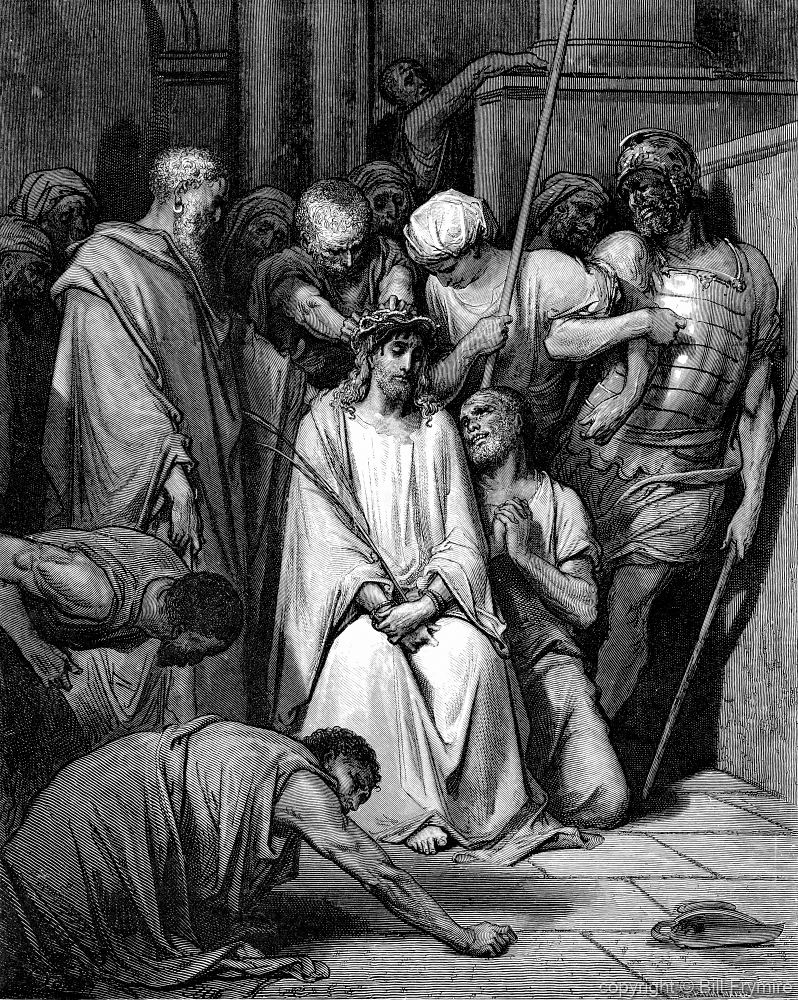
in Mark 15They kept striking His head with a staff and spitting on Him. And they knelt down and bowed before Him.
BSB
The same verse in ASV and KJV ▾
ASV
And they smote his head with a reed, and spat upon him, and bowing their knees worshipped him.
KJV
And they smote him on the head with a reed, and did spit upon him, and bowing their knees worshipped him.
⋯
This verse in Mark 15
Commentary
13 notes on this verseIn that very hour of his passion and cross, before they had come to the cruel act of his slaughter and the shedding of his blood, what violent abuses he listened to with patience, and what shameful insults he endured! He was even covered with the spittle of his revilers, when, but a short time before, with his own spittle he had cured the eyes of the blind man.
This site's exposition
into the hall, called Pretorium
on Mark 15:16-19
The soldiers led him away into the hall, called Pretorium, and call together the whole band, likely several hundred men, turning a Roman garrison's guardroom into a stage for organized cruelty. They clothed him with purple, likely a soldier's scarlet cloak read as royal purple, platted a crown of thorns, and mocked him with Hail, King of the Jews, striking him on the head with a reed and spitting on him while bowing their knees in a grotesque parody of homage. The bench reads the whole scene as unintended prophecy, Gentile soldiers performing before Jesus the very worship the nations would one day owe him in truth.
The record, by era
The Medieval Church5 voices
(ubi sup.) And that the soldiers worshipped Him as one who falsely called Himself God, is clear from what is added: And bowing their knees, worshipped him, as though He pretended to be God.
(ubi sup.) But they smite the head of Christ, who deny that He is very God. And because men are wont to use a reed to write with, they, as it were, smite the head of Christ with a reed, who speak against His divinity, and endeavour to confirm their error by the authority of Holy Writ. They spit in His face, who spit from them by their accursed words the presence of His grace. There are some also in this day, who adore Him, with a sure faith, as very God, but by their perverse actions, despise His words as though they were fabulous, and think the promises of that word inferior to worldly allurements. But just as Caiaphas said, though he knew not what it meant, It is expedient for us that one man should die for the people, (John 11:50) so also the soldiers do these things in ignorance.
The vainglory of soldiers, ever rejoicing in disorder and in insult, here displayed what properly belonged to them. Wherefore it is said, And the soldiers led him away into the hall called Praetorium, and they call together the whole band, that is, the whole company of the soldiers, and they clothed him with purple as a king. Let us also put on the purple and royal robe, because we must walk as kings treading on serpents and scorpions, and 1 having sin under our feet. For we are called Christians, that is, anointed ones, just as kings were then called anointed. Let us also take upon ourselves the crown of thorns, that is, let us make haste to be crowned with a strict life, with self-denials and purity.
His shame took away our shame; His bonds made us free; by the thorny crown of His head, we have obtained the crown of the kingdom; by His wounds we are healed. But in a mystic sense, Jesus was stripped of His clothes, that is, of the Jews, and is clothed in a purple robe, that is, in the Gentile church, which is gathered together out of the rocks. Again, putting it off in the end, as offending, He again is clothed with the Jewish people, for when the fulness of the Gentiles is come in, then shall all Israel be saved. (Rom. 11:25.)
The military class, always finding consolation in acts of violence and insult, now too displayed its customary character. For if the Jews, who had heard so many teachings from Christ and had received from Him so often and so many benefactions, inflicted upon Him so …
6 more voices on this verse
The Medieval Church2 voices
And they were striking his head with a reed and spitting upon him. And kneeling down, they worshipped him. These things then the soldiers of Pilate did, these things up to today the heretics and pagans do, indeed the soldiers of the devil. For since …
And indeed the soldiers, as if he had falsely claimed to be God, mocked and adored him. But today there are those, with greater madness, who adore him with firm faith as true God, but by perverse actions soon despise his words as if fanciful, …
The Puritans and the Awakening1 voice
And they smote him on the head with a reed,.... Or cane, a walking stick which they had put into his hands for a sceptre: this they took out again, and struck him on the head with it, which drove the sharp pointed thorns into his temples: and did spit upon him; "upon his face", as the Syriac, Arabic, and Persic versions read: and bowing their knees, as to a sovereign prince, worshipped him; saying the above words, hail, king of the Jews? See Gill on Mat 27:29, Mat 27:30.
The Nineteenth Century3 voices
A commentator
Albert Barnes1798–1870
Notes, Explanatory and Practical, on the Old and New Testaments (1832-1869)
Worshipped him - Mocked him with the “appearance” of homage. The word “worship” here denotes only the respect and honor shown to princes and kings. It does not refer to any “religious” homage. They regarded him as foolishly and madly claiming to be a king - not as claiming to be divine.
A commentator
J.C. Ryle1816–1900
Expository Thoughts on the Gospels: Mark (lightly modernized text, Grace Gems edition) (1857)
The passage we have now read, is one of those which show us the infinite love of Christ toward sinners. The sufferings described in it would fill our minds with mingled horror and compassion, if they had been inflicted on one who was only a man like ourselves. But when we reflect that the sufferer was the eternal Son of God, we are lost in wonder and amazement.
A commentator
J.C. Ryle1816–1900
Expository Thoughts on the Gospels: Mark (lightly modernized text, Grace Gems edition) (1857)
proposed
The passage we have now read, is one of those which show us the infinite love of Christ toward sinners. The sufferings described in it would fill our minds with mingled horror and compassion, if they had been inflicted on one who was only a man like ourselves. But when we reflect that the sufferer was the eternal Son of God, we are lost in wonder and amazement. And when we reflect further that these sufferings were voluntarily endured to deliver sinful men and women like ourselves from hell, we may see something of Paul's meaning when he says, "The love of Christ passes knowledge." "God commends His love toward us in that while we were yet sinners, Christ died for us." (Ephes. 3:19; Rom. 5:8.) We shall find it useful to examine separately the several parts of our Lord's passion. Let us follow Him step by step from the moment of His condemnation by Pilate to His last hour upon the cross. There is a deep meaning in every jot and tittle of His sorrows. All were striking emblems of spiritual truths. And let us not forget as we dwell on the wondrous story, that we and our sins were the cause of all these sufferings. "Christ suffered for sins, the just for the unjust, that He might bring us to God." (1 Peter 3:18.) It is the death of our own Surety and Substitute that we are reading. First of all we see Jesus delivered into the hands of the Roman soldiers, as a criminal condemned to death. He before whom the whole world will one day stand and be judged, allowed Himself to be sentenced unjustly, and given over into the hands of wicked men. And why was this? It was that we, the poor sinful children of men, believing on Him, might be delivered from the pit of destruction, and the torment of the prison of hell. It was that we might be set free from every charge in the day of judgment, and be presented faultless before God the Father with exceeding joy.
The words behind it
15 Greek wordsEvery Greek word of this verse in the order it stands, with what it means and the door to its own study. The last column counts the times a word stands in the whole Bible: the rarer the word, the more the places it appears belong together.
| Greek | Sound | Meaning | Word study | In the Bible |
|---|---|---|---|---|
| καὶ | kai | And | G2532 → | 9120 times |
| ἔτυπτον | etupton | they were striking | G5180 → | |
| αὐτοῦ | autou | His | G846 → | 5565 times |
| τὴν | ten | <the> | G3588 → | 19766 times |
| κεφαλὴν | kephalen | head | G2776 → | 75 times |
| καλάμῳ | kalamo | with a reed | G2563 → | |
| καὶ | kai | and | G2532 → | 9120 times |
| ἐνέπτυον | eneptuon | were spitting | G1716 → | 6 times |
| αὐτῷ, | auto | on Him, | G846 → | 5565 times |
| καὶ | kai | and | G2532 → | 9120 times |
| τιθέντες | tithentes | bending | G5087 → | 100 times |
| τὰ | ta | the | G3588 → | 19766 times |
| γόνατα | gonata | knees | G1119 → | |
| προσεκύνουν | prosekunoun | they were kneeling down | G4352 → | |
| αὐτῷ. | auto | to Him. | G846 → | 5565 times |
καὶAnd
kaiG2532 →9120 times
ἔτυπτονthey were striking
etuptonG5180 →
αὐτοῦHis
autouG846 →5565 times
τὴν<the>
tenG3588 →19766 times
κεφαλὴνhead
kephalenG2776 →75 times
καλάμῳwith a reed
kalamoG2563 →
καὶand
kaiG2532 →9120 times
ἐνέπτυονwere spitting
eneptuonG1716 →6 times
αὐτῷ,on Him,
autoG846 →5565 times
καὶand
kaiG2532 →9120 times
τιθέντεςbending
tithentesG5087 →100 times
τὰthe
taG3588 →19766 times
γόναταknees
gonataG1119 →
προσεκύνουνthey were kneeling down
prosekunounG4352 →
αὐτῷ.to Him.
autoG846 →5565 times
A shaded row is a word that stands 400 times or fewer in the Bible.
The walk
8 stopsEach card is a verse this one points to, and under it the verses that one points to in turn. Where several paths arrive at the same place, that place is listed first: the text keeps returning to it.
Through
Mark 9:12He replied, “Elijah does indeed come first, and he restores all things. Why then is it written that the Son of Man must suffer many things and be rejected?
it leads to
- Isaiah 50:6
I offered My back to those who struck Me, and My cheeks to those who tore out My beard. I did not hide My face from scorn and spittle.
Reached by 2 separate paths from here.
- Isaiah 53:1–12
Who has believed our message? And to whom has the arm of the LORD been revealed?
- Isaiah 52:14
Just as many were appalled at Him—His appearance was disfigured beyond that of any man, and His form was marred beyond human likeness—
- Isaiah 40:3–5
A voice of one calling: “Prepare the way for the LORD in the wilderness; make a straight highway for our God in the desert.
- Luke 1:16–17
Many of the sons of Israel he will turn back to the Lord their God.
- Isaiah 50:6
Through
1 Kings 19:18Nevertheless, I have reserved seven thousand in Israel—all whose knees have not bowed to Baal and whose mouths have not kissed him.”
it leads to
- Romans 11:4–5
And what was the divine reply to him? “I have reserved for Myself seven thousand men who have not bowed the knee to Baal.”
- Isaiah 1:9
Unless the LORD of Hosts had left us a few survivors, we would have become like Sodom, we would have resembled Gomorrah.
- Isaiah 10:20–22
On that day the remnant of Israel and the survivors of the house of Jacob will no longer depend on him who struck them, but they will truly rely on the LORD, the Holy…
- Romans 11:4–5
Where this verse is studied
About Mark
This page draws on 11 works. Open the list of works
This page draws on Albert Barnes, Notes, Explanatory and Practical, on the Old and New Testaments (1832-1869); Bede, Catena Aurea by Aquinas; Bede, On the Gospel of Mark; Cyprian, Treatise IX. On the Advantage of Patience 7; J.C. Ryle, Expository Thoughts on the Gospels: Mark (lightly modernized text, Grace Gems edition); Jamieson, Fausset & Brown, Commentary Critical and Explanatory on the Whole Bible; John Gill, Exposition of the New Testament (1746-1748); Matthew Henry, Commentary on the Whole Bible; Pseudo-Jerome, Catena Aurea by Aquinas; Theophylact of Ohrid, Catena Aurea by Aquinas and Theophylact of Ohrid, Commentary on Mark.