
Mark 15:11
in Mark 15But the chief priests stirred up the crowd to have him release Barabbas to them instead.
BSB
The same verse in ASV and KJV ▾
ASV
But the chief priests stirred up the multitude, that he should rather release Barabbas unto them.
KJV
But the chief priests moved the people, that he should rather release Barabbas unto them.
⋯
This verse in Mark 15
Commentary
9 notes on this verseHere are two goats; one is the scape goat, that is, one loosed and sent out into the wilderness of hell with the sin of the people; the other is slain, as a lamb, for the sins of those who are forgiven. The Lord's portion is always slain; the devil's part, (for he is the master of those men, which is the meaning of Barabbas,) when freed, is cast headlong into hell.
This site's exposition
Do you want me to release to you the King of the Jews
on Mark 15:9-11
Pilate knew it was out of envy that the chief priests had handed Jesus over. But the chief priests stirred up the crowd to have him release Barabbas to them instead, turning a crowd that had cried Hosanna days before.
This site's exposition
stirred up the crowd
Gill pictures the chief priests stirring up the crowd in person and through officers among them. The crowd asked, but Mark names who moved it. Bede states the result: the crowd chose a murderer from the insurrection over Jesus.
The record, by era
The Church Fathers1 voice
(ubi sup.) No one can feel it a difficulty that Matthew is silent as to their asking some one to be released unto them, which Mark here mentions; for it is a thing of no consequence that one should mention a thing which another leaves out. There follows: But Pilate answered them, saying, Will ye that I release unto you the King of the Jews? For he knew that the Chief Priests had delivered him for envy. Some one may ask, which were the words of which Pilate made use, those which are related by Matthew, or those which Mark relates; for there seems to be a difference between, Whom will ye that I release unto you? Barabbas, or Jesus which is called Christ? as Matthew has it; and, Will ye that I release unto you the King of the Jews? (Matt. 27:17) as is here said. But since they gave to kings the name of Christs, he who said this man or that must have asked whether they wished the King of the Jews to be released unto them, that is, Christ. It makes no difference to the sense that Mark has said nothing of Barabbas, wishing only to mention what belonged to the Lord, since by their answer he sufficiently showed whom they wished to have released to them. For there follows, But the Chief Priests moved the people that he should rather release unto them Barabbas.
The Medieval Church2 voices
But the chief priests stirred up the crowd that he might rather release Barabbas to them. To the Jews to this day remains their request, which they obtained with such effort. For given the choice, they chose a thief over Jesus, a murderer over the …
(ubi sup.) This demand which the Jews made with such toil to themselves still sticks to them. Because, when the choice was given to them, they chose a robber instead of Christ, a murderer instead of the Saviour, they deservedly lost their salvation and their life, and they subjected themselves to such a degree to robbery and sedition, that they lost their country and their kingdom which they preferred to Christ, and never regained their liberty, body or soul.
The Puritans and the Awakening1 voice
But the chief priests moved the people,.... Greatly solicited and persuaded them, both in person, and by their officers they employed, and dispersed among them, to make use of arguments with them to prevail upon them: that he should rather release Barabbas unto them; than Jesus of Nazareth; choosing rather to have a murderer granted unto them, than the holy and just one.
The Nineteenth Century1 voice
A commentator
J.C. Ryle1816–1900
Expository Thoughts on the Gospels: Mark (lightly modernized text, Grace Gems edition) (1857)
These verses begin the chapter in which Mark describes the slaying of "the Lamb of God, who takes away the sin of the world." It is a part of the Gospel history which should always be read with peculiar reverence. We should call to mind, that Christ was cut off, not for Himself, but for us. (Dan. 9:26.) We should remember that His death is the life of our souls, and that unless His blood had been shed, we must have perished miserably in our sins.
1 more voice on this verse
The Nineteenth Century1 voice
A commentator
J.C. Ryle1816–1900
Expository Thoughts on the Gospels: Mark (lightly modernized text, Grace Gems edition) (1857)
proposed
These verses begin the chapter in which Mark describes the slaying of "the Lamb of God, who takes away the sin of the world." It is a part of the Gospel history which should always be read with peculiar reverence. We should call to mind, that Christ was cut off, not for Himself, but for us. (Dan. 9:26.) We should remember that His death is the life of our souls, and that unless His blood had been shed, we must have perished miserably in our sins. Let us mark in these verses, what a striking proof the Jewish rulers gave to their own nation that the times of Messiah had come . The chapter opens with the fact, that the chief priests bound Jesus and "delivered Him to Pilate," the Roman Governor. Why did they do so? Because they had no longer the power of putting any one to death, and were under the dominion of the Romans. By this one act and deed they declared that the prophecy of Jacob was fulfilled. "The scepter had departed from Judah, and the lawgiver from between his feet," and Shiloh the Messiah, whom God had promised to send, must have come. (Gen. 49:10.) Yet there is nothing whatever to show that they remembered this prophecy. Their eyes were blinded. They either could not, or would not, see what they were doing. Let us never forget that wicked men are often fulfilling God's predictions to their own ruin, and yet know it not. In the very height of their madness, folly, and unbelief, they are often unconsciously supplying fresh evidence that the Bible is true. The unhappy scoffers who make a jest of all serious religion, and can scarcely talk of Christianity without ridicule and scorn, would do well to remember that their conduct was long ago foreseen and foretold. "There shall come in the last days scoffers, walking after their own lusts." (2 Peter 3:3) Let us mark, secondly, in these verses, the meekness and lowliness of our Lord Jesus Christ .
The words behind it
12 Greek wordsEvery Greek word of this verse in the order it stands, with what it means and the door to its own study. The last column counts the times a word stands in the whole Bible: the rarer the word, the more the places it appears belong together.
| Greek | Sound | Meaning | Word study | In the Bible |
|---|---|---|---|---|
| οἱ | hoi | <the> | G3588 → | 19766 times |
| δὲ | de | But | G1161 → | 2765 times |
| ἀρχιερεῖς | archiereis | the chief priests | G749 → | 122 times |
| ἀνέσεισαν | aneseisan | stirred up | G383 → | |
| τὸν | ton | the | G3588 → | 19766 times |
| ὄχλον | ochlon | crowd | G3793 → | 175 times |
| ἵνα | ina | so that | G2443 → | 668 times |
| μᾶλλον | mallon | instead | G3123 → | 81 times |
| τὸν | ton | <the> | G3588 → | 19766 times |
| Βαραββᾶν | barabban | Barabbas | G912 → | 11 times |
| ἀπολύσῃ | apoluse | he may release | G630 → | 63 times |
| αὐτοῖς.¶ | autois | to them. | G846 → | 5565 times |
οἱ<the>
hoiG3588 →19766 times
δὲBut
deG1161 →2765 times
ἀρχιερεῖςthe chief priests
archiereisG749 →122 times
ἀνέσεισανstirred up
aneseisanG383 →
τὸνthe
tonG3588 →19766 times
ὄχλονcrowd
ochlonG3793 →175 times
ἵναso that
inaG2443 →668 times
μᾶλλονinstead
mallonG3123 →81 times
τὸν<the>
tonG3588 →19766 times
ΒαραββᾶνBarabbas
barabbanG912 →11 times
ἀπολύσῃhe may release
apoluseG630 →63 times
αὐτοῖς.¶to them.
autoisG846 →5565 times
A shaded row is a word that stands 400 times or fewer in the Bible.
The walk
8 stopsEach card is a verse this one points to, and under it the verses that one points to in turn. Where several paths arrive at the same place, that place is listed first: the text keeps returning to it.
Through
Acts 3:14You rejected the Holy and Righteous One and asked that a murderer be released to you.
it leads to
- Mark 1:24
“What do You want with us, Jesus of Nazareth? Have You come to destroy us? I know who You are—the Holy One of God!”
- Acts 7:52
Which of the prophets did your fathers fail to persecute? They even killed those who foretold the coming of the Righteous One. And now you are His betrayers and murderers—
- 1 Peter 3:18
For Christ also suffered for sins once for all, the righteous for the unrighteous, to bring you to God. He was put to death in the body but made alive in the Spirit,
- Acts 4:27
In fact, this is the very city where Herod and Pontius Pilate conspired with the Gentiles and the people of Israel against Your holy servant Jesus, whom You anointed.
- James 5:6
You have condemned and murdered the righteous, who did not resist you.
- Mark 1:24
Through
Hosea 5:1“Hear this, O priests! Take heed, O house of Israel! Give ear, O royal house! For this judgment is against you because you have been a snare at Mizpah, a net spread out on…
it leads to
- Hosea 9:8
The prophet is Ephraim’s watchman, along with my God, yet the snare of the fowler lies on all his paths. Hostility is in the house of his God!
- Hosea 9:8
Through
Matthew 27:20But the chief priests and elders persuaded the crowds to ask for Barabbas and to have Jesus put to death.
it leads to
- John 19:15–16
At this, they shouted, “Away with Him! Away with Him! Crucify Him!” “Shall I crucify your King?” Pilate asked. “We have no king but Caesar,” replied the chief priests.
- Acts 3:14–15
You rejected the Holy and Righteous One and asked that a murderer be released to you.
- John 19:15–16
Where this verse is studied
On this page
About Mark
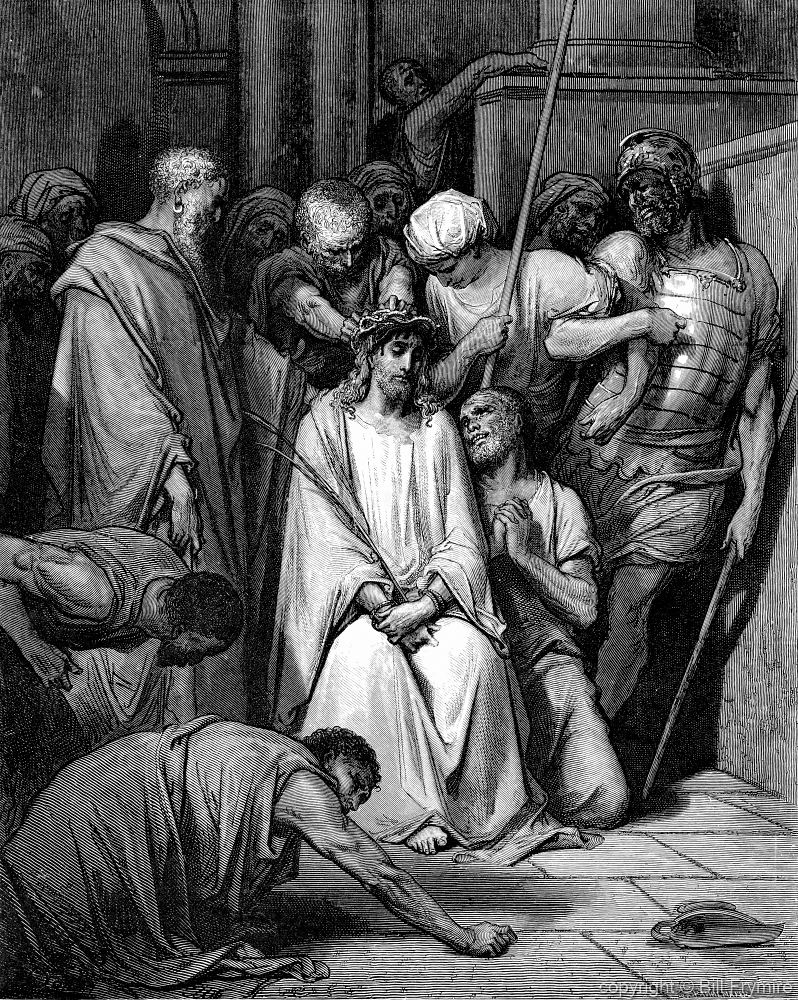
This page draws on Albert Barnes, Notes, Explanatory and Practical, on the Gospels; Augustine of Hippo, Catena Aurea by Aquinas; Bede, On the Gospel of Mark; Bede, Catena Aurea by Aquinas; J.C. Ryle, Expository Thoughts on the Gospels: Mark (lightly modernized text, Grace Gems edition); John Gill, Exposition of the New Testament; John Gill, Exposition of the New Testament (1746-1748) and Pseudo-Jerome, Catena Aurea by Aquinas.