
Mark 15:20
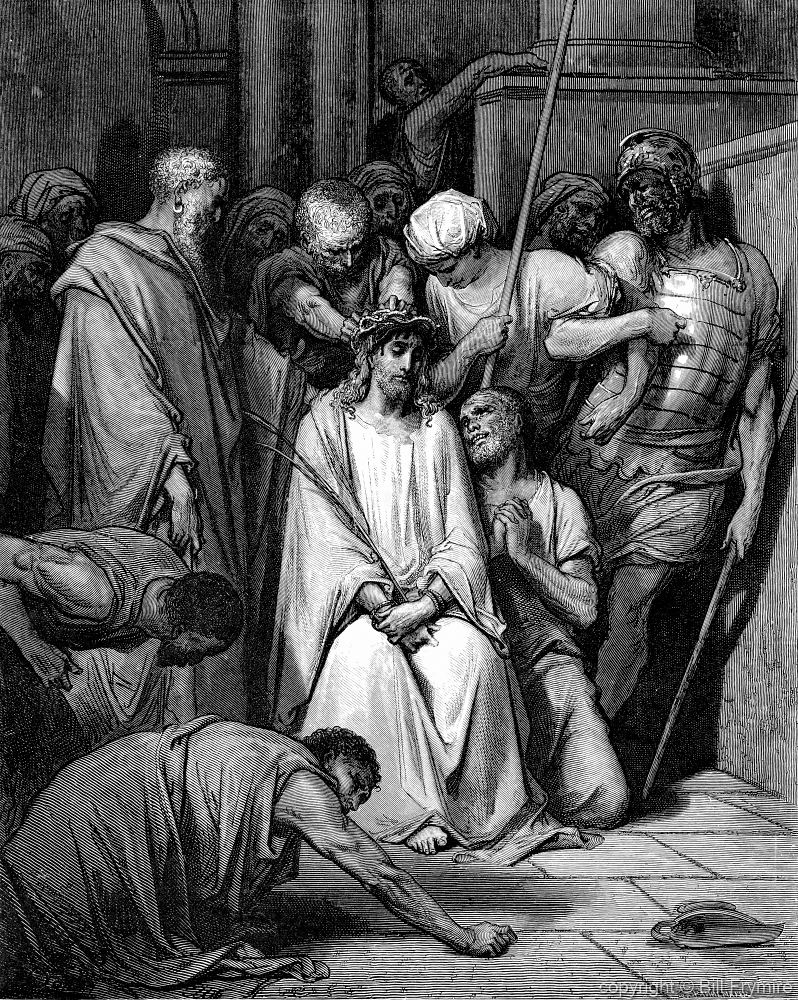
in Mark 15After they had mocked Him, they removed the purple robe and put His own clothes back on Him. Then they led Him out to crucify Him.
BSB
The same verse in ASV and KJV ▾
ASV
And when they had mocked him, they took off from him the purple, and put on him his garments. And they lead him out to crucify him.
KJV
And when they had mocked him, they took off the purple from him, and put his own clothes on him, and led him out to crucify him.
⋯
This verse in Mark 15
Commentary
13 notes on this verseHe who has given the food of heaven was fed with gall; he who has offered us the cup of salvation was given vinegar to drink. He the innocent, he the just, nay rather, innocence itself and justice itself is counted among criminals, and truth is concealed by false testimonies. He who is to judge is judged and the Word of God, silent, is led to the cross.
This site's exposition
removed the purple robe
on Mark 15:20-21
The soldiers forced Simon of Cyrene, passing by on his way in from the country, to carry the cross of Jesus. Mark names him the father of Alexander and Rufus, men apparently known to his first readers as members of the early church.
The record, by era
The Church Fathers1 voice
(ubi sup.) It appears that Matthew and Mark here relate things which took place previously, not that they happened when Pilate had already delivered Him to be crucified. For John says that these things took place at Pilate's house; but that which follows, And when they had mocked him, they took off the purple from him, and put on him his own clothes, must be understood to have taken place last of all, when He was already being led to be crucified.
The Medieval Church4 voices
And they led him out to crucify him. And they compelled a certain passer-by, Simon of Cyrene, coming from the country, the father of Alexander and Rufus, to carry his cross. Simon seems to have been of great repute then, as his sons also are …
(non occ.) After the condemnation of Christ, and the insults heaped upon Him when He was condemned, the Evangelist proceeds to relate His crucifixion, saying, And led him out to crucify him.
His shame took away our shame; His bonds made us free; by the thorny crown of His head, we have obtained the crown of the kingdom; by His wounds we are healed. But in a mystic sense, Jesus was stripped of His clothes, that is, of the Jews, and is clothed in a purple robe, that is, in the Gentile church, which is gathered together out of the rocks. Again, putting it off in the end, as offending, He again is clothed with the Jewish people, for when the fulness of the Gentiles is come in, then shall all Israel be saved. (Rom. 11:25.)
Here Abel is brought out into the field by his brother, to be slain by him. Here Isaac comes forth with the wood, and Abraham with the ram caught in the thicket. Here also Joseph with the sheaf of which he dreamed, and the long robe steeped in blood. Here is Moses with the rod, and the serpent hanging on the wood. Here is the cluster of grapes, carried on a staff. Here is Elisha with the piece of wood sent to seek for the axe, which had sunk, and which swam to the wood; that is, mankind, which by the forbidden tree, fell down to hell, but by the wood of the cross of Christ, and by the baptism of water, swims to paradise.z Here is Jonah out of the wood of the ship sent down into the sea and into the whale's belly for three days.
6 more voices on this verse
The Puritans and the Awakening2 voices
26 And the superscription of his accusation was written over, THE KING OF THE JEWS. 27 And with him they crucify two thieves; the one on his right hand, and the other on his left. 28 And the scripture was fulfilled, which saith, And he was numbered with the transgressors.
quarantine:scripture (2026-07-29) — verbatim-scripture
And when they had mocked him,....
The Nineteenth Century4 voices
A commentator
J.C. Ryle1816–1900
Expository Thoughts on the Gospels: Mark (lightly modernized text, Grace Gems edition) (1857)
The passage we have now read, is one of those which show us the infinite love of Christ toward sinners. The sufferings described in it would fill our minds with mingled horror and compassion, if they had been inflicted on one who was only a man like ourselves. But when we reflect that the sufferer was the eternal Son of God, we are lost in wonder and amazement.
WHEN our Lord had been condemned to die, the execution of His sentence was hurried. The Jews were in great haste to shed His blood. So intense was the enmity of the chief priests and Pharisees, that every moment of delay was wearisome to them. Besides, it was the day of the Passover and they wished to have this matter finished before they went, with hypocritical piety, to celebrate the festival of Israel's deliverance!
A commentator
J.C. Ryle1816–1900
Expository Thoughts on the Gospels: Mark (lightly modernized text, Grace Gems edition) (1857)
proposed
The passage we have now read, is one of those which show us the infinite love of Christ toward sinners. The sufferings described in it would fill our minds with mingled horror and compassion, if they had been inflicted on one who was only a man like ourselves. But when we reflect that the sufferer was the eternal Son of God, we are lost in wonder and amazement. And when we reflect further that these sufferings were voluntarily endured to deliver sinful men and women like ourselves from hell, we may see something of Paul's meaning when he says, "The love of Christ passes knowledge." "God commends His love toward us in that while we were yet sinners, Christ died for us." (Ephes. 3:19; Rom. 5:8.) We shall find it useful to examine separately the several parts of our Lord's passion. Let us follow Him step by step from the moment of His condemnation by Pilate to His last hour upon the cross. There is a deep meaning in every jot and tittle of His sorrows. All were striking emblems of spiritual truths. And let us not forget as we dwell on the wondrous story, that we and our sins were the cause of all these sufferings. "Christ suffered for sins, the just for the unjust, that He might bring us to God." (1 Peter 3:18.) It is the death of our own Surety and Substitute that we are reading. First of all we see Jesus delivered into the hands of the Roman soldiers, as a criminal condemned to death. He before whom the whole world will one day stand and be judged, allowed Himself to be sentenced unjustly, and given over into the hands of wicked men. And why was this? It was that we, the poor sinful children of men, believing on Him, might be delivered from the pit of destruction, and the torment of the prison of hell. It was that we might be set free from every charge in the day of judgment, and be presented faultless before God the Father with exceeding joy.
WHEN our Lord had been condemned to die, the execution of His sentence was hurried. The Jews were in great haste to shed His blood. So intense was the enmity of the chief priests and Pharisees, that every moment of delay was wearisome to them. Besides, it was the day of the Passover and they wished to have this matter finished before they went, with hypocritical piety, to celebrate the festival of Israel's deliverance! We do not wonder at their eagerness, for they could not bear themselves while He lived, since His very Presence reproved them for their falsehood and hypocrisy. But at Pilate, we do wonder, and herein he is much to be blamed. In all civilized countries there is usually an interval between the sentencing of the prisoner and the time of his being put to death. As the capital sentence is irreversible, it is well to have a little space in which possible evidence may be forthcoming which may prevent the fatal stroke. In some countries we have thought that there has been a cruelly long delay between the sentence and the execution, but with the Romans it was usual to allow the reasonable respite of 10 days. Now, I do not say that it was incumbent upon Pilate, according to Roman Law, to have allowed 10 days to a Jew, who had not the rights of Roman citizenship, but I do say that he might have pleaded the custom of his country and so have secured a delay—and afterwards he might have released his prisoner. It was within his reach to have done so and he was blameworthy, as he was all along, in thus yielding to the clamor for an immediate execution for no other reason than that he was "willing to content the people." When once we begin to make the wishes of other men our law, we know not to what extremity of criminality we may be led.
The words behind it
20 Greek wordsEvery Greek word of this verse in the order it stands, with what it means and the door to its own study. The last column counts the times a word stands in the whole Bible: the rarer the word, the more the places it appears belong together.
| Greek | Sound | Meaning | Word study | In the Bible |
|---|---|---|---|---|
| καὶ | kai | And | G2532 → | 9120 times |
| ὅτε | hote | when | G3753 → | 103 times |
| ἐνέπαιξαν | enepaixan | they had mocked | G1702 → | 13 times |
| αὐτῷ, | auto | Him, | G846 → | 5565 times |
| ἐξέδυσαν | exedusan | they took off | G1562 → | |
| αὐτὸν | auton | him | G846 → | 5565 times |
| τὴν | ten | the | G3588 → | 19766 times |
| πορφύραν | porphuran | purple | G4209 → | |
| καὶ | kai | and | G2532 → | 9120 times |
| ἐνέδυσαν | enedusan | put on | G1746 → | 27 times |
| αὐτὸν | auton | Him | G846 → | 5565 times |
| τὰ | ta | the | G3588 → | 19766 times |
| ἱμάτια | himatia | garments | G2440 → | 60 times |
| αὐτοῦ. | autou | His. | G846 → | 5565 times |
| καὶ | kai | And | G2532 → | 9120 times |
| ἐξάγουσιν | exagousin | they are leading out | G1806 → | |
| αὐτὸν | auton | him | G846 → | 5565 times |
| ἵνα | ina | that | G2443 → | 668 times |
| σταυρώσωσιν | staurososin | they may crucify | G4717 → | 46 times |
| αὐτόν. | auton | Him. | G846 → | 5565 times |
καὶAnd
kaiG2532 →9120 times
ὅτεwhen
hoteG3753 →103 times
ἐνέπαιξανthey had mocked
enepaixanG1702 →13 times
αὐτῷ,Him,
autoG846 →5565 times
ἐξέδυσανthey took off
exedusanG1562 →
αὐτὸνhim
autonG846 →5565 times
τὴνthe
tenG3588 →19766 times
πορφύρανpurple
porphuranG4209 →
καὶand
kaiG2532 →9120 times
ἐνέδυσανput on
enedusanG1746 →27 times
αὐτὸνHim
autonG846 →5565 times
τὰthe
taG3588 →19766 times
ἱμάτιαgarments
himatiaG2440 →60 times
αὐτοῦ.His.
autouG846 →5565 times
καὶAnd
kaiG2532 →9120 times
ἐξάγουσινthey are leading out
exagousinG1806 →
αὐτὸνhim
autonG846 →5565 times
ἵναthat
inaG2443 →668 times
σταυρώσωσινthey may crucify
staurososinG4717 →46 times
αὐτόν.Him.
autonG846 →5565 times
A shaded row is a word that stands 400 times or fewer in the Bible.
The walk
8 stopsEach card is a verse this one points to, and under it the verses that one points to in turn. Where several paths arrive at the same place, that place is listed first: the text keeps returning to it.
Through
John 19:16Then Pilate handed Jesus over to be crucified, and the soldiers took Him away.
it leads to
- Matthew 27:26–31
So Pilate released Barabbas to them. But he had Jesus flogged, and handed Him over to be crucified.
- Luke 23:24–25
So Pilate sentenced that their demand be met.
- Mark 15:15–20
And wishing to satisfy the crowd, Pilate released Barabbas to them. But he had Jesus flogged, and handed Him over to be crucified.
- Matthew 27:26–31
Through
Matthew 27:31After they had mocked Him, they removed the robe and put His own clothes back on Him. Then they led Him away to crucify Him.
it leads to
- Isaiah 53:7
He was oppressed and afflicted, yet He did not open His mouth. He was led like a lamb to the slaughter, and as a sheep before her shearers is silent, so He did not…
- 1 Kings 21:13
And the two scoundrels came in and sat opposite Naboth, and these men testified against him before the people, saying, “Naboth has cursed both God and the king!” So they took him outside the…
- Matthew 21:39
So they seized him and threw him out of the vineyard and killed him.
- Hebrews 13:12
And so Jesus also suffered outside the city gate, to sanctify the people by His own blood.
- Acts 7:58
They dragged him out of the city and began to stone him. Meanwhile the witnesses laid their garments at the feet of a young man named Saul.
- Isaiah 53:7
Where this verse is studied
On this page
About Mark
This page draws on 11 works. Open the list of works
This page draws on Augustine of Hippo, Catena Aurea by Aquinas; Bede, On the Gospel of Mark; Charles Spurgeon, The Metropolitan Tabernacle Pulpit, Sermon No. 1683: “The Great Cross-bearer and His Followers” (lightly modernized text, CCEL edition); Cyprian, Treatise IX. On the Advantage of Patience 7; Glossa Ordinaria, Catena Aurea by Aquinas; J.C. Ryle, Expository Thoughts on the Gospels: Mark (lightly modernized text, Grace Gems edition); Jamieson, Fausset & Brown, Commentary Critical and Explanatory on the Whole Bible; John Gill, Exposition of the New Testament; John Gill, Exposition of the New Testament (1746-1748); Matthew Henry, Commentary on the Whole Bible and Pseudo-Jerome, Catena Aurea by Aquinas.