
Mark 15:16
in Mark 15Then the soldiers led Jesus away into the palace (that is, the Praetorium) and called the whole company together.
BSB
The same verse in ASV and KJV ▾
ASV
And the soldiers led him away within the court, which is the Prætorium; and they call together the whole band.
KJV
And the soldiers led him away into the hall, called Pretorium; and they call together the whole band.
⋯
This verse in Mark 15
Commentary
9 notes on this verseA commentator
Albert Barnes1798–1870
Notes, Explanatory and Practical, on the Old and New Testaments (1832-1869)
Called Praetorium - The hall of the “praetor,” or Roman governor, where he sat to administer justice. Whole band - See the notes at Mat 27:27.
This site's exposition
led Jesus away into the palace
on Mark 15:16-19
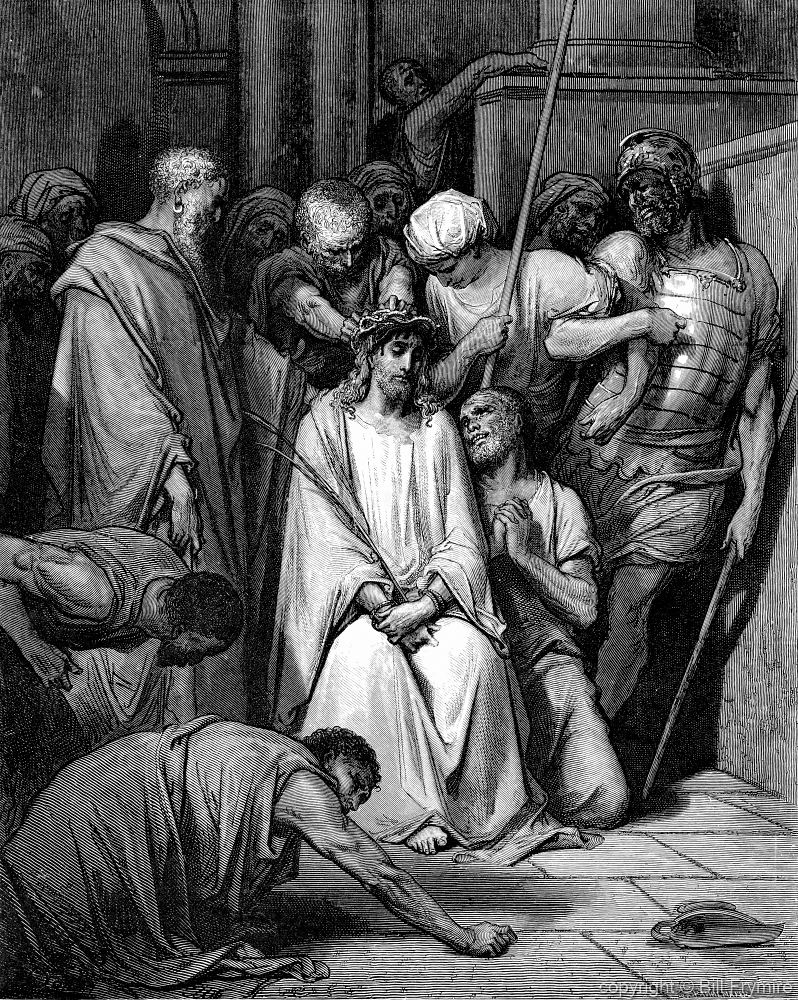
The soldiers called the whole company together, likely several hundred men, and dressed Jesus in a purple robe with a crown of thorns. Their salute, Hail, King of the Jews, the blows and the kneeling made a parody of homage.
The record, by era
The Medieval Church4 voices
But the soldiers led Him into the courtyard of the praetorium, and called together the entire cohort, and they clothed Him in purple, and after weaving a crown of thorns, they placed it on Him, and began to salute Him: Hail, King of the Jews. …
His shame took away our shame; His bonds made us free; by the thorny crown of His head, we have obtained the crown of the kingdom; by His wounds we are healed. But in a mystic sense, Jesus was stripped of His clothes, that is, of the Jews, and is clothed in a purple robe, that is, in the Gentile church, which is gathered together out of the rocks. Again, putting it off in the end, as offending, He again is clothed with the Jewish people, for when the fulness of the Gentiles is come in, then shall all Israel be saved. (Rom. 11:25.)
The vainglory of soldiers, ever rejoicing in disorder and in insult, here displayed what properly belonged to them. Wherefore it is said, And the soldiers led him away into the hall called Praetorium, and they call together the whole band, that is, the whole company of the soldiers, and they clothed him with purple as a king. Let us also put on the purple and royal robe, because we must walk as kings treading on serpents and scorpions, and 1 having sin under our feet. For we are called Christians, that is, anointed ones, just as kings were then called anointed. Let us also take upon ourselves the crown of thorns, that is, let us make haste to be crowned with a strict life, with self-denials and purity.
The military class, always finding consolation in acts of violence and insult, now too displayed its customary character. For if the Jews, who had heard so many teachings from Christ and had received from Him so often and so many benefactions, inflicted upon Him so …
The Puritans and the Awakening1 voice
And the soldiers led him away into the hall,....
2 more voices on this verse
The Nineteenth Century2 voices
A commentator
J.C. Ryle1816–1900
Expository Thoughts on the Gospels: Mark (lightly modernized text, Grace Gems edition) (1857)
The passage we have now read, is one of those which show us the infinite love of Christ toward sinners. The sufferings described in it would fill our minds with mingled horror and compassion, if they had been inflicted on one who was only a man like ourselves. But when we reflect that the sufferer was the eternal Son of God, we are lost in wonder and amazement.
A commentator
J.C. Ryle1816–1900
Expository Thoughts on the Gospels: Mark (lightly modernized text, Grace Gems edition) (1857)
proposed
The passage we have now read, is one of those which show us the infinite love of Christ toward sinners. The sufferings described in it would fill our minds with mingled horror and compassion, if they had been inflicted on one who was only a man like ourselves. But when we reflect that the sufferer was the eternal Son of God, we are lost in wonder and amazement. And when we reflect further that these sufferings were voluntarily endured to deliver sinful men and women like ourselves from hell, we may see something of Paul's meaning when he says, "The love of Christ passes knowledge." "God commends His love toward us in that while we were yet sinners, Christ died for us." (Ephes. 3:19; Rom. 5:8.) We shall find it useful to examine separately the several parts of our Lord's passion. Let us follow Him step by step from the moment of His condemnation by Pilate to His last hour upon the cross. There is a deep meaning in every jot and tittle of His sorrows. All were striking emblems of spiritual truths. And let us not forget as we dwell on the wondrous story, that we and our sins were the cause of all these sufferings. "Christ suffered for sins, the just for the unjust, that He might bring us to God." (1 Peter 3:18.) It is the death of our own Surety and Substitute that we are reading. First of all we see Jesus delivered into the hands of the Roman soldiers, as a criminal condemned to death. He before whom the whole world will one day stand and be judged, allowed Himself to be sentenced unjustly, and given over into the hands of wicked men. And why was this? It was that we, the poor sinful children of men, believing on Him, might be delivered from the pit of destruction, and the torment of the prison of hell. It was that we might be set free from every charge in the day of judgment, and be presented faultless before God the Father with exceeding joy.
The words behind it
16 Greek wordsEvery Greek word of this verse in the order it stands, with what it means and the door to its own study. The last column counts the times a word stands in the whole Bible: the rarer the word, the more the places it appears belong together.
| Greek | Sound | Meaning | Word study | In the Bible |
|---|---|---|---|---|
| Οἱ | hoi | <the> | G3588 → | 19766 times |
| δὲ | de | And | G1161 → | 2765 times |
| στρατιῶται | stratiotai | the soldiers | G4757 → | |
| ἀπήγαγον | apegagon | led away | G520 → | 15 times |
| αὐτὸν | auton | him | G846 → | 5565 times |
| ἔσω | eso | into | G2080 → | |
| τῆς | tes | the | G3588 → | 19766 times |
| αὐλῆς, | aules | palace, | G833 → | 12 times |
| ὅ | ho | that | G3739 → | 1405 times |
| ἐστιν | estin | is | G1510 → | 2333 times |
| πραιτώριον, | praitorion | [the] Praetorium, | G4232 → | |
| καὶ | kai | and | G2532 → | 9120 times |
| συγκαλοῦσιν | sugkalousin | they call together | G4779 → | |
| ὅλην | holen | all | G3650 → | 109 times |
| τὴν | ten | the | G3588 → | 19766 times |
| σπεῖραν | speiran | cohort | G4686 → |
Οἱ<the>
hoiG3588 →19766 times
δὲAnd
deG1161 →2765 times
στρατιῶταιthe soldiers
stratiotaiG4757 →
ἀπήγαγονled away
apegagonG520 →15 times
αὐτὸνhim
autonG846 →5565 times
ἔσωinto
esoG2080 →
τῆςthe
tesG3588 →19766 times
αὐλῆς,palace,
aulesG833 →12 times
ὅthat
hoG3739 →1405 times
ἐστινis
estinG1510 →2333 times
πραιτώριον,[the] Praetorium,
praitorionG4232 →
καὶand
kaiG2532 →9120 times
συγκαλοῦσινthey call together
sugkalousinG4779 →
ὅληνall
holenG3650 →109 times
τὴνthe
tenG3588 →19766 times
σπεῖρανcohort
speiranG4686 →
A shaded row is a word that stands 400 times or fewer in the Bible.
The walk
8 stopsEach card is a verse this one points to, and under it the verses that one points to in turn. Where several paths arrive at the same place, that place is listed first: the text keeps returning to it.
Through
John 18:28Then they led Jesus away from Caiaphas into the Praetorium. By now it was early morning, and the Jews did not enter the Praetorium, to avoid being defiled and unable to eat the Passover.
it leads to
- John 18:33
Pilate went back into the Praetorium, summoned Jesus, and asked Him, “Are You the King of the Jews?”
Reached by 2 separate paths from here.
- John 19:9
and he went back into the Praetorium. “Where are You from?” he asked. But Jesus gave no answer.
- Mark 15:1–5
Early in the morning, the chief priests, elders, scribes, and the whole Sanhedrin devised a plan. They bound Jesus, led Him away, and handed Him over to Pilate.
- John 19:14
It was the day of Preparation for the Passover, about the sixth hour. And Pilate said to the Jews, “Here is your King!”
- Matthew 27:27
Then the governor’s soldiers took Jesus into the Praetorium and gathered the whole company around Him.
- John 18:33
Through
Matthew 26:3At that time the chief priests and elders of the people assembled in the courtyard of the high priest, whose name was Caiaphas,
it leads to
- John 11:47–53
Then the chief priests and Pharisees convened the Sanhedrin and said, “What are we to do? This man is performing many signs.
- John 18:24
Then Annas sent Him, still bound, to Caiaphas the high priest.
- John 11:47–53
Through
John 18:33Pilate went back into the Praetorium, summoned Jesus, and asked Him, “Are You the King of the Jews?”
it leads to
- Luke 23:3–4
So Pilate asked Him, “Are You the King of the Jews?” “You have said so,” Jesus replied.
- Luke 23:3–4
Where this verse is studied
On this page
About Mark
This page draws on 9 works. Open the list of works
This page draws on Albert Barnes, Notes, Explanatory and Practical, on the Old and New Testaments (1832-1869); Bede, On the Gospel of Mark; J.C. Ryle, Expository Thoughts on the Gospels: Mark (lightly modernized text, Grace Gems edition); Jamieson, Fausset & Brown, Commentary Critical and Explanatory on the Whole Bible; John Gill, Exposition of the New Testament (1746-1748); Matthew Henry, Commentary on the Whole Bible; Pseudo-Jerome, Catena Aurea by Aquinas; Theophylact of Ohrid, Catena Aurea by Aquinas and Theophylact of Ohrid, Commentary on Mark.