
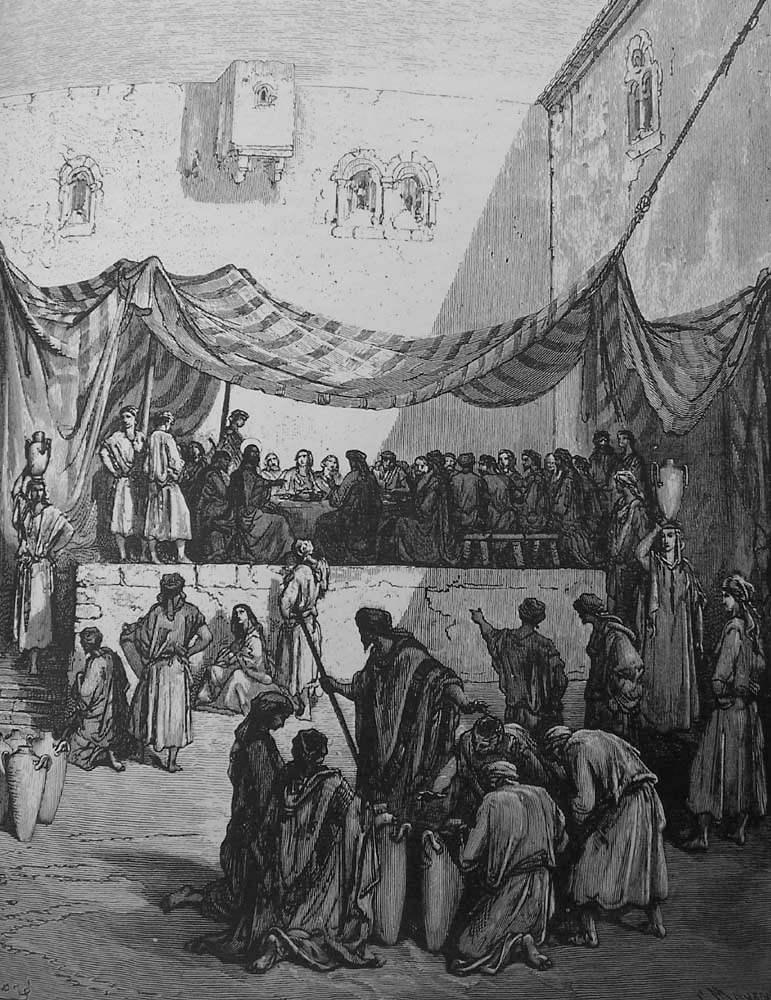
Johnchapter 2
25 verses · John, by tradition · AD 85 to 95 · The Gospels
Jesus answered, “Destroy this temple, and in three days I will raise it up again.”
Introduction
John, by tradition, The Gospels, John Overview.
John, one of the Twelve, wrote this chapter for readers who knew the purity rules and the temple even if they had never seen them. He sets two scenes side by side, one at a family celebration in a small town and one in the busiest court of the holy city. The first is the opening sign of the book and the second is its first confrontation. Listen for the word hour, and for the way each scene ends with a comment about what the disciples believed. Read the chapter as two doors into the same claim.
Context
- Who
- Readers who knew both village hospitality and temple commerce
- What
- The first of the signs in this Gospel, at a wedding in Cana, and the clearing of the temple courts at Passover.
- Where
- Cana in Galilee, then Capernaum for a few days, then the temple courts in Jerusalem.
- When
- The first year of the ministry, about AD 27 to 28, at and before the Passover.
- Why
- To show that Jesus brings what the old rites and the temple pointed toward, and to begin the record of signs that leads to faith.
Historical context
A village wedding was a week-long public event, and the groom's family carried the cost. Running out of wine was not an awkward moment; it was a lasting disgrace that the whole district would remember, and in that culture it could even expose the family to a legal claim from the bride's relatives. That is the size of the problem the mother of Jesus brings to him.
Show the rest of the historical context, 3 more paragraphs
The six jars are specified as stone, and the material is the point. Under the purity rules that governed Jewish households, stone vessels do not contract ritual impurity, while pottery does and has to be broken. Workshops that cut such vessels have been excavated near Jerusalem, and stone cups and jars turn up all over first-century Jewish sites. These jars were there for washing, and their capacity, twenty or thirty gallons each, tells you how much water a household went through.
The temple trade had a logic behind it. Pilgrims came from across the empire with foreign coin, the temple tax had to be paid in an approved currency, and sacrificial animals had to pass inspection, so exchange tables and animal pens were genuinely useful. What made them intolerable was where they stood: in the outer court, the only part of the complex a non-Jew was permitted to enter.
John places this cleansing at the start of the ministry, while Matthew, Mark, and Luke place one in the final week. Some hold there were two cleansings, three years apart; others hold that John has moved the scene forward to state his theme early. The text does not settle it, and honest readers land in both camps.
Significance
The water for purification becomes the best wine of the feast, and the master of the banquet says the good wine has been kept until now. Readers who had grown up inside the washing system would have felt the whole argument of the Gospel in that one swap.
Show the rest of the significance, 1 more paragraph
The forty-six years detail let readers date the scene. Herod began rebuilding the temple around 20 or 19 BC, and the work continued long after Jesus died, it was not finished until about AD 63, seven years before Rome burned it down. When Jesus said he would raise this temple in three days, the joke about the building schedule was obvious to everyone in the courtyard.
The heads below are this chapter's scenes. The numbered points under each are its verses.
Water Turned to Wine at the Cana Wedding
John 2:1-2
a wedding took place at Cana: Jesus, His disciples and His mother are at a village wedding. A Galilean wedding feast ran several days, with the wine standing as the host's honor before the whole village. The signs of this Gospel begin here.
John 2:1
“And the third day there was a marriage,.... Either from the second testimony bore by John the Baptist concerning Christ, and from the call of Simon Peter, which seem to be of the same date; see Joh 1:35, or from Christ's coming into Galilee; or from the conversation he had with Nathanael; from either of which the date is taken, it matters not; the first is as agreeable and plain, as any.”
1 more voice on this verseWhat preachers and commentators have said about this verse, in their own words.
John 2:1
“And the third day - On the third day after his conversation with Nathanael. Cana - This was a small town about 15 miles northwest of Tiberias and 6 miles northeast of Nazareth. It is now called Kerr Kenna, is under the government of a Turkish officer, and contains perhaps 300 inhabitants, chiefly Catholics.”
had also been invited to the wedding: John Gill thinks Jesus was asked as a relation, with His disciples bidden on His account; Nathanael came from Cana itself. John Wesley says Christ sanctifies human society. Cyril of Alexandria sees Him blessing marriage and the births to come.
John 2:2
“And both Jesus was called, and his disciples - There are several remarkable circumstances here. 1. This was probably the first Christian wedding that was ever in the world. 2. The great Author of the Christian religion, with his disciples, (probably then only four or five in number, see Joh 1:37, etc.), were invited to it. 3. The first miracle Jesus Christ wrought was at it, and in honor of it. 4. The mother of Christ, the most pure of all virgins, the most holy of all wives, and the first Christian mother, was also at it.”
Adam Clarke · Commentary on the Bible (1810-1826)evangelical
3 more voices on this verse
John 2:2
“And both Jesus was called,.... Or invited, as being a relation, according to the flesh: and his disciples, to the marriage; who were bidden, on his account; and they seem to be these, Andrew, and the other disciple, that followed Jesus, and Simon Peter, and Philip, and Nathanael, who was of this place; and accordingly they all went to it.”
John 2:2
“For it was fitting that He, Who was renewing the very nature of man, and refashioning it all for the better, should not only impart His blessing to those already called into being, but also prepare before grace for those soon to be born, and make holy their entrance into being. Receive also yet a third reason. It had been said to the woman by God, In sorrow thou shalt bring forth children. How then was it not needful that we should thrust off this curse too, or how else could we escape a condemned marriage?”
Cyril of Alexandria · written before 444 · Commentary on the Gospel of John, Book 2patristic
John 2:2
“Jesus and his disciples were invited to the marriage - Christ does not take away human society, but sanctifies it. Water might have quenched thirst; yet our Lord allows wine; especially at a festival solemnity. Such was his facility in drawing his disciples at first, who were afterward to go through rougher ways.”
John Wesley · Explanatory Notes upon the New Testament (1755)evangelical
The wine ran out at the wedding, and the host's honor ran out with it. Wine at a feast stood for gladness, and the gladness had failed; His mother brings it to Jesus and asks for nothing. What she expects she leaves unsaid.
John 2:3
“When they wanted wine - A marriage feast among the Jews was commonly observed for seven or eight days. It is not probable that there would be a want of wine at the marriage itself, and it is possible, therefore, that Jesus came there some time during the marriage feast. They have no wine - It is not known why Mary told this to Jesus. It would seem that she had a belief that he was able to supply it, though he had as yet worked no miracle.”
2 more voices on this verse
John 2:3
“That wine, which was produced by God in a vineyard, and which was first consumed, was good. None of those who drank of it found fault with it; and the Lord partook of it also. But that wine was better which the Word made from water, on the moment, and simply for the use of those who had been called to the marriage.”
Irenaeus · written before 202 · Against Heresies Book III, Chapter XIpatristic
John 2:3
“Note, They who, being married, are come to care for the things of the world must expect trouble in the flesh, and count upon disappointment. (3.) It should seem, Christ and his disciples were the occasion of this want, because there was more company than was expected when the provision was made; but they who straiten themselves for Christ shall not lose by him.”
Matthew Henry · Commentary on the Whole Bible (1707-1721)puritan
My hour has not yet come is the first of this Gospel's many uses of the hour. It is the fixed time of the cross and the glory, and it returns at 7:30, 8:20, 12:23 and 13:1. He acts all the same.
John 2:4
“A mild reproof of her inordinate concern and untimely interposal. Mine hour is not yet come - The time of my working this miracle, or of my going away. May we not learn hence, if his mother was rebuked for attempting to direct him in the days of his flesh, how absurd it is to address her as if she had a right to command him, on the throne of his glory?”
John Wesley · Explanatory Notes upon the New Testament (1755)evangelical
2 more voices on this verse
John 2:4
“Woman, what have I to do with thee? - Τι εμοι και σοι, γυναι: O, woman, what is this to thee and me? This is an abrupt denial, as if he had said: “We are not employed to provide the necessaries for this feast: this matter belongs to others, who should have made a proper and sufficient provision for the persons they had invited.” The words seem to convey a reproof to the virgin, for meddling with that which did not particularly concern her.”
Adam Clarke · Commentary on the Bible (1810-1826)evangelical
John 2:4
“With Him is nothing incomplete or out of due season, just as with the Father there is nothing incongruous. For all these things were foreknown by the Father; but the Son works them out at the proper time in perfect order and sequence.”
Irenaeus · written before 202 · Against Heresies Book III, Chapter XVIpatristic
Do whatever He tells you is the last word Mary speaks in Scripture. His mother says it to the servants and gives them no plan and no explanation, pointing them past herself to Jesus. The servants fill the jars on that word.
John 2:5
“His mother saith ... - It is evident from this verse that his mother did not understand what he had said as a harsh reproof and repulse, but as an indication of his willingness at the proper time to furnish wine. In all this transaction he evinced the appropriate feelings of a son toward a mother.”
2 more voices on this verse
John 2:5
“The woman having great influence to the performing of the miracle, prevailed, persuading the Lord, on account of what was fitting, as her Son. She begins the work by preparing the servants of the assembly to obey the things that should be enjoined.”
Cyril of Alexandria · written before 444 · Commentary on the Gospel of John, Book 2patristic
John 2:5
“The beginning of Moses's miracles was turning water into blood ( Exod. iv. 20 ), the beginning of Christ's miracles was turning water into wine; which intimates the difference between the law of Moses and the gospel of Christ.”
Matthew Henry · Commentary on the Whole Bible (1707-1721)puritan
John 2:6-7
six stone water jars: The six stone jars stood there for the washing the Jewish rites of purification required. Each held twenty to thirty gallons, so the six together held a hundred and twenty gallons at least. Jesus tells the servants to fill them to the brim.
John 2:6
“After the manner of the purifying of the Jews - Or, for the purpose of the purifying of the Jews. The preposition κατα, which I have translated, for the purpose, often denotes in the best Greek writers the final cause of a thing. See several examples produced by Raphelius, from Arrian and Herodotus. These six vessels were set in a convenient place, for the purpose of the Jews washing their hands before they sat down to meat, and probably for other purposes of purification. See this custom referred to in Mat 15:2 (note).”
Adam Clarke · Commentary on the Bible (1810-1826)evangelical
The servants filled the jars with water, and for Albert Barnes the disciples had no hand in it, and the servants knew what went in. Matthew Henry compares them to Moses going to the rock at God's word. They obeyed a command that looked unlikely.
John 2:7
“Jesus saith unto them,.... To the servants that waited at the feast, fill the water pots with water. The Ethiopic version adds, "to their brims", as they did.”
2 more voices on this verse
John 2:7
“With water - This was done by the servants employed at the feast. It was done by “them,” so that there might be no opportunity of saying that the disciples of Jesus had filled them with wine to produce the “appearance” of a miracle. In this case there could be no deception. The quantity was very considerable. The servants would know whether the “wine” or “water” had been put in these vessels.”
John 2:7
“As Moses, the servant of the Lord, when God bade him, went to the rock, to draw water; so these servants, when Christ bade them, went to the water, to fetch wine. Note, Since no difficulties can be opposed to the arm of God's power, no improbabilities are to be objected against the word of his command.”
Matthew Henry · Commentary on the Whole Bible (1707-1721)puritan
John 2:8-10
No word in the account describes the change. The servants draw, and the master of the banquet tastes wine. Where it came from he could not say, while the servants who drew the water could.
John 2:8
“Governor of the feast - The original word, αρχιτρικλινος, signifies one who is chief or head over three couches, or tables. In the Asiatic countries, they take their meals sitting, or rather reclining, on small low couches. And when many people are present, so that they cannot all eat together, three of these low tables or couches are put together in form of a crescent, and some one of the guests is appointed to take charge of the persons who sit at these tables.”
Adam Clarke · Commentary on the Bible (1810-1826)evangelical
He did not know where it was from: Albert Barnes reads the master's ignorance as the value of his verdict: knowing nothing of what was done, he judged the wine without favour. Hilary of Poitiers sets the two parties against each other. The pourer knew water went in, and the drawer found wine coming out.
John 2:9
“And knew not whence it was - This is said, probably, to indicate that his judgment was not biased by any favor, or any lack of favor, toward Jesus. Had he known what was done, he would have been less likely to have judged impartially. As it is, we have his testimony that this was real wine, and of so fine a body and flavor as to surpass that which had been provided for the occasion. Everything in this miracle shows that there was no collusion or understanding between Jesus and any of the persons at the feast.”
2 more voices on this verse
John 2:9
“When Christ provided so much good wine for them that had well drunk, he intended to try their sobriety, and to teach them how to abound, as well as how to want. Temperance per force is a thankless virtue; but if divine providence gives us abundance of the delights of sense, and divine grace enables us to use them moderately, this is self-denial that is praiseworthy.”
Matthew Henry · Commentary on the Whole Bible (1707-1721)puritan
John 2:9
“THE governor of the feast said more than he intended to say, or rather, there is more truth in what he said than he himself imagined. This is the established rule all the world over: “the good wine first, and when men have well drunk, then that which is worse.” It is the rule with men; and have not hundreds of disappointed hearts bewailed it? Friendship first—the oily tongue, the words softer than butter, and afterwards the drawn sword.”
After the guests are drunk, Albert Barnes says, can mean drinking until the taste is dulled, so the cheap wine passes. Thomas Aquinas, following Chrysostom, reads the fine wine saved until now as a sign that everything Jesus does in His signs is most perfect.
the first of His signs: John calls it a sign, semeion in Greek, an act that makes a claim about who Jesus is. It is the first of seven signs that carry the first half of this Gospel. The disciples already followed Him, and now they believed.
John 2:11
“Many most excellent things were accomplished at once through the one first miracle. For honourable marriage was sanctified, the curse on women put away (for no more in sorrow shall they bring forth children, now Christ has blessed the very beginning of our birth), and the glory of our Saviour shone forth as the sun's rays, and more than this, the disciples are confirmed in faith by the miracle. The historical account then will stop here, but I think we ought to consider the other view of what has been said, and to say what is therein signified.”
Cyril of Alexandria · written before 444 · Commentary on the Gospel of John, Book 2patristic
2 more voices on this verse
John 2:11
“This beginning of miracles - This his first public miracle. This is declared by the sacred writer to be a “miracle” - that is, an exertion of divine power, producing a change of the substance of water into wine, which no human power could do. Manifested forth - Showed; exhibited. His glory - His power, and proper character as the Messiah; showed that he had divine power, and that God had certainly commissioned him. This is shown to be a real miracle by the following considerations: 1. Real water was placed in the vessels.”
John 2:11
“AT this time I shall not consider the relation of this miracle to total abstinence. The wine which Jesus made was good wine and it was made of water—we are not likely to meet with anything of the kind in this country where the wine is seldom made from the pure juice of the grape—and where it is not known who made it, or of what it is made. What is now called wine is a very different liquid from that which our Lord Divinely produced.”
A Whip of Cords in His Father's House
He went down to Capernaum: He goes down to Capernaum, and His mother, His brothers and His disciples go with Him. Capernaum sits on the shore of the Sea of Galilee and becomes the base of the Galilean ministry. The road from here runs to Jerusalem and the Passover.
John 2:12
“To Capernaum - See the notes at Mat 4:13. Not many days - The reason why he remained there no longer was that the Passover was near, and they went up to Jerusalem to attend it.”
3 more voices on this verse
John 2:12
“The other three authors of the Gospels say that after the Lord's struggle with the devil, he withdrew into Galilee. Matthew and Luke, however, say that he was in Nazareth first after these events and that he left there and went to settle in Capernaum.”
Origen of Alexandria · written before 253 · Commentary on the Gospel of John 10.3-4, 10, 18-20patristic
John 2:12
“It is called the Jews' passover, because it was peculiar to them (Christ is our Passover); now shortly God will no longer own it for his. Christ kept the passover at Jerusalem yearly, ever since he was twelve years old, in obedience to the law; but now that he has entered upon his public ministry we may expect something more from him than before; and two things we are here told he did there:-- 1.”
Matthew Henry · Commentary on the Whole Bible (1707-1721)puritan
John 2:12
“The second miracle which our Lord is recorded to have wrought demands our attention in these verses. Like the first miracle at Cana, it is eminently typical and significant of things yet to come. To attend a marriage feast, and cleanse the temple from profanation were among the first acts of our Lord's ministry at His first coming. To purify the whole visible Church, and hold a marriage supper, will be among His first acts, when He comes again. We see, for one thing, in this passage, how much Christ disapproves all irreverent behavior in the house of God .”
the Jewish Passover was near: This is the first of three Passovers John names, at 2:13, 6:4 and 11:55, and that count sets the public ministry at about three years. Jesus went up to Jerusalem as the law required of every man at the feast. A traveler always went up to Jerusalem.
John 2:13
“And the Jews' passover was at hand,.... That feast which was kept on the fourteenth day of Nisan, in commemoration of the Lord's passing over, and by the houses of the Israelites, when he slew the firstborn in Egypt: and it is called the Jews' passover, because they only were obliged to keep it: nor was it obligatory upon the Gentiles; and, besides, was now abolished when John wrote this Gospel, though still retained by the Jews.”
John 2:14-16
men selling cattle, sheep, and doves: The animal sellers and money changers served pilgrims who arrived without a sacrifice or the temple's coin. The trade had settled into the Court of the Gentiles, where a man outside Israel came near to pray.
John 2:14
“Oxen, and sheep, and doves - Used for sacrifice: And the changers of money - Those who changed foreign money for that which was current at Jerusalem, for the convenience of them that came from distant countries.”
John Wesley · Explanatory Notes upon the New Testament (1755)evangelical
3 more voices on this verse
John 2:14
“Found in the temple those that sold oxen, etc. - This is a similar fact to that mentioned Mat 21:12; Mar 11:15; Luk 19:45. See it explained on Mat 21:12 (note). If it be the same fact, then John anticipates three years of time in relating it here; as that cleansing of the temple mentioned by the other evangelists took place in the last week of our Lord’s life.”
Adam Clarke · Commentary on the Bible (1810-1826)evangelical
John 2:14
“The Jews are again hereby too convicted of despising the laws given them, and making of no account the Mosaic writings, looking only to their own love of gain.”
Cyril of Alexandria · written before 444 · Commentary on the Gospel of John, Book 2patristic
John 2:14
“And found in the temple,.... Not in the holy place itself, nor in the court of the priests, where the sacrifices were offered, nor in the court of the women, nor in the court of the Israelites, where the people worshipped; but in the court of the Gentiles, or the outward court, even all that space of ground which was between the wall which divided the whole from common ground, and the buildings of the temple, and which was open to the air; for the whole sacred enclosure, or all within the wall, went by the name of the temple.”
He made a whip out of cords: Readers have asked how one man cleared the courts. Albert Barnes calls the whip an emblem of authority used to drive out the cattle. Origen reports those who answer by His divine power, which can quiet the anger of any crowd.
John 2:15
“Having made a scourge of rushes - (Which were strewed on the ground, ) he drove all out of the temple, (that is, the court of it, ) both the sheep and the oxen - Though it does not appear that he struck even them; and much less, any of the men. But a terror from God, it is evident, fell upon them.”
John Wesley · Explanatory Notes upon the New Testament (1755)evangelical
2 more voices on this verse
John 2:15
“A scourge - A whip. Of small cords - This whip was made as an emblem of authority, and also for the purpose of driving from the temple the cattle which had been brought there for sale. There is no evidence that he used any violence to the men engaged in that unhallowed traffic. The original word implies that these “cords” were made of twisted “rushes” or “reeds” - probably the ancient material for making ropes.”
John 2:15
“And when he had made a scourge of small cords,.... That is, Jesus, as the Persic version expresses it. This scourge might be made either of thongs cut out of the hides of beasts slain in sacrifice; or of the cords, with which the owners of the cattle had brought them to this place; or with which they had fastened them in it.”
To those selling doves He said: Doves could not be driven out like the sheep and cattle, so Jesus tells those selling doves to get them out. Clement of Alexandria widens the charge to all who make a marketplace of the truth, the avaricious, the liars and the hypocrites.
John 2:16
“But those who act contrary to these things-the avaricious, the liars, the hypocrites, those who make merchandise of the truth-the Lord cast out of His Father's court, not willing that the holy house of God should be the house of unrighteous traffic either in words or in material things.”
Clement of Alexandria · written before 215 · The Instructor Book 3patristic
The disciples remember Psalm 69:9, where a righteous man suffers for God's house. The same psalm supplies the thirst and the sour wine at the cross, at 19:28 and 29. The zeal that cleared the courts carried Him to it.
John 2:17
“And his disciples remembered that it was written,.... In Psa 69:9, which Psalm belongs to the Messiah, as is manifest from the citations out of it in the New Testament, and the application of them to Christ, as in Joh 15:25, compared with Psa 69:4. Christ is represented in it, as suffering for the sins of his people; for he himself was innocent; and was hated without a cause; but having the sins of his people imputed to him, he made satisfaction for them, and so restored what he took not away.”
2 more voices on this verse
John 2:17
“It was written ... - This is recorded in Psa 69:9. Its meaning is, that he was affected with great zeal or concern for the pure worship of God. The zeal of thine house - “Zeal” is intense ardor in reference to any object. The “zeal of thine house” means extraordinary concern for the temple of God; intense solicitude that the worship there should be pure, and such as God would approve.”
John 2:17
“All the graces that were to be found among the Old-Testament saints were eminently in Christ, and particularly this of zeal for the house of God, and in them, as they were patterns to us, so they were types of him. Observe, (1.) Jesus Christ was zealously affected to the house of God, his church: he loved it, and was always jealous for its honour and welfare.”
Matthew Henry · Commentary on the Whole Bible (1707-1721)puritan
Cross references
John 2:17
- QuotingPsalms 69:9“because zeal for Your house has consumed me, and the insults of those who insult You have fallen on me.”
'The zeal of thine house hath eaten me up' (temple cleansing, disciples remember)
ConnectionsPsalms 69:9
Destroy This Temple and in Three Days I Will Raise It
John 2:18-19
The Jews demanded a sign to prove His authority to clear the courts. He answered with a riddle: destroy this temple and He will raise it in three days, and His hearers heard a boast about Herod's building. His own followers understood it after the resurrection.
John 2:18
“The multitude of the Jews are startled at the unwonted authority, and they who are over the temple are extremely vexed, deprived of their not easily counted gains. And they cannot convict Him of not having spoken most rightly in commanding them not to exhibit the Divine Temple as a house of merchandise. But they devise delays to the flight of the merchants, excusing themselves that they ought not to submit to Him off-hand, nor without investigation to receive as Son of God Him Who was witnessed to by no sign.”
Cyril of Alexandria · written before 444 · Commentary on the Gospel of John, Book 2patristic
2 more voices on this verse
John 2:18
“What sign showest thou - See on Mat 12:38 (note); Mat 16:1 (note). When Moses came to deliver Israel, he gave signs, or miracles, that he acted under a Divine commission. What miracle dost thou work to show us that thou art vested with similar authority?”
Adam Clarke · Commentary on the Bible (1810-1826)evangelical
John 2:18
“What sign showest thou unto us, seeing that thou doest these things?--Though the act and the words of Christ, taken together, were sign enough, they were unconvinced: yet they were awed, and though at His very next appearance at Jerusalem they "sought to kill Him" for speaking of "His Father" just as He did now (Joh 5:18), they, at this early stage, only ask a sign.”
Jamieson, Fausset & Brown · Commentary Critical and Explanatory on the Whole Bible (1871)reformed
Destroy this temple is a command in form. Albert Barnes gives it the force of a future: the Jews who made the house a marketplace will destroy this temple. Barnes thinks it likely He pointed to His body.
John 2:19
“Whence also he says, that this handiwork is "the temple of God," thus declaring: "Know ye not that ye are the temple of God, and that the Spirit of God dwelleth in you? If any man, therefore, will defile the temple of God, him will God destroy: for the temple of God is holy, which [temple] ye are." Here he manifestly declares the body to be the temple in which the Spirit dwells.”
Irenaeus · written before 202 · Against Heresies Book V, Chapter VIpatristic
2 more voices on this verse
John 2:19
“Destroy this temple - The evangelist informs us Joh 2:21 that by “temple,” here, he meant his body. It is not improbable that he pointed with his finger to his body as he spoke. The word “destroy,” used here in the “imperative,” has rather the force of the “future.” Its meaning may thus be expressed: “You are now profaners of the temple of God. You have defiled the sanctuary; you have made it a place of traffic. You have also despised my authority, and been unmoved by the miracles which I have already performed.”
John 2:19
“Secondly, Because the death of Christ was indeed the destruction of the Jewish temple, the procuring cause of it; and his resurrection was the raising up of another temple, the gospel church, Zech. vi.”
Matthew Henry · Commentary on the Whole Bible (1707-1721)puritan
John 2:20-22
Herod began rebuilding the temple around 20 BC, so forty-six years of work places this exchange near AD 27. The temple He meant was His own body. The disciples remembered after He was raised, and then they believed.
John 2:20
“Then said the Jews,.... Unto him, as read the Syriac, Arabic, Persic, and Ethiopic versions: forty and six years was this temple in building; which cannot be understood of the temple as built by Solomon, for that was but seven years in building, 1Ki 6:37. But rather of the temple, as built by Zorobabel, commonly called the second temple, and might be more properly said to be "this temple"; the calculations of this made by learned men, are various and endless to recite.”
3 more voices on this verse
John 2:20
“Forty and six years was this temple in building - The temple of which the Jews spake was begun to be rebuilt by Herod the Great, in the 18th year of his reign: Josephus. Ant. b. xv. c. 11, s. 1; and xx. c. 9, s. 5, 7. But though he finished the main work in nine years and a half, yet some additional buildings or repairs were constantly carried on for many years afterwards.”
Adam Clarke · Commentary on the Bible (1810-1826)evangelical
John 2:20
“Forty and six years - Just so many years before the time of this conversation, Herod the Great had begun his most magnificent reparation of the temple, (one part after another, ) which he continued all his life, and which was now going on, and was continued thirty-six years longer, till within six or seven years of the destruction of the state, city, and temple by the Romans.”
John Wesley · Explanatory Notes upon the New Testament (1755)evangelical
John 2:20
“Secondly, Of the almighty power of Christ, as if he could do no more than another man. Had they known that this was he who built all things in six days they would not have made it such an absurdity that he should build a temple in three days. (4.) A vindication of Christ's answer from their cavil.”
Matthew Henry · Commentary on the Whole Bible (1707-1721)puritan
the temple of His body: Adam Clarke reads Jesus as speaking of the temple that is His body. It was the house where His Godhead dwelt, as God had dwelt in the temple at Jerusalem.
John 2:21
“Of the temple of his body - Rather, the temple, his body: his body had no particular temple: but it was the temple of his Divinity - the place in which, as in the ancient temple, his Godhead dwelt; See how the Jews perverted these words, Mat 26:60 (note), and the notes there.”
Adam Clarke · Commentary on the Bible (1810-1826)evangelical
1 more voice on this verse
John 2:21
“Though Christ had discovered a great respect for the temple, in purging it, yet he will have us know that the holiness of it, which he was so jealous for, was but typical, and leads us to the consideration of another temple of which that was but a shadow, the substance being Christ, Heb. ix.”
Matthew Henry · Commentary on the Whole Bible (1707-1721)puritan
Then they believed the Scripture: Which Scripture they believed is left unnamed. Adam Clarke suggests Psalm 16:10, the verse Peter reads of Jesus raised from the dead at Acts 2:31. Bonaventure ties what His disciples remembered to Luke 24:45, where Jesus, raised, opens their minds to the Scriptures.
John 2:23-25
believed in His name: Many people believed in His name at the feast on the strength of the signs they had watched. The Greek turns the same verb back on itself: they trusted Him, and He did not entrust Himself to them. He already knew what was in a man.
Jesus did not entrust Himself to them: Cyril of Alexandria explains why Jesus did not entrust Himself to them. A faith that believed on fresh signs was still green, and nearness to God comes by zeal and time.
John 2:24
“He knew all men - Instead of παντας all men, EGH, and about thirty others, read παντα, every man, or all things; and this I am inclined to believe is the true reading. Jesus knew all things; and why? Because he made all things, Joh 1:3, and because he was the all-wise God, Joh 1:1; and he knew all men, because he alone searches the heart, and tries the reins. He knows who are sincere, and who are hypocritical: he knows those in whom he can confide, and those to whom he can neither trust himself nor his gifts.”
Adam Clarke · Commentary on the Bible (1810-1826)evangelical
1 more voice on this verse
John 2:24
“Not firmly established is the judgment of new believers, nor is the mind firmly built upon fresh miracles. And how should they whose course of instruction was yet so to say green, be already rooted in piety? Therefore Christ doth not yet commit Himself to the novices, showing that a great thing and most worthy of love is affinity with God, and that it doth not just lie before those who desire to have it, but is achieved by zeal for good, and diligence and time.”
Cyril of Alexandria · written before 444 · Commentary on the Gospel of John, Book 2patristic
He knew what was in a man: Albert Barnes takes this knowledge as evidence that Jesus was omniscient and therefore divine. Irenaeus sets it beside His anointing: as man He received the Spirit, and as God He judged beyond outward show. John Wesley names what He found there, a deceitful heart.
John 2:25
For inasmuch as the Word of God was man from the root of Jesse, and son of Abraham, in this respect did the Spirit of God rest upon Him, and anoint Him to preach the Gospel to the lowly. But inasmuch as He was God, He did not judge according to glory, nor reprove after the manner of speech. For "He needed not that any should testify to Him of man, for He Himself knew what was in man."
Irenaeus · written before 202 · Against Heresies Book III, Chapter IXpatristic
2 more voices on this verse
John 2:25
“Should testify of man - Should give him the character of any man. He knew what was in man - This he did because he had made all Joh 1:3, and because he was God, Joh 1:1. There can be no higher evidence than this that he was omniscient, and was therefore divine.”
John 2:25
“He - To whom all things are naked, knew what was in man - Namely, a desperately deceitful heart.”
John Wesley · Explanatory Notes upon the New Testament (1755)evangelical
Keep studying
Sources for this chapter
The summary
Jamieson, Fausset & Brown, Commentary Critical and Explanatory; John Calvin, Commentaries; John Wesley, Explanatory Notes Upon the New Testament and Matthew Henry, Complete Commentary.
The exposition
Adam Clarke, Commentary on the Bible; Albert Barnes; Bonaventure, Commentary on John, Chapter 2; Brooke Foss Westcott, The Gospel according to St. John; Charles Spurgeon, The New Park Street Pulpit, Sermon No. 225: “Satan's Banquet” (lightly modernized text, CCEL edition); Clement of Alexandria, The Instructor Book 3; Cyril of Alexandria, Commentary on the Gospel of John, Book 2; Hilary of Poitiers, Catena Aurea by Aquinas; Irenaeus, Against Heresies Book III, Chapter IX; J. C. Ryle, Expository Thoughts on the Gospels, John; Jamieson, Fausset & Brown, Commentary Critical and Explanatory on the Whole Bible; John Calvin, Commentary on the Gospel according to John; John Gill; John Lightfoot, Horae Hebraicae et Talmudicae on John; John Wesley, Explanatory Notes upon the New Testament; Matthew Henry, Commentary on the Whole Bible; Origen of Alexandria, Catena Aurea by Aquinas and Thomas Aquinas, Commentary on John.
The painting
The Marriage at Cana, Gustave Doré (engraving), public domain