
John 2:7
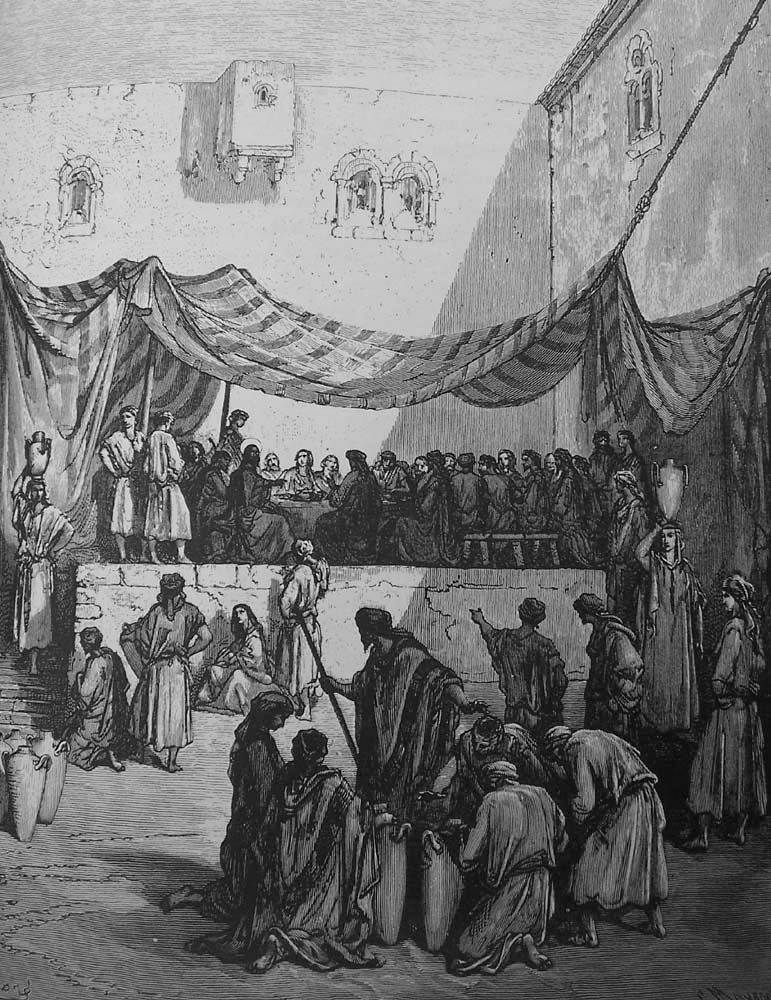
in John 2Jesus told the servants, “Fill the jars with water.” So they filled them to the brim.
BSB
The same verse in ASV and KJV ▾
ASV
Jesus saith unto them, Fill the waterpots with water. And they filled them up to the brim.
KJV
Jesus saith unto them, Fill the waterpots with water. And they filled them up to the brim.
⋯
This verse in John 2
Commentary
23 notes on this verseJesus saith unto them,.... To the servants that waited at the feast, fill the water pots with water. The Ethiopic version adds, "to their brims", as they did.
This site's exposition
six stone water jars
on John 2:6-7
The six stone jars stood there for the washing the Jewish rites of purification required. Each held twenty to thirty gallons, so the six together held a hundred and twenty gallons at least. Jesus tells the servants to fill them to the brim.
This site's exposition
Fill the jars with water
The servants filled the jars with water, and for Albert Barnes the disciples had no hand in it, and the servants knew what went in. Matthew Henry compares them to Moses going to the rock at God's word. They obeyed a command that looked unlikely.
The record, by era
The Church Fathers5 voices
(Tr. ix. c. 7) A firkin is a certain measure; as urn, amphora, and the like. Metron is the Greek for measure: whence metretae. Two or three, is not to be taken to mean some holding two, others three, but the same vessels holding two or three. Jesus saith unto them, Fill the waterpots with water. And they filled them up to the brim.
Addressing the expectant servants, he said, "Fill the jars with water." The servants promptly obeyed, and suddenly in a marvelous way the water began to acquire potency, take on color, emit fragrance and gain flavor—all at once it changed its nature completely! Now this transformation …
In the ancient times there was prophecy, and no times were left without the dispensation of prophecy. But the prophecy, since Christ was not understood therein, was water. For in water wine is in some manner latent. The apostle tells us what we are to understand by this water: "Even unto this day," saith he, "whilst Moses is read, that same veil is upon their heart; that it is not unveiled because it is done away in Christ. And when thou shalt have passed over," saith he, "to the Lord, the veil shall be taken away." By the veil he means the covering over of prophecy, so that it was not understood. When thou hast passed over to the Lord, the veil is taken away; so likewise is tastelessness taken away when thou hast passed over to the Lord; and what was water now becomes wine to thee. Read all the prophetic books; and if Christ be not understood therein, what canst thou find so insipid and silly? Understand Christ in them, and what thou readest not only has a taste, but even inebriates thee; transporting the mind from the body, so that forgetting the things that are past, thou reachest forth to the things that are before. Wherefore, prophecy from ancient times, even from the time when the series of human births began to run onwards, was not silent concerning Christ; but the import of the prophecy was concealed therein, for as yet it was water. When these words of the Gospel are understood, and they are certainly clear, all the mysteries which are latent in this miracle of the Lord will be laid open. Observe what He says, that it behoved the things to be fulfilled in Christ that were written of Him. Where were they written? "In the law," saith He, "and in the prophets, and in the Psalms." He omitted no part of the Old Scriptures. These were water; and hence the disciples were called irrational by the Lord, because as yet they tasted to them as water, not as wine. […]
A commentator
Philoxenus of Mabbug13 Ascetic Discourses, Discourse 2 -- On Faith · Written before 523.
proposed
Others, however, He healed by a command of power, without either looking up to heaven or asking His Father. For by a command of power He raised up the young man, the son of the widow; with a word He called to the daughter of …
Let Cana thank you for gladdening her banquet! The bridegroom's crown exalted you for exalting it, And the bride's crown belonged to your victory. In her mirror allegories are expounded and traced, For you portrayed your church in the bride, And in her guests, yours …
15 more voices on this verse
The Church Fathers5 voices
For these thankless men saw, and by means of His miracles handled the wonder-working God, and yet remained in unbelief. ... They heard of the wine that, without previous culture, was ministered; of the bread that was eaten at that spontaneous banquet; they heard that the demons had been put to flight; the sick restored to health.
"And why was it, that He did not the miracle before they filled them, which would have been more marvelous by far? for it is one thing to change given matter to a different quality, and another to create matter out of nothing." The latter would indeed have been more wonderful, but would not have seemed so credible to the many. And therefore He often purposely lessens the greatness of His miracles, that it may be the more readily received.
"But why," says one, "did not He Himself produce the water which He afterwards showed to be wine, instead of bidding the servants bring it?" For the very same reason; and also, that He might have those who drew it out to witness that what had been effected was no delusion since if any had been inclined to be shameless, those who ministered might have said to them, "We drew the water, we filled the vessels." And besides what we have mentioned, He thus overthrows those doctrines which spring up against the Church. For since there are some who say that the Creator of the world is another, and that the things which are seen are not His works, but those of a certain other opposing god, to curb these men's madness He doth most of His miracles on matter found at hand. Because, had the creator of these been opposed to Him, He would not have used what was another's to set forth His own power. But now to show that it is He who transmutes water in the vine plants, and who converts the rain by its passage through the root into wine, He effected that in a moment at the wedding which in the plant is long in doing.
(Hom. xxii. 2) But why did He not work the miracle before they had filled the waterpots, which would have been much more wonderful; inasmuch as it is one thing to change the quality of some existing substance, another to make it that substance out of nothing? The latter miracle would be the more wonderful, but the former would be the more easy of belief. And this principle often acts as a check, to moderate the greatness of our Lord's miracles: He wishes to make them more credible, therefore He makes them less marvellous; a refutation this of the perverse doctrine of some, that He was a different Being from the Maker of the world. For we see He performs most of His miracles upon subject-matter already existing, whereas were He contrary to the Creator of the world, He would not use a material thus alien, to demonstrate His own power. He did not draw out the water Himself which He made wine, but ordered the servants to do so. This was for the sake of having witnesses of the miracle; And He saith unto them, Draw out now, and bear unto the governor of the feast.
A commentator
Cyril of AlexandriaCommentary on the Gospel of John, Book 2 · Written before 444.
proposed
The ministers accomplish what is commanded, and by unspeakable might was the water changed into wine. For what is hard to Him Who can do all things? He that calleth into being things which are not, how will He weary, trans-ordering into what He will things already made? They marvel at the thing, as strange; for such are Christ's works to look upon. But the governor of the feast charges the bridegroom with expending what was better on the latter end of the feast, not unfitly, as appears to me, according to the narration of the story.
The Medieval Church4 voices
A commentator
BonaventureCollations on the Hexaemeron, Collation 19 · Written in the 13th century.
proposed
Note that when Christ performed the miracle of changing water into wine, he did not say from the very first: "Let there be wine." Nor did He produce it out of nothing: as Gregory comments, He asked the servants to fill the water jars. It …
Jesus says to them: Fill the water jars with water. And they filled them up to the brim. And it should be understood that when they were filled, by the Lord's power the water was converted into wine; therefore he commanded them to be filled, …
Then when he says that Jesus instructed them, Fill those jars with water, he gives the material of the miracle. Here we might ask why this miracle was performed with already existing material, and not from nothing. There are three reasons for this. The first …
But could He not have produced wine from nothing, without filling the vessels with water? Of course He could; but the greatness of miracles often diminishes their acceptability. There could also have been the purpose of having the servants who carried the water into the …
The Puritans and the Awakening1 voice
As Moses, the servant of the Lord, when God bade him, went to the rock, to draw water; so these servants, when Christ bade them, went to the water, to fetch wine. Note, Since no difficulties can be opposed to the arm of God's power, no improbabilities are to be objected against the word of his command.
The Nineteenth Century5 voices
A commentator
Albert Barnes1798–1870
Notes, Explanatory and Practical, on the Old and New Testaments (1832-1869)
With water - This was done by the servants employed at the feast. It was done by “them,” so that there might be no opportunity of saying that the disciples of Jesus had filled them with wine to produce the “appearance” of a miracle. In this case there could be no deception. The quantity was very considerable. The servants would know whether the “wine” or “water” had been put in these vessels.
A commentator
J.C. Ryle1816–1900
Expository Thoughts on the Gospels: John (lightly modernized text, Grace Gems edition) (1869)
proposed
These verses describe a miracle which should always possess a special interest in the eyes of a true Christian. It is the first, in order of time, of the many mighty works which Jesus did, when He was upon earth. We are distinctly told, "This beginning of miracles did Jesus in Cana of Galilee." Like every other miracle which John was inspired to record, it is related with great minuteness and particularity. And, like every other miracle in John's Gospel, it is rich in spiritual lessons.
A commentator
J.C. Ryle1816–1900
Expository Thoughts on the Gospels: John (lightly modernized text, Grace Gems edition) (1869)
proposed
These verses describe a miracle which should always possess a special interest in the eyes of a true Christian. It is the first, in order of time, of the many mighty works which Jesus did, when He was upon earth. We are distinctly told, "This beginning of miracles did Jesus in Cana of Galilee." Like every other miracle which John was inspired to record, it is related with great minuteness and particularity. And, like every other miracle in John's Gospel, it is rich in spiritual lessons. We learn, firstly, from these verses, how honorable in the sight of Christ is the estate of matrimony . To be present at a "marriage" was almost the first public act of our Lord's earthly ministry. Marriage is not a sacrament, as the Church of Rome asserts. It is simply a state of life ordained by God for man's benefit. But it is a state which ought never to be spoken of with levity, or regarded with disrespect. The Prayerbook service has well described it, as "an honorable estate, instituted of God in the time of man's innocency, and signifying unto us the mystical union that is between Christ and his Church." Society is never in a healthy condition, and true religion never flourishes in that land where the marriage tie is lightly esteemed. They who lightly esteem it have not the mind of Christ. He who "beautified and adorned the estate of matrimony by His presence and first miracle that He wrought in Cana of Galilee," is One who is always of one mind. "Marriage," says the Holy Spirit by Paul, "is honorable in all." (Heb. 13:4.) One thing, however, ought not to be forgotten. Marriage is a step which so seriously affects the temporal happiness and spiritual welfare of two immortal souls, that it ought never to be taken in hand "unadvisedly, lightly, wantonly, and without due consideration."
‘Jesus saith unto them, Fill the waterpots with water. And they filled them up to the brim.’John 2:7. YOU KNOW THE NARRATIVE. Jesus was at a wedding feast, and when the wine ran short, he provided for it right bountifully. I do not think that I should do any good if I were to enter upon the discussion as to what sort of wine our Lord Jesus made on this occasion. It was wine, and I am sure it was very good wine, for he would produce nothing quite but the best.
‘Jesus saith unto them, Fill the waterpots with water. And they filled them up to the brim.’John 2:7. YOU KNOW THE NARRATIVE. Jesus was at a wedding feast, and when the wine ran short, he provided for it right bountifully. I do not think that I should do any good if I were to enter upon the discussion as to what sort of wine our Lord Jesus made on this occasion. It was wine, and I am sure it was very good wine, for he would produce nothing quite but the best. Was it wine such as men understand by that word now? It was wine; but there are very few people in this country who ever see, much less drink, any of that beverage. That which goes under the name of wine is not true wine, but a fiery, brandied concoction of which I feel sure that Jesus would not have tasted a drop. The fire-waters and blazing spirits of modern wine manufacturers are very different articles from the juice of the grape, mildly exhilarating, which was the usual wine of more sober centuries. As to the wine such as is commonly used in the East, a person must drink inordinately before he would become intoxicated with it. It would be possible, for there were cases in which men were intoxicated with wine; but, as a rule, intoxication was a rare vice in the Savior’s times and in the preceding ages. Had our great Exemplar lived under our present circumstances, surrounded by a sea of deadly drink, which is ruining tens of thousands, I know how he would have acted. I am sure he would not have contributed by word or deed to the rivers of poisonous beverages in which bodies and souls are now being destroyed wholesale. The kind of wine which he made was such that, if there had been no stronger drink in the world, nobody might have thought it necessary to enter any protest against drinking it. It would have done nobody any hurt, be sure of that, or else Jesus our loving Savior would not have made it.
The words behind it
13 Greek wordsEvery Greek word of this verse in the order it stands, with what it means and the door to its own study. The last column counts the times a word stands in the whole Bible: the rarer the word, the more the places it appears belong together.
| Greek | Sound | Meaning | Word study | In the Bible |
|---|---|---|---|---|
| λέγει | legei | Says | G3004 → | 1325 times |
| αὐτοῖς | autois | to them | G846 → | 5565 times |
| ὁ | ho | <the> | G3588 → | 19766 times |
| Ἰησοῦς· | iesous | Jesus; | G2424 → | 908 times |
| γεμίσατε | gemisate | do fill | G1072 → | 8 times |
| τὰς | tas | the | G3588 → | 19766 times |
| ὑδρίας | hudrias | jars | G5201 → | 3 times |
| ὕδατος. | hudatos | with water. | G5204 → | 76 times |
| καὶ | kai | And | G2532 → | 9120 times |
| ἐγέμισαν | egemisan | they filled | G1072 → | 8 times |
| αὐτὰς | autas | them | G846 → | 5565 times |
| ἕως | he'os | up to | G2193 → | 146 times |
| ἄνω. | ano | [the] brim. | G507 → | 9 times |
λέγειSays
legeiG3004 →1325 times
αὐτοῖςto them
autoisG846 →5565 times
ὁ<the>
hoG3588 →19766 times
Ἰησοῦς·Jesus;
iesousG2424 →908 times
γεμίσατεdo fill
gemisateG1072 →8 times
τὰςthe
tasG3588 →19766 times
ὑδρίαςjars
hudriasG5201 →3 times
ὕδατος.with water.
hudatosG5204 →76 times
καὶAnd
kaiG2532 →9120 times
ἐγέμισανthey filled
egemisanG1072 →8 times
αὐτὰςthem
autasG846 →5565 times
ἕωςup to
he'osG2193 →146 times
ἄνω.[the] brim.
anoG507 →9 times
A shaded row is a word that stands 400 times or fewer in the Bible.
The walk
8 stopsEach card is a verse this one points to, and under it the verses that one points to in turn. Where several paths arrive at the same place, that place is listed first: the text keeps returning to it.
Through
John 2:5His mother said to the servants, “Do whatever He tells you.”
it leads to
- Genesis 6:22
So Noah did everything precisely as God had commanded him.
- John 15:14
You are My friends if you do what I command you.
- Hebrews 11:8
By faith Abraham, when called to go to a place he would later receive as his inheritance, obeyed and went, without knowing where he was going.
- Luke 5:5–6
“Master,” Simon replied, “we have worked hard all night without catching anything. But because You say so, I will let down the nets.”
- Hebrews 5:9
And having been made perfect, He became the source of eternal salvation to all who obey Him
- Genesis 6:22
Through
1 Kings 17:13“Do not be afraid,” Elijah said to her. “Go and do as you have said. But first make me a small cake of bread from what you have, and bring it out to me.…
it leads to
- Malachi 3:10
Bring the full tithe into the storehouse, so that there may be food in My house. Test Me in this,” says the LORD of Hosts. “See if I will not open the windows of…
- Matthew 6:33
But seek first the kingdom of God and His righteousness, and all these things will be added unto you.
- Malachi 3:10
Through
John 2:3When the wine ran out, Jesus’ mother said to Him, “They have no more wine.”
it leads to
- Psalms 104:15
wine that gladdens the heart of man, oil that makes his face to shine, and bread that sustains his heart.
- Psalms 104:15
Where this verse is studied
On this page
Studies17
On this verse
On this chapter
About John
This page draws on 20 works. Open the list of works
This page draws on Albert Barnes, Notes, Explanatory and Practical, on the Gospels; Albert Barnes, Notes, Explanatory and Practical, on the Old and New Testaments (1832-1869); Augustine of Hippo, Catena Aurea by Aquinas; Augustine of Hippo, Tractates on John 9; Bonaventure, Collations on the Hexaemeron, Collation 19; Bonaventure, Commentary on John, Chapter 2; Charles Spurgeon, The Metropolitan Tabernacle Pulpit, Sermon No. 1556: “The Waterpots at Cana” (lightly modernized text, CCEL edition); Cyril of Alexandria, Commentary on the Gospel of John, Book 2; Ephrem the Syrian, HYMNS ON VIRGINITY 33.1-2; J.C. Ryle, Expository Thoughts on the Gospels: John (lightly modernized text, Grace Gems edition); John Chrysostom, Homily on the Gospel of John 22; John Chrysostom, Catena Aurea by Aquinas; John Gill, Exposition of the New Testament (1746-1748); John Lightfoot, Horae Hebraicae et Talmudicae on John; Matthew Henry, Commentary on the Whole Bible; Maximus of Turin, SERMON 23; Methodius of Olympus, Methodius Oration on the Psalms; Philoxenus of Mabbug, 13 Ascetic Discourses, Discourse 2 -- On Faith; Theophylact of Ohrid, Commentary on John and Thomas Aquinas, Commentary on John.