
John 2:6
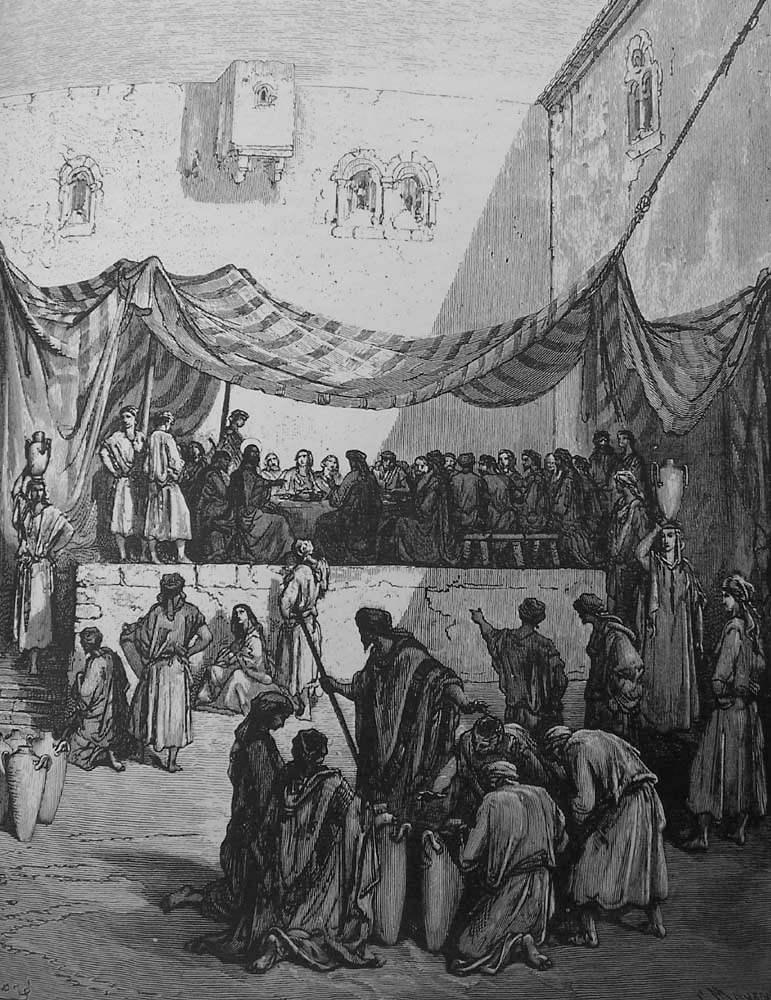
in John 2Now six stone water jars had been set there for the Jewish rites of purification. Each could hold from twenty to thirty gallons.
BSB
The same verse in ASV and KJV ▾
ASV
Now there were six waterpots of stone set there after the Jews’ manner of purifying, containing two or three firkins apiece.
KJV
And there were set there six waterpots of stone, after the manner of the purifying of the Jews, containing two or three firkins apiece.
⋯
This verse in John 2
Commentary
20 notes on this verseAfter the manner of the purifying of the Jews - Or, for the purpose of the purifying of the Jews. The preposition κατα, which I have translated, for the purpose, often denotes in the best Greek writers the final cause of a thing. See several examples produced by Raphelius, from Arrian and Herodotus. These six vessels were set in a convenient place, for the purpose of the Jews washing their hands before they sat down to meat, and probably for other purposes of purification. See this custom referred to in Mat 15:2 (note).
This site's exposition
six stone water jars
on John 2:6-7
The six stone jars stood there for the washing the Jewish rites of purification required. Each held twenty to thirty gallons, so the six together held a hundred and twenty gallons at least. Jesus tells the servants to fill them to the brim.
The record, by era
The Church Fathers5 voices
But observe what Himself saith, "The things which were written in the law, and in the prophets, and in the Psalms concerning me." And we know that the law extends from the time of which we have record, that is, from the beginning of the world: "In the beginning God made the heaven and the earth." Thence down to the time in which we are now living are six ages, this being the sixth, as you have often heard and know. The first age is reckoned from Adam to Noah; the second, from Noah to Abraham; and, as Matthew the evangelist duly follows and distinguishes, the third, from Abraham to David; the fourth, from David to the carrying away into Babylon; the fifth, from the carrying away into Babylon to John the Baptist; the sixth, from John the Baptist to the end of the world. Moreover, God made man after His own image on the sixth day, because in this sixth age is manifested the renewing of our mind through the gospel, after the image of Him who created us; and the water is turned into wine, that we may taste of Christ, now manifested in the law and the prophets. Hence "there were there six water-pots," which He bade be filled with water. Now the six water-pots signify the six ages, which were not without prophecy. And those six periods, divided and separated as it were by joints, would be as empty vessels unless they were filled by Christ. Why did I say, the periods which would run fruitlessly on, unless the Lord Jesus were preached in them? Prophecies are fulfilled, the water-pots are full; but that the water may be turned into wine, Christ must be understood in that whole prophecy.
But what means this: "They contained two or three metretae apiece"? This phrase certainly conveys to us a mysterious meaning. For by "metretae" he means certain measures, as if he should say jars, flasks, or something of that sort. Metreta is the name of a measure, and takes its name from the word "measure." For metron is the Greek word for measure, whence the word "metretae" is derived. "They contained," then, "two or three metretae apiece." What are we to say, brethren? If He had simply said "three apiece," our mind would at once have run to the mystery of the Trinity. And, perhaps, we ought not at once to reject this application of the meaning, because He said, "two or three apiece;" for when the Father and Son are named, the Holy Spirit must necessarily be understood. For the Holy Spirit is not that of the Father only, nor of the Son only, but the Spirit of the Father and of the Son. For it is written, "If any man love the world, the Spirit of the Father is not in him." And again, "Whoso hath not the Spirit of Christ is none of His." The same, then, is the Spirit of the Father and of the Son. Therefore, the Father and the Son being named, the Holy Spirit also is understood, because He is the Spirit of the Father and of the Son. […]
But there is also another meaning that must not be passed over, and which I will declare: let every man choose which he likes best. We keep not back what is suggested to us. For it is the Lord's table, and the minister ought not to defraud the guests, especially when they hunger as you now do, so that your longing is manifest. Prophecy, which is dispensed from the ancient times, has for its object the salvation of all nations. True, Moses was sent to the people of Israel alone, and to that people alone was the law given by him; and the prophets, too, were of that people, and the very distribution of times was marked out according to the same people; whence also the water-pots are said to be "according to the purification of the Jews:" nevertheless, that the prophecy was proclaimed to all other nations also is manifest, forasmuch as Christ was concealed in him in whom all nations are blessed, as it was promised to Abraham by the Lord, saying, "In thy seed shall all nations be blessed." But this was not as yet understood, for as yet the water was not turned into wine. The prophecy therefore was dispensed to all nations. But how do we show that all nations belong to the "two or three metretae apiece"? It was a matter of reckoning, in some measure, that he should say the same water-pots contained "two apiece," which he had said contained "three apiece;" evidently in order to intimate to us a mystery therein. How are there "two metretae apiece"? Circumcision and uncircumcision. Scripture mentions these two classes of people, and leaves out no kind of men, when it says, "Circumcision and uncircumcision;" in these two appellations thou hast all nations: they are the two metretae apiece. […]
(Tr. ix. 5. et sq.) Now if He ordered the water to be poured out, and then introduced the wine from the hidden recesses of creation, He would seem to have rejected the Old Testament. But converting, as He did, the water into wine, He showed us that the Old Testament was from Himself, for it was by His order that the waterpots were filled. But those Scriptures have no meaning, if Christ be not understood there. Now we know from what time the law dates, viz. from the foundation of the world. From that time to this are six ages; the first, reekoning from Adam to Noah; the second, from Noah to Abraham; the third, from Abraham to David; the fourth, from David to the carrying away into Babylon; the fifth, from that time to John the Baptist; the sixth, from John the Baptist to the end of the world. The six waterpots then denote these six ages of prophecy. The prophecies are fulfilled; the waterpots are full. But what is the meaning of their holding two or three firkins apiece? Had He said three only, our minds would have run immediately to the mystery of the Trinity. Nor perhaps can we reject it, even though it is said, two or three: for the Father and the Son being named, the Holy Ghost may be understood by consequence; inasmuch as it is the love between the Father and the Son, which is the Holy Ghost. (c. 17.). Nor should we pass over another interpretation, which makes the two firkins alluded to the two races of men, the Jews and the Greeks; and the three to the three sons of Noah.
In the ancient times there was prophecy, and no times were left without the dispensation of prophecy. But the prophecy, since Christ was not understood therein, was water. For in water wine is in some manner latent. The apostle tells us what we are to understand by this water: "Even unto this day," saith he, "whilst Moses is read, that same veil is upon their heart; that it is not unveiled because it is done away in Christ. And when thou shalt have passed over," saith he, "to the Lord, the veil shall be taken away." By the veil he means the covering over of prophecy, so that it was not understood. When thou hast passed over to the Lord, the veil is taken away; so likewise is tastelessness taken away when thou hast passed over to the Lord; and what was water now becomes wine to thee. Read all the prophetic books; and if Christ be not understood therein, what canst thou find so insipid and silly? Understand Christ in them, and what thou readest not only has a taste, but even inebriates thee; transporting the mind from the body, so that forgetting the things that are past, thou reachest forth to the things that are before. Wherefore, prophecy from ancient times, even from the time when the series of human births began to run onwards, was not silent concerning Christ; but the import of the prophecy was concealed therein, for as yet it was water. When these words of the Gospel are understood, and they are certainly clear, all the mysteries which are latent in this miracle of the Lord will be laid open. Observe what He says, that it behoved the things to be fulfilled in Christ that were written of Him. Where were they written? "In the law," saith He, "and in the prophets, and in the Psalms." He omitted no part of the Old Scriptures. These were water; and hence the disciples were called irrational by the Lord, because as yet they tasted to them as water, not as wine. […]
13 more voices on this verse
The Church Fathers2 voices
A commentator
Ephrem the SyrianCOMMENTARY ON TATIAN'S DIATESSARON 5.6-7 · Written before 373.
proposed
Why did our Lord change nature at the beginning of his signs, if it was not to show that the divinity that changed nature in the interior of the jars was the same that changed nature in the womb of the virgin? And at the …
It is not without a reason that the Evangelist says, "After the manner of the purifying of the Jews," but in order that none of the unbelievers might suspect that lees having been left in the vessels, and water having been poured upon and mixed with them, a very weak wine had been made. Therefore he says, "after the manner of the purifying of the Jews," to show that those vessels were never receptacles for wine. For because Palestine is a country with but little water, and brooks and fountains were not everywhere to be found, they always used to fill waterpots with water, so that they might not have to hasten to the rivers if at any time they were filed, but might have the means of purification at hand.
The Medieval Church6 voices
The stone water jars were used for the purification of the Jews. For the Jews washed themselves almost every day and only then partook of food. Whether they touched a leper, a dead body, or had contact with a woman, they washed themselves as being …
Morally: These nuptials are those of God and the soul in the very reconciliation of the soul to God, of which Hosea 2 says: I will espouse thee to me in faith, and thou shalt know that I am the Lord. To celebrate these nuptials …
Vessels to hold water were there, after the manner of the purifying of Jews. Among other traditions of the Pharisees, they observed frequent washings.
(in loc.) As if she said, Though He appear to refuse, He will do it nevertheless. She knew His pity and mercifulness. And there were set there six waterpots of stone, after the manner of the purifying of the Jews, containing two or three firkins apiece. Hydriæ1 are vessels to hold water: hydor being the Greek for water.
Now there were six water jars etc. Here the third point is touched upon, namely the working of the miracle. And because God does all things in a certain "weight, number, and measure," he states the measure in which this miracle was performed. On account …
Now Christ's completion of the miracle is set forth. First, the vessels in which the miracle was performed are described. Secondly, the matter of the miracle is stated (v 7). Thirdly, we have how the miracle was made known and approved (v 8). The miracle …
The Puritans and the Awakening2 voices
To what use Christ put them, quite different from what they were intended for; to be the receptacles of the miraculous wine. Thus Christ came to bring in the grace of the gospel, which is as wine, that cheereth God and man ( Judg. ix.
quarantine:debris (2026-07-29) — unbalanced-parens
And there were set six water pots of stone,....
The Nineteenth Century3 voices
A commentator
J.C. Ryle1816–1900
Expository Thoughts on the Gospels: John (lightly modernized text, Grace Gems edition) (1869)
proposed
These verses describe a miracle which should always possess a special interest in the eyes of a true Christian. It is the first, in order of time, of the many mighty works which Jesus did, when He was upon earth. We are distinctly told, "This beginning of miracles did Jesus in Cana of Galilee." Like every other miracle which John was inspired to record, it is related with great minuteness and particularity. And, like every other miracle in John's Gospel, it is rich in spiritual lessons.
A commentator
J.C. Ryle1816–1900
Expository Thoughts on the Gospels: John (lightly modernized text, Grace Gems edition) (1869)
proposed
These verses describe a miracle which should always possess a special interest in the eyes of a true Christian. It is the first, in order of time, of the many mighty works which Jesus did, when He was upon earth. We are distinctly told, "This beginning of miracles did Jesus in Cana of Galilee." Like every other miracle which John was inspired to record, it is related with great minuteness and particularity. And, like every other miracle in John's Gospel, it is rich in spiritual lessons. We learn, firstly, from these verses, how honorable in the sight of Christ is the estate of matrimony . To be present at a "marriage" was almost the first public act of our Lord's earthly ministry. Marriage is not a sacrament, as the Church of Rome asserts. It is simply a state of life ordained by God for man's benefit. But it is a state which ought never to be spoken of with levity, or regarded with disrespect. The Prayerbook service has well described it, as "an honorable estate, instituted of God in the time of man's innocency, and signifying unto us the mystical union that is between Christ and his Church." Society is never in a healthy condition, and true religion never flourishes in that land where the marriage tie is lightly esteemed. They who lightly esteem it have not the mind of Christ. He who "beautified and adorned the estate of matrimony by His presence and first miracle that He wrought in Cana of Galilee," is One who is always of one mind. "Marriage," says the Holy Spirit by Paul, "is honorable in all." (Heb. 13:4.) One thing, however, ought not to be forgotten. Marriage is a step which so seriously affects the temporal happiness and spiritual welfare of two immortal souls, that it ought never to be taken in hand "unadvisedly, lightly, wantonly, and without due consideration."
A commentator
Albert Barnes1798–1870
Notes, Explanatory and Practical, on the Old and New Testaments (1832-1869)
proposed
Six water-pots of stone - Made of stone; or, as we should say, stoneware. After the manner - After the usual custom. Of the purifying - Of the “washings” or ablutions of the Jews. They were for the purpose of washing the hands before and after eating Mat 15:2, and for the formal washing of vessels, and even articles of furniture, Luk 11:39; Mar 7:3-4. Two or three firkins - It is not quite certain what is meant here by the word “firkins.” It is probable that the measure intended is the Hebrew “bath,” containing about 7 12 gallons.
The words behind it
18 Greek wordsEvery Greek word of this verse in the order it stands, with what it means and the door to its own study. The last column counts the times a word stands in the whole Bible: the rarer the word, the more the places it appears belong together.
| Greek | Sound | Meaning | Word study | In the Bible |
|---|---|---|---|---|
| ἦσαν | esan | There were | G1510 → | 2333 times |
| δὲ | de | now | G1161 → | 2765 times |
| ἐκεῖ | ekei | there | G1563 → | 105 times |
| λίθιναι | lithinai | of stone | G3035 → | |
| ὑδρίαι | hudriai | water jars | G5201 → | 3 times |
| ἓξ | hex | six | G1803 → | 13 times |
| κατὰ | kata | according to | G2596 → | 468 times |
| τὸν | ton | the | G3588 → | 19766 times |
| καθαρισμὸν | katharismon | purification | G2512 → | |
| τῶν | ton | of the | G3588 → | 19766 times |
| Ἰουδαίων | ioudaion | Jews | G2453 → | 192 times |
| κείμεναι, | keimenai | standing, | G2749 → | 23 times |
| χωροῦσαι | chorousai | having space | G5562 → | 10 times |
| ἀνὰ | ana | for | G303 → | |
| μετρητὰς | metretas | metretae | G3355 → | |
| δύο | duo | two | G1417 → | 133 times |
| ἢ | e | or | G2228 → | 342 times |
| τρεῖς. | treis | three. | G5140 → | 69 times |
ἦσανThere were
esanG1510 →2333 times
δὲnow
deG1161 →2765 times
ἐκεῖthere
ekeiG1563 →105 times
λίθιναιof stone
lithinaiG3035 →
ὑδρίαιwater jars
hudriaiG5201 →3 times
ἓξsix
hexG1803 →13 times
κατὰaccording to
kataG2596 →468 times
τὸνthe
tonG3588 →19766 times
καθαρισμὸνpurification
katharismonG2512 →
τῶνof the
tonG3588 →19766 times
ἸουδαίωνJews
ioudaionG2453 →192 times
κείμεναι,standing,
keimenaiG2749 →23 times
χωροῦσαιhaving space
chorousaiG5562 →10 times
ἀνὰfor
anaG303 →
μετρητὰςmetretae
metretasG3355 →
δύοtwo
duoG1417 →133 times
ἢor
eG2228 →342 times
τρεῖς.three.
treisG5140 →69 times
A shaded row is a word that stands 400 times or fewer in the Bible.
The walk
8 stopsEach card is a verse this one points to, and under it the verses that one points to in turn. Where several paths arrive at the same place, that place is listed first: the text keeps returning to it.
Through
Hebrews 10:22let us draw near with a sincere heart in full assurance of faith, having our hearts sprinkled to cleanse us from a guilty conscience and our bodies washed with pure water.
it leads to
- Ezekiel 36:25
I will also sprinkle clean water on you, and you will be clean. I will cleanse you from all your impurities and all your idols.
Reached by 2 separate paths from here.
- John 3:5
Jesus answered, “Truly, truly, I tell you, no one can enter the kingdom of God unless he is born of water and the Spirit.
Reached by 2 separate paths from here.
- Ephesians 5:26
to sanctify her, cleansing her by the washing with water through the word,
- 1 Peter 3:21
And this water symbolizes the baptism that now saves you also—not the removal of dirt from the body, but the pledge of a clear conscience toward God—through the resurrection of Jesus Christ,
- 1 Corinthians 6:11
And that is what some of you were. But you were washed, you were sanctified, you were justified, in the name of the Lord Jesus Christ and by the Spirit of our God.
- Ezekiel 36:25
Through
Ephesians 5:26to sanctify her, cleansing her by the washing with water through the word,
it leads to
- Hebrews 10:22
let us draw near with a sincere heart in full assurance of faith, having our hearts sprinkled to cleanse us from a guilty conscience and our bodies washed with pure water.
- John 15:3
You are already clean because of the word I have spoken to you.
- John 17:17–19
Sanctify them by the truth; Your word is truth.
- Hebrews 10:22
Where this verse is studied
About John
This page draws on 16 works. Open the list of works
This page draws on Adam Clarke, Commentary on the Bible; Albert Barnes, Notes, Explanatory and Practical, on the Gospels; Albert Barnes, Notes, Explanatory and Practical, on the Old and New Testaments (1832-1869); Alcuin of York, Catena Aurea by Aquinas; Augustine of Hippo, Tractates on John 9; Augustine of Hippo, Catena Aurea by Aquinas; Bede, Catena Aurea by Aquinas; Bonaventure, Commentary on John, Chapter 2; Ephrem the Syrian, COMMENTARY ON TATIAN'S DIATESSARON 5.6-7; J.C. Ryle, Expository Thoughts on the Gospels: John (lightly modernized text, Grace Gems edition); John Chrysostom, Homily on the Gospel of John 22; John Gill, Exposition of the New Testament (1746-1748); John Lightfoot, Horae Hebraicae et Talmudicae on John; Matthew Henry, Commentary on the Whole Bible; Theophylact of Ohrid, Commentary on John and Thomas Aquinas, Commentary on John.