
John 2:3
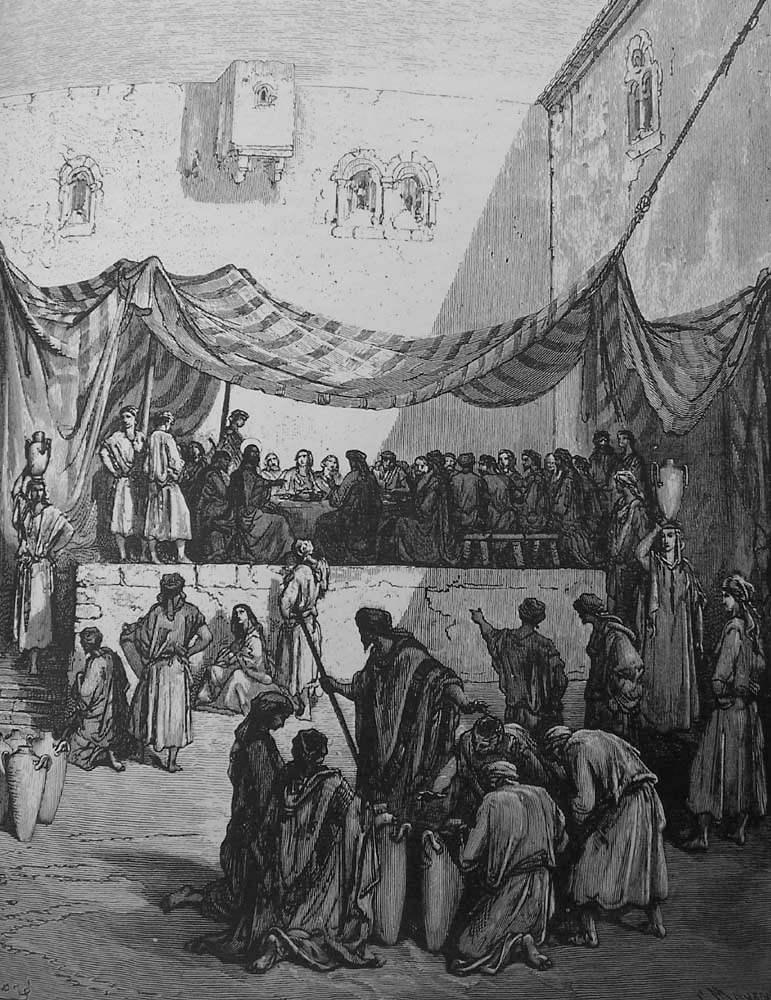
in John 2When the wine ran out, Jesus’ mother said to Him, “They have no more wine.”
BSB
The same verse in ASV and KJV ▾
ASV
And when the wine failed, the mother of Jesus saith unto him, They have no wine.
KJV
And when they wanted wine, the mother of Jesus saith unto him, They have no wine.
⋯
This verse in John 2
Commentary
21 notes on this verseThat wine, which was produced by God in a vineyard, and which was first consumed, was good. None of those who drank of it found fault with it; and the Lord partook of it also. But that wine was better which the Word made from water, on the moment, and simply for the use of those who had been called to the marriage.
This site's exposition
They have no more wine
The wine ran out at the wedding, and the host's honor ran out with it. Wine at a feast stood for gladness, and the gladness had failed; His mother brings it to Jesus and asks for nothing. What she expects she leaves unsaid.
The record, by era
The Church Fathers5 voices
In the ancient times there was prophecy, and no times were left without the dispensation of prophecy. But the prophecy, since Christ was not understood therein, was water. For in water wine is in some manner latent. The apostle tells us what we are to understand by this water: "Even unto this day," saith he, "whilst Moses is read, that same veil is upon their heart; that it is not unveiled because it is done away in Christ. And when thou shalt have passed over," saith he, "to the Lord, the veil shall be taken away." By the veil he means the covering over of prophecy, so that it was not understood. When thou hast passed over to the Lord, the veil is taken away; so likewise is tastelessness taken away when thou hast passed over to the Lord; and what was water now becomes wine to thee. Read all the prophetic books; and if Christ be not understood therein, what canst thou find so insipid and silly? Understand Christ in them, and what thou readest not only has a taste, but even inebriates thee; transporting the mind from the body, so that forgetting the things that are past, thou reachest forth to the things that are before. Wherefore, prophecy from ancient times, even from the time when the series of human births began to run onwards, was not silent concerning Christ; but the import of the prophecy was concealed therein, for as yet it was water. When these words of the Gospel are understood, and they are certainly clear, all the mysteries which are latent in this miracle of the Lord will be laid open. Observe what He says, that it behoved the things to be fulfilled in Christ that were written of Him. Where were they written? "In the law," saith He, "and in the prophets, and in the Psalms." He omitted no part of the Old Scriptures. These were water; and hence the disciples were called irrational by the Lord, because as yet they tasted to them as water, not as wine. […]
A commentator
Romanos the MelodistKONTAKION ON THE MARRIAGE AT CANA 7.5-9 · Written before 555.
proposed
When Christ was present at the marriage feast, and the crowd of guests were faring sumptuously, The supply of wine failed them, and their joy was turned into distress; The bridegroom was upset; the cupbearers muttered unceasingly; There was this one sad display of penury, …
A commentator
Cyril of AlexandriaCommentary on the Gospel of John, Book 2 · Written before 444.
proposed
Seasonably comes He at length, to the beginning of miracles, even if He seems to have been called to it without set purpose. For a marriage feast being held (it is clear that it was altogether holily), the mother of the Saviour is present, and Himself also being bidden comes together with His own disciples, to work miracles rather than to feast with them, and yet more to sanctify the very beginning of the birth of man: I mean so far as appertains to the flesh. For it was fitting that He, Who was renewing the very nature of man, and refashioning it all for the better, should not only impart His blessing to those already called into being, but also prepare before grace for those soon to be born, and make holy their entrance into being. Receive also yet a third reason. It had been said to the woman by God, In sorrow thou shalt bring forth children. How then was it not needful that we should thrust off this curse too, or how else could we escape a condemned marriage? This too the Saviour, being loving to man, removes. For He, the Delight and Joy of all, honoured marriage with His Presence, that He might expel the old shame of child-bearing. For if any man be in Christ, he is a new creature; and old things are passed away, as Paul saith, they are become new. He cometh therefore with. His disciples to the marriage. For it was needful that the lovers of miracles should be present with the Wonderworker, to collect what was wrought as a kind of food to their faith. But when wine failed the feasters, His mother called the Lord being good according to His wonted Love for man, saying, They have no wine. For since it was in His Power to do whatsoever He would, she urges Him to the miracle.
Here it is worth while to enquire whence it came into His mother's mind to imagine anything great of her Son; for He had as yet done no miracle, since the Evangelist saith, "This beginning of miracles did Jesus in Cana of Galilee." Now if any say that this is not a sufficient proof that it was the "beginning of His miracles," because there is added simply "in Cana of Galilee," as allowing it to have been the first done there, but not altogether and absolutely the first, for He probably might have done others elsewhere, we will make answer to him of that which we have said before. And of what kind? The words of John (the Baptist); "And I knew Him not; but that He should be made manifest to Israel, therefore am I come, baptizing with water." Now if He had wrought miracles in early age, the Israelites would not have needed another to declare Him. For He who came among men, and by His miracles was so made known, not to those only in Judaea, but also to those in Syria and beyond, and who did this in three years only, or rather who did not need even these three years to manifest Himself (Matt. iv. 24), for immediately and from the first His fame went abroad everywhere; He, I say, who in a short time so shone forth by the multitude of His miracles, that His name was well known to all, was much less likely, if while a child He had from an early age wrought miracles, to escape notice so long. For what was done would have seemed stranger as done by a boy, and there would have been time for twice or thrice as many, and much more. But in fact He did nothing while He was a child, save only that one thing to which Luke has testified (Luke ii. 46), that at the age of twelve years He sat hearing the doctors, and was thought admirable for His questioning. […]
"How then," asks some one, "came it into the mind of His mother to imagine anything great of Him?" He was now beginning to reveal Himself, and was plainly discovered by the witness of John, and by what He had said to His disciples. And before all this, the Conception itself and all its attending circumstances had inspired her with a very great opinion of the Child; "for," said Luke, "she heard all the sayings concerning the Child, and kept them in her heart." "Why then," says one, "did not she speak this before?" Because, as I said, it was now at last that He was beginning to manifest Himself. Before this time He lived as one of the many, and therefore His mother had not confidence to say any such thing to Him; but when she heard that John had come on His account, and that he had borne such witness to Him as he did, and that He had disciples, after that she took confidence, and called Him, and said, when they wanted wine, "They have no wine." For she desired both to do them a favor, and through her Son to render herself more conspicuous; perhaps too she had some human feelings, like His brethren, when they said, "Show thyself to the world" (c. xvii. 4), desiring to gain credit from His miracles.
14 more voices on this verse
The Church Fathers1 voice
A commentator
Theodore of MopsuestiaCOMMENTARY ON THE GOSPEL OF JOHN 1.2, 3 · Written before 428.
proposed
Perhaps his mother, as mothers do, incited him to perform a miracle, wishing that the greatness of her son would be revealed—and thinking that the lack of wine offered the right occasion for the miracle.
The Medieval Church5 voices
The Mother urges Him to perform a miracle, because from the events of the conception and birth She had received a lofty understanding of His power. For She kept all these things in Her heart (Luke 2:19, 51) and from this concluded that Her Son …
And the wine failing. Here is touched upon the second point, namely the obtaining of the miracle, which was done by the Mother having compassion on the bridegroom's want. Therefore he says: And the wine failing, the Mother of Jesus says to him: They have …
She represents here the Synagogue, which challenges Christ to perform a miracle. It was customary with the Jews to ask for miracles.
The wine was made to fail, to give our Lord the opportunity of making better; that so the glory of God in man might be brought out of its hiding place: And when they wanted wine, the mother of Jesus saith unto Him, They have no wine.
At this physical marriage some role in the miracle belongs to the mother of Christ, some to Christ, and some to the disciples. When he says, When the wine ran out, he indicates the part of each. The role of Christ's mother was to superintend …
The Puritans and the Awakening4 voices
Note, They who, being married, are come to care for the things of the world must expect trouble in the flesh, and count upon disappointment. (3.) It should seem, Christ and his disciples were the occasion of this want, because there was more company than was expected when the provision was made; but they who straiten themselves for Christ shall not lose by him.
Then his hour is come when we are reduced to the utmost strait, and know not what to do. This encouraged those that waited for him to believe that though his hour was not yet come it would come. Note, The delays of mercy are not to be construed the denials of prayer.
For every thing Christ did, and that was done to him, he had his hour, the fixed time and the fittest time, which was punctually observed. First, "Mine hour for working miracles is not yet come." Yet afterwards he wrought this, before the hour, because he foresaw it would confirm the faith of his infant disciples (
quarantine:debris (2026-07-29) — unbalanced-parens
And when they wanted wine,....
The Nineteenth Century4 voices
A commentator
Albert Barnes1798–1870
Notes, Explanatory and Practical, on the Old and New Testaments (1832-1869)
When they wanted wine - A marriage feast among the Jews was commonly observed for seven or eight days. It is not probable that there would be a want of wine at the marriage itself, and it is possible, therefore, that Jesus came there some time during the marriage feast. They have no wine - It is not known why Mary told this to Jesus. It would seem that she had a belief that he was able to supply it, though he had as yet worked no miracle.
A commentator
J.C. Ryle1816–1900
Expository Thoughts on the Gospels: John (lightly modernized text, Grace Gems edition) (1869)
proposed
These verses describe a miracle which should always possess a special interest in the eyes of a true Christian. It is the first, in order of time, of the many mighty works which Jesus did, when He was upon earth. We are distinctly told, "This beginning of miracles did Jesus in Cana of Galilee." Like every other miracle which John was inspired to record, it is related with great minuteness and particularity. And, like every other miracle in John's Gospel, it is rich in spiritual lessons.
A commentator
J.C. Ryle1816–1900
Expository Thoughts on the Gospels: John (lightly modernized text, Grace Gems edition) (1869)
proposed
These verses describe a miracle which should always possess a special interest in the eyes of a true Christian. It is the first, in order of time, of the many mighty works which Jesus did, when He was upon earth. We are distinctly told, "This beginning of miracles did Jesus in Cana of Galilee." Like every other miracle which John was inspired to record, it is related with great minuteness and particularity. And, like every other miracle in John's Gospel, it is rich in spiritual lessons. We learn, firstly, from these verses, how honorable in the sight of Christ is the estate of matrimony . To be present at a "marriage" was almost the first public act of our Lord's earthly ministry. Marriage is not a sacrament, as the Church of Rome asserts. It is simply a state of life ordained by God for man's benefit. But it is a state which ought never to be spoken of with levity, or regarded with disrespect. The Prayerbook service has well described it, as "an honorable estate, instituted of God in the time of man's innocency, and signifying unto us the mystical union that is between Christ and his Church." Society is never in a healthy condition, and true religion never flourishes in that land where the marriage tie is lightly esteemed. They who lightly esteem it have not the mind of Christ. He who "beautified and adorned the estate of matrimony by His presence and first miracle that He wrought in Cana of Galilee," is One who is always of one mind. "Marriage," says the Holy Spirit by Paul, "is honorable in all." (Heb. 13:4.) One thing, however, ought not to be forgotten. Marriage is a step which so seriously affects the temporal happiness and spiritual welfare of two immortal souls, that it ought never to be taken in hand "unadvisedly, lightly, wantonly, and without due consideration."
They have no wine - Though the blessed virgin is supposed to have never seen her son work a miracle before this time, yet she seems to have expected him to do something extraordinary on this occasion; as, from her acquaintance with him, she must have formed some adequate idea of his power and goodness.
The words behind it
13 Greek wordsEvery Greek word of this verse in the order it stands, with what it means and the door to its own study. The last column counts the times a word stands in the whole Bible: the rarer the word, the more the places it appears belong together.
| Greek | Sound | Meaning | Word study | In the Bible |
|---|---|---|---|---|
| καὶ | kai | And | G2532 → | 9120 times |
| ὑστερήσαντος | husteresantos | when was running out | G5302 → | |
| οἴνου | oinou | [the] wine | G3631 → | 34 times |
| λέγει | legei | says | G3004 → | 1325 times |
| ἡ | he | the | G3588 → | 19766 times |
| μήτηρ | meter | mother | G3384 → | 83 times |
| τοῦ | tou | <the> | G3588 → | 19766 times |
| Ἰησοῦ | iesou | of Jesus | G2424 → | 908 times |
| πρὸς | pros | to | G4314 → | 700 times |
| αὐτόν· | auton | Him; | G846 → | 5565 times |
| οἶνον | oinon | Wine | G3631 → | 34 times |
| οὐκ | ouk | not | G3756 → | 1664 times |
| ἔχουσιν. | echousin | they have. | G2192 → | 707 times |
καὶAnd
kaiG2532 →9120 times
ὑστερήσαντοςwhen was running out
husteresantosG5302 →
οἴνου[the] wine
oinouG3631 →34 times
λέγειsays
legeiG3004 →1325 times
ἡthe
heG3588 →19766 times
μήτηρmother
meterG3384 →83 times
τοῦ<the>
touG3588 →19766 times
Ἰησοῦof Jesus
iesouG2424 →908 times
πρὸςto
prosG4314 →700 times
αὐτόν·Him;
autonG846 →5565 times
οἶνονWine
oinonG3631 →34 times
οὐκnot
oukG3756 →1664 times
ἔχουσιν.they have.
echousinG2192 →707 times
A shaded row is a word that stands 400 times or fewer in the Bible.
The walk
8 stopsEach card is a verse this one points to, and under it the verses that one points to in turn. Where several paths arrive at the same place, that place is listed first: the text keeps returning to it.
Through
Philippians 4:6Be anxious for nothing, but in everything, by prayer and petition, with thanksgiving, present your requests to God.
it leads to
- Proverbs 3:5–6
Trust in the LORD with all your heart, and lean not on your own understanding;
- 1 Peter 5:7
Cast all your anxiety on Him, because He cares for you.
- Matthew 6:25–33
Therefore I tell you, do not worry about your life, what you will eat or drink; or about your body, what you will wear. Is not life more than food, and the body more…
- Psalms 55:22
Cast your burden upon the LORD and He will sustain you; He will never let the righteous be shaken.
- 1 Thessalonians 5:17–18
Pray without ceasing.
- Proverbs 3:5–6
Through
Matthew 26:28This is My blood of the covenant, which is poured out for many for the forgiveness of sins.
it leads to
- Hebrews 10:4–14
because it is impossible for the blood of bulls and goats to take away sins.
- Hebrews 9:14–22
how much more will the blood of Christ, who through the eternal Spirit offered Himself unblemished to God, purify our consciences from works of death, so that we may serve the living God!
- Leviticus 17:11
For the life of the flesh is in the blood, and I have given it to you to make atonement for your souls upon the altar; for it is the blood that makes atonement…
- Hebrews 10:4–14
Where this verse is studied
About John
This page draws on 18 works. Open the list of works
This page draws on Adam Clarke, Commentary on the Bible; Albert Barnes, Notes, Explanatory and Practical, on the Old and New Testaments (1832-1869); Alcuin of York, Catena Aurea by Aquinas; Augustine of Hippo, Tractates on John 9; Bede, Catena Aurea by Aquinas; Bonaventure, Commentary on John, Chapter 2; Cyril of Alexandria, Commentary on the Gospel of John, Book 2; Irenaeus, Against Heresies Book III, Chapter XI; J.C. Ryle, Expository Thoughts on the Gospels: John (lightly modernized text, Grace Gems edition); John Calvin, Commentary on the Gospel according to John; John Chrysostom, Homily on the Gospel of John 21; John Gill, Exposition of the New Testament; John Gill, Exposition of the New Testament (1746-1748); Matthew Henry, Commentary on the Whole Bible; Romanos the Melodist, KONTAKION ON THE MARRIAGE AT CANA 7.5-9; Theodore of Mopsuestia, COMMENTARY ON THE GOSPEL OF JOHN 1.2, 3; Theophylact of Ohrid, Commentary on John and Thomas Aquinas, Commentary on John.