
John 2:9
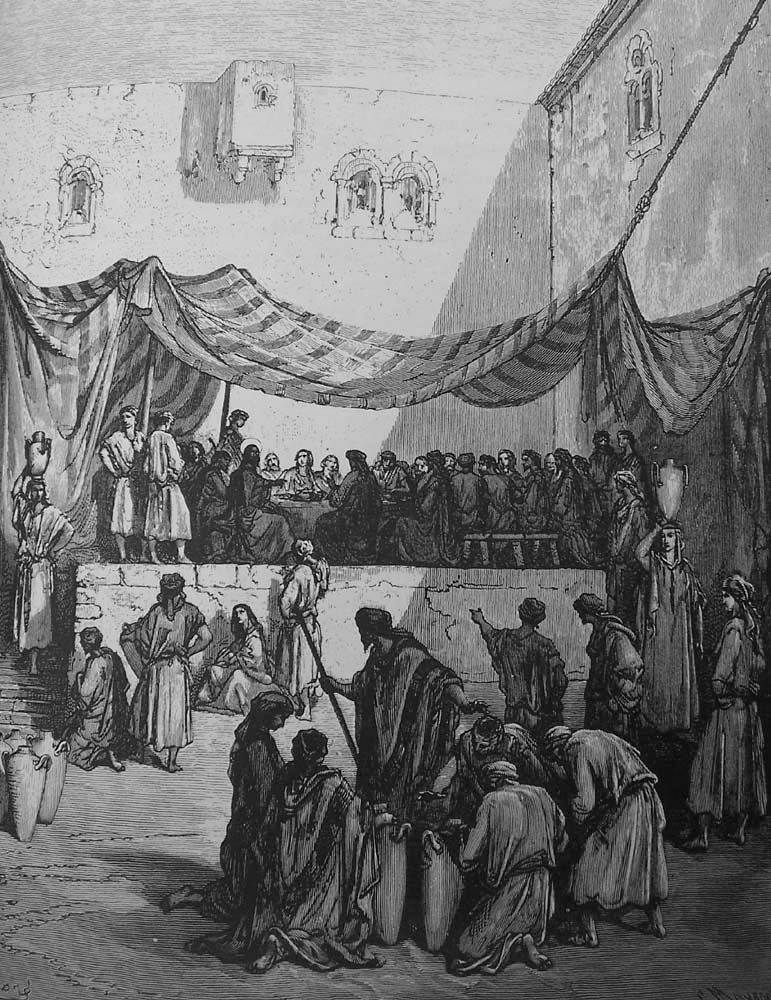
in John 2and the master of the banquet tasted the water that had been turned into wine. He did not know where it was from, but the servants who had drawn the water knew. Then he called the bridegroom aside
BSB
The same verse in ASV and KJV ▾
ASV
And when the ruler of the feast tasted the water now become wine, and knew not whence it was (but the servants that had drawn the water knew), the ruler of the feast calleth the bridegroom,
KJV
When the ruler of the feast had tasted the water that was made wine, and knew not whence it was: (but the servants which drew the water knew;) the governor of the feast called the bridegroom,
⋯
This verse in John 2
Commentary
24 notes on this verse(iii. de Trin. c. 5) Water is poured into the waterpots; wine is drawn out into the chalices; the senses of the drawer out agree not with the knowledge of the pourer in. The pourer in thinks that water is drawn out; the drawer out thinks that wine was poured in. When the ruler of the feast had tasted the water that was made wine, and knew not whence it was, (but the servants who drew the water knew,) the governor of the feast called the bridegroom.
This site's exposition
take it to the master of the banquet
on John 2:8-10
No word in the account describes the change. The servants draw, and the master of the banquet tastes wine. Where it came from he could not say, while the servants who drew the water could.
This site's exposition
He did not know where it was from
Albert Barnes reads the master's ignorance as the value of his verdict: knowing nothing of what was done, he judged the wine without favour. Hilary of Poitiers sets the two parties against each other. The pourer knew water went in, and the drawer found wine coming out.
The record, by era
The Church Fathers5 voices
(Tr. ix. c. 5) But see the mysteries which lie hid in that miracle of our Lord. It was necessary that all things should be fulfilled in Christ which were written of Him: those Scriptures were the water. He made the water wine when He opened unto them the meaning of these things, and expounded the Scriptures; for thus that came to have a taste which before had none, and that inebriated, which did not inebriate before.
In the ancient times there was prophecy, and no times were left without the dispensation of prophecy. But the prophecy, since Christ was not understood therein, was water. For in water wine is in some manner latent. The apostle tells us what we are to understand by this water: "Even unto this day," saith he, "whilst Moses is read, that same veil is upon their heart; that it is not unveiled because it is done away in Christ. And when thou shalt have passed over," saith he, "to the Lord, the veil shall be taken away." By the veil he means the covering over of prophecy, so that it was not understood. When thou hast passed over to the Lord, the veil is taken away; so likewise is tastelessness taken away when thou hast passed over to the Lord; and what was water now becomes wine to thee. Read all the prophetic books; and if Christ be not understood therein, what canst thou find so insipid and silly? Understand Christ in them, and what thou readest not only has a taste, but even inebriates thee; transporting the mind from the body, so that forgetting the things that are past, thou reachest forth to the things that are before. Wherefore, prophecy from ancient times, even from the time when the series of human births began to run onwards, was not silent concerning Christ; but the import of the prophecy was concealed therein, for as yet it was water. When these words of the Gospel are understood, and they are certainly clear, all the mysteries which are latent in this miracle of the Lord will be laid open. Observe what He says, that it behoved the things to be fulfilled in Christ that were written of Him. Where were they written? "In the law," saith He, "and in the prophets, and in the Psalms." He omitted no part of the Old Scriptures. These were water; and hence the disciples were called irrational by the Lord, because as yet they tasted to them as water, not as wine. […]
Such powers are there in God; powers which the methods of our reason cannot comprehend, but of which our faith, on the sure evidence of His action, is convinced. We shall find instances of this action in the bodily sphere as well as in the spiritual, its manifestation taking, not the form of an analogy which might illustrate the Birth, but of a deed marvellous yet comprehensible. On the wedding day in Galilee water was made wine. Have we words to tell or senses to ascertain what methods produced the change by which the tastelessness of water disappeared, and was replaced by the full flavour of wine? It was not a mixing; it was a creation, and a creation which was not a beginning, but a transformation. A weaker liquid was not obtained by admixture of a stronger element; an existing thing perished and a new thing came into being. The bridegroom was anxious, the household in confusion, the harmony of the marriage feast imperilled. Jesus is asked for help. He does not rise or busy Himself; He does the work without an effort. Water is poured into the vessels, wine drawn out in the cups. The evidence of the senses of the pourer contradicts that of the drawer. They who poured expect water to be drawn; they who draw think that wine must have been poured in. The intervening time cannot account for any gain or loss of character in the liquid. The mode of action baffles sight and sense, but the power of God is manifest in the result achieved.
He who did not want to change stones changed water at Cana.
Here again some mock, saying, "this was an assembly of drunken men, the sense of the judges was spoilt, and not able to taste what was made, or to decide on what was done, so that they did not know whether what was made was water or wine: for that they were drunk," it is alleged, "the ruler himself has shown by what he said." Now this is most ridiculous, yet even this suspicion the Evangelist has removed. For he does not say that the guests gave their opinion on the matter, but "the ruler of the feast," who was sober, and had not as yet tasted anything. For of course you are aware, that those who are entrusted with the management of such banquets are the most sober, as having this one business, to dispose all things in order and regularity; and therefore the Lord called such a man's sober senses to testify to what was done. For He did not say, "Pour forth to them that sit at meat," but, "Bear unto the governor of the feast."
16 more voices on this verse
The Church Fathers2 voices
Thus when he was about to heal the nobleman's son, the Evangelist has shown that it had already become more clearly known; for it was chiefly because the nobleman had become acquainted with the miracle that he called upon Him, as John incidentally shows when he says, "Jesus came into Cana of Galilee, where He made the water wine." (c. iv. 46.) And not wine simply, but the best wine. For such are the miraculous works of Christ, they are far more perfect and better than the operations of nature. This is seen also in other instances; when He restored any infirm member of the body, He made it better than the sound. That it was wine then, and the best of wine, that had been made, not the servants only, but the bridegroom and the ruler of the feast would testify; and that it was made by Christ, those who drew the water; so that although the miracle were not then revealed, yet it could not in the end be passed in silence, so many and constraining testimonies had He provided for the future. That He had made the water wine, He had the servants for witnesses; that the wine was good that had been made, the ruler of the feast and the bridegroom.
"And when the ruler of the feast had tasted the water that was made wine, and knew not whence it was, (but the servants knew,) the governor of the feast called the bridegroom." "And why did he not call the servants? for so the miracle would have been revealed." Because Jesus had not Himself revealed what had been done, but desired that the power of His miracles should be known gently, little by little. And suppose that it had then been mentioned, the servants who related it would never have been believed, but would have been thought mad to bear such testimony to one who at that time seemed to the many a mere man; and although they knew the certainty of the thing by experience, (for they were not likely to disbelieve their own hands,) yet they were not sufficient to convince others. And so He did not reveal it to all, but to him who was best able to understand what was done, reserving the clearer knowledge of it for a future time; since after the manifestation of other miracles this also would be credible. Thus when he was about to heal the nobleman's son, the Evangelist has shown that it had already become more clearly known; for it was chiefly because the nobleman had become acquainted with the miracle that he called upon Him, as John incidentally shows when he says, "Jesus came into Cana of Galilee, where He made the water wine." (c. iv. 46.) And not wine simply, but the best.
The Medieval Church5 voices
When the master of the feast tasted the water made wine, that is, wine made from water, and did not know where it was from, but the servants knew, who had drawn the water, the master of the feast calls the bridegroom, namely so that …
The Triclinium is a circle of three couches, cline signifying couch: the ancients used to recline upon couches. And the Architriclinus is the one at the head of the Triclinium, i. e. the chief of the guests. Some say that among the Jews, He was a priest, and attended the marriage in order to instruct in the duties of the married state.
The servants are the doctors of the New Testament, who interpret the holy Scripture to others spiritually; the ruler of the feast is some lawyer, as Nicodemus, Gamaliel, or Saul. When to the former then is committed the word of the Gospel, hid under the letter of the law, it is the water made wine, being set before the ruler of the feast. And the three rows of guests at table in the house of the marriage are properly mentioned; the Church consisting of three orders of believers, the married, the continent, and the doctors.
Then the judgment of the one examining the wine is given. First, he inquires into the truth of the fact; secondly, he gives his opinion. He says, Now when the head waiter tasted the water made wine, and not knowing where it came from, because …
The master of the feast asks not the servants, but the bridegroom. Why? Of course, by divine arrangement. If he had asked the servants, they would certainly have revealed the miracle; but no one would have believed them, for it was the beginning of signs, …
The Puritans and the Awakening2 voices
When Christ provided so much good wine for them that had well drunk, he intended to try their sobriety, and to teach them how to abound, as well as how to want. Temperance per force is a thankless virtue; but if divine providence gives us abundance of the delights of sense, and divine grace enables us to use them moderately, this is self-denial that is praiseworthy.
When the ruler of the feast had tasted the water,....
The Nineteenth Century7 voices
A commentator
Albert Barnes1798–1870
Notes, Explanatory and Practical, on the Old and New Testaments (1832-1869)
And knew not whence it was - This is said, probably, to indicate that his judgment was not biased by any favor, or any lack of favor, toward Jesus. Had he known what was done, he would have been less likely to have judged impartially. As it is, we have his testimony that this was real wine, and of so fine a body and flavor as to surpass that which had been provided for the occasion. Everything in this miracle shows that there was no collusion or understanding between Jesus and any of the persons at the feast.
THE governor of the feast said more than he intended to say, or rather, there is more truth in what he said than he himself imagined. This is the established rule all the world over: “the good wine first, and when men have well drunk, then that which is worse.” It is the rule with men; and have not hundreds of disappointed hearts bewailed it? Friendship first—the oily tongue, the words softer than butter, and afterwards the drawn sword.
A commentator
J.C. Ryle1816–1900
Expository Thoughts on the Gospels: John (lightly modernized text, Grace Gems edition) (1869)
proposed
These verses describe a miracle which should always possess a special interest in the eyes of a true Christian. It is the first, in order of time, of the many mighty works which Jesus did, when He was upon earth. We are distinctly told, "This beginning of miracles did Jesus in Cana of Galilee." Like every other miracle which John was inspired to record, it is related with great minuteness and particularity. And, like every other miracle in John's Gospel, it is rich in spiritual lessons.
A commentator
J.C. Ryle1816–1900
Expository Thoughts on the Gospels: John (lightly modernized text, Grace Gems edition) (1869)
proposed
These verses describe a miracle which should always possess a special interest in the eyes of a true Christian. It is the first, in order of time, of the many mighty works which Jesus did, when He was upon earth. We are distinctly told, "This beginning of miracles did Jesus in Cana of Galilee." Like every other miracle which John was inspired to record, it is related with great minuteness and particularity. And, like every other miracle in John's Gospel, it is rich in spiritual lessons. We learn, firstly, from these verses, how honorable in the sight of Christ is the estate of matrimony . To be present at a "marriage" was almost the first public act of our Lord's earthly ministry. Marriage is not a sacrament, as the Church of Rome asserts. It is simply a state of life ordained by God for man's benefit. But it is a state which ought never to be spoken of with levity, or regarded with disrespect. The Prayerbook service has well described it, as "an honorable estate, instituted of God in the time of man's innocency, and signifying unto us the mystical union that is between Christ and his Church." Society is never in a healthy condition, and true religion never flourishes in that land where the marriage tie is lightly esteemed. They who lightly esteem it have not the mind of Christ. He who "beautified and adorned the estate of matrimony by His presence and first miracle that He wrought in Cana of Galilee," is One who is always of one mind. "Marriage," says the Holy Spirit by Paul, "is honorable in all." (Heb. 13:4.) One thing, however, ought not to be forgotten. Marriage is a step which so seriously affects the temporal happiness and spiritual welfare of two immortal souls, that it ought never to be taken in hand "unadvisedly, lightly, wantonly, and without due consideration."
THE governor of the feast said more than he intended to say, or rather, there is more truth in what he said than he himself imagined. This is the established rule all the world over: “the good wine first, and when men have well drunk, then that which is worse.” It is the rule with men; and have not hundreds of disappointed hearts bewailed it? Friendship first—the oily tongue, the words softer than butter, and afterwards the drawn sword. Ahithophel first presents the lordly dish of love and kindness to David, then afterwards that which is worse, for he forsakes his master, and becomes the counsellor of his rebel son. Judas presents first of all the dish of fair speech and of kindness; the Saviour partook thereof, he walked to the house of God in company with him, and took sweet counsel with him; but afterwards there came the dregs of the wine—“He that eateth bread with me hath lifted up his heel against me.” Judas the thief betrayed his Master, bringing forth afterwards “that which is worse.” Ye have found it so with many whom ye thought your friends. In the heyday of prosperity, when the sun was shining, and the birds were singing, and all was fair and gay and cheerful with you, they brought forth the good wine; but there came a chilling frost, and nipped your flowers, and the leaves fell from the trees, and your streams were frosted with the ice, and then they brought forth that which is worse,—they forsook you and fled; they left you in your hour of peril, and taught you that great truth, that “Cursed is he that trusteth in man, and maketh flesh his arm.” And this is the way all the world over—I say it once again—not merely with men, but with nature too.
I HAD EXHAUSTED my time this morning by describing the feast of Satan—how at the four tables, whereat did sit the profligate, the self-righteous, the worldly, and the secretly sinful, the course of Satan, was always on this wise,—first, the good wine, and when men had well drunken, that which was worse. His feast diminished in its value as it proceeded, and went from the bright crackling of the thorn under the pot to the blackness of darkness for ever.
I HAD EXHAUSTED my time this morning by describing the feast of Satan—how at the four tables, whereat did sit the profligate, the self-righteous, the worldly, and the secretly sinful, the course of Satan, was always on this wise,—first, the good wine, and when men had well drunken, that which was worse. His feast diminished in its value as it proceeded, and went from the bright crackling of the thorn under the pot to the blackness of darkness for ever. I had then in my second point to show, that the rule of Christ’s banquet is just the very reverse—that Christ doth always give the best wine last—that he doth save the good things until the end of the feast; nay, that sometimes the first cups at the table of Christ are full of wormwood and gall, and are exceeding bitter, but that if we tarry at the feast, they will grow sweeter, and sweeter, and sweeter, until at last, when we shall come into the land Beulah, and especially when we shall enter into the city of our God, we shall be compelled to say, “Thou hast kept the good wine until now.” Now, my dear friends, this is a great fact, that Christ’s feast increaseth in sweetness. When first the lord Jesus Christ proclaimed a feast for the sons of men, the first cup he set upon the table was but a very little one, and it had in it but few words of consolation. You remember the inscription upon that ancient vessel, the first cup of consolation that was ever held to the sons of men—“The seed of the woman shall bruise the serpent’s head.” There was to them but little sweetness there: much to us, because we can understand it better, and some to them, because God’s Spirit might help them to understand it, but still in the revelation of it there seemed but little promise.
The words behind it
27 Greek wordsEvery Greek word of this verse in the order it stands, with what it means and the door to its own study. The last column counts the times a word stands in the whole Bible: the rarer the word, the more the places it appears belong together.
| Greek | Sound | Meaning | Word study | In the Bible |
|---|---|---|---|---|
| ὡς | hos | When | G5613 → | 500 times |
| δὲ | de | then | G1161 → | 2765 times |
| ἐγεύσατο | egeusato | tasted | G1089 → | |
| ὁ | ho | the | G3588 → | 19766 times |
| ἀρχιτρίκλινος | architriklinos | master of the feast | G755 → | 3 times |
| τὸ | to | the | G3588 → | 19766 times |
| ὕδωρ | hudor | water | G5204 → | 76 times |
| οἶνον | oinon | wine | G3631 → | 34 times |
| γεγενημένον | gegenemenon | became | G1096 → | 667 times |
| καὶ | kai | and | G2532 → | 9120 times |
| οὐκ | ouk | not | G3756 → | 1664 times |
| ᾔδει | edei | he knew | G1492 → | 374 times |
| πόθεν | pothen | from where | G4159 → | 29 times |
| ἐστίν, | estin | it is — | G1510 → | 2333 times |
| οἱ | hoi | the | G3588 → | 19766 times |
| δὲ | de | however | G1161 → | 2765 times |
| διάκονοι | diakonoi | servants | G1249 → | 29 times |
| ᾔδεισαν | edeisan | knew | G1492 → | 374 times |
| οἱ | hoi | which | G3588 → | 19766 times |
| ἠντληκότες | entlekotes | having drawn | G501 → | 4 times |
| τὸ | to | the | G3588 → | 19766 times |
| ὕδωρ, | hudor | water — | G5204 → | 76 times |
| φωνεῖ | phonei | calls | G5455 → | 43 times |
| τὸν | ton | the | G3588 → | 19766 times |
| νυμφίον | numphion | bridegroom | G3566 → | 16 times |
| ὁ | ho | the | G3588 → | 19766 times |
| ἀρχιτρίκλινος | architriklinos | master of the feast | G755 → | 3 times |
ὡςWhen
hosG5613 →500 times
δὲthen
deG1161 →2765 times
ἐγεύσατοtasted
egeusatoG1089 →
ὁthe
hoG3588 →19766 times
ἀρχιτρίκλινοςmaster of the feast
architriklinosG755 →3 times
τὸthe
toG3588 →19766 times
ὕδωρwater
hudorG5204 →76 times
οἶνονwine
oinonG3631 →34 times
γεγενημένονbecame
gegenemenonG1096 →667 times
καὶand
kaiG2532 →9120 times
οὐκnot
oukG3756 →1664 times
ᾔδειhe knew
edeiG1492 →374 times
πόθενfrom where
pothenG4159 →29 times
ἐστίν,it is —
estinG1510 →2333 times
οἱthe
hoiG3588 →19766 times
δὲhowever
deG1161 →2765 times
διάκονοιservants
diakonoiG1249 →29 times
ᾔδεισανknew
edeisanG1492 →374 times
οἱwhich
hoiG3588 →19766 times
ἠντληκότεςhaving drawn
entlekotesG501 →4 times
τὸthe
toG3588 →19766 times
ὕδωρ,water —
hudorG5204 →76 times
φωνεῖcalls
phoneiG5455 →43 times
τὸνthe
tonG3588 →19766 times
νυμφίονbridegroom
numphionG3566 →16 times
ὁthe
hoG3588 →19766 times
ἀρχιτρίκλινοςmaster of the feast
architriklinosG755 →3 times
A shaded row is a word that stands 400 times or fewer in the Bible.
The walk
8 stopsEach card is a verse this one points to, and under it the verses that one points to in turn. Where several paths arrive at the same place, that place is listed first: the text keeps returning to it.
Through
John 7:17If anyone desires to do His will, he will know whether My teaching is from God or whether I speak on My own.
it leads to
- John 8:31–32
So He said to the Jews who had believed Him, “If you continue in My word, you are truly My disciples.
- John 8:43
Why do you not understand what I am saying? It is because you are unable to accept My message.
- Jeremiah 31:33–34
“But this is the covenant I will make with the house of Israel after those days, declares the LORD. I will put My law in their minds and inscribe it on their hearts. And…
- John 8:47
Whoever belongs to God hears the words of God. The reason you do not hear is that you do not belong to God.”
- Daniel 12:10
Many will be purified, made spotless, and refined, but the wicked will continue to act wickedly. None of the wicked will understand, but the wise will understand.
- John 8:31–32
Through
Psalms 119:100I discern more than the elders, for I obey Your precepts.
it leads to
- Psalms 111:10
The fear of the LORD is the beginning of wisdom; all who follow His precepts gain rich understanding. His praise endures forever!
- James 3:13
Who is wise and understanding among you? Let him show it by his good conduct, by deeds done in the humility that comes from wisdom.
- Psalms 111:10
Through
John 4:46So once again He came to Cana in Galilee, where He had turned the water into wine. And there was a royal official whose son lay sick at Capernaum.
it leads to
- John 2:1–11
On the third day a wedding took place at Cana in Galilee. Jesus’ mother was there,
- John 2:1–11
Where this verse is studied
On this page
Studies17
On this chapter
About John
This page draws on 18 works. Open the list of works
This page draws on Albert Barnes, Notes, Explanatory and Practical, on the Old and New Testaments (1832-1869); Alcuin of York, Catena Aurea by Aquinas; Augustine of Hippo, Catena Aurea by Aquinas; Augustine of Hippo, Tractates on John 9; Bonaventure, Commentary on John, Chapter 2; Charles Spurgeon, The New Park Street Pulpit, Sermon No. 225: “Satan's Banquet” (lightly modernized text, CCEL edition); Charles Spurgeon, The New Park Street Pulpit, Sermon No. 226: “The Feast of the Lord” (lightly modernized text, CCEL edition); Ephrem the Syrian, HYMNS ON VIRGINITY 14.11; Hilary of Poitiers, Catena Aurea by Aquinas; Hilary of Poitiers, ON THE TRINITY 3.5; J.C. Ryle, Expository Thoughts on the Gospels: John (lightly modernized text, Grace Gems edition); Jamieson, Fausset & Brown, Commentary Critical and Explanatory on the Whole Bible; John Calvin, Commentary on the Gospel according to John; John Chrysostom, Homily on the Gospel of John 22; John Gill, Exposition of the New Testament (1746-1748); Matthew Henry, Commentary on the Whole Bible; Theophylact of Ohrid, Commentary on John and Thomas Aquinas, Commentary on John.