
John 2:8
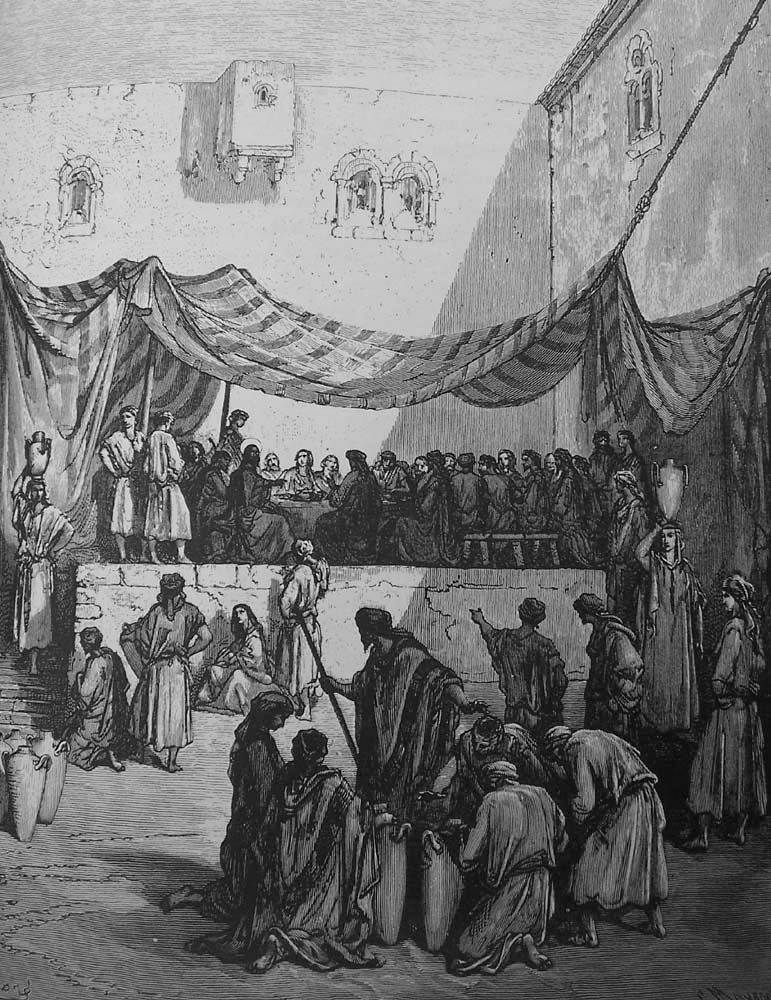
in John 2“Now draw some out,” He said, “and take it to the master of the banquet.” They did so,
BSB
The same verse in ASV and KJV ▾
ASV
And he saith unto them, Draw out now, and bear unto the ruler of the feast. And they bare it.
KJV
And he saith unto them, Draw out now, and bear unto the governor of the feast. And they bare it.
⋯
This verse in John 2
Commentary
13 notes on this verseAnd Jesus said to them. Here the fourth point is touched upon, namely the approval of the miracle, in the approval of the wine made by the testimony of the chief steward, whose duty it was to judge the wine. On account of which he …
This site's exposition
take it to the master of the banquet
on John 2:8-10
No word in the account describes the change. The servants draw, and the master of the banquet tastes wine. Where it came from he could not say, while the servants who drew the water could.
The record, by era
The Church Fathers3 voices
According to the will of the one who gave the command, the water was changed into wine, slaking the thirst of those who drank but also providing wine more abundantly for the couple's future.
(Hom. xxii. 2) But why did He not work the miracle before they had filled the waterpots, which would have been much more wonderful; inasmuch as it is one thing to change the quality of some existing substance, another to make it that substance out of nothing? The latter miracle would be the more wonderful, but the former would be the more easy of belief. And this principle often acts as a check, to moderate the greatness of our Lord's miracles: He wishes to make them more credible, therefore He makes them less marvellous; a refutation this of the perverse doctrine of some, that He was a different Being from the Maker of the world. For we see He performs most of His miracles upon subject-matter already existing, whereas were He contrary to the Creator of the world, He would not use a material thus alien, to demonstrate His own power. He did not draw out the water Himself which He made wine, but ordered the servants to do so. This was for the sake of having witnesses of the miracle; And He saith unto them, Draw out now, and bear unto the governor of the feast.
In the ancient times there was prophecy, and no times were left without the dispensation of prophecy. But the prophecy, since Christ was not understood therein, was water. For in water wine is in some manner latent. The apostle tells us what we are to understand by this water: "Even unto this day," saith he, "whilst Moses is read, that same veil is upon their heart; that it is not unveiled because it is done away in Christ. And when thou shalt have passed over," saith he, "to the Lord, the veil shall be taken away." By the veil he means the covering over of prophecy, so that it was not understood. When thou hast passed over to the Lord, the veil is taken away; so likewise is tastelessness taken away when thou hast passed over to the Lord; and what was water now becomes wine to thee. Read all the prophetic books; and if Christ be not understood therein, what canst thou find so insipid and silly? Understand Christ in them, and what thou readest not only has a taste, but even inebriates thee; transporting the mind from the body, so that forgetting the things that are past, thou reachest forth to the things that are before. Wherefore, prophecy from ancient times, even from the time when the series of human births began to run onwards, was not silent concerning Christ; but the import of the prophecy was concealed therein, for as yet it was water. When these words of the Gospel are understood, and they are certainly clear, all the mysteries which are latent in this miracle of the Lord will be laid open. Observe what He says, that it behoved the things to be fulfilled in Christ that were written of Him. Where were they written? "In the law," saith He, "and in the prophets, and in the Psalms." He omitted no part of the Old Scriptures. These were water; and hence the disciples were called irrational by the Lord, because as yet they tasted to them as water, not as wine. […]
The Medieval Church2 voices
Then, the miracle is made known. For as soon as the jars were filled, the water was turned into wine. So the Lord reveals the miracle at once, saying: Now pour out a drink and take it to the head waiter. First, we have the …
He commands the servants to bring the drink for tasting to the master of the feast not without purpose, but so that no one would think that it was a gathering of drunkards, that their taste had been corrupted, and that in a state of …
6 more voices on this verse
The Puritans and the Awakening2 voices
), and it was done, ( a. ) Without any ceremony, in the eye of the spectators. One would have thought, as Naaman, he should have come out, and stood, and called on the name of God, 2 Kings
quarantine:debris (2026-07-29) — leading-punctuation+unbalanced-parens
And he saith unto them, draw out now,....
The Nineteenth Century4 voices
Governor of the feast - The original word, αρχιτρικλινος, signifies one who is chief or head over three couches, or tables. In the Asiatic countries, they take their meals sitting, or rather reclining, on small low couches. And when many people are present, so that they cannot all eat together, three of these low tables or couches are put together in form of a crescent, and some one of the guests is appointed to take charge of the persons who sit at these tables.
A commentator
J.C. Ryle1816–1900
Expository Thoughts on the Gospels: John (lightly modernized text, Grace Gems edition) (1869)
proposed
These verses describe a miracle which should always possess a special interest in the eyes of a true Christian. It is the first, in order of time, of the many mighty works which Jesus did, when He was upon earth. We are distinctly told, "This beginning of miracles did Jesus in Cana of Galilee." Like every other miracle which John was inspired to record, it is related with great minuteness and particularity. And, like every other miracle in John's Gospel, it is rich in spiritual lessons. We learn, firstly, from these verses, how honorable in the sight of Christ is the estate of matrimony . To be present at a "marriage" was almost the first public act of our Lord's earthly ministry. Marriage is not a sacrament, as the Church of Rome asserts. It is simply a state of life ordained by God for man's benefit. But it is a state which ought never to be spoken of with levity, or regarded with disrespect. The Prayerbook service has well described it, as "an honorable estate, instituted of God in the time of man's innocency, and signifying unto us the mystical union that is between Christ and his Church." Society is never in a healthy condition, and true religion never flourishes in that land where the marriage tie is lightly esteemed. They who lightly esteem it have not the mind of Christ. He who "beautified and adorned the estate of matrimony by His presence and first miracle that He wrought in Cana of Galilee," is One who is always of one mind. "Marriage," says the Holy Spirit by Paul, "is honorable in all." (Heb. 13:4.) One thing, however, ought not to be forgotten. Marriage is a step which so seriously affects the temporal happiness and spiritual welfare of two immortal souls, that it ought never to be taken in hand "unadvisedly, lightly, wantonly, and without due consideration."
A commentator
J.C. Ryle1816–1900
Expository Thoughts on the Gospels: John (lightly modernized text, Grace Gems edition) (1869)
proposed
These verses describe a miracle which should always possess a special interest in the eyes of a true Christian. It is the first, in order of time, of the many mighty works which Jesus did, when He was upon earth. We are distinctly told, "This beginning of miracles did Jesus in Cana of Galilee." Like every other miracle which John was inspired to record, it is related with great minuteness and particularity. And, like every other miracle in John's Gospel, it is rich in spiritual lessons.
A commentator
Albert Barnes1798–1870
Notes, Explanatory and Practical, on the Old and New Testaments (1832-1869)
proposed
Draw out now - This command was given to the servants. It showed that the miracle had been performed immediately. As soon as they were filled the servants were directed to take to the governor of the feast. Jesus made no parade about it, and it does not even appear that he approached the waterpots. He willed it, and it was done. This was a clear exertion of divine power, and made in such a manner as to leave no doubt of its reality. The governor - One who presided on the occasion. The one who stood at the “head” or upper end of the table. He had the charge of the entertainment, provided the food, gave directions to the servants, etc.
The words behind it
12 Greek wordsEvery Greek word of this verse in the order it stands, with what it means and the door to its own study. The last column counts the times a word stands in the whole Bible: the rarer the word, the more the places it appears belong together.
| Greek | Sound | Meaning | Word study | In the Bible |
|---|---|---|---|---|
| καὶ | kai | And | G2532 → | 9120 times |
| λέγει | legei | He says | G3004 → | 1325 times |
| αὐτοῖς· | autois | to them; | G846 → | 5565 times |
| ἀντλήσατε | antlesate | do draw out | G501 → | 4 times |
| νῦν | nun | now | G3568 → | 145 times |
| καὶ | kai | and | G2532 → | 9120 times |
| φέρετε | pherete | do carry | G5342 → | 66 times |
| τῷ | to | to the | G3588 → | 19766 times |
| ἀρχιτρικλίνῳ. | architriklino | master of the feast. | G755 → | 3 times |
| οἱ | hoi | they | G3588 → | 19766 times |
| δὲ | de | then | G1161 → | 2765 times |
| ἤνεγκαν. | enegkan | carried [it]. | G5342 → | 66 times |
καὶAnd
kaiG2532 →9120 times
λέγειHe says
legeiG3004 →1325 times
αὐτοῖς·to them;
autoisG846 →5565 times
ἀντλήσατεdo draw out
antlesateG501 →4 times
νῦνnow
nunG3568 →145 times
καὶand
kaiG2532 →9120 times
φέρετεdo carry
phereteG5342 →66 times
τῷto the
toG3588 →19766 times
ἀρχιτρικλίνῳ.master of the feast.
architriklinoG755 →3 times
οἱthey
hoiG3588 →19766 times
δὲthen
deG1161 →2765 times
ἤνεγκαν.carried [it].
enegkanG5342 →66 times
A shaded row is a word that stands 400 times or fewer in the Bible.
The walk
8 stopsEach card is a verse this one points to, and under it the verses that one points to in turn. Where several paths arrive at the same place, that place is listed first: the text keeps returning to it.
Through
Romans 13:7Pay everyone what you owe him: taxes to whom taxes are due, revenue to whom revenue is due, respect to whom respect is due, honor to whom honor is due.
it leads to
- Luke 20:25
So Jesus told them, “Give to Caesar what is Caesar’s, and to God what is God’s.”
- Matthew 17:25
“Yes,” he answered. When Peter entered the house, Jesus preempted him. “What do you think, Simon?” He asked. “From whom do the kings of the earth collect customs and taxes: from their own sons,…
- Proverbs 24:21
My son, fear the LORD and the king, and do not associate with the rebellious.
- 1 Peter 2:17–18
Treat everyone with high regard: Love the brotherhood of believers, fear God, honor the king.
- Matthew 22:21
“Caesar’s,” they answered. So Jesus told them, “Give to Caesar what is Caesar’s, and to God what is God’s.”
- Luke 20:25
Through
Ecclesiastes 9:6Their love, their hate, and their envy have already vanished, and they will never again have a share in all that is done under the sun.
it leads to
- Psalms 146:3–4
Put not your trust in princes, in mortal man, who cannot save.
- Psalms 146:3–4
Through
John 2:9and the master of the banquet tasted the water that had been turned into wine. He did not know where it was from, but the servants who had drawn the water knew. Then he…
it leads to
Where this verse is studied
On this page
Studies17
On this verse
On this chapter
About John
This page draws on 13 works. Open the list of works
This page draws on Adam Clarke, Commentary on the Bible; Albert Barnes, Notes, Explanatory and Practical, on the Old and New Testaments (1832-1869); Augustine of Hippo, Tractates on John 9; Bonaventure, Commentary on John, Chapter 2; J.C. Ryle, Expository Thoughts on the Gospels: John (lightly modernized text, Grace Gems edition); Jamieson, Fausset & Brown, Commentary Critical and Explanatory on the Whole Bible; John Calvin, Commentary on the Gospel according to John; John Chrysostom, Catena Aurea by Aquinas; John Gill, Exposition of the New Testament (1746-1748); Matthew Henry, Commentary on the Whole Bible; Theodore of Mopsuestia, COMMENTARY ON JOHN 1.2.6-7; Theophylact of Ohrid, Commentary on John and Thomas Aquinas, Commentary on John.