
John 2:5
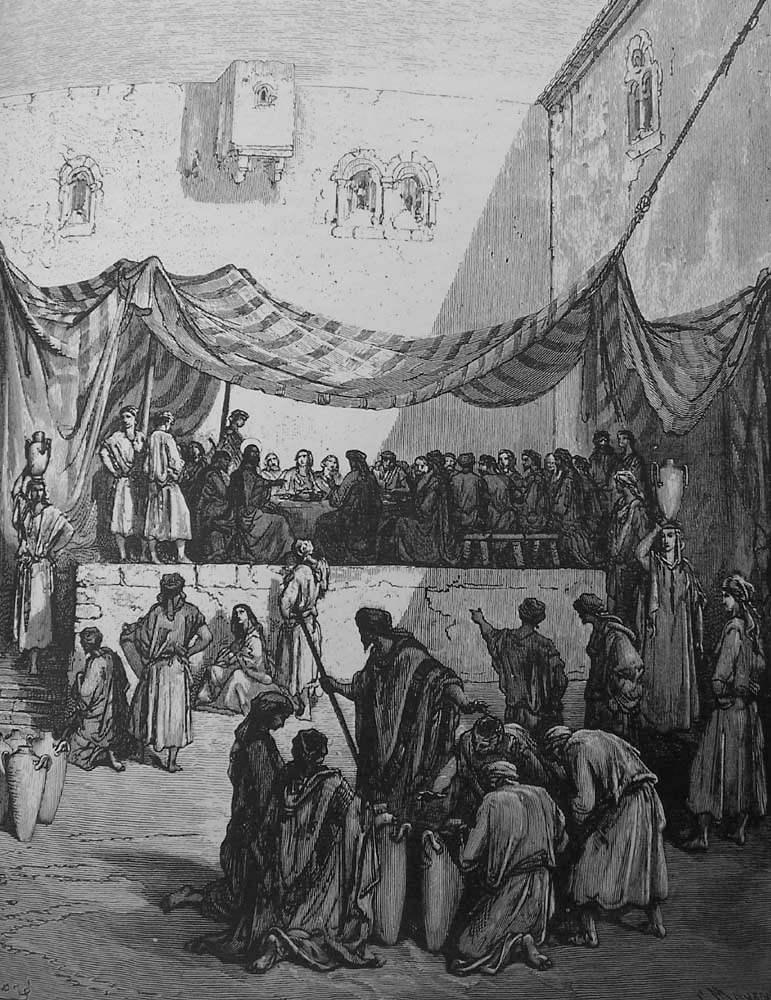
in John 2His mother said to the servants, “Do whatever He tells you.”
BSB
The same verse in ASV and KJV ▾
ASV
His mother saith unto the servants, Whatsoever he saith unto you, do it.
KJV
His mother saith unto the servants, Whatsoever he saith unto you, do it.
⋯
This verse in John 2
Commentary
18 notes on this verseThe woman having great influence to the performing of the miracle, prevailed, persuading the Lord, on account of what was fitting, as her Son. She begins the work by preparing the servants of the assembly to obey the things that should be enjoined.
This site's exposition
Do whatever He tells you
Do whatever He tells you is the last word Mary speaks in Scripture. His mother says it to the servants and gives them no plan and no explanation, pointing them past herself to Jesus. The servants fill the jars on that word.
The record, by era
The Church Fathers3 voices
In the ancient times there was prophecy, and no times were left without the dispensation of prophecy. But the prophecy, since Christ was not understood therein, was water. For in water wine is in some manner latent. The apostle tells us what we are to understand by this water: "Even unto this day," saith he, "whilst Moses is read, that same veil is upon their heart; that it is not unveiled because it is done away in Christ. And when thou shalt have passed over," saith he, "to the Lord, the veil shall be taken away." By the veil he means the covering over of prophecy, so that it was not understood. When thou hast passed over to the Lord, the veil is taken away; so likewise is tastelessness taken away when thou hast passed over to the Lord; and what was water now becomes wine to thee. Read all the prophetic books; and if Christ be not understood therein, what canst thou find so insipid and silly? Understand Christ in them, and what thou readest not only has a taste, but even inebriates thee; transporting the mind from the body, so that forgetting the things that are past, thou reachest forth to the things that are before. Wherefore, prophecy from ancient times, even from the time when the series of human births began to run onwards, was not silent concerning Christ; but the import of the prophecy was concealed therein, for as yet it was water. When these words of the Gospel are understood, and they are certainly clear, all the mysteries which are latent in this miracle of the Lord will be laid open. Observe what He says, that it behoved the things to be fulfilled in Christ that were written of Him. Where were they written? "In the law," saith He, "and in the prophets, and in the Psalms." He omitted no part of the Old Scriptures. These were water; and hence the disciples were called irrational by the Lord, because as yet they tasted to them as water, not as wine. […]
On the wedding day in Galilee water was made wine. Have we words to tell or senses to ascertain what methods produced the change by which the tastelessness of water disappeared, and was replaced by the full flavour of wine? It was not a mixing; it was a creation, and a creation which was not a beginning, but a transformation. A weaker liquid was not obtained by admixture of a stronger element; an existing thing perished and a new thing came into being. The bridegroom was anxious, the household in confusion, the harmony of the marriage feast imperilled. Jesus is asked for help. He does not rise or busy Himself; He does the work without an effort. Water is poured into the vessels, wine drawn out in the cups. The evidence of the senses of the pourer contradicts that of the drawer. They who poured expect water to be drawn; they who draw think that wine must have been poured in. The intervening time cannot account for any gain or loss of character in the liquid. The mode of action baffles sight and sense, but the power of God is manifest in the result achieved.
Besides, even while saying to the Canaanitish woman, "It is not meet to take the children's bread, and to give it unto dogs" (Matt. xv. 26), He still gave the bread, as considering her perseverance; and though after his first reply, He said, "I am not sent save unto the lost sheep of the house of Israel," yet even after saying this, He healed the woman's daughter. Hence we learn, that although we be unworthy, we often by perseverance make ourselves worthy to receive. And for this reason His mother remained by, and openly brought to Him the servants, that the request might be made by a greater number; and therefore she added, "Whatsoever He saith unto you, do it." For she knew that His refusal proceeded not from want of power, but from humility, and that He might not seem without cause to hurry to the miracle; and therefore she brought the servants.
The Medieval Church2 voices
His Mother says to the servants: Whatever he shall say to you, do it. For she knew that he was able; she knew also that he knew; she knew that he would be willing, because he always obeyed her: whence Luke 2: "He went down …
He would not dishonor his mother, since he orders us to honor our father and mother.
11 more voices on this verse
The Medieval Church3 voices
(in loc.) As if she said, Though He appear to refuse, He will do it nevertheless. She knew His pity and mercifulness. And there were set there six waterpots of stone, after the manner of the purifying of the Jews, containing two or three firkins apiece. Hydriæ1 are vessels to hold water: hydor being the Greek for water.
Now although his mother was refused, she did not lose hope in her Son's mercy. So she instructs the servants, Do whatever he tells you, in which, indeed, consists the perfection of all justice. For perfect justice consists in obeying Christ in all things: "We …
The Mother says to the servants "whatever He says to you, do it" so that the request might be strengthened through their own approach and petition, so that it would be clear that the refusal was not from powerlessness, but with the aim of dispelling …
The Puritans and the Awakening2 voices
The beginning of Moses's miracles was turning water into blood ( Exod. iv. 20 ), the beginning of Christ's miracles was turning water into wine; which intimates the difference between the law of Moses and the gospel of Christ.
His mother said unto the servants,.... She took the reproof in good part, and by the words he said, and the manner in which he spoke them, or by the looks he gave, and the gestures he might use, she hoped, and even believed, that the thing she moved for would be done; and therefore went immediately to the servants, and gave them the following instructions: whatsoever he saith unto you, do it; punctually observe and obey his orders in every circumstance.
The Nineteenth Century6 voices
A commentator
Albert Barnes1798–1870
Notes, Explanatory and Practical, on the Old and New Testaments (1832-1869)
His mother saith ... - It is evident from this verse that his mother did not understand what he had said as a harsh reproof and repulse, but as an indication of his willingness at the proper time to furnish wine. In all this transaction he evinced the appropriate feelings of a son toward a mother.
A commentator
J.C. Ryle1816–1900
Expository Thoughts on the Gospels: John (lightly modernized text, Grace Gems edition) (1869)
proposed
These verses describe a miracle which should always possess a special interest in the eyes of a true Christian. It is the first, in order of time, of the many mighty works which Jesus did, when He was upon earth. We are distinctly told, "This beginning of miracles did Jesus in Cana of Galilee." Like every other miracle which John was inspired to record, it is related with great minuteness and particularity. And, like every other miracle in John's Gospel, it is rich in spiritual lessons.
A commentator
J.C. Ryle1816–1900
Expository Thoughts on the Gospels: John (lightly modernized text, Grace Gems edition) (1869)
proposed
These verses describe a miracle which should always possess a special interest in the eyes of a true Christian. It is the first, in order of time, of the many mighty works which Jesus did, when He was upon earth. We are distinctly told, "This beginning of miracles did Jesus in Cana of Galilee." Like every other miracle which John was inspired to record, it is related with great minuteness and particularity. And, like every other miracle in John's Gospel, it is rich in spiritual lessons. We learn, firstly, from these verses, how honorable in the sight of Christ is the estate of matrimony . To be present at a "marriage" was almost the first public act of our Lord's earthly ministry. Marriage is not a sacrament, as the Church of Rome asserts. It is simply a state of life ordained by God for man's benefit. But it is a state which ought never to be spoken of with levity, or regarded with disrespect. The Prayerbook service has well described it, as "an honorable estate, instituted of God in the time of man's innocency, and signifying unto us the mystical union that is between Christ and his Church." Society is never in a healthy condition, and true religion never flourishes in that land where the marriage tie is lightly esteemed. They who lightly esteem it have not the mind of Christ. He who "beautified and adorned the estate of matrimony by His presence and first miracle that He wrought in Cana of Galilee," is One who is always of one mind. "Marriage," says the Holy Spirit by Paul, "is honorable in all." (Heb. 13:4.) One thing, however, ought not to be forgotten. Marriage is a step which so seriously affects the temporal happiness and spiritual welfare of two immortal souls, that it ought never to be taken in hand "unadvisedly, lightly, wantonly, and without due consideration."
A commentator
Charles Spurgeon1834–1892
The Metropolitan Tabernacle Pulpit, Sermon No. 2317: “Obeying Christ's Orders” (lightly modernized text, CCEL edition) · Written before 1892.
proposed
IT does not need a strong imagination to picture Mary, probably at that time the widowed mother of our Lord. She is full of love and of a naturally kind, sympathetic disposition. She is at a marriage and she is very pleased that her Son is there, with the first handful of His disciples.
A commentator
Charles Spurgeon1834–1892
The Metropolitan Tabernacle Pulpit, Sermon No. 2317: “Obeying Christ's Orders” (lightly modernized text, CCEL edition) · Written before 1892.
proposed
IT does not need a strong imagination to picture Mary, probably at that time the widowed mother of our Lord. She is full of love and of a naturally kind, sympathetic disposition. She is at a marriage and she is very pleased that her Son is there, with the first handful of His disciples. Their being there has made a greater demand upon the provisions than was expected and the supply is running short, so she, with an anxiety that was natural to such a mother of her years, and of her gentle spirit, thinks that she will speak to her Son and tell Him that there is a need. So she says to Him, "They have no wine." There was not much amiss in that, surely, but our Lord, who sees not as man sees, perceived that she was putting to the front her motherly relationship at a time when it was necessary that it should be in the background. How necessary it was, history has shown, for the apostate church of Rome has actually made Mary a Mediatrix and prayers have been addressed to her! She has even been asked to use her maternal authority with her Son. It was well that our Savior should check anything that might tend to give any countenance to Mariolatry which has been altogether so mischievous. And it was necessary for Him to speak to His mother with somewhat more of sharpness than, perhaps, her conduct, in itself, alone, might have required. So her august Son felt bound to say to her, "Woman, what have I to do with you in such a matter as this? I am not your Son as a miracle-worker. I cannot work to please you. No, if I work a miracle as the Son of God, it cannot be as your Son—it must be in another character. What have I to do with you in this matter?" And He gives His reason—"My hour is not yet come." It was a gentle rebuke, absolutely necessary from the prescience of all that would follow. You can easily picture how Mary took it.
His mother saith, etc. - The virgin seems to have understood our Lord as hinted above. It was not yet time to grant them a supply, because the want had not as yet been generally felt. But, silently receiving the respectful caution, she saw that the miracle should be wrought when it best suited the purposes of the Divine wisdom.
The words behind it
12 Greek wordsEvery Greek word of this verse in the order it stands, with what it means and the door to its own study. The last column counts the times a word stands in the whole Bible: the rarer the word, the more the places it appears belong together.
| Greek | Sound | Meaning | Word study | In the Bible |
|---|---|---|---|---|
| λέγει | legei | Says | G3004 → | 1325 times |
| ἡ | he | the | G3588 → | 19766 times |
| μήτηρ | meter | mother | G3384 → | 83 times |
| αὐτοῦ | autou | of Him | G846 → | 5565 times |
| τοῖς | tois | to the | G3588 → | 19766 times |
| διακόνοις· | diakonois | servants; | G1249 → | 29 times |
| ὅ | ho | Whatever | G3739 → | 1405 times |
| τι | ti | anyhow | G5100 → | 528 times |
| ἂν | an | maybe | G302 → | 165 times |
| λέγῃ | lege | He may say | G3004 → | 1325 times |
| ὑμῖν, | humin | to you, | G4771 → | 2973 times |
| ποιήσατε.¶ | poiesate | do perform. | G4160 → | 569 times |
λέγειSays
legeiG3004 →1325 times
ἡthe
heG3588 →19766 times
μήτηρmother
meterG3384 →83 times
αὐτοῦof Him
autouG846 →5565 times
τοῖςto the
toisG3588 →19766 times
διακόνοις·servants;
diakonoisG1249 →29 times
ὅWhatever
hoG3739 →1405 times
τιanyhow
tiG5100 →528 times
ἂνmaybe
anG302 →165 times
λέγῃHe may say
legeG3004 →1325 times
ὑμῖν,to you,
huminG4771 →2973 times
ποιήσατε.¶do perform.
poiesateG4160 →569 times
A shaded row is a word that stands 400 times or fewer in the Bible.
The walk
8 stopsEach card is a verse this one points to, and under it the verses that one points to in turn. Where several paths arrive at the same place, that place is listed first: the text keeps returning to it.
Through
John 15:14You are My friends if you do what I command you.
it leads to
- Matthew 12:50
For whoever does the will of My Father in heaven is My brother and sister and mother.”
- 1 John 5:3
For this is the love of God, that we keep His commandments. And His commandments are not burdensome,
- James 2:23
And the Scripture was fulfilled that says, “Abraham believed God, and it was credited to him as righteousness,” and he was called a friend of God.
- John 14:21
Whoever has My commandments and keeps them is the one who loves Me. The one who loves Me will be loved by My Father, and I will love him and reveal Myself to him.”
- John 14:15
If you love Me, you will keep My commandments.
- Matthew 12:50
Through
Hebrews 11:8By faith Abraham, when called to go to a place he would later receive as his inheritance, obeyed and went, without knowing where he was going.
it leads to
- Acts 7:2–4
And Stephen declared: “Brothers and fathers, listen to me! The God of glory appeared to our father Abraham while he was still in Mesopotamia, before he lived in Haran,
- Genesis 12:1–4
Then the LORD said to Abram, “Leave your country, your kindred, and your father’s household, and go to the land I will show you.
- Acts 7:2–4
Through
Hebrews 5:9And having been made perfect, He became the source of eternal salvation to all who obey Him
it leads to
- Hebrews 9:15
Therefore Christ is the mediator of a new covenant, so that those who are called may receive the promised eternal inheritance, now that He has died to redeem them from the transgressions committed under…
- Hebrews 9:15
Where this verse is studied
About John
This page draws on 15 works. Open the list of works
This page draws on Adam Clarke, Commentary on the Bible; Albert Barnes, Notes, Explanatory and Practical, on the Old and New Testaments (1832-1869); Augustine of Hippo, Tractates on John 9; Bede, Homilies on the Gospels 1.14; Bede, Catena Aurea by Aquinas; Bonaventure, Commentary on John, Chapter 2; Charles Spurgeon, The Metropolitan Tabernacle Pulpit, Sermon No. 2317: “Obeying Christ's Orders” (lightly modernized text, CCEL edition); Cyril of Alexandria, Commentary on the Gospel of John, Book 2; Hilary of Poitiers, On the Trinity 3.5; J.C. Ryle, Expository Thoughts on the Gospels: John (lightly modernized text, Grace Gems edition); John Chrysostom, Homily on the Gospel of John 22; John Gill, Exposition of the New Testament (1746-1748); Matthew Henry, Commentary on the Whole Bible; Theophylact of Ohrid, Commentary on John and Thomas Aquinas, Commentary on John.